 Metamorphosis -transition in multi cellular organisms, from a larval to a
juvenile (or adult) stage, accompanied by dramatic morphological,
physiological, and ecological changes.
Such changes typically include
 Major restructuring of morphology, and
 Transition from a non-reproductive to a reproductive state,
 Dispersal and settlement to a new habitat, and
 A shift in nutrition and feeding behavior
The young lacks some adult structures which are developed in late development
Some structures of young are distinctive and become lost during later development
The young bears no resemblance to adult
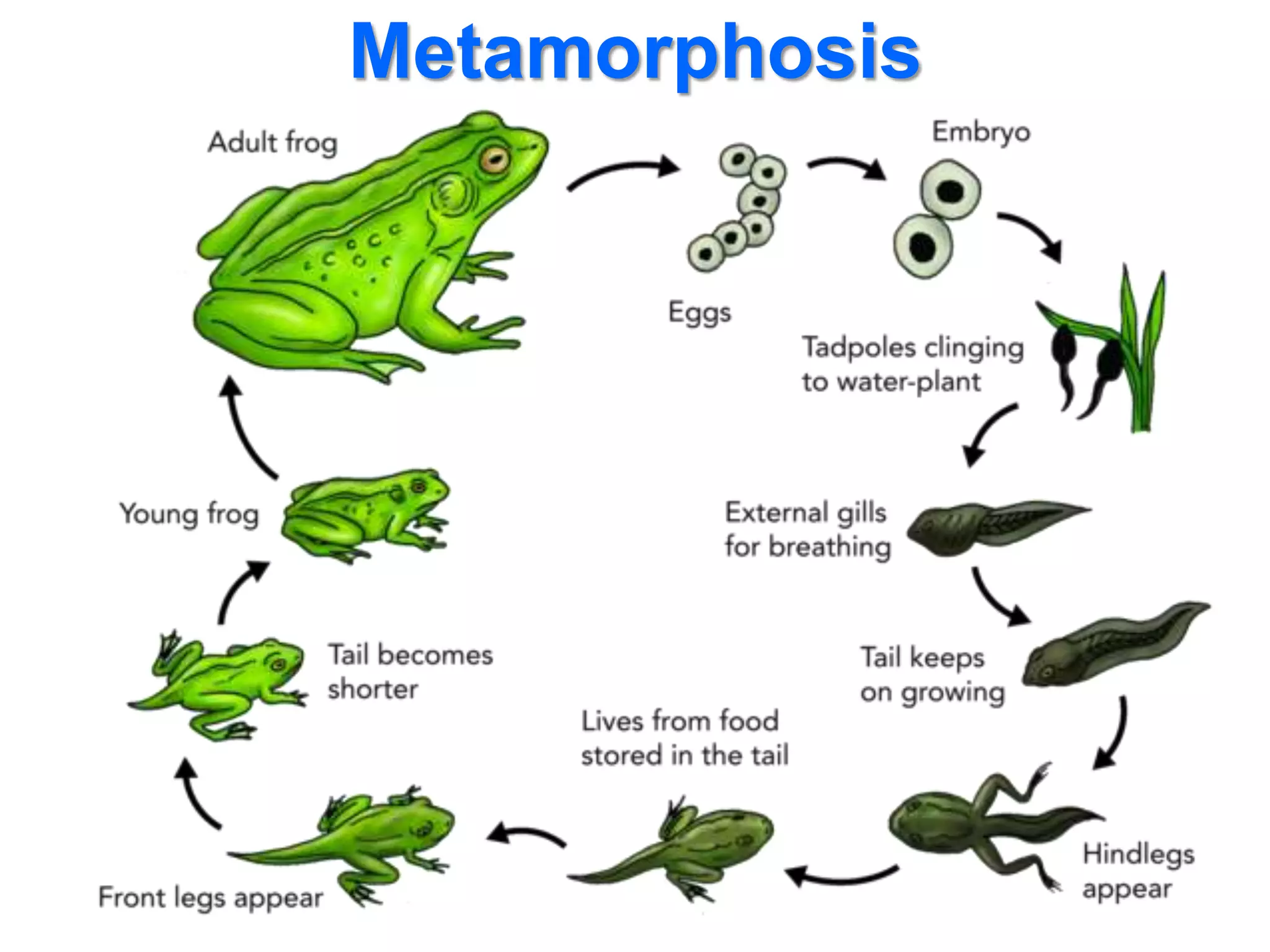
Amphibia- Greek;- amphi (double) and bios (life)- refers to "double life",
or life in water and on land
Characterized by:
 Being tetrapods (4 limbs) that facilitate moving about on
 Both gill and lung breathers - usually gills in the larval stage, replaced by
lungs in the adult.
Three primary orders of Amphibia within the Subclass Lissamphibia (all
modern amphibians)
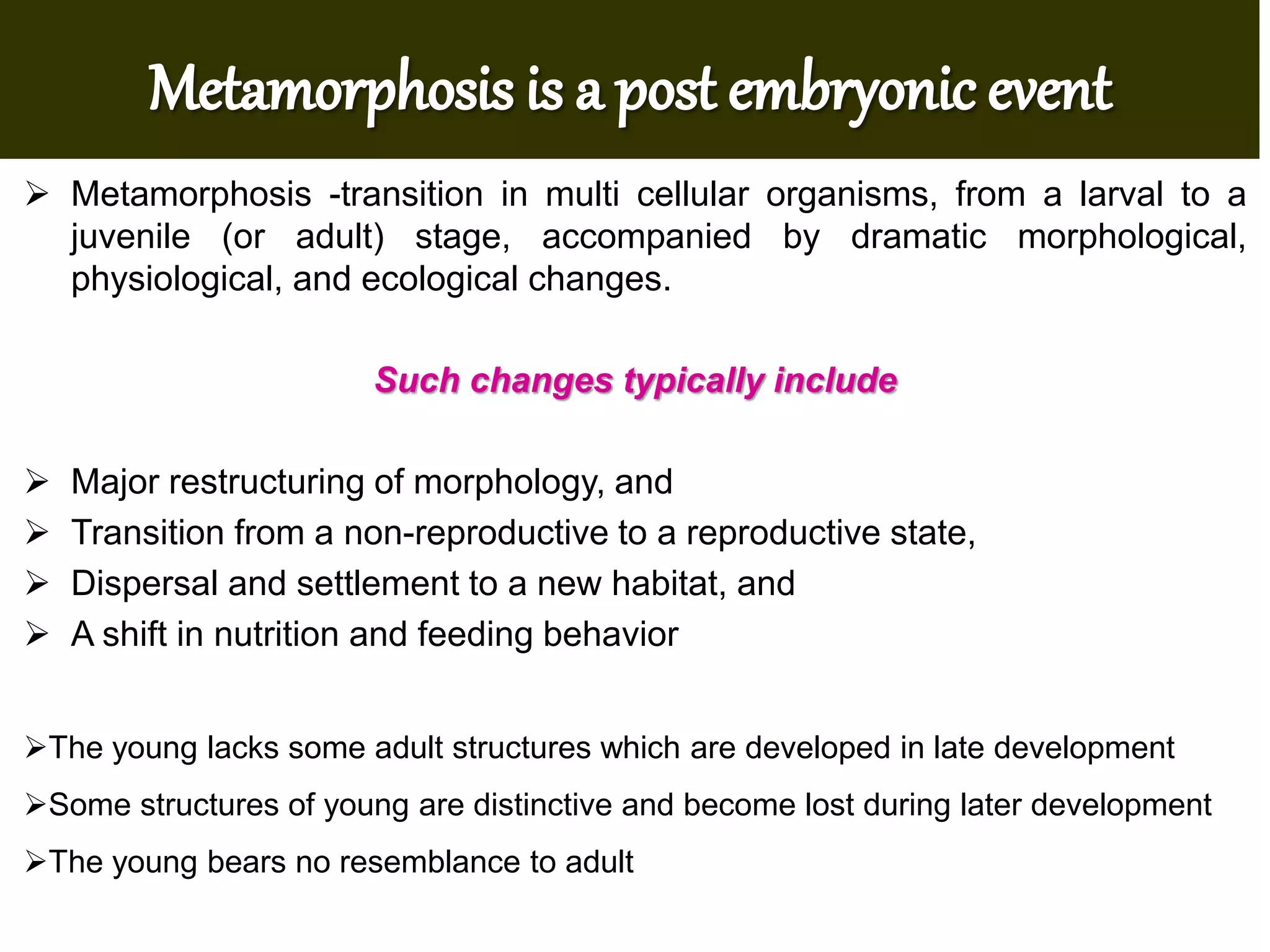
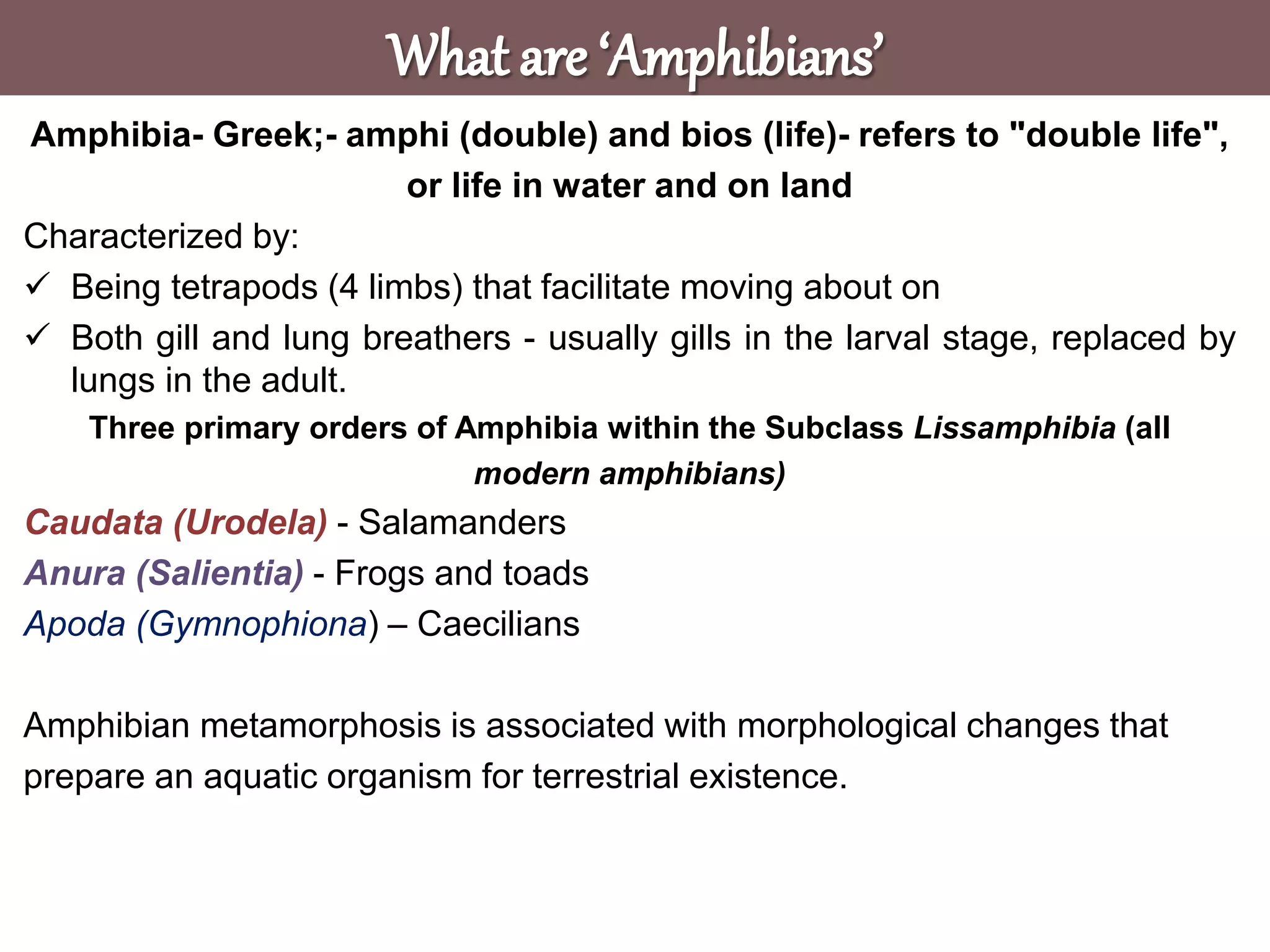
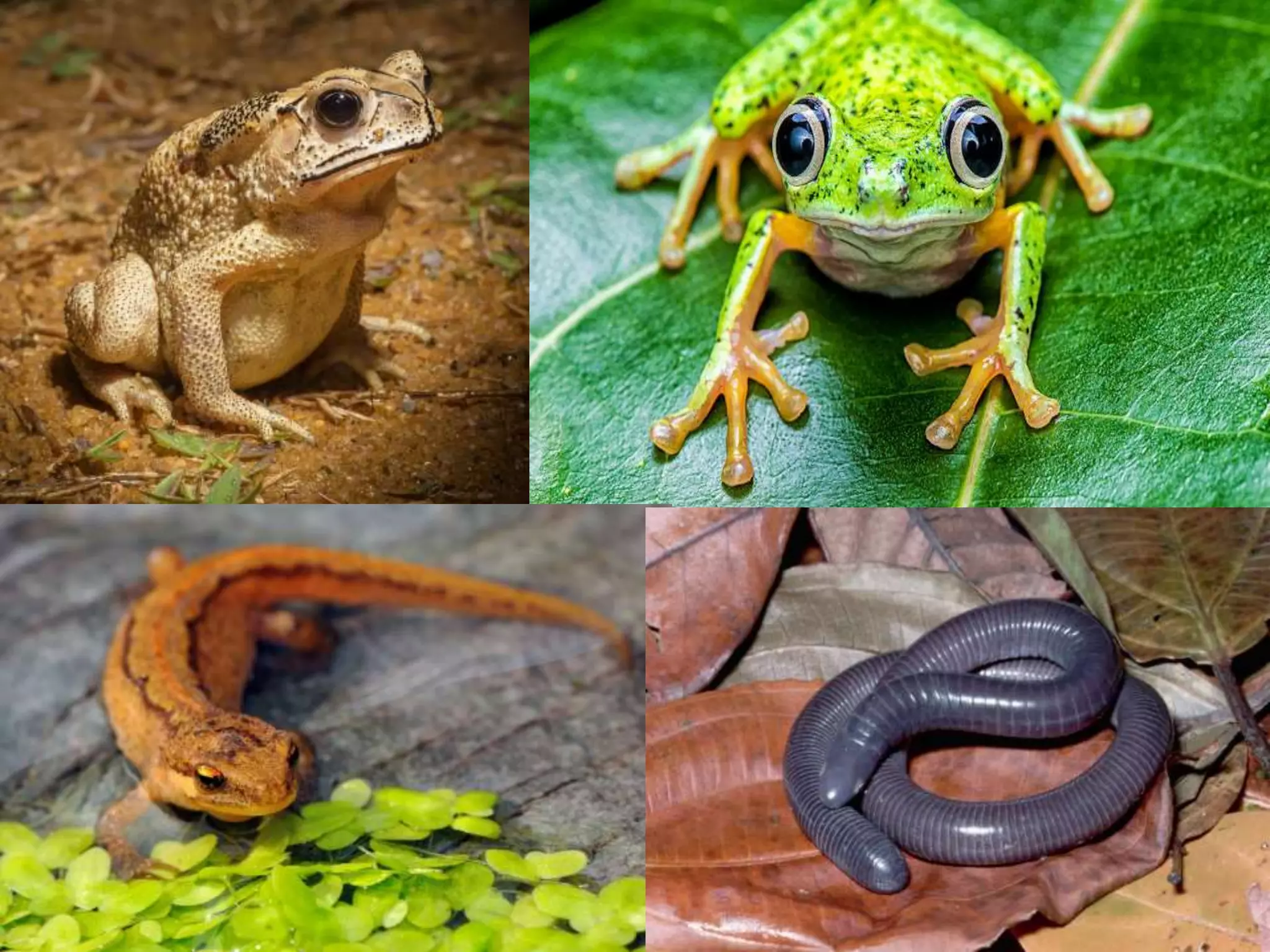
Caudata (Urodela) - Salamanders
Anura (Salientia) - Frogs and toads
Apoda (Gymnophiona) – Caecilians
Amphibian metamorphosis is associated with morphological changes that
prepare an aquatic organism for terrestrial existence.
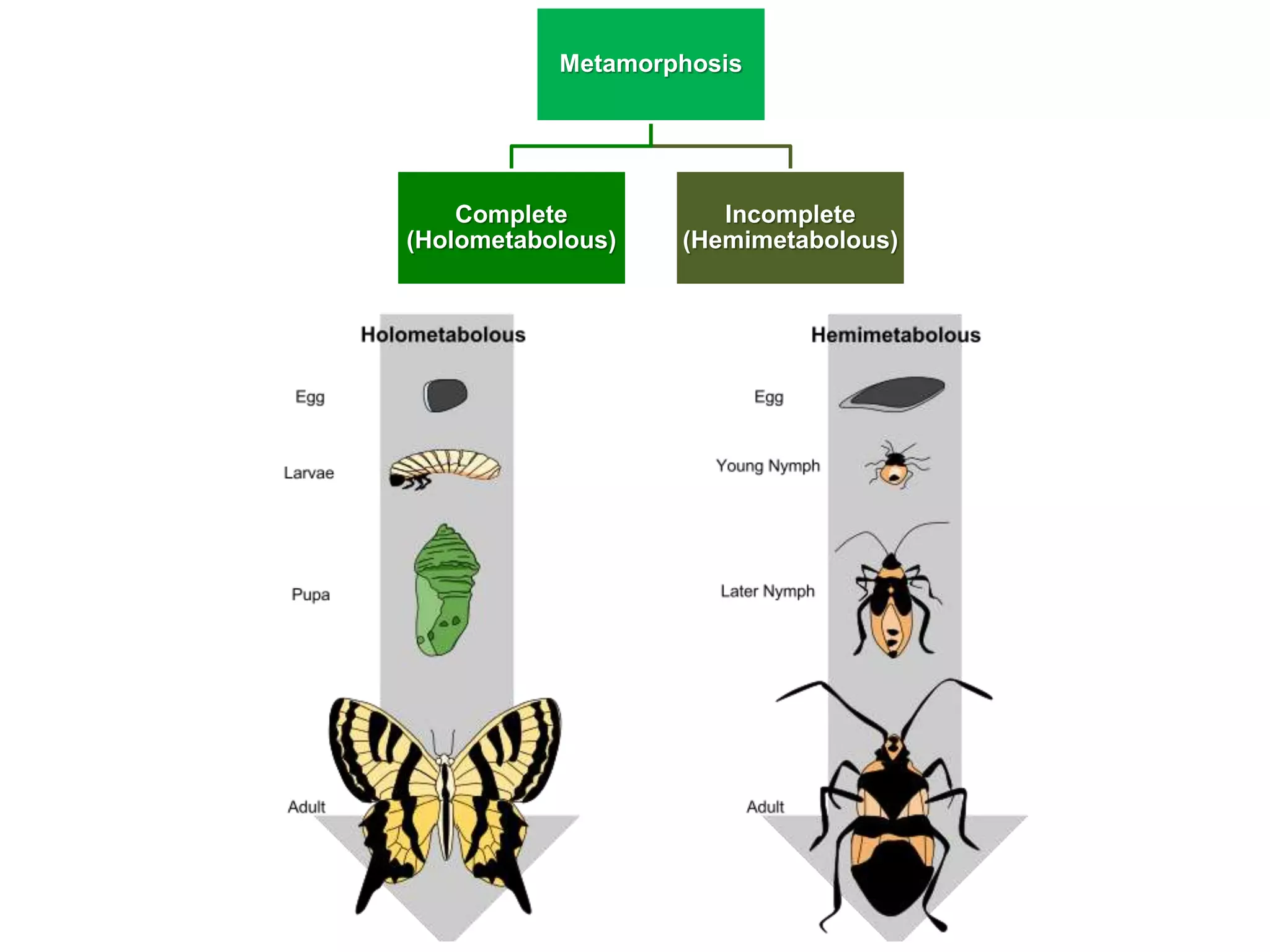
Metamorphosis
Complete
(Holometabolous)
Incomplete
(Hemimetabolous)
Metamorphosis
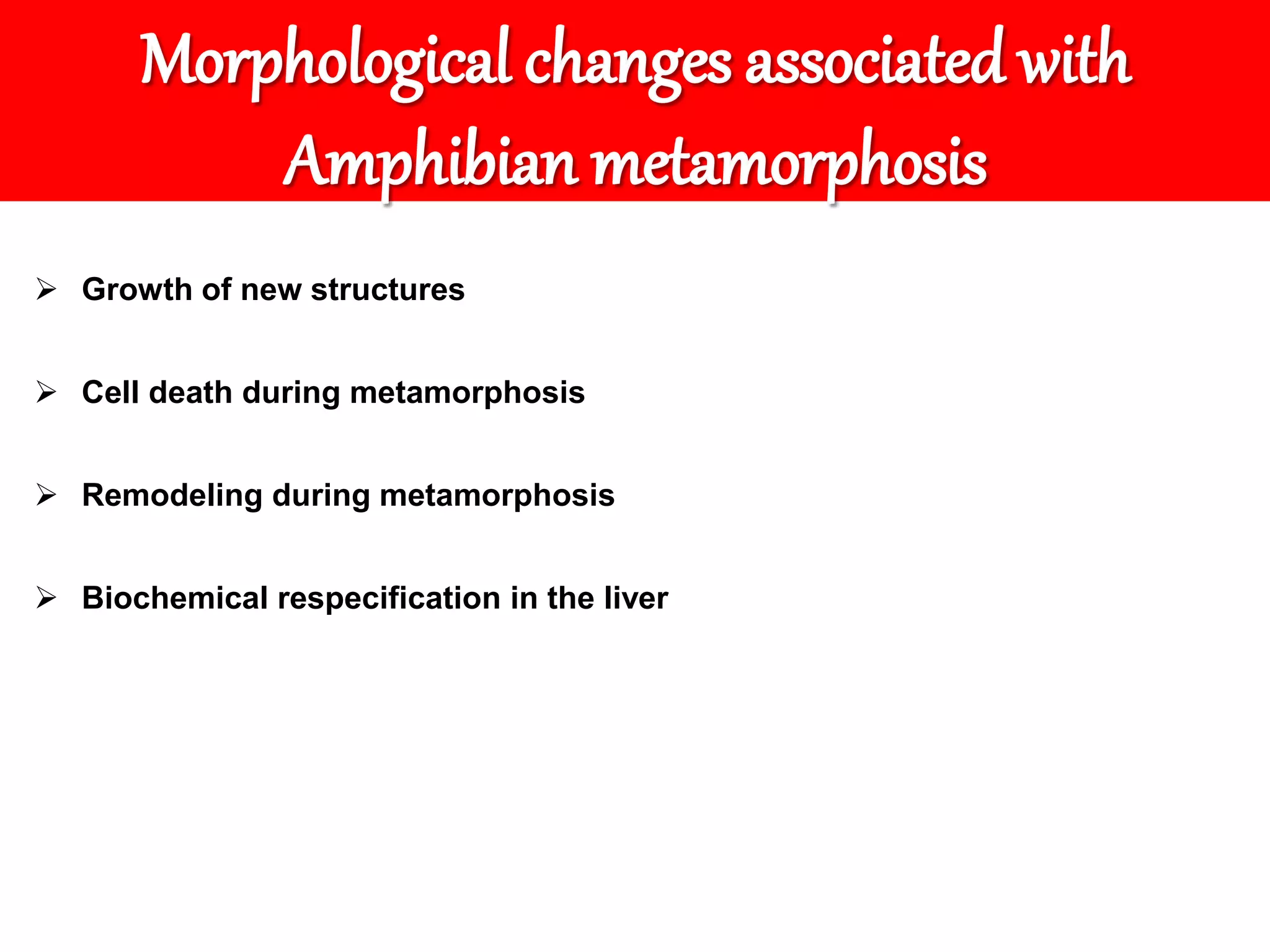
 Growth of new structures
 Cell death during metamorphosis
 Remodeling during metamorphosis
 Biochemical respecification in the liver
• The changes in amphibian metamorphosis are initiated by Thyroid
hormones- and
T3 induces
1. Emergence of limbs on metamorphosing tadpole;
2. In the eyes, eyelids and nictitating membranes emerge
3. Proliferation and differentiation of new neurons-to form limb musculature
• Blocking T3 activity- paralysis of limbs
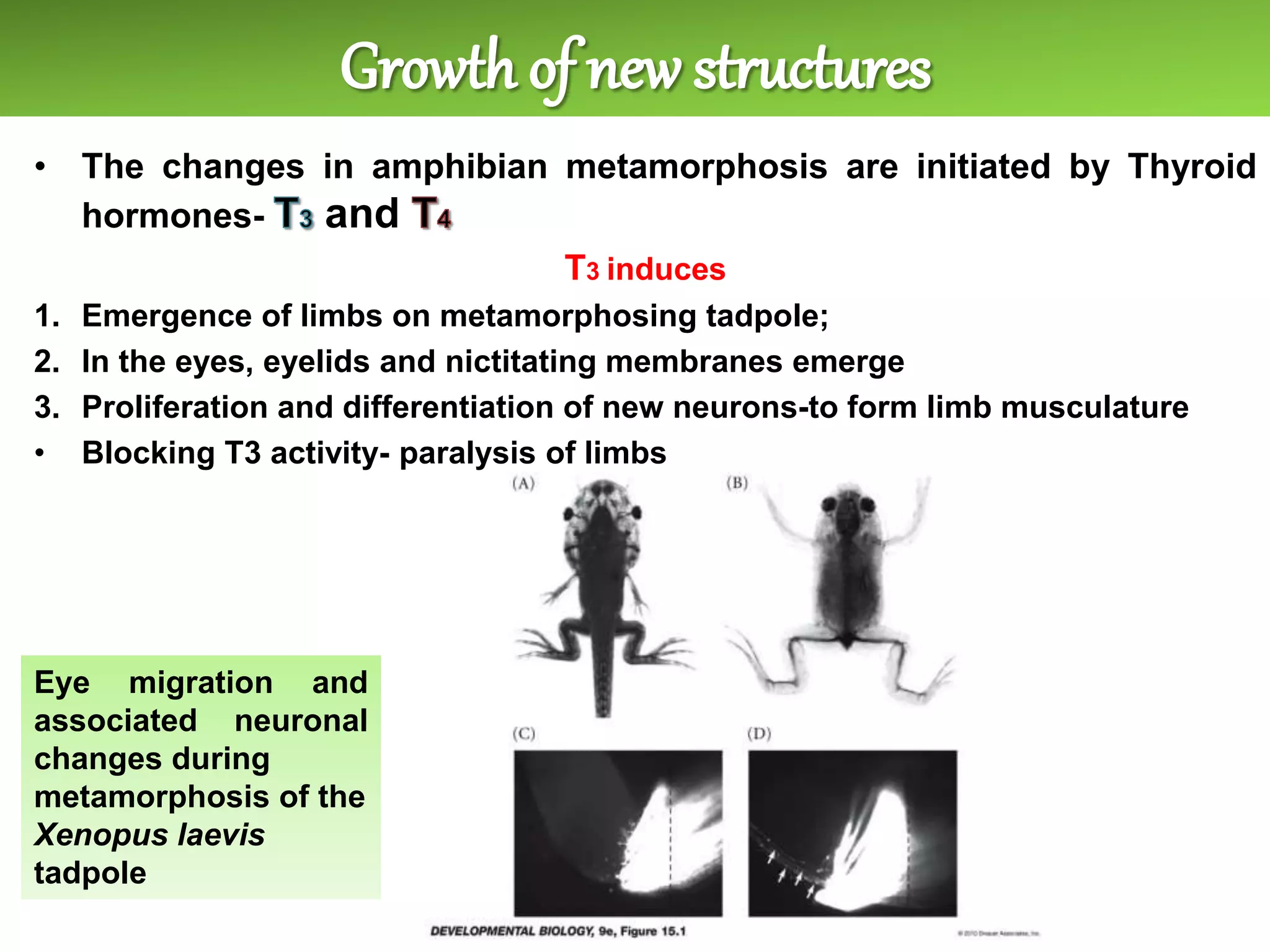
Eye migration and
associated neuronal
changes during
metamorphosis of the
Xenopus laevis
tadpole
Cell death during metamorphosis
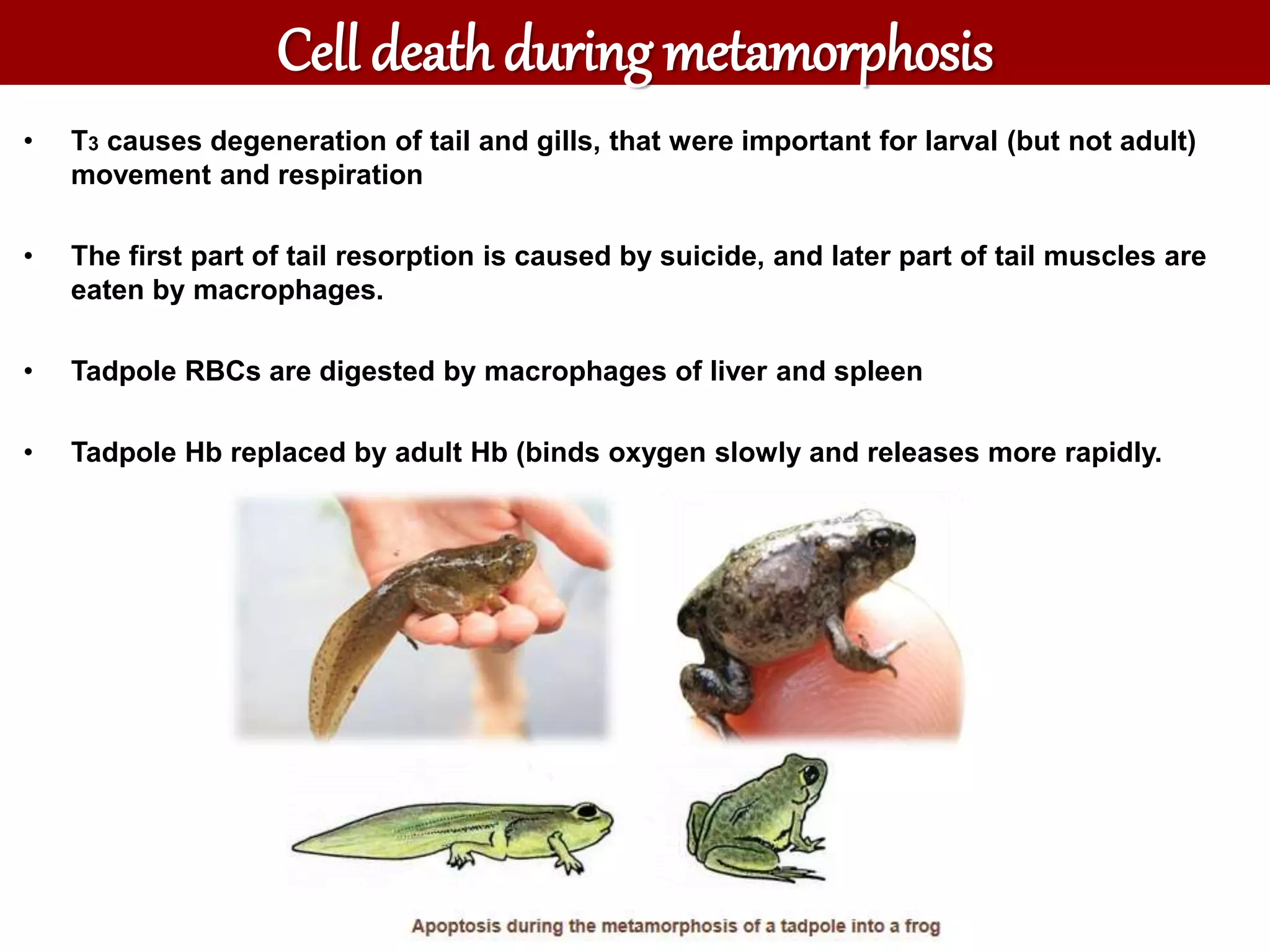
• T3 causes degeneration of tail and gills, that were important for larval (but not adult)
movement and respiration
• The first part of tail resorption is caused by suicide, and later part of tail muscles are
eaten by macrophages.
• Tadpole RBCs are digested by macrophages of liver and spleen
• Tadpole Hb replaced by adult Hb (binds oxygen slowly and releases more rapidly.
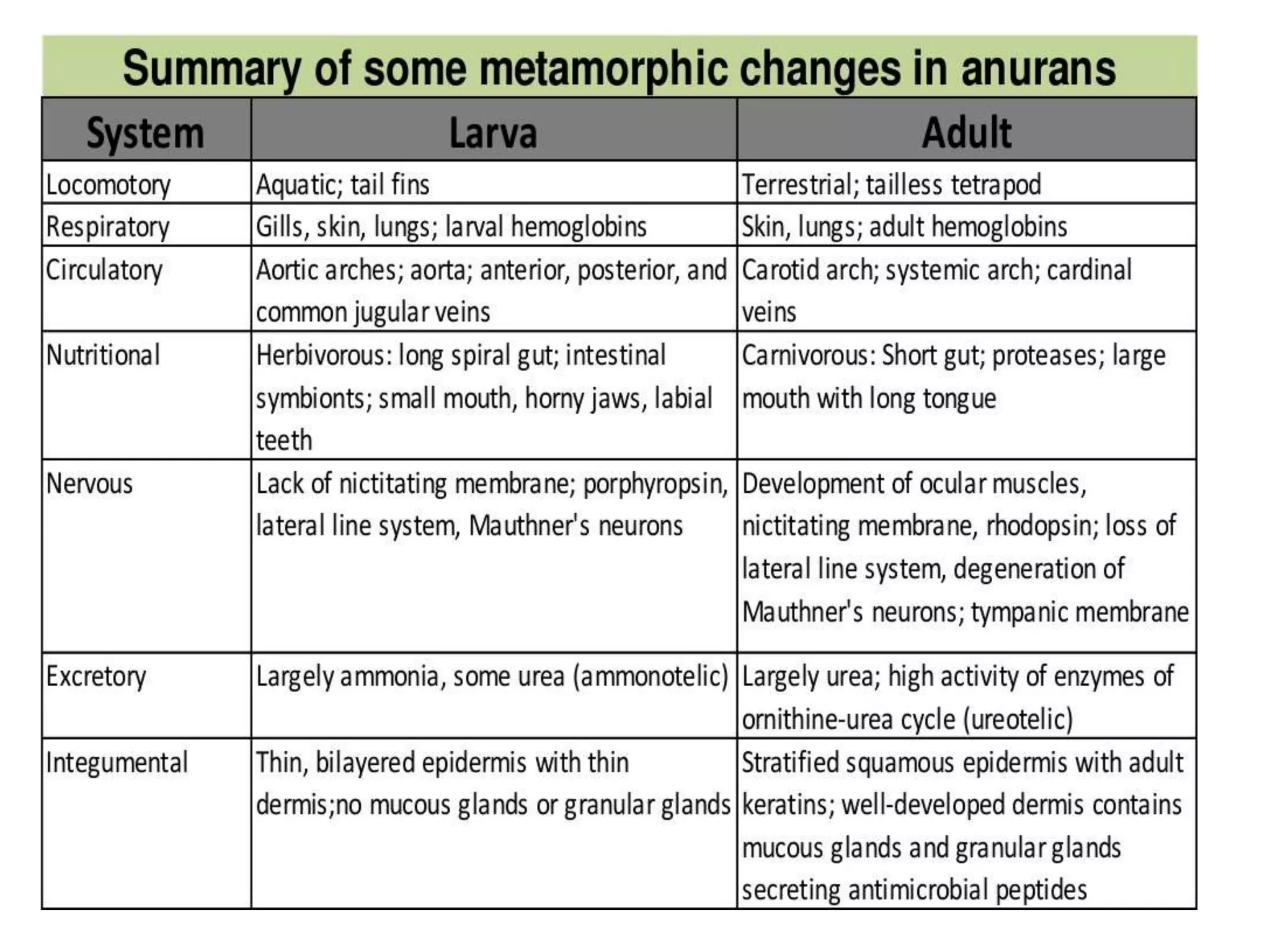
 Development of the lungs and the disappearance of the gills and gill pouch
 The lower jaw transforms into the big mandible of the carnivorous adult
 The long, spiral gut of the herbivorous tadpole is replaced by the typical
short gut of a carnivorous predator
 Nervous system becomes adapted for hearing and stereoscopic vision and
for new methods of locomotion
 Eyes are repositioned higher up on the head with eyelids and associated
glands formed.
 Eardrum, middle ear, and inner ear are developed
 Skin becomes thicker and tougher
 In tadpoles (as in freshwater fishes), the major retinal
photopigment is porphyropsin. During metamorphosis, the
pigment changes to rhodopsin, the characteristic photopigment
of terrestrial and marine vertebrates .
 Tadpole hemoglobin is changed into an adult hemoglobin that
binds oxygen more slowly and releases it more rapidly.
 The liver enzymes also change, reflecting the change in habitat.
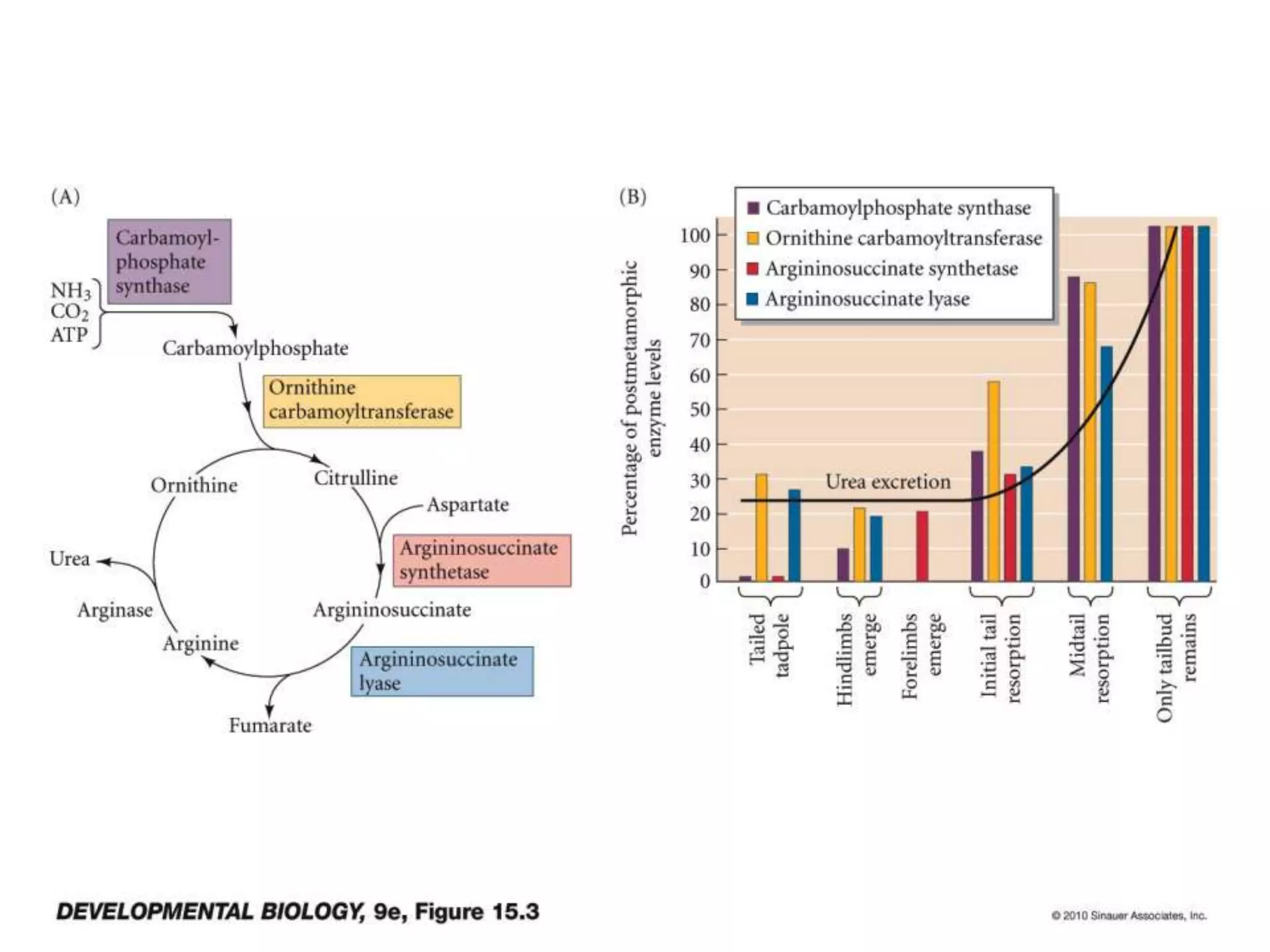
 Tadpoles, like most freshwater fishes, are ammonotelic;
 Many adult frogs (such as the genus Rana) are ureotelic,
excreting urea, like most terrestrial vertebrates, which requires
less water than excreting ammonia.
 During metamorphosis, the liver begins to synthesize the urea
cycle enzymes necessary to create urea from carbon dioxide and
ammonia
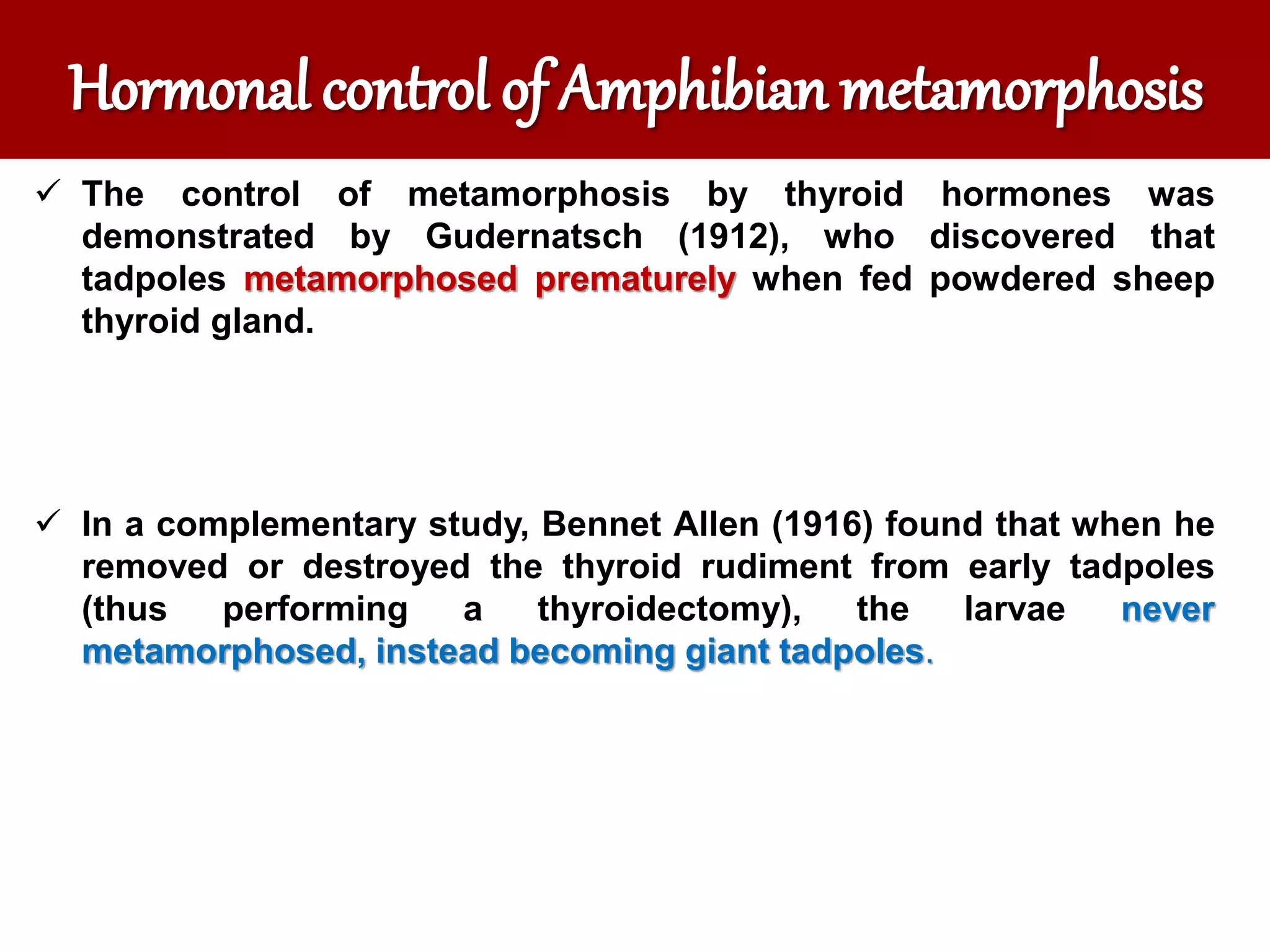
 The control of metamorphosis by thyroid hormones was
demonstrated by Gudernatsch (1912), who discovered that
tadpoles metamorphosed prematurely when fed powdered sheep
thyroid gland.
 In a complementary study, Bennet Allen (1916) found that when he
removed or destroyed the thyroid rudiment from early tadpoles
(thus performing a thyroidectomy), the larvae never
metamorphosed, instead becoming giant tadpoles.
 The metamorphic changes of frog
development are all brought about by the
secretion of the hormones thyroxine (T4)
and triiodothyronine (T3) from the
thyroid during metamorphosis.
 The conversion of T4 into the more active
hormone T3, by the target tissues
 Degradation of T3 in the target tissues
 Thyroid hormone receptors are
members of the steroid hormone
receptor superfamily of transcription
factors. There are two major types of
T3 receptors, TRα and TRβ.
 TRα= receptor for T3; ubiquitous
 TRβ= receptor induced by
hormones; increases w.r.t rise in
thyroid hormones
 TR/RXR complexes
 In the unbound state, TR-RXR is a
transcriptional repressor,
 In the bound state, repressors
leave the complex and are
replaced by co activators such as
HAT.
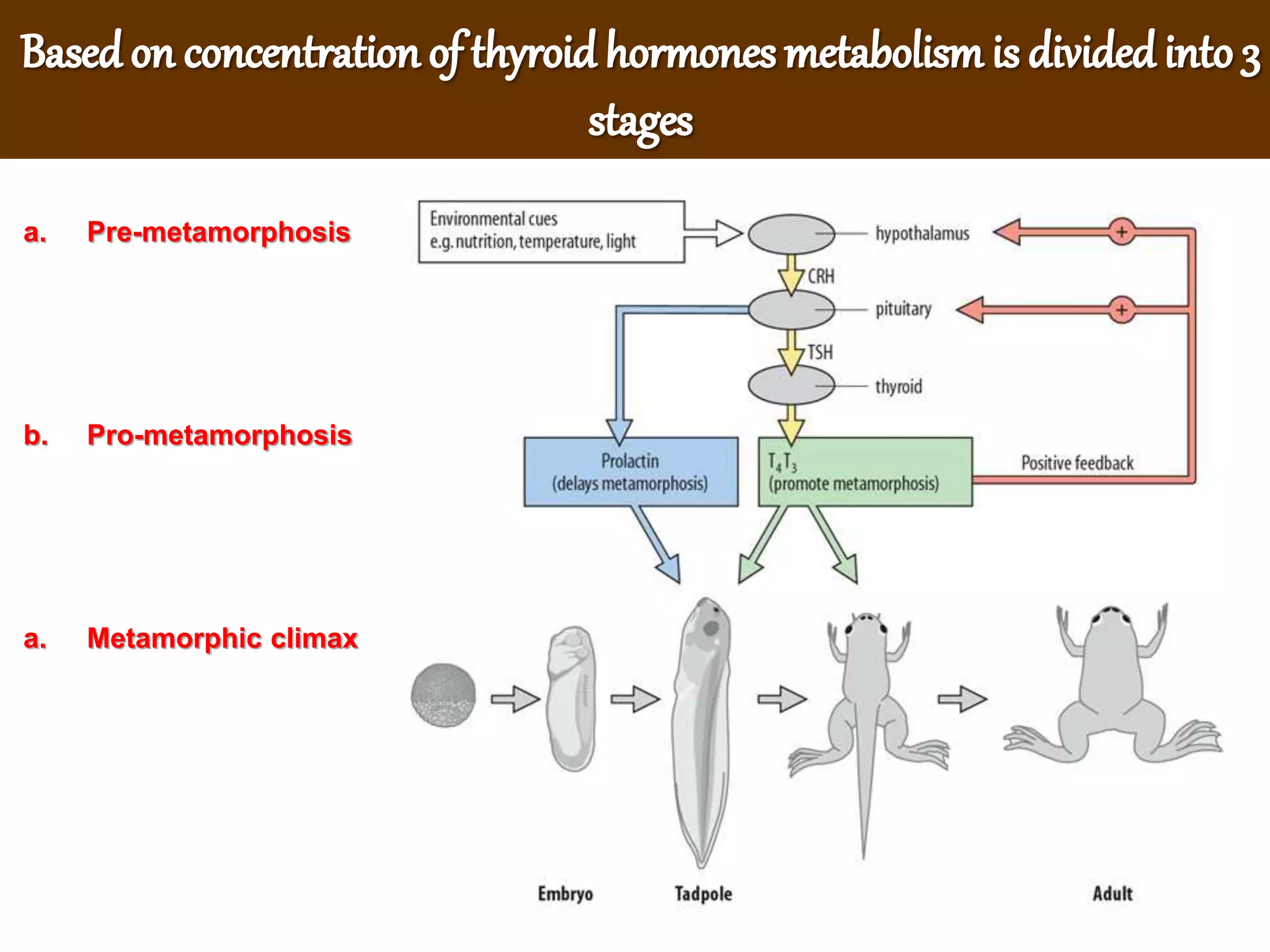
a. Pre-metamorphosis
b. Pro-metamorphosis
a. Metamorphic climax
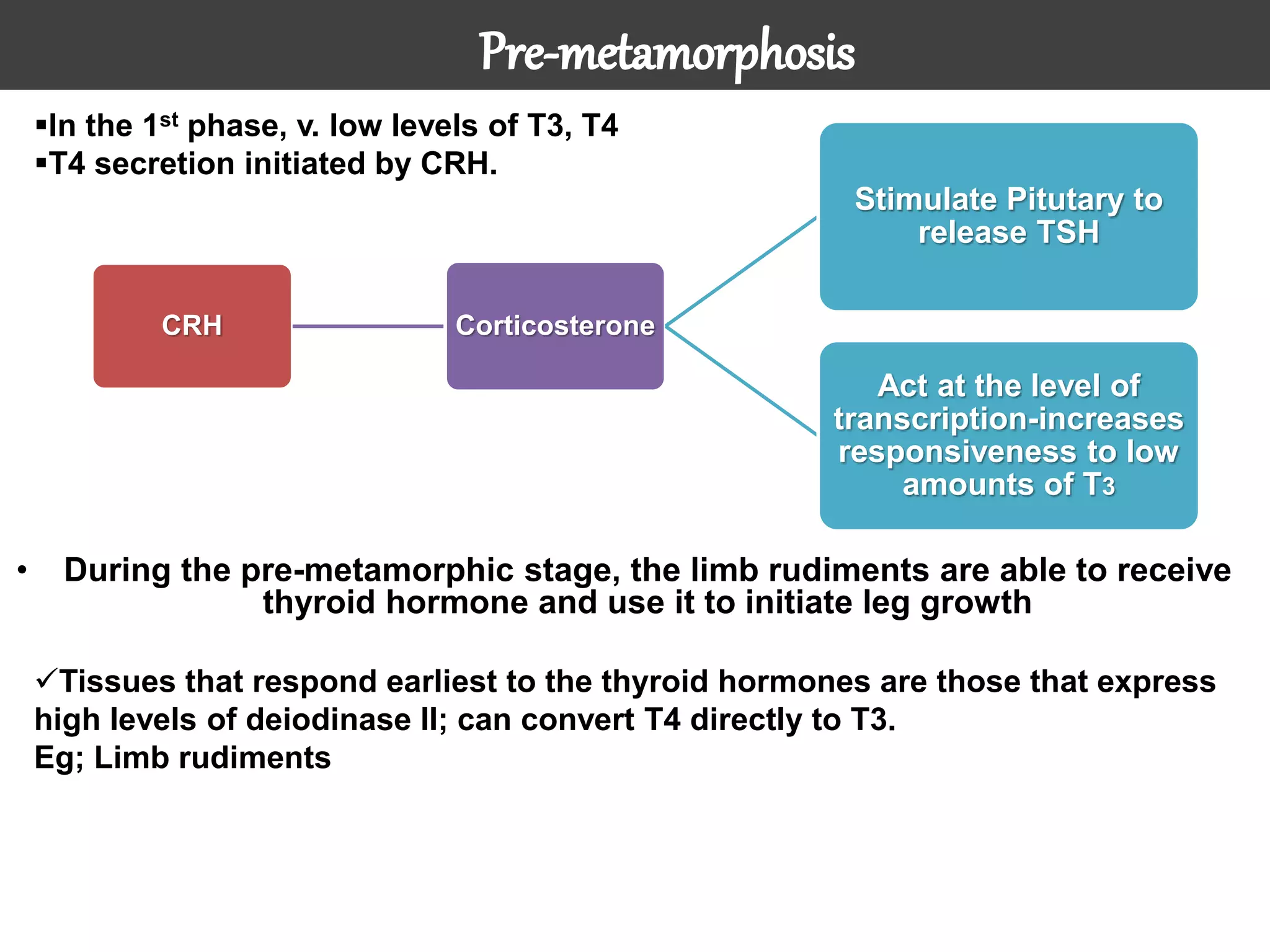
• During the pre-metamorphic stage, the limb rudiments are able to receive
thyroid hormone and use it to initiate leg growth
Tissues that respond earliest to the thyroid hormones are those that express
high levels of deiodinase II; can convert T4 directly to T3.
Eg; Limb rudiments
In the 1st phase, v. low levels of T3, T4
T4 secretion initiated by CRH.
CRH Corticosterone
Stimulate Pitutary to
release TSH
Act at the level of
transcription-increases
responsiveness to low
amounts of T3
 The concentration of T4 increases dramatically and TR β levels
increase, leading to tail resorption.
 TR β is the principal receptor that mediates metamorphic climax. In
this way the tail undergoes resorption only after legs are functional.
 The wisdom of the frog is simple:
“Never get rid of your tail before your legs are functional”
 Some tissues are not responsive to thyroid hormones, e.g., dorsal
retina.
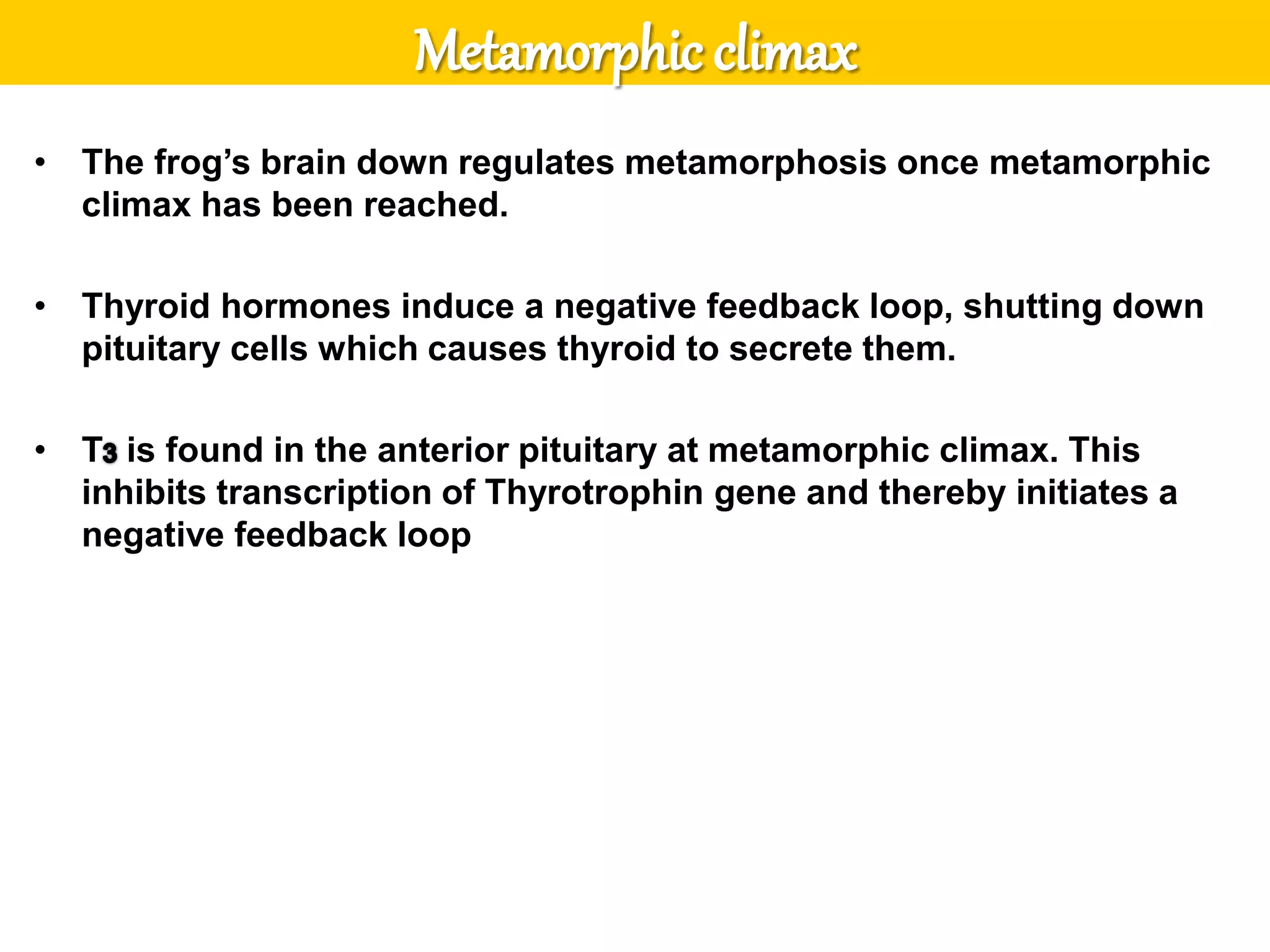
• The frog’s brain down regulates metamorphosis once metamorphic
climax has been reached.
• Thyroid hormones induce a negative feedback loop, shutting down
pituitary cells which causes thyroid to secrete them.
• T is found in the anterior pituitary at metamorphic climax. This
inhibits transcription of Thyrotrophin gene and thereby initiates a
negative feedback loop
Metamorphosis-amphibians, hormonal control

Metamorphosis-amphibians, hormonal control

  • 2.
     Metamorphosis -transitionin multi cellular organisms, from a larval to a juvenile (or adult) stage, accompanied by dramatic morphological, physiological, and ecological changes. Such changes typically include  Major restructuring of morphology, and  Transition from a non-reproductive to a reproductive state,  Dispersal and settlement to a new habitat, and  A shift in nutrition and feeding behavior The young lacks some adult structures which are developed in late development Some structures of young are distinctive and become lost during later development The young bears no resemblance to adult
  • 3.
    Amphibia- Greek;- amphi(double) and bios (life)- refers to "double life", or life in water and on land Characterized by:  Being tetrapods (4 limbs) that facilitate moving about on  Both gill and lung breathers - usually gills in the larval stage, replaced by lungs in the adult. Three primary orders of Amphibia within the Subclass Lissamphibia (all modern amphibians) Caudata (Urodela) - Salamanders Anura (Salientia) - Frogs and toads Apoda (Gymnophiona) – Caecilians Amphibian metamorphosis is associated with morphological changes that prepare an aquatic organism for terrestrial existence.
  • 5.
  • 7.
  • 8.
     Growth ofnew structures  Cell death during metamorphosis  Remodeling during metamorphosis  Biochemical respecification in the liver
  • 9.
    • The changesin amphibian metamorphosis are initiated by Thyroid hormones- and T3 induces 1. Emergence of limbs on metamorphosing tadpole; 2. In the eyes, eyelids and nictitating membranes emerge 3. Proliferation and differentiation of new neurons-to form limb musculature • Blocking T3 activity- paralysis of limbs Eye migration and associated neuronal changes during metamorphosis of the Xenopus laevis tadpole
  • 10.
    Cell death duringmetamorphosis • T3 causes degeneration of tail and gills, that were important for larval (but not adult) movement and respiration • The first part of tail resorption is caused by suicide, and later part of tail muscles are eaten by macrophages. • Tadpole RBCs are digested by macrophages of liver and spleen • Tadpole Hb replaced by adult Hb (binds oxygen slowly and releases more rapidly.
  • 11.
     Development ofthe lungs and the disappearance of the gills and gill pouch  The lower jaw transforms into the big mandible of the carnivorous adult  The long, spiral gut of the herbivorous tadpole is replaced by the typical short gut of a carnivorous predator  Nervous system becomes adapted for hearing and stereoscopic vision and for new methods of locomotion  Eyes are repositioned higher up on the head with eyelids and associated glands formed.  Eardrum, middle ear, and inner ear are developed  Skin becomes thicker and tougher
  • 12.
     In tadpoles(as in freshwater fishes), the major retinal photopigment is porphyropsin. During metamorphosis, the pigment changes to rhodopsin, the characteristic photopigment of terrestrial and marine vertebrates .  Tadpole hemoglobin is changed into an adult hemoglobin that binds oxygen more slowly and releases it more rapidly.  The liver enzymes also change, reflecting the change in habitat.  Tadpoles, like most freshwater fishes, are ammonotelic;  Many adult frogs (such as the genus Rana) are ureotelic, excreting urea, like most terrestrial vertebrates, which requires less water than excreting ammonia.  During metamorphosis, the liver begins to synthesize the urea cycle enzymes necessary to create urea from carbon dioxide and ammonia
  • 14.
     The controlof metamorphosis by thyroid hormones was demonstrated by Gudernatsch (1912), who discovered that tadpoles metamorphosed prematurely when fed powdered sheep thyroid gland.  In a complementary study, Bennet Allen (1916) found that when he removed or destroyed the thyroid rudiment from early tadpoles (thus performing a thyroidectomy), the larvae never metamorphosed, instead becoming giant tadpoles.
  • 15.
     The metamorphicchanges of frog development are all brought about by the secretion of the hormones thyroxine (T4) and triiodothyronine (T3) from the thyroid during metamorphosis.  The conversion of T4 into the more active hormone T3, by the target tissues  Degradation of T3 in the target tissues
  • 16.
     Thyroid hormonereceptors are members of the steroid hormone receptor superfamily of transcription factors. There are two major types of T3 receptors, TRα and TRβ.  TRα= receptor for T3; ubiquitous  TRβ= receptor induced by hormones; increases w.r.t rise in thyroid hormones  TR/RXR complexes  In the unbound state, TR-RXR is a transcriptional repressor,  In the bound state, repressors leave the complex and are replaced by co activators such as HAT.
  • 17.
  • 18.
    • During thepre-metamorphic stage, the limb rudiments are able to receive thyroid hormone and use it to initiate leg growth Tissues that respond earliest to the thyroid hormones are those that express high levels of deiodinase II; can convert T4 directly to T3. Eg; Limb rudiments In the 1st phase, v. low levels of T3, T4 T4 secretion initiated by CRH. CRH Corticosterone Stimulate Pitutary to release TSH Act at the level of transcription-increases responsiveness to low amounts of T3
  • 19.
     The concentrationof T4 increases dramatically and TR β levels increase, leading to tail resorption.  TR β is the principal receptor that mediates metamorphic climax. In this way the tail undergoes resorption only after legs are functional.  The wisdom of the frog is simple: “Never get rid of your tail before your legs are functional”  Some tissues are not responsive to thyroid hormones, e.g., dorsal retina.
  • 20.
    • The frog’sbrain down regulates metamorphosis once metamorphic climax has been reached. • Thyroid hormones induce a negative feedback loop, shutting down pituitary cells which causes thyroid to secrete them. • T is found in the anterior pituitary at metamorphic climax. This inhibits transcription of Thyrotrophin gene and thereby initiates a negative feedback loop

Editor's Notes

  • #3 Metamorphosis is a characteristic event in an organism’s life history, which involves a morphological transformation, more distinct than simply growth and morphogenesis. That is, there are organs and structures characteristic of pre-metamorphic stages, which are lost at metamorphosis and structures characteristic of post-metamorphic stages. This transformation marks a transition between distinct stages in life history (for example larva and juvenile), which often occupy and are adapted to different environments
  • #6 Egg- nymph- adult *Three stages of development At each stage the insect looks much the same as it does when it becomes an adult. Examples: Grasshopper or cockroaches . INCOMPLETE METAMORPHOSIS - has THREE stages (p.s. incomplete doesn’t mean not finished. It just means that the adult in complete metamorphosis is completely different from the larva. A nymph and its adult form are not completely different. They’re only a little different.) Complete Egg -Larvae-Pupae-Adult Four stages of development OMPLETE METAMORPHOSIS -has FOUR stages
  • #11 2,3 bpg-easy release of oxygen The various organs of the body respond differently to hormonal stimulation. The same stimulus causes some tissues to degenerate while causing others to develop and differentiate. For instance, tail degeneration is clearly associated with increasing levels of thyroid hormones. The degeneration of tail structures is relatively rapid, as the bony skeleton does not extend to the tail, which is supported only by the notochord (Wassersug 1989). The regression of the tail is brought about by apoptosis, and it occurs in four stages. First, protein synthesis decreases in the striated muscle cells of the tail (Little et al. 1973). Next, there is an increase in concentrations of digestive enzymes within the cells. Concentrations of lysosomal proteases, RNase, DNase, collagenase, phosphatase, and glycosidases all rise in the epidermis, notochord, and nerve cord cells (Fox 1973). Cell death is probably caused by the release of these enzymes into the cytoplasm. After cell death occurs, macrophages collect in the tail region, digesting the debris with their own proteolytic enzymes (Kaltenbach et al. 1979). The result is that the tail becomes a large sac of proteolytic enzymes (Figure 18.4). The major proteolytic enzymes involved appear to be collagenases and other metalloproteinases whose synthesis depends on thyroid hormones. If a metalloproteinase inhibitor (TIMP) is added to the tail, it prevents tail regression (Oofusa and Yoshizato 1991; Patterson et al. 1995).
  • #13 During amphibian metamorphosis, the animal body dramatically remodels to adapt from the aquatic to the terrestrial life. Cell death of larval organs/tissues occurs massively in balance with proliferation of adult organs/tissues, to ensure survival of the individuals