Zulkifal yousaf [email_address]
Preview Main Idea Regional Issues Map: Creation of Israel The Arab-Israeli Conflicts Golda Meir Revolution in Iran Conflict in Iraq Conflicts in the Middle East
Focuses How regional issues contributed to conflicts in the Middle East? What were some key events in the Arab-Israeli conflict? What caused a revolution in Iran? How have conflicts affected Iraq? Main Idea Regional issues in the Middle East have led to conflicts between Israel and its neighbors and to conflicts in and between Iran and Iraq. Conflicts in the Middle East
However, oil has also been a source of conflict. Over the last few decades, major conflicts have erupted in the Middle East. Issues that have contributed to the conflicts include the presence of huge oil reserves, the growth of Islam, and the conflict between Israel and its neighbors.  Regional Issues About two-thirds of world’s known oil reserved located in Middle East Reserves have been great source of wealth for Saudi Arabia, Iran, Iraq, Kuwait, other countries Most members of Organization of Petroleum Exporting Countries  Oil in the Middle East OPEC attempts to regulate production of oil exports to maximize revenues Oil revenues allowed Middle East governments to modernize countries, promote industrialization, economic, social development Oil Revenues
Oil as source of conflict in Middle East  Some governments have used oil revenues to build up military, maintain power, which threatens the neighboring countries  Oil wealth has caused internal clashes within countries, societies Region’s strategic importance as source of oil has led outside nations to become involved in Middle Eastern affairs, politics Importance of Oil
Religious Aspects Revolution in Iran, movement to reorder government, society according to Islamic laws Muslim believe countries have strayed from true Islam, followed Western models of political, economic development Islam
Expansion of Israel Series of wars between Israel, neighbors has led to expansion of Israel Israel controls more land now than in 1948 when created Result: many Palestinian Arabs live under Israeli control; another source of tension, conflict in region Conflicts with Israel 1948, Israel established; since then most Middle Eastern countries have refused to recognize its existence Some countries have retaliated against Israel, funded militant groups that conduct raids, and repeated attacks against Israelis
 
The Arab-Israeli conflict that began in 1948 has continued through the years. In 1967 and again in 1973, war erupted. Six years after the 1973 war, Egypt and Israel singed a peace agreement, but unrest among Palestinian Arabs in Israel remained a major problem. The Arab-Israeli Conflict 1967, Egypt demanded UN remove troops from Gaza, Sinai Peninsula Egyptian troops moved into Sinai to close off Gulf of Aqaba, Israel’s route to Red Sea War in 1967, 1973 Israel expected large-scale Arab attack, decided to strike first Launched air strikes against Egypt, Syria, Jordan; destroyed most of airplanes on ground Ground troops moved in, defeated Arabs Israeli Attacks In Six-Day War Israel took control of Golan Heights, Sinai Peninsula, Gaza Strip, West Bank, East Jerusalem Took control of land in West Bank, Gaza with large Palestinian population Six-Day War
Yom Kippur War Egypt, Syria determined to win territory back, launched Yom Kippur War, surprise attack against Israel in 1973 Took name from Jewish holy day when attack began Oil Embargo Both sides agreed to cease-fire after weeks of fighting During war, Arab members of OPEC declared oil embargo against countries supporting Israel Price of oil around world rose dramatically as result of refusal to sell oil U.S. Support At first Arab troops made gains in war; Israeli’s government, led by Golda Meir, not fully prepared for attack; needed military support from U.S. With support, Israeli forces regrouped, pushed back Egyptian, Syrian armies Egypt Strikes Back
 
Until the late 1970s, no Arab nation had recognized Israel’s right to exist.  A Peace Agreement 1977, Egyptian president Anwar Sadat made momentous declaration: Egypt wanted peace with Israel U.S. president Jimmy Carter invited Sadat, Israeli prime minister Menachem Begin to Camp David, presidential retreat in Maryland Camp David 1978, Sadat, Begin reached agreement known as Camp David Accords Egypt recognized Israel; Israel returned Sinai Peninsula to Egypt Treaty ended 30 years hostility between Egypt, Israel Peace Treaty
Egypt, Israel made peace; Palestinian Arabs continued struggle for nationhood 1947 UN partition plan had called for two states in Palestine—a Jewish state, an Arab state After 1948 Arab-Israeli war, land set aside for Arab state occupied by Israel, Egypt, Jordan Palestinian Unrest 1964, Palestine Liberation Organization (PLO) formed Pledged to destroy Israel, replace with Palestinian state 1969, Yasser Arafat became leader, PLO launched guerilla attacks against Israel Palestinian Nationalism In effort to stop attacks, Israel invaded Lebanon, 1978 and 1982 Tensions building also in West Bank, Gaza where Israel had begun building settlements 1987, Palestinian resentment began rebellion called intifada Palestinian Resentment
Intifada  Palestinian youths battled Israeli troops in widespread street violence Israel responded with military, police resistance; fighting continued to 1990s 1993, Arafat, Israeli prime minister Yitzhak Rabin negotiated Oslo Accords Undermining Peace Extremists on both sides worked to undermine peace process Militant group Hamas launched attacks in Israel 1995, Rabin assassinated; relations between Israeli, Palestinian leadership soured Oslo Accords Oslo Accords called for Palestinians to gradually gain control over governing West Bank, Gaza Israel, PLO supposed to sign permanent peace agreement by 1998 Tenuous Peace
Armed conflict also erupted when Israeli soldiers were kidnapped along borders with Gaza and Lebanon. Israel launched air strikes to secure its borders. 2000 — second intifada began Palestinian youths joined by Palestinian security forces with guns Continuing the Conflict Israelis countered by sending troops backed by tanks, fighter jets, helicopter gunships into cities in West Bank, Gaza  2004, Arafat died, succeeded by Mahmoud Abbas More Fighting 2004, Israeli prime minister Ariel Sharon withdrew Israel from Gaza, parts of West Bank  2005, Gaza turned over to Palestinians 2006, militant Hamas won control of Palestinian parliament Hamas in Control
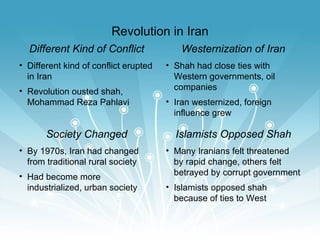
Different Kind of Conflict Different kind of conflict erupted in Iran Revolution ousted shah, Mohammad Reza Pahlavi Society Changed By 1970s, Iran had changed from traditional rural society Had become more industrialized, urban society Westernization of Iran Shah had close ties with Western governments, oil companies Iran westernized, foreign influence grew Islamists Opposed Shah Many Iranians felt threatened by rapid change, others felt betrayed by corrupt government Islamists opposed shah because of ties to West  Revolution in Iran
1978, Iranians began to protest against shah’s rule  Protests inspired by  Ayatollah Ruhollah Khomeini , Shia religious leader 1979, unable to calm unrest, shah fled Iran Iran became Islamic republic with Khomeini as leader, during  Iranian Revolution Rise of Khomeini
Khomeini’s Reign 1979, Iranian revolutionaries seized U.S. embassy in Tehran, took 66 Americans hostage Iranians demanded shah be returned to Iran, stand trial Shah left U.S., but Iranians held hostages until January, 1981 American Hostages
As Iran’s new government was dealing with the hostage crisis, it found itself at war with its neighbor, Iraq.  Conflict in Iraq
Weapons  After war, UN continued economic sanctions, insisted Iraq destroy chemical, biological weapons, agree not to develop nuclear weapons Inspectors had been sent to verify Iraq’s weapons had been destroyed Iraq failed to fully cooperate with UN weapons inspectors Sanctions  In effort to end Iraqi occupation of Kuwait, UN passed economic sanctions against Iraq; sanctions failed Result: U.S.-led coalition launched Persian Gulf War Attacked Iraqi forces in Kuwait; Kuwait freed within weeks
Insurgent attacks by different groups from both inside and outside Iraq caused a greater number of casualties. After attacks of September 11, 2001, some U.S. leaders believed Saddam Hussein posed a greater threat to America than before Hussein might have deadly weapons he could give to terrorists The Iraq War UN weapons inspections did not find stockpiles of chemical, biological, nuclear weapons Iraq again did not fully cooperate Some U.S. officials convinced Hussein hiding weapons  Weapons Inspections
Meanwhile, coalition worked to create new, democratic government in Iraq   2004, power transferred to Iraqis  2005, Iraqis voted in country’s first multiparty election in fifty years Later approved new constitution to make Iraq Islamic federal democracy Continued violence, potential for civil war made country’s future highly uncertain Coalition Government
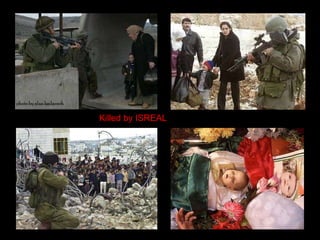
Killed by ISREAL
Killed by  Israel

Arab Isreal conflicts

  • 1.
  • 2.
    Preview Main IdeaRegional Issues Map: Creation of Israel The Arab-Israeli Conflicts Golda Meir Revolution in Iran Conflict in Iraq Conflicts in the Middle East
  • 3.
    Focuses How regionalissues contributed to conflicts in the Middle East? What were some key events in the Arab-Israeli conflict? What caused a revolution in Iran? How have conflicts affected Iraq? Main Idea Regional issues in the Middle East have led to conflicts between Israel and its neighbors and to conflicts in and between Iran and Iraq. Conflicts in the Middle East
  • 4.
    However, oil hasalso been a source of conflict. Over the last few decades, major conflicts have erupted in the Middle East. Issues that have contributed to the conflicts include the presence of huge oil reserves, the growth of Islam, and the conflict between Israel and its neighbors. Regional Issues About two-thirds of world’s known oil reserved located in Middle East Reserves have been great source of wealth for Saudi Arabia, Iran, Iraq, Kuwait, other countries Most members of Organization of Petroleum Exporting Countries Oil in the Middle East OPEC attempts to regulate production of oil exports to maximize revenues Oil revenues allowed Middle East governments to modernize countries, promote industrialization, economic, social development Oil Revenues
  • 5.
    Oil as sourceof conflict in Middle East Some governments have used oil revenues to build up military, maintain power, which threatens the neighboring countries Oil wealth has caused internal clashes within countries, societies Region’s strategic importance as source of oil has led outside nations to become involved in Middle Eastern affairs, politics Importance of Oil
  • 6.
    Religious Aspects Revolutionin Iran, movement to reorder government, society according to Islamic laws Muslim believe countries have strayed from true Islam, followed Western models of political, economic development Islam
  • 7.
    Expansion of IsraelSeries of wars between Israel, neighbors has led to expansion of Israel Israel controls more land now than in 1948 when created Result: many Palestinian Arabs live under Israeli control; another source of tension, conflict in region Conflicts with Israel 1948, Israel established; since then most Middle Eastern countries have refused to recognize its existence Some countries have retaliated against Israel, funded militant groups that conduct raids, and repeated attacks against Israelis
  • 8.
  • 9.
    The Arab-Israeli conflictthat began in 1948 has continued through the years. In 1967 and again in 1973, war erupted. Six years after the 1973 war, Egypt and Israel singed a peace agreement, but unrest among Palestinian Arabs in Israel remained a major problem. The Arab-Israeli Conflict 1967, Egypt demanded UN remove troops from Gaza, Sinai Peninsula Egyptian troops moved into Sinai to close off Gulf of Aqaba, Israel’s route to Red Sea War in 1967, 1973 Israel expected large-scale Arab attack, decided to strike first Launched air strikes against Egypt, Syria, Jordan; destroyed most of airplanes on ground Ground troops moved in, defeated Arabs Israeli Attacks In Six-Day War Israel took control of Golan Heights, Sinai Peninsula, Gaza Strip, West Bank, East Jerusalem Took control of land in West Bank, Gaza with large Palestinian population Six-Day War
  • 10.
    Yom Kippur WarEgypt, Syria determined to win territory back, launched Yom Kippur War, surprise attack against Israel in 1973 Took name from Jewish holy day when attack began Oil Embargo Both sides agreed to cease-fire after weeks of fighting During war, Arab members of OPEC declared oil embargo against countries supporting Israel Price of oil around world rose dramatically as result of refusal to sell oil U.S. Support At first Arab troops made gains in war; Israeli’s government, led by Golda Meir, not fully prepared for attack; needed military support from U.S. With support, Israeli forces regrouped, pushed back Egyptian, Syrian armies Egypt Strikes Back
  • 11.
  • 12.
    Until the late1970s, no Arab nation had recognized Israel’s right to exist. A Peace Agreement 1977, Egyptian president Anwar Sadat made momentous declaration: Egypt wanted peace with Israel U.S. president Jimmy Carter invited Sadat, Israeli prime minister Menachem Begin to Camp David, presidential retreat in Maryland Camp David 1978, Sadat, Begin reached agreement known as Camp David Accords Egypt recognized Israel; Israel returned Sinai Peninsula to Egypt Treaty ended 30 years hostility between Egypt, Israel Peace Treaty
  • 13.
    Egypt, Israel madepeace; Palestinian Arabs continued struggle for nationhood 1947 UN partition plan had called for two states in Palestine—a Jewish state, an Arab state After 1948 Arab-Israeli war, land set aside for Arab state occupied by Israel, Egypt, Jordan Palestinian Unrest 1964, Palestine Liberation Organization (PLO) formed Pledged to destroy Israel, replace with Palestinian state 1969, Yasser Arafat became leader, PLO launched guerilla attacks against Israel Palestinian Nationalism In effort to stop attacks, Israel invaded Lebanon, 1978 and 1982 Tensions building also in West Bank, Gaza where Israel had begun building settlements 1987, Palestinian resentment began rebellion called intifada Palestinian Resentment
  • 14.
    Intifada Palestinianyouths battled Israeli troops in widespread street violence Israel responded with military, police resistance; fighting continued to 1990s 1993, Arafat, Israeli prime minister Yitzhak Rabin negotiated Oslo Accords Undermining Peace Extremists on both sides worked to undermine peace process Militant group Hamas launched attacks in Israel 1995, Rabin assassinated; relations between Israeli, Palestinian leadership soured Oslo Accords Oslo Accords called for Palestinians to gradually gain control over governing West Bank, Gaza Israel, PLO supposed to sign permanent peace agreement by 1998 Tenuous Peace
  • 15.
    Armed conflict alsoerupted when Israeli soldiers were kidnapped along borders with Gaza and Lebanon. Israel launched air strikes to secure its borders. 2000 — second intifada began Palestinian youths joined by Palestinian security forces with guns Continuing the Conflict Israelis countered by sending troops backed by tanks, fighter jets, helicopter gunships into cities in West Bank, Gaza 2004, Arafat died, succeeded by Mahmoud Abbas More Fighting 2004, Israeli prime minister Ariel Sharon withdrew Israel from Gaza, parts of West Bank 2005, Gaza turned over to Palestinians 2006, militant Hamas won control of Palestinian parliament Hamas in Control
  • 16.
    Different Kind ofConflict Different kind of conflict erupted in Iran Revolution ousted shah, Mohammad Reza Pahlavi Society Changed By 1970s, Iran had changed from traditional rural society Had become more industrialized, urban society Westernization of Iran Shah had close ties with Western governments, oil companies Iran westernized, foreign influence grew Islamists Opposed Shah Many Iranians felt threatened by rapid change, others felt betrayed by corrupt government Islamists opposed shah because of ties to West Revolution in Iran
  • 17.
    1978, Iranians beganto protest against shah’s rule Protests inspired by Ayatollah Ruhollah Khomeini , Shia religious leader 1979, unable to calm unrest, shah fled Iran Iran became Islamic republic with Khomeini as leader, during Iranian Revolution Rise of Khomeini
  • 18.
    Khomeini’s Reign 1979,Iranian revolutionaries seized U.S. embassy in Tehran, took 66 Americans hostage Iranians demanded shah be returned to Iran, stand trial Shah left U.S., but Iranians held hostages until January, 1981 American Hostages
  • 19.
    As Iran’s newgovernment was dealing with the hostage crisis, it found itself at war with its neighbor, Iraq. Conflict in Iraq
  • 20.
    Weapons Afterwar, UN continued economic sanctions, insisted Iraq destroy chemical, biological weapons, agree not to develop nuclear weapons Inspectors had been sent to verify Iraq’s weapons had been destroyed Iraq failed to fully cooperate with UN weapons inspectors Sanctions In effort to end Iraqi occupation of Kuwait, UN passed economic sanctions against Iraq; sanctions failed Result: U.S.-led coalition launched Persian Gulf War Attacked Iraqi forces in Kuwait; Kuwait freed within weeks
  • 21.
    Insurgent attacks bydifferent groups from both inside and outside Iraq caused a greater number of casualties. After attacks of September 11, 2001, some U.S. leaders believed Saddam Hussein posed a greater threat to America than before Hussein might have deadly weapons he could give to terrorists The Iraq War UN weapons inspections did not find stockpiles of chemical, biological, nuclear weapons Iraq again did not fully cooperate Some U.S. officials convinced Hussein hiding weapons Weapons Inspections
  • 22.
    Meanwhile, coalition workedto create new, democratic government in Iraq 2004, power transferred to Iraqis 2005, Iraqis voted in country’s first multiparty election in fifty years Later approved new constitution to make Iraq Islamic federal democracy Continued violence, potential for civil war made country’s future highly uncertain Coalition Government
  • 23.
  • 24.
    Killed by Israel