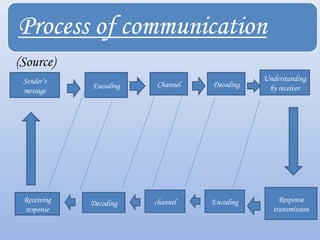
(Source)
Sender’s
message
Encoding Channel Decoding
Understanding
by receiver
Response
transmission
EncodingchannelDecodingReceiving
response
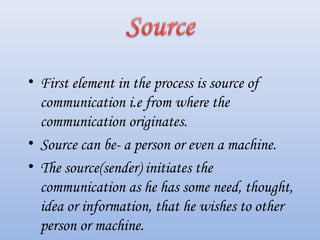
• First element in the process is source of
communication i.e from where the
communication originates.
• Source can be- a person or even a machine.
• The source(sender) initiates the
communication as he has some need, thought,
idea or information, that he wishes to other
person or machine.
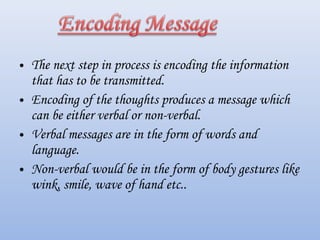
• The next step in process is encoding the information
that has to be transmitted.
• Encoding of the thoughts produces a message which
can be either verbal or non-verbal.
• Verbal messages are in the form of words and
language.
• Non-verbal would be in the form of body gestures like
wink, smile, wave of hand etc..
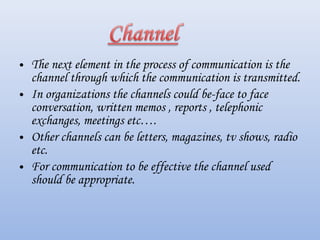
• The next element in the process of communication is the
channel through which the communication is transmitted.
• In organizations the channels could be-face to face
conversation, written memos , reports , telephonic
exchanges, meetings etc….
• Other channels can be letters, magazines, tv shows, radio
etc.
• For communication to be effective the channel used
should be appropriate.
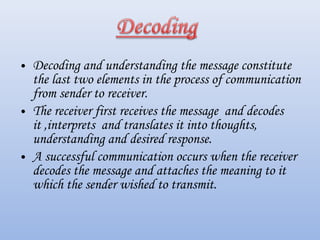
• Decoding and understanding the message constitute
the last two elements in the process of communication
from sender to receiver.
• The receiver first receives the message and decodes
it ,interprets and translates it into thoughts,
understanding and desired response.
• A successful communication occurs when the receiver
decodes the message and attaches the meaning to it
which the sender wished to transmit.
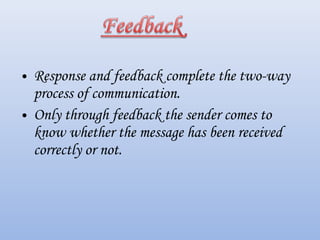
• Response and feedback complete the two-way
process of communication.
• Only through feedback the sender comes to
know whether the message has been received
correctly or not.
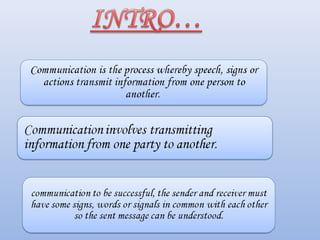
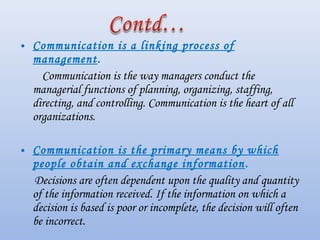
• Communication is a linking process of
management.
 Communication is the way managers conduct the
managerial functions of planning, organizing, staffing,
directing, and controlling. Communication is the heart of all
organizations.
• Communication is the primary means by which
people obtain and exchange information. 
Decisions are often dependent upon the quality and quantity
of the information received. If the information on which a
decision is based is poor or incomplete, the decision will often
be incorrect.
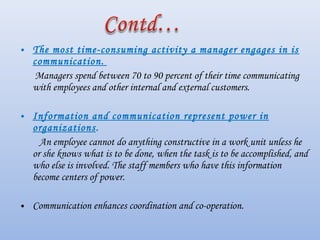
• The most time-consuming activity a manager engages in is
communication. 
Managers spend between 70 to 90 percent of their time communicating
with employees and other internal and external customers.
• Information and communication represent power in
organizations.
 An employee cannot do anything constructive in a work unit unless he
or she knows what is to be done, when the task is to be accomplished, and
who else is involved. The staff members who have this information
become centers of power.
• Communication enhances coordination and co-operation.
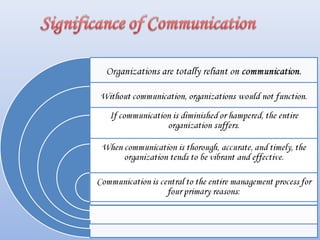
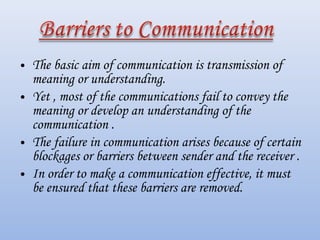
• The basic aim of communication is transmission of
meaning or understanding.
• Yet , most of the communications fail to convey the
meaning or develop an understanding of the
communication .
• The failure in communication arises because of certain
blockages or barriers between sender and the receiver .
• In order to make a communication effective, it must
be ensured that these barriers are removed.
A)Semantic Barriers- Most of the difficulties in
communication arise because the same word or symbol
means different things to different individuals.
• Same words are interpret in different ways.
B) Psychological barriers- These are the prime
barriers in inter-personal communication.
• The meaning of the message depends upon the
emotional or psychological status of both the parties.
C) Organizational Barriers- The structure of the
organization itself acts as a barrier against the free
flow of communication between employees and levels
in the org.
• When the information is channeled through levels of
organisation, it become altered as people interpreted
facts differently.
D) Emotions - How the receiver feels at the time of
receipt of communication message will influence how
he or she interprets it.
• The same message received when you are angry is
likely to be interpreted differently when you are in a
neutral disposition.
E) Language
• Naveen singh
• B.Tech 1st
year 2nd
semester
• Mechanical branch
• 13/emhme/037
• M.A.I.I.T. ranpur,kota

Communication system ppt

  • 8.
    (Source) Sender’s message Encoding Channel Decoding Understanding byreceiver Response transmission EncodingchannelDecodingReceiving response
  • 9.
    • First elementin the process is source of communication i.e from where the communication originates. • Source can be- a person or even a machine. • The source(sender) initiates the communication as he has some need, thought, idea or information, that he wishes to other person or machine.
  • 10.
    • The nextstep in process is encoding the information that has to be transmitted. • Encoding of the thoughts produces a message which can be either verbal or non-verbal. • Verbal messages are in the form of words and language. • Non-verbal would be in the form of body gestures like wink, smile, wave of hand etc..
  • 11.
    • The nextelement in the process of communication is the channel through which the communication is transmitted. • In organizations the channels could be-face to face conversation, written memos , reports , telephonic exchanges, meetings etc…. • Other channels can be letters, magazines, tv shows, radio etc. • For communication to be effective the channel used should be appropriate.
  • 12.
    • Decoding andunderstanding the message constitute the last two elements in the process of communication from sender to receiver. • The receiver first receives the message and decodes it ,interprets and translates it into thoughts, understanding and desired response. • A successful communication occurs when the receiver decodes the message and attaches the meaning to it which the sender wished to transmit.
  • 13.
    • Response andfeedback complete the two-way process of communication. • Only through feedback the sender comes to know whether the message has been received correctly or not.
  • 15.
    • Communication isa linking process of management.  Communication is the way managers conduct the managerial functions of planning, organizing, staffing, directing, and controlling. Communication is the heart of all organizations. • Communication is the primary means by which people obtain and exchange information.  Decisions are often dependent upon the quality and quantity of the information received. If the information on which a decision is based is poor or incomplete, the decision will often be incorrect.
  • 16.
    • The mosttime-consuming activity a manager engages in is communication.  Managers spend between 70 to 90 percent of their time communicating with employees and other internal and external customers. • Information and communication represent power in organizations.  An employee cannot do anything constructive in a work unit unless he or she knows what is to be done, when the task is to be accomplished, and who else is involved. The staff members who have this information become centers of power. • Communication enhances coordination and co-operation.
  • 17.
    • The basicaim of communication is transmission of meaning or understanding. • Yet , most of the communications fail to convey the meaning or develop an understanding of the communication . • The failure in communication arises because of certain blockages or barriers between sender and the receiver . • In order to make a communication effective, it must be ensured that these barriers are removed.
  • 18.
    A)Semantic Barriers- Mostof the difficulties in communication arise because the same word or symbol means different things to different individuals. • Same words are interpret in different ways. B) Psychological barriers- These are the prime barriers in inter-personal communication. • The meaning of the message depends upon the emotional or psychological status of both the parties.
  • 19.
    C) Organizational Barriers-The structure of the organization itself acts as a barrier against the free flow of communication between employees and levels in the org. • When the information is channeled through levels of organisation, it become altered as people interpreted facts differently.
  • 20.
    D) Emotions -How the receiver feels at the time of receipt of communication message will influence how he or she interprets it. • The same message received when you are angry is likely to be interpreted differently when you are in a neutral disposition. E) Language
  • 21.
    • Naveen singh •B.Tech 1st year 2nd semester • Mechanical branch • 13/emhme/037 • M.A.I.I.T. ranpur,kota