VCE Environmental Science
   Unit 3: Biodiversity
    Measuring Biodiversity
Biological Sampling
• The study of any species requires an estimate of
  their density in different habitats. Scientists use
  many different methods of measuring density,
  depending on the size, abundance, behaviour and
  habitat of the species. Sometimes a line transect
  and quadrats are used to measure the abundance
  and cover of different floral species in a grassland
  reserve.
• Reference: Charles J. Krebs (1985) “Ecology – The
  Experimental Analysis of Distribution and
  Abundance” Harper International, New York.
Sampling techniques:
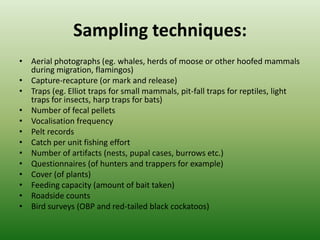
• Aerial photographs (eg. whales, herds of moose or other hoofed mammals
  during migration, flamingos)
• Capture-recapture (or mark and release)
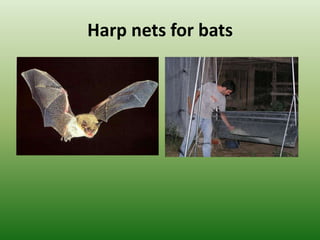
• Traps (eg. Elliot traps for small mammals, pit-fall traps for reptiles, light
  traps for insects, harp traps for bats)
• Number of fecal pellets
• Vocalisation frequency
• Pelt records
• Catch per unit fishing effort
• Number of artifacts (nests, pupal cases, burrows etc.)
• Questionnaires (of hunters and trappers for example)
• Cover (of plants)
• Feeding capacity (amount of bait taken)
• Roadside counts
• Bird surveys (OBP and red-tailed black cockatoos)
Aerial photographs are suitable for large
mammals that congregate in known
locations.
Surveys for birds
Harp nets for bats
Pit traps for reptiles and invertebrates
                 http://www.bobtrlin.com/Fauna/Australian-
                 Wildlife/Herps/12840134_tRhHKj/1463524527_f
                 DL6Wgz#!i=1463524527&k=fDL6Wgz
Counting artefacts – nesting sites, tree hollows, skins.
Leadbeater’s Possum –
 Critically Endangered
Brush-tailed Rock Wallaby –
   Critically Endangered
Biological Sampling
• Each method has it’s advantages and
  disadvantages and is most valuable when used as
  an adjunct to more direct methods. This article
  from the CSIRO, “Estimating whale numbers in
  the Southern Ocean” explains how scientists go
  about estimating the abundance and population
  structure of minke whales.
• This activity, Counting Smarties, from Maths by
  Email, models the “Mark and Recapture” or “Tag
  and Release” methods using smarties.
Quadrats
Transects
Species         Site A   Site B
Shrub 1         3        1
Shrub 2         7        2
Understorey 1   5        0
Understorey 2   6        2
Understorey 3   94       94
Understorey 4   75       75
Weed 1          0        2
Weed 2          0        20
D = 1 – p2      0.5961   0.6129
Simpson’s Index
• Simpson's Diversity Index (D) is a measure of
  diversity. In ecology, it is often used to
  quantify the biodiversity of a habitat. It takes
  into account the number of species present,
  as well as the abundance of each species.
• This index is based upon the probability that
  two specimens belong to the same species.
• It ranges from 0 (low diversity) to 0.9999
  (high diversity)
Simpson’s Index
Page 49 (1st ed) Page 53 (2nd ed)
Calculate the ‘p’ value = no. of individuals
                           Total Number

 Calculate p2 (site A)= p x p = 0.4039
 Simpson’s Index (D) = 1-0.4039= 0.5961
 Calculate p2 (site B) = p x p = 0.3871
 Simpson’s Index (D) = 1 – 0.38712=
 0.6129
Discussion Questions:
• Describe the species diversity before and after
  sheep grazing
• What does the calculated Simpson’s Index for
  the site tell you about species richness before
  and after impact?
• Describe and compare the species
  composition of Site A before and after the
  impact. How does this analysis compare with
  the analysis by the Simpson’s Index?
Discussion Questions:
• What effect has sheep grazing had on the
  species composition at this site?
• Using this example, explain the limitations of
  relying only on Simpson’s Index as a
  determinate for species diversity. What do you
  suggest to improve the data collection and
  analysis to determine the site’s diversity?
• If you were asked to manage this site for
  species diversity what would you aim to do?
Shannon-Weiner Index
• Another commonly used index is the
  Shannon-Weiner Diversity Index (H).
• Mostly used in freshwater ecology
• Based on the question: “How difficult is it to
  predict correctly the species of the next
  individual collected?”
• The higher the value, between 0 and logS, the
  higher the species diversity.
Endemism
• Australia, as one of the 12 mega-diverse regions on
  earth, is defined in terms not only of species richness
  but also in terms of the level of endemism. (species
  unique to Australia, that exist nowhere else)
                        Number of species   % endemic
      Vascular plants   250,000             85%
      Mammals           369                 82%
      Birds             825                 45%
      Reptiles          633                 89%
      Frogs             176                 93%
      Invertebrates     193,470             95%
“SAFE” Index
• Read the Mathsmasters article in The Age
• http://education.theage.com.au/cmspage.php
  ?intid=147
• “Will maths kill the rhino?” by Polster and
  Ross
• Is the “SAFE” Index a good measure of the
  threat of extinction?
• Do you agree with the article?
C
H
I
P
P
O
http://www.dse.vic.gov.au/__data/assets/pdf_file/0006/103389/Advisory_List_of_Threatened_
Vert_Fauna_in_Victoria_-_2007_amended_11_august_2009.pdf

3B.2 Measuring Biodiversity

  • 1.
    VCE Environmental Science Unit 3: Biodiversity Measuring Biodiversity
  • 2.
    Biological Sampling • Thestudy of any species requires an estimate of their density in different habitats. Scientists use many different methods of measuring density, depending on the size, abundance, behaviour and habitat of the species. Sometimes a line transect and quadrats are used to measure the abundance and cover of different floral species in a grassland reserve. • Reference: Charles J. Krebs (1985) “Ecology – The Experimental Analysis of Distribution and Abundance” Harper International, New York.
  • 3.
    Sampling techniques: • Aerialphotographs (eg. whales, herds of moose or other hoofed mammals during migration, flamingos) • Capture-recapture (or mark and release) • Traps (eg. Elliot traps for small mammals, pit-fall traps for reptiles, light traps for insects, harp traps for bats) • Number of fecal pellets • Vocalisation frequency • Pelt records • Catch per unit fishing effort • Number of artifacts (nests, pupal cases, burrows etc.) • Questionnaires (of hunters and trappers for example) • Cover (of plants) • Feeding capacity (amount of bait taken) • Roadside counts • Bird surveys (OBP and red-tailed black cockatoos)
  • 4.
    Aerial photographs aresuitable for large mammals that congregate in known locations.
  • 5.
  • 6.
  • 7.
    Pit traps forreptiles and invertebrates http://www.bobtrlin.com/Fauna/Australian- Wildlife/Herps/12840134_tRhHKj/1463524527_f DL6Wgz#!i=1463524527&k=fDL6Wgz
  • 10.
    Counting artefacts –nesting sites, tree hollows, skins.
  • 11.
    Leadbeater’s Possum – Critically Endangered
  • 12.
    Brush-tailed Rock Wallaby– Critically Endangered
  • 13.
    Biological Sampling • Eachmethod has it’s advantages and disadvantages and is most valuable when used as an adjunct to more direct methods. This article from the CSIRO, “Estimating whale numbers in the Southern Ocean” explains how scientists go about estimating the abundance and population structure of minke whales. • This activity, Counting Smarties, from Maths by Email, models the “Mark and Recapture” or “Tag and Release” methods using smarties.
  • 14.
  • 15.
  • 16.
    Species Site A Site B Shrub 1 3 1 Shrub 2 7 2 Understorey 1 5 0 Understorey 2 6 2 Understorey 3 94 94 Understorey 4 75 75 Weed 1 0 2 Weed 2 0 20 D = 1 – p2 0.5961 0.6129
  • 18.
    Simpson’s Index • Simpson'sDiversity Index (D) is a measure of diversity. In ecology, it is often used to quantify the biodiversity of a habitat. It takes into account the number of species present, as well as the abundance of each species. • This index is based upon the probability that two specimens belong to the same species. • It ranges from 0 (low diversity) to 0.9999 (high diversity)
  • 19.
    Simpson’s Index Page 49(1st ed) Page 53 (2nd ed) Calculate the ‘p’ value = no. of individuals Total Number Calculate p2 (site A)= p x p = 0.4039 Simpson’s Index (D) = 1-0.4039= 0.5961 Calculate p2 (site B) = p x p = 0.3871 Simpson’s Index (D) = 1 – 0.38712= 0.6129
  • 20.
    Discussion Questions: • Describethe species diversity before and after sheep grazing • What does the calculated Simpson’s Index for the site tell you about species richness before and after impact? • Describe and compare the species composition of Site A before and after the impact. How does this analysis compare with the analysis by the Simpson’s Index?
  • 21.
    Discussion Questions: • Whateffect has sheep grazing had on the species composition at this site? • Using this example, explain the limitations of relying only on Simpson’s Index as a determinate for species diversity. What do you suggest to improve the data collection and analysis to determine the site’s diversity? • If you were asked to manage this site for species diversity what would you aim to do?
  • 22.
    Shannon-Weiner Index • Anothercommonly used index is the Shannon-Weiner Diversity Index (H). • Mostly used in freshwater ecology • Based on the question: “How difficult is it to predict correctly the species of the next individual collected?” • The higher the value, between 0 and logS, the higher the species diversity.
  • 23.
    Endemism • Australia, asone of the 12 mega-diverse regions on earth, is defined in terms not only of species richness but also in terms of the level of endemism. (species unique to Australia, that exist nowhere else) Number of species % endemic Vascular plants 250,000 85% Mammals 369 82% Birds 825 45% Reptiles 633 89% Frogs 176 93% Invertebrates 193,470 95%
  • 24.
    “SAFE” Index • Readthe Mathsmasters article in The Age • http://education.theage.com.au/cmspage.php ?intid=147 • “Will maths kill the rhino?” by Polster and Ross • Is the “SAFE” Index a good measure of the threat of extinction? • Do you agree with the article?
  • 26.
  • 27.