Research
Jack Reagan Wallis
Terminology
• Circulation
– How many copies of a print have been made
• Hits
– How many times the websites been viewed
• Box Office Figures
– How much money a film has made in cinemas
• Ratings
– The products ratings
• Sales
-how many of the products have been sold
Primary Research
• Definition
– When people ask other people questions for research.
• Advantages
– You can make your own questions for your research.
• Disadvantages
– It can take a long time to set up all the questions also
trying to find the right people to ask can be hard.
• Example
– Interviewing the public
Secondary Research
• Definition
– Studying previous undertaken existing research to use in your own
work
• Advantages
– You don’t have to go out and do the research yourself its already there
you just need to find it and use it in your own work
• Disadvantages
the research might be exactly what you was looking for and it might not
be that easy to find
• Example
– Using the internet to find research thats already been
done
Quantitative Research
• Definition
– Research that is measured and put into percentages, fractions and
numbers. The questions that are asked are usually answered with one
word answers.
• Advantages
– It is pretty easy to put the research together and get the percentage
• Disadvantages
– You don’t find out much from the short answers
• Example
– Do you like this new energy drink? Yes? No?
Qualitative Research
• Definition
• Research presented as a discussion finding out
opinions/beliefs/reasonings
• Advantages
• You get more in depth answers and find out quite a lot
• Disadvantages
• Long answers are harder to work with
• Example
– Why do you like or don’t like this new energy drink?
Audience Research
• Definition
• Any communication research done with people to gather information
from them.
• Advantages
• You get direct feedback and find out what the audience want
• Disadvantages
• It can be very time consuming
• Example
– Asking the public about a product.
Market Research
• Definition
• Collecting information to help you find out if there is a market for your
proposed product or service.
• Advantages
• Its fast because you can do it all online
• Disadvantages
• Sometimes this can cost quite a lot
• Example
– Using the internet to find the best market to sell your
product
Production Research
• Definition
• It is always needed when making a new product, it is research to help find
out information on the characteristics of the product.
• Advantages
• it will help a huge amount
• Disadvantages
• It can be very time consuming
• Example
– It can be used to establish why a particular genre of game
is more popular than another
Terminology
• Objective
Of a person or their judgement, not influenced by personal
feelings or opinions in considering and representing facts.
• Subjective
Based on or influenced by personal feelings, tastes or
opinions
• Valid
Of argument or point. having a sound basis in logic or fact.
Reasonable or cogent. “a valid criticism”
• Reliable
Being able to use the same or compatible results in
different clinical experiments or statistical trials
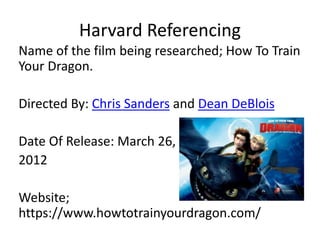
Harvard Referencing
Name of the film being researched; How To Train
Your Dragon.
Directed By: Chris Sanders and Dean DeBlois
Date Of Release: March 26,
2012
Website;
https://www.howtotrainyourdragon.com/

3. research (jrw) theory

  • 1.
  • 2.
    Terminology • Circulation – Howmany copies of a print have been made • Hits – How many times the websites been viewed • Box Office Figures – How much money a film has made in cinemas • Ratings – The products ratings • Sales -how many of the products have been sold
  • 3.
    Primary Research • Definition –When people ask other people questions for research. • Advantages – You can make your own questions for your research. • Disadvantages – It can take a long time to set up all the questions also trying to find the right people to ask can be hard. • Example – Interviewing the public
  • 4.
    Secondary Research • Definition –Studying previous undertaken existing research to use in your own work • Advantages – You don’t have to go out and do the research yourself its already there you just need to find it and use it in your own work • Disadvantages the research might be exactly what you was looking for and it might not be that easy to find • Example – Using the internet to find research thats already been done
  • 5.
    Quantitative Research • Definition –Research that is measured and put into percentages, fractions and numbers. The questions that are asked are usually answered with one word answers. • Advantages – It is pretty easy to put the research together and get the percentage • Disadvantages – You don’t find out much from the short answers • Example – Do you like this new energy drink? Yes? No?
  • 6.
    Qualitative Research • Definition •Research presented as a discussion finding out opinions/beliefs/reasonings • Advantages • You get more in depth answers and find out quite a lot • Disadvantages • Long answers are harder to work with • Example – Why do you like or don’t like this new energy drink?
  • 7.
    Audience Research • Definition •Any communication research done with people to gather information from them. • Advantages • You get direct feedback and find out what the audience want • Disadvantages • It can be very time consuming • Example – Asking the public about a product.
  • 8.
    Market Research • Definition •Collecting information to help you find out if there is a market for your proposed product or service. • Advantages • Its fast because you can do it all online • Disadvantages • Sometimes this can cost quite a lot • Example – Using the internet to find the best market to sell your product
  • 9.
    Production Research • Definition •It is always needed when making a new product, it is research to help find out information on the characteristics of the product. • Advantages • it will help a huge amount • Disadvantages • It can be very time consuming • Example – It can be used to establish why a particular genre of game is more popular than another
  • 10.
    Terminology • Objective Of aperson or their judgement, not influenced by personal feelings or opinions in considering and representing facts. • Subjective Based on or influenced by personal feelings, tastes or opinions • Valid Of argument or point. having a sound basis in logic or fact. Reasonable or cogent. “a valid criticism” • Reliable Being able to use the same or compatible results in different clinical experiments or statistical trials
  • 11.
    Harvard Referencing Name ofthe film being researched; How To Train Your Dragon. Directed By: Chris Sanders and Dean DeBlois Date Of Release: March 26, 2012 Website; https://www.howtotrainyourdragon.com/

Editor's Notes

  • #3 Provide definitions for each term
  • #11 Provide definitions
  • #12 1. Film, 2.Book, 3. Website, 4. Magazine Article