RESEARCH
Benjamin Lawrenson
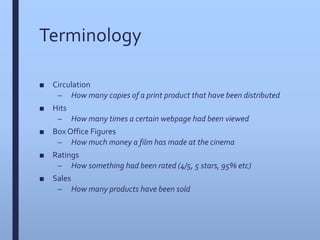
Terminology
■ Circulation
– How many copies of a print product that have been distributed
■ Hits
– How many times a certain webpage had been viewed
■ Box Office Figures
– How much money a film has made at the cinema
■ Ratings
– How something had been rated (4/5, 5 stars, 95% etc)
■ Sales
– How many products have been sold
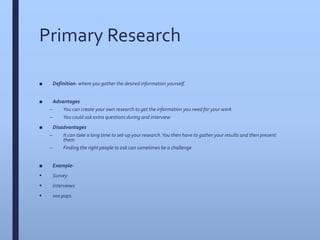
Primary Research
■ Definition- where you gather the desired information yourself.
■ Advantages
– You can create your own research to get the information you need for your work
– You could ask extra questions during and interview
■ Disadvantages
– It can take a long time to set-up your research.You then have to gather your results and then present
them
– Finding the right people to ask can sometimes be a challenge
■ Example-
 Survey
 Interviews
 vox pops.
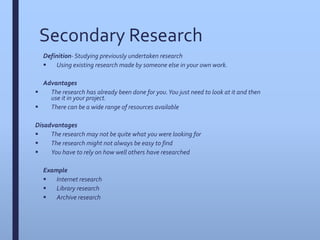
Secondary Research
Definition- Studying previously undertaken research
 Using existing research made by someone else in your own work.
Advantages
 The research has already been done for you.You just need to look at it and then
use it in your project.
 There can be a wide range of resources available
Disadvantages
 The research may not be quite what you were looking for
 The research might not always be easy to find
 You have to rely on how well others have researched
Example
 Internet research
 Library research
 Archive research
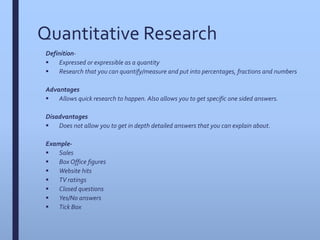
Quantitative Research
Definition-
 Expressed or expressible as a quantity
 Research that you can quantify/measure and put into percentages, fractions and numbers
Advantages
 Allows quick research to happen. Also allows you to get specific one sided answers.
Disadvantages
 Does not allow you to get in depth detailed answers that you can explain about.
Example-
 Sales
 Box Office figures
 Website hits
 TV ratings
 Closed questions
 Yes/No answers
 Tick Box
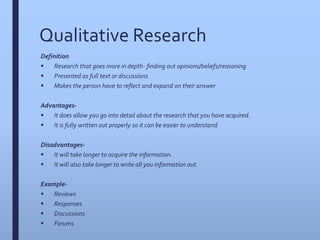
Qualitative Research
Definition
 Research that goes more in depth- finding out opinions/beliefs/reasoning
 Presented as full text or discussions
 Makes the person have to reflect and expand on their answer
Advantages-
 It does allow you go into detail about the research that you have acquired.
 It is fully written out properly so it can be easier to understand
Disadvantages-
 It will take longer to acquire the information.
 It will also take longer to write all you information out.
Example-
 Reviews
 Responses
 Discussions
 Forums
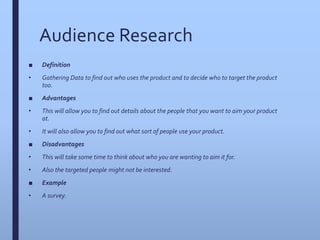
Audience Research
■ Definition
• Gathering Data to find out who uses the product and to decide who to target the product
too.
■ Advantages
• This will allow you to find out details about the people that you want to aim your product
at.
• It will also allow you to find out what sort of people use your product.
■ Disadvantages
• This will take some time to think about who you are wanting to aim it for.
• Also the targeted people might not be interested.
■ Example
• A survey.
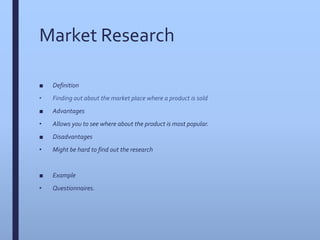
Market Research
■ Definition
• Finding out about the market place where a product is sold
■ Advantages
• Allows you to see where about the product is most popular.
■ Disadvantages
• Might be hard to find out the research
■ Example
• Questionnaires.
Production Research
■ Definition.
• Gathering information and details that allow you to come up with the piece of
media.
■ Advantages.
• Allows you to create media the media based on the information that you have
found.
■ Disadvantages.
• Could cause a bias factor to for and by only using this method you wont know who
its aimed at.
■ Example.
• Vox pops.
Terminology
Objective
• Research that isn’t inspired by personal emotions or bias
opinions.
■ Subjective
• Research that has been inspired by personal emotion or bias
opinion.
■ Valid
If the research proposed make correct statement/point.
■ Reliable
• Research that make accurate and ongoing results.
Harvard Referencing
Name of the film being researched: Harry Potter.
Film: :Yates, D. (2011) Harry Potter Deathly Hallows II
Book: Rowling, JK. (2007) Harry Potter Deathly Hallows
Website: O'Hara, H. (2010)
Article: Grossman, L (2007)

Theory research pro-forma

  • 1.
  • 2.
    Terminology ■ Circulation – Howmany copies of a print product that have been distributed ■ Hits – How many times a certain webpage had been viewed ■ Box Office Figures – How much money a film has made at the cinema ■ Ratings – How something had been rated (4/5, 5 stars, 95% etc) ■ Sales – How many products have been sold
  • 3.
    Primary Research ■ Definition-where you gather the desired information yourself. ■ Advantages – You can create your own research to get the information you need for your work – You could ask extra questions during and interview ■ Disadvantages – It can take a long time to set-up your research.You then have to gather your results and then present them – Finding the right people to ask can sometimes be a challenge ■ Example-  Survey  Interviews  vox pops.
  • 4.
    Secondary Research Definition- Studyingpreviously undertaken research  Using existing research made by someone else in your own work. Advantages  The research has already been done for you.You just need to look at it and then use it in your project.  There can be a wide range of resources available Disadvantages  The research may not be quite what you were looking for  The research might not always be easy to find  You have to rely on how well others have researched Example  Internet research  Library research  Archive research
  • 5.
    Quantitative Research Definition-  Expressedor expressible as a quantity  Research that you can quantify/measure and put into percentages, fractions and numbers Advantages  Allows quick research to happen. Also allows you to get specific one sided answers. Disadvantages  Does not allow you to get in depth detailed answers that you can explain about. Example-  Sales  Box Office figures  Website hits  TV ratings  Closed questions  Yes/No answers  Tick Box
  • 6.
    Qualitative Research Definition  Researchthat goes more in depth- finding out opinions/beliefs/reasoning  Presented as full text or discussions  Makes the person have to reflect and expand on their answer Advantages-  It does allow you go into detail about the research that you have acquired.  It is fully written out properly so it can be easier to understand Disadvantages-  It will take longer to acquire the information.  It will also take longer to write all you information out. Example-  Reviews  Responses  Discussions  Forums
  • 7.
    Audience Research ■ Definition •Gathering Data to find out who uses the product and to decide who to target the product too. ■ Advantages • This will allow you to find out details about the people that you want to aim your product at. • It will also allow you to find out what sort of people use your product. ■ Disadvantages • This will take some time to think about who you are wanting to aim it for. • Also the targeted people might not be interested. ■ Example • A survey.
  • 8.
    Market Research ■ Definition •Finding out about the market place where a product is sold ■ Advantages • Allows you to see where about the product is most popular. ■ Disadvantages • Might be hard to find out the research ■ Example • Questionnaires.
  • 9.
    Production Research ■ Definition. •Gathering information and details that allow you to come up with the piece of media. ■ Advantages. • Allows you to create media the media based on the information that you have found. ■ Disadvantages. • Could cause a bias factor to for and by only using this method you wont know who its aimed at. ■ Example. • Vox pops.
  • 10.
    Terminology Objective • Research thatisn’t inspired by personal emotions or bias opinions. ■ Subjective • Research that has been inspired by personal emotion or bias opinion. ■ Valid If the research proposed make correct statement/point. ■ Reliable • Research that make accurate and ongoing results.
  • 11.
    Harvard Referencing Name ofthe film being researched: Harry Potter. Film: :Yates, D. (2011) Harry Potter Deathly Hallows II Book: Rowling, JK. (2007) Harry Potter Deathly Hallows Website: O'Hara, H. (2010) Article: Grossman, L (2007)

Editor's Notes

  • #3 Provide definitions for each term
  • #11 Provide definitions
  • #12 1. Film, 2.Book, 3. Website, 4. Magazine Article