Research
James Pateman
Terminology
• Circulation- The public availability or knowledge of
something.
• Hits- The amount of downloads or views a media
product has.
• Box Office Figures- The amount of ticket sales for a
movie/ event.
• Ratings- The level of quality a product is rated.
• Sales- The amount of said product bought.
Primary Research
• Definition
– Primary research is research you conducted yourself that is new,
rather than using other resources such as Wikipedia and google.
• Advantages
– You did the research yourself so you now how accurate it is, you
also can ask specific questions to get the answers you
particularly need.
• Disadvantages
– Doing the research yourself can sometimes be costly which has
a negative impact on the person conducting it, It also can be
very time consuming.
• Example
- Surveys, questionnaires and close group interviews.
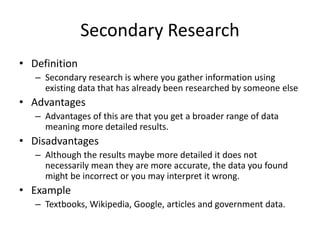
Secondary Research
• Definition
– Secondary research is where you gather information using
existing data that has already been researched by someone else
• Advantages
– Advantages of this are that you get a broader range of data
meaning more detailed results.
• Disadvantages
– Although the results maybe more detailed it does not
necessarily mean they are more accurate, the data you found
might be incorrect or you may interpret it wrong.
• Example
– Textbooks, Wikipedia, Google, articles and government data.
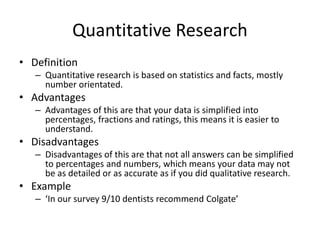
Quantitative Research
• Definition
– Quantitative research is based on statistics and facts, mostly
number orientated.
• Advantages
– Advantages of this are that your data is simplified into
percentages, fractions and ratings, this means it is easier to
understand.
• Disadvantages
– Disadvantages of this are that not all answers can be simplified
to percentages and numbers, which means your data may not
be as detailed or as accurate as if you did qualitative research.
• Example
– ‘In our survey 9/10 dentists recommend Colgate’
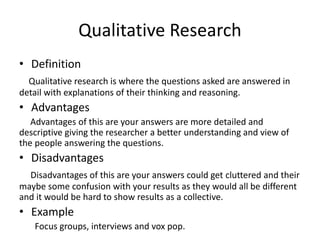
Qualitative Research
• Definition
Qualitative research is where the questions asked are answered in
detail with explanations of their thinking and reasoning.
• Advantages
Advantages of this are your answers are more detailed and
descriptive giving the researcher a better understanding and view of
the people answering the questions.
• Disadvantages
Disadvantages of this are your answers could get cluttered and their
maybe some confusion with your results as they would all be different
and it would be hard to show results as a collective.
• Example
Focus groups, interviews and vox pop.
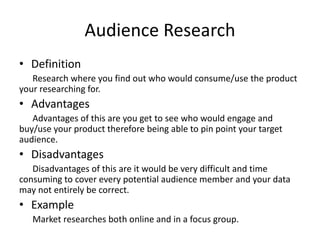
Audience Research
• Definition
Research where you find out who would consume/use the product
your researching for.
• Advantages
Advantages of this are you get to see who would engage and
buy/use your product therefore being able to pin point your target
audience.
• Disadvantages
Disadvantages of this are it would be very difficult and time
consuming to cover every potential audience member and your data
may not entirely be correct.
• Example
Market researches both online and in a focus group.
Market Research
• Definition
Market research is where you gather information about customers needs
and appeals.
• Advantages
Advantages of this are that you can find a gap in the market for your
product and can make any changes to it regarding customer satisfaction
• Disadvantages
Disadvantages of this are that market research is time consuming and
costly, the longer the research takes the more costly it is.
• Example
Focus groups where a company ask specific questions about a product.
Production Research
• Definition
Production research is where a company researches how they will create
their product i.e. what materials to use, how much they cost, how to put
them together etc.
• Advantages
Advantages of this are that the company knows the most efficient way of
how to produce the product in a cost effective way.
• Disadvantages
Disadvantages of this are production research can be very time consuming
and depending on how the company does it could be a waste of resources
and money, since you would be researching a particular method you may miss
out on a better more efficient way.
• Example
– You can conduct production research through market research,
in order to determine whether a products income would out
way its outcome.
Terminology
• Objective
– Where you have no personal attachment or influence to a
certain product therefore giving it a non biased view.
• Subjective
– Where you have a particular opinion/feeling about a
product such as personal attachment.
• Valid
– Whether or not a piece of information is relevant to the
research
• Reliable
- Whether or not a piece of information is trustworthy or factual.
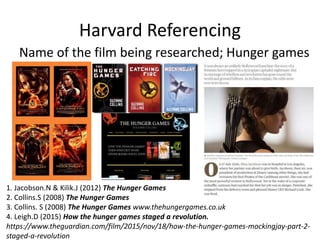
Harvard Referencing
Name of the film being researched; Hunger games
1. Jacobson.N & Kilik.J (2012) The Hunger Games
2. Collins.S (2008) The Hunger Games
3. Collins. S (2008) The Hunger Games www.thehungergames.co.uk
4. Leigh.D (2015) How the hunger games staged a revolution.
https://www.theguardian.com/film/2015/nov/18/how-the-hunger-games-mockingjay-part-2-
staged-a-revolution

Theory research pro- 1

  • 1.
  • 2.
    Terminology • Circulation- Thepublic availability or knowledge of something. • Hits- The amount of downloads or views a media product has. • Box Office Figures- The amount of ticket sales for a movie/ event. • Ratings- The level of quality a product is rated. • Sales- The amount of said product bought.
  • 3.
    Primary Research • Definition –Primary research is research you conducted yourself that is new, rather than using other resources such as Wikipedia and google. • Advantages – You did the research yourself so you now how accurate it is, you also can ask specific questions to get the answers you particularly need. • Disadvantages – Doing the research yourself can sometimes be costly which has a negative impact on the person conducting it, It also can be very time consuming. • Example - Surveys, questionnaires and close group interviews.
  • 4.
    Secondary Research • Definition –Secondary research is where you gather information using existing data that has already been researched by someone else • Advantages – Advantages of this are that you get a broader range of data meaning more detailed results. • Disadvantages – Although the results maybe more detailed it does not necessarily mean they are more accurate, the data you found might be incorrect or you may interpret it wrong. • Example – Textbooks, Wikipedia, Google, articles and government data.
  • 5.
    Quantitative Research • Definition –Quantitative research is based on statistics and facts, mostly number orientated. • Advantages – Advantages of this are that your data is simplified into percentages, fractions and ratings, this means it is easier to understand. • Disadvantages – Disadvantages of this are that not all answers can be simplified to percentages and numbers, which means your data may not be as detailed or as accurate as if you did qualitative research. • Example – ‘In our survey 9/10 dentists recommend Colgate’
  • 6.
    Qualitative Research • Definition Qualitativeresearch is where the questions asked are answered in detail with explanations of their thinking and reasoning. • Advantages Advantages of this are your answers are more detailed and descriptive giving the researcher a better understanding and view of the people answering the questions. • Disadvantages Disadvantages of this are your answers could get cluttered and their maybe some confusion with your results as they would all be different and it would be hard to show results as a collective. • Example Focus groups, interviews and vox pop.
  • 7.
    Audience Research • Definition Researchwhere you find out who would consume/use the product your researching for. • Advantages Advantages of this are you get to see who would engage and buy/use your product therefore being able to pin point your target audience. • Disadvantages Disadvantages of this are it would be very difficult and time consuming to cover every potential audience member and your data may not entirely be correct. • Example Market researches both online and in a focus group.
  • 8.
    Market Research • Definition Marketresearch is where you gather information about customers needs and appeals. • Advantages Advantages of this are that you can find a gap in the market for your product and can make any changes to it regarding customer satisfaction • Disadvantages Disadvantages of this are that market research is time consuming and costly, the longer the research takes the more costly it is. • Example Focus groups where a company ask specific questions about a product.
  • 9.
    Production Research • Definition Productionresearch is where a company researches how they will create their product i.e. what materials to use, how much they cost, how to put them together etc. • Advantages Advantages of this are that the company knows the most efficient way of how to produce the product in a cost effective way. • Disadvantages Disadvantages of this are production research can be very time consuming and depending on how the company does it could be a waste of resources and money, since you would be researching a particular method you may miss out on a better more efficient way. • Example – You can conduct production research through market research, in order to determine whether a products income would out way its outcome.
  • 10.
    Terminology • Objective – Whereyou have no personal attachment or influence to a certain product therefore giving it a non biased view. • Subjective – Where you have a particular opinion/feeling about a product such as personal attachment. • Valid – Whether or not a piece of information is relevant to the research • Reliable - Whether or not a piece of information is trustworthy or factual.
  • 11.
    Harvard Referencing Name ofthe film being researched; Hunger games 1. Jacobson.N & Kilik.J (2012) The Hunger Games 2. Collins.S (2008) The Hunger Games 3. Collins. S (2008) The Hunger Games www.thehungergames.co.uk 4. Leigh.D (2015) How the hunger games staged a revolution. https://www.theguardian.com/film/2015/nov/18/how-the-hunger-games-mockingjay-part-2- staged-a-revolution

Editor's Notes

  • #3 Provide definitions for each term
  • #11 Provide definitions
  • #12 1. Film, 2.Book, 3. Website, 4. Magazine Article