Research
James Gannon
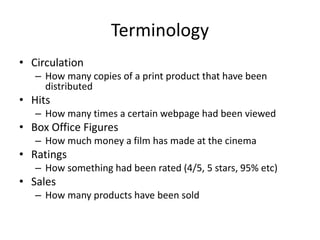
Terminology
• Circulation
– How many copies of a print product that have been
distributed
• Hits
– How many times a certain webpage had been viewed
• Box Office Figures
– How much money a film has made at the cinema
• Ratings
– How something had been rated (4/5, 5 stars, 95% etc)
• Sales
– How many products have been sold
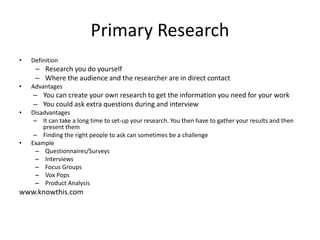
Primary Research
• Definition
– Research you do yourself
– Where the audience and the researcher are in direct contact
• Advantages
– You can create your own research to get the information you need for your work
– You could ask extra questions during and interview
• Disadvantages
– It can take a long time to set-up your research. You then have to gather your results and then
present them
– Finding the right people to ask can sometimes be a challenge
• Example
– Questionnaires/Surveys
– Interviews
– Focus Groups
– Vox Pops
– Product Analysis
www.knowthis.com
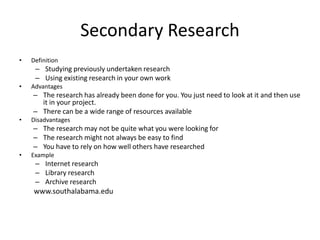
Secondary Research
• Definition
– Studying previously undertaken research
– Using existing research in your own work
• Advantages
– The research has already been done for you. You just need to look at it and then use
it in your project.
– There can be a wide range of resources available
• Disadvantages
– The research may not be quite what you were looking for
– The research might not always be easy to find
– You have to rely on how well others have researched
• Example
– Internet research
– Library research
– Archive research
www.southalabama.edu
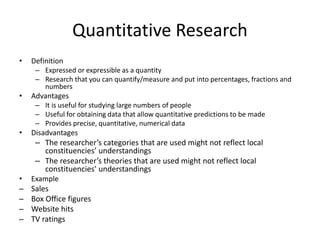
Quantitative Research
• Definition
– Expressed or expressible as a quantity
– Research that you can quantify/measure and put into percentages, fractions and
numbers
• Advantages
– It is useful for studying large numbers of people
– Useful for obtaining data that allow quantitative predictions to be made
– Provides precise, quantitative, numerical data
• Disadvantages
– The researcher’s categories that are used might not reflect local
constituencies’ understandings
– The researcher’s theories that are used might not reflect local
constituencies’ understandings
• Example
─ Sales
─ Box Office figures
─ Website hits
─ TV ratings
Qualitative Research
• Definition
– Research that goes more in depth- finding out opinions/beliefs/reasoning
– Presented as full text or discussions
– Makes the person have to reflect and expand on their answer
• Advantages
─ Issues and subjects covered can be evaluated in depth and in detail.
─ Interviews are not limited to particular questions and can be redirected or guided by
researchers in real time.
• Disadvantages
─ The quality of research is heavily dependent on the skills of the researcher and can be
easily influenced by personal idiosyncrasies and biases of researchers.
• Example
─ Reviews
─ Responses
─ Discussions
─ Forums
Audience Research
• Definition
– Finding out about who consumes a product
• Advantages
– it will assure that your campaign will respond directly to your
target audience.
– Finding out the likes and dislikes effectively.
• Disadvantages
– It may be time consuming.
• Example
– Surveys
– interviews
Market Research
• Definition
– Finding out about the market place where a product is
sold
• Advantages
– It facilitates planned production.
– Helpful in improving relations with dealers.
• Disadvantages
– A disadvantage of doing market research is the time
associated with doing the research and performing
questionnaires and interviews.
• Example
– Sales
Production Research
• Definition
– Finding information and resources required to produce a
piece of media.
• Advantages
– It could give ideas about what to include in the product.
– a wide audience will see the advertisements and it will increase
public knowledge and likeness of the product.
• Disadvantages
– it is easy to over advertise, causing people to get bored of them.
• Example
– Surveys
Terminology
• Objective
– Research that is not influenced by personal feelings or
opinions
• Subjective
– Research that has been influenced by personal feelings or
opinions
• Valid
– Whether the research proposed is able to answer the
intended outcome/question
• Reliable
– Research that produces accurate and consistent results
Harvard Referencing
Name of the film being researched;
1. Film – David Ayer, Suicide squad
2. Book – Suicide Squad Vol. 2: Basilisk Rising
3. Website – www.dccomics.com/comics/suicide-
squad-2016/suicide-squad-1
4. Magazine article –
http://www.theverge.com/2016/8/9/12405466/sui
cide-squad-movie-discussion-amanda-waller-
deadshot-harley-quinn-dc

Theory research pro-forma(1)

  • 1.
  • 2.
    Terminology • Circulation – Howmany copies of a print product that have been distributed • Hits – How many times a certain webpage had been viewed • Box Office Figures – How much money a film has made at the cinema • Ratings – How something had been rated (4/5, 5 stars, 95% etc) • Sales – How many products have been sold
  • 3.
    Primary Research • Definition –Research you do yourself – Where the audience and the researcher are in direct contact • Advantages – You can create your own research to get the information you need for your work – You could ask extra questions during and interview • Disadvantages – It can take a long time to set-up your research. You then have to gather your results and then present them – Finding the right people to ask can sometimes be a challenge • Example – Questionnaires/Surveys – Interviews – Focus Groups – Vox Pops – Product Analysis www.knowthis.com
  • 4.
    Secondary Research • Definition –Studying previously undertaken research – Using existing research in your own work • Advantages – The research has already been done for you. You just need to look at it and then use it in your project. – There can be a wide range of resources available • Disadvantages – The research may not be quite what you were looking for – The research might not always be easy to find – You have to rely on how well others have researched • Example – Internet research – Library research – Archive research www.southalabama.edu
  • 5.
    Quantitative Research • Definition –Expressed or expressible as a quantity – Research that you can quantify/measure and put into percentages, fractions and numbers • Advantages – It is useful for studying large numbers of people – Useful for obtaining data that allow quantitative predictions to be made – Provides precise, quantitative, numerical data • Disadvantages – The researcher’s categories that are used might not reflect local constituencies’ understandings – The researcher’s theories that are used might not reflect local constituencies’ understandings • Example ─ Sales ─ Box Office figures ─ Website hits ─ TV ratings
  • 6.
    Qualitative Research • Definition –Research that goes more in depth- finding out opinions/beliefs/reasoning – Presented as full text or discussions – Makes the person have to reflect and expand on their answer • Advantages ─ Issues and subjects covered can be evaluated in depth and in detail. ─ Interviews are not limited to particular questions and can be redirected or guided by researchers in real time. • Disadvantages ─ The quality of research is heavily dependent on the skills of the researcher and can be easily influenced by personal idiosyncrasies and biases of researchers. • Example ─ Reviews ─ Responses ─ Discussions ─ Forums
  • 7.
    Audience Research • Definition –Finding out about who consumes a product • Advantages – it will assure that your campaign will respond directly to your target audience. – Finding out the likes and dislikes effectively. • Disadvantages – It may be time consuming. • Example – Surveys – interviews
  • 8.
    Market Research • Definition –Finding out about the market place where a product is sold • Advantages – It facilitates planned production. – Helpful in improving relations with dealers. • Disadvantages – A disadvantage of doing market research is the time associated with doing the research and performing questionnaires and interviews. • Example – Sales
  • 9.
    Production Research • Definition –Finding information and resources required to produce a piece of media. • Advantages – It could give ideas about what to include in the product. – a wide audience will see the advertisements and it will increase public knowledge and likeness of the product. • Disadvantages – it is easy to over advertise, causing people to get bored of them. • Example – Surveys
  • 10.
    Terminology • Objective – Researchthat is not influenced by personal feelings or opinions • Subjective – Research that has been influenced by personal feelings or opinions • Valid – Whether the research proposed is able to answer the intended outcome/question • Reliable – Research that produces accurate and consistent results
  • 11.
    Harvard Referencing Name ofthe film being researched; 1. Film – David Ayer, Suicide squad 2. Book – Suicide Squad Vol. 2: Basilisk Rising 3. Website – www.dccomics.com/comics/suicide- squad-2016/suicide-squad-1 4. Magazine article – http://www.theverge.com/2016/8/9/12405466/sui cide-squad-movie-discussion-amanda-waller- deadshot-harley-quinn-dc

Editor's Notes

  • #3 Provide definitions for each term
  • #11 Provide definitions
  • #12 1. Film, 2.Book, 3. Website, 4. Magazine Article