Research
Theory
Your Name
Terminology
• Circulation
– The amount of copies by which a product has been released and sold.
• Hits
– The amount of people who have watched a video and or listened to a
song.
• Box Office Figures
– How much money a film made whilst it was released in cinemas.
• Ratings
– How a product was rated overall by critics, or just people who bought
the product, usually out of a certain amount (5 or 10) or using stars.
• Sales
– The amount of how much a product sold, such as how a
microwave could have been sold to 7,000+ people.
Primary Research
• Definition
– Finding the research for yourself, being able to have help by finding
facts from others by either surveying, interviewing and or just
discussing with them.
• Advantages
– Good way to discuss the facts and ideas with others.
– Participation off of others and even an audience.
• Disadvantages
– Untrustworthy information off of other people.
– Not being able to fact check properly.
• Example
– Surveying a group of people to get results, example would be asking a
group of people what pets they own, which can be good results to see
who has what pet.
Secondary Research
• Definition
– Using existing sources and websites to help gather information to use for
your own work.
• Advantages
– Good way to gather up information for your work.
– Being able to find good sites that can sum up information in an easy to
understand way.
– The source finding has been done, you just need to read and write it into
your own words.
• Disadvantages
– Misinformation.
– Some sources can be quite biased, or tries to hide the truth of the actual
source’s facts.
– Some sites, like Wikipedia, can be freely edited and changed by anyone, so
easy way for misinformation to get out there.
• Example
– Using existing fact websites that contain the sources and helpful
information for the research you are doing.
Quantitative Research
• Definition
– Research that can be quantified, usually put into fractions,
numbers and even percentages.
• Advantages
– Broader studies can be made.
– More accurate information.
– Few variables involved.
• Disadvantages
– Can be misleading.
– Can be difficult setting up a research model.
• Example
– A close question, simple question with a yes or no answer.
Example, “do you like the colour red?” “Yes.”
Qualitative Research
• Definition
– More in-depth information, usually as more explanatory paragraphs and full text. It
usually involves full opinions, facts and figures, as well as other information.
• Advantages
– Good way to get as much information out there.
– You can express your opinion on whatever you are talking about as well as using
your own information and knowledge on it.
• Disadvantages
– Misinformation.
– Sometimes the person who wrote the information can be quite biased.
– Untrustworthy sources.
• Example
– Open question, similar to close questions with how you ask a general question, be
it someone’s opinion on something, however the answers need to be more
detailed, going into more depth, using their own facts and knowledge.
Audience Research
• Definition
– Researching and finding out who the target audience would be, as well
as figure out ways to appeal a product to them by advertising.
• Advantages
– Good way to gather information on the types of people to advertise
your product to.
– Understanding your target audience.
– So you do not make some copy, you can understand needs or desires
people want for a product.
• Disadvantages
– It is not as easy to analyse, or measure.
– Less control over a group unlike when you do a interview.
• Example
– Interviewing various people, to see what would appeal to most
people.
Market Research
• Definition
– Researching the target market in which you want to advertise your
product to.
• Advantages
– Helps establish your market positioning.
– Helps you benchmark and monitor your progress.
– Good for making decisions as well as for when you want to make action.
• Disadvantages
– Pretty pricey.
– Cannot give accurate results all the time.
– Consumer behaviour cannot be predicted.
– Limited practical value.
– Can be pretty lengthy and time consuming.
• Example
– Looking at a recent topic, and making notes of the data taken from that
specific topic to be able to use it as an idea for your marketing.
Production Research
• Definition
– Researching to mostly gather information on production related
issues, as well as ideas.
• Advantages
– Scans multiple marketplaces.
– Also scans multiple trends currently going on.
– Can help in saving money.
• Disadvantages
– Pricey.
– Time constraint.
– False and inconsistent or inaccurate results can be made.
– Changing markets constantly.
• Example
– Questionaries to ask and find multiple information to get ideas for
advertising and selling the product.
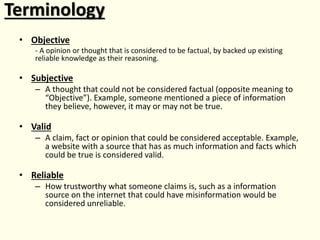
Terminology
• Objective
- A opinion or thought that is considered to be factual, by backed up existing
reliable knowledge as their reasoning.
• Subjective
– A thought that could not be considered factual (opposite meaning to
“Objective”). Example, someone mentioned a piece of information
they believe, however, it may or may not be true.
• Valid
– A claim, fact or opinion that could be considered acceptable. Example,
a website with a source that has as much information and facts which
could be true is considered valid.
• Reliable
– How trustworthy what someone claims is, such as a information
source on the internet that could have misinformation would be
considered unreliable.
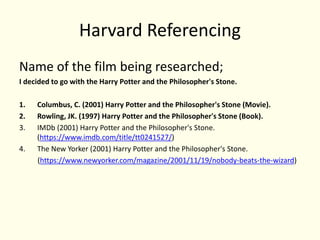
Harvard Referencing
Name of the film being researched;
I decided to go with the Harry Potter and the Philosopher's Stone.
1. Columbus, C. (2001) Harry Potter and the Philosopher's Stone (Movie).
2. Rowling, JK. (1997) Harry Potter and the Philosopher's Stone (Book).
3. IMDb (2001) Harry Potter and the Philosopher's Stone.
(https://www.imdb.com/title/tt0241527/)
4. The New Yorker (2001) Harry Potter and the Philosopher's Stone.
(https://www.newyorker.com/magazine/2001/11/19/nobody-beats-the-wizard)

Research theory pro forma

  • 1.
  • 2.
    Terminology • Circulation – Theamount of copies by which a product has been released and sold. • Hits – The amount of people who have watched a video and or listened to a song. • Box Office Figures – How much money a film made whilst it was released in cinemas. • Ratings – How a product was rated overall by critics, or just people who bought the product, usually out of a certain amount (5 or 10) or using stars. • Sales – The amount of how much a product sold, such as how a microwave could have been sold to 7,000+ people.
  • 3.
    Primary Research • Definition –Finding the research for yourself, being able to have help by finding facts from others by either surveying, interviewing and or just discussing with them. • Advantages – Good way to discuss the facts and ideas with others. – Participation off of others and even an audience. • Disadvantages – Untrustworthy information off of other people. – Not being able to fact check properly. • Example – Surveying a group of people to get results, example would be asking a group of people what pets they own, which can be good results to see who has what pet.
  • 4.
    Secondary Research • Definition –Using existing sources and websites to help gather information to use for your own work. • Advantages – Good way to gather up information for your work. – Being able to find good sites that can sum up information in an easy to understand way. – The source finding has been done, you just need to read and write it into your own words. • Disadvantages – Misinformation. – Some sources can be quite biased, or tries to hide the truth of the actual source’s facts. – Some sites, like Wikipedia, can be freely edited and changed by anyone, so easy way for misinformation to get out there. • Example – Using existing fact websites that contain the sources and helpful information for the research you are doing.
  • 5.
    Quantitative Research • Definition –Research that can be quantified, usually put into fractions, numbers and even percentages. • Advantages – Broader studies can be made. – More accurate information. – Few variables involved. • Disadvantages – Can be misleading. – Can be difficult setting up a research model. • Example – A close question, simple question with a yes or no answer. Example, “do you like the colour red?” “Yes.”
  • 6.
    Qualitative Research • Definition –More in-depth information, usually as more explanatory paragraphs and full text. It usually involves full opinions, facts and figures, as well as other information. • Advantages – Good way to get as much information out there. – You can express your opinion on whatever you are talking about as well as using your own information and knowledge on it. • Disadvantages – Misinformation. – Sometimes the person who wrote the information can be quite biased. – Untrustworthy sources. • Example – Open question, similar to close questions with how you ask a general question, be it someone’s opinion on something, however the answers need to be more detailed, going into more depth, using their own facts and knowledge.
  • 7.
    Audience Research • Definition –Researching and finding out who the target audience would be, as well as figure out ways to appeal a product to them by advertising. • Advantages – Good way to gather information on the types of people to advertise your product to. – Understanding your target audience. – So you do not make some copy, you can understand needs or desires people want for a product. • Disadvantages – It is not as easy to analyse, or measure. – Less control over a group unlike when you do a interview. • Example – Interviewing various people, to see what would appeal to most people.
  • 8.
    Market Research • Definition –Researching the target market in which you want to advertise your product to. • Advantages – Helps establish your market positioning. – Helps you benchmark and monitor your progress. – Good for making decisions as well as for when you want to make action. • Disadvantages – Pretty pricey. – Cannot give accurate results all the time. – Consumer behaviour cannot be predicted. – Limited practical value. – Can be pretty lengthy and time consuming. • Example – Looking at a recent topic, and making notes of the data taken from that specific topic to be able to use it as an idea for your marketing.
  • 9.
    Production Research • Definition –Researching to mostly gather information on production related issues, as well as ideas. • Advantages – Scans multiple marketplaces. – Also scans multiple trends currently going on. – Can help in saving money. • Disadvantages – Pricey. – Time constraint. – False and inconsistent or inaccurate results can be made. – Changing markets constantly. • Example – Questionaries to ask and find multiple information to get ideas for advertising and selling the product.
  • 10.
    Terminology • Objective - Aopinion or thought that is considered to be factual, by backed up existing reliable knowledge as their reasoning. • Subjective – A thought that could not be considered factual (opposite meaning to “Objective”). Example, someone mentioned a piece of information they believe, however, it may or may not be true. • Valid – A claim, fact or opinion that could be considered acceptable. Example, a website with a source that has as much information and facts which could be true is considered valid. • Reliable – How trustworthy what someone claims is, such as a information source on the internet that could have misinformation would be considered unreliable.
  • 11.
    Harvard Referencing Name ofthe film being researched; I decided to go with the Harry Potter and the Philosopher's Stone. 1. Columbus, C. (2001) Harry Potter and the Philosopher's Stone (Movie). 2. Rowling, JK. (1997) Harry Potter and the Philosopher's Stone (Book). 3. IMDb (2001) Harry Potter and the Philosopher's Stone. (https://www.imdb.com/title/tt0241527/) 4. The New Yorker (2001) Harry Potter and the Philosopher's Stone. (https://www.newyorker.com/magazine/2001/11/19/nobody-beats-the-wizard)

Editor's Notes

  • #3 Provide definitions for each term
  • #11 Provide definitions
  • #12 1. Film, 2.Book, 3. Website, 4. Magazine Article