Bacterial Cell Structures &  Functions
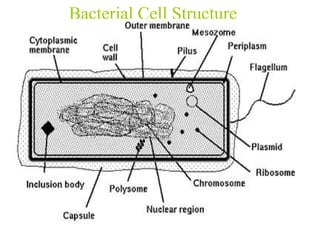
Bacterial Cell Structure
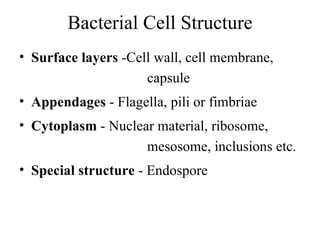
Bacterial Cell Structure Surface layers  -Cell wall, cell membrane,  capsule Appendages  - Flagella, pili or fimbriae Cytoplasm  - Nuclear material, ribosome,  mesosome, inclusions etc. Special structure  - Endospore
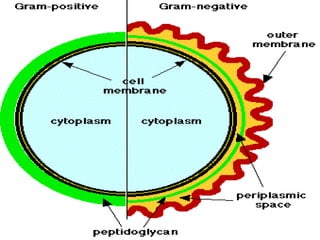
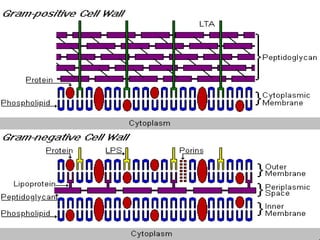
Cell envelope Various layers-Collectively cell envelope Gram positive- plasma memebrane, cell wall  sometimes capsule Gram negative- plasma memebrane, cell wall ,    outer membrane sometimes  capsule Plasma membrane in gram negative bacteria is sometimes called inner membrane Space between inner membrane and outer membrane is called Periplasmic space.
 
Bacterial Cell Wall: 10-25nm in thickness, Neg 10-15nm, Pos 20-25nm Functions Accounts shape of the cells Provides protection of the cells against Osmotic damage Confers rigidity Takes part in cell division Target site for antibiotic Carries bacterial antigens- virulence & immunity
General structure :   Chemically made up of Peptidoglycan.  It is made by two hexose sugars    N- acetylglucosamine [NAG] and   N-  acetylmuramic acid [NAM]  in alternating chains interconnected by tri, tetra or penta pedtide chains.
Gram positive cell walls : a. Peptidoglycan-Thicker in gram positive b.Polysachharides –Teichoic acids- polymer of glycerol and ribitol phosphates Some gram positive bacteria eg Mycobacteria contain lipid-  Mycolic acids
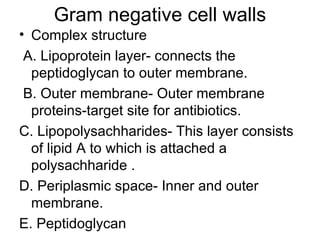
Gram negative cell walls Complex structure A. Lipoprotein layer- connects the peptidoglycan to outer membrane. B. Outer membrane- Outer membrane proteins-target site for antibiotics.  C. Lipopolysachharides- This layer consists of lipid A to which is attached a polysachharide .  D. Periplasmic space- Inner and outer membrane.  E. Peptidoglycan
 
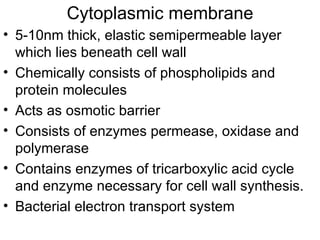
Cytoplasmic membrane 5-10nm thick, elastic semipermeable layer which lies beneath cell wall Chemically consists of phospholipids and protein molecules Acts as osmotic barrier Consists of enzymes permease, oxidase and polymerase  Contains enzymes of tricarboxylic acid cycle and enzyme necessary for cell wall synthesis. Bacterial electron transport system
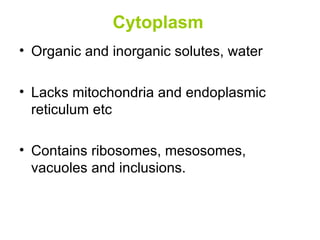
Cytoplasm   Organic and inorganic solutes, water Lacks mitochondria and endoplasmic reticulum etc Contains ribosomes, mesosomes, vacuoles and inclusions.
Ribosomes Centre of protein synthesis Composed of ribosomal RNA and robosomal proteins Two subunits 50s and 30s - 70s  Mesosomes Centre for respiratory enzymes Septal and lateral Septal attached to bacterial chromosome involved in DNA segregation and formation of cross wall during binary fission.
Inclusions Sources of stored energy. May be present as polymetaphosphate,lipids and polysachharides and granules of sulphur. Nucleus No nuclear membrane and nucleolus. Dna doesn’t contain any basic proteins. Genomic DNA is double stranded in the form of circle.
Plasmids Small circular covalently closed double stranded DNA molecules found in cytoplasm. Not essential for life , confer on certain properties like drug resistance and toxigenecity. Can be transmitted from one bacteria to another by conjugation or by bacteriophage.
CAPSULE AND SLIME LAYER Amorphous viscid bacterial secretion surrounding the bacteria Loose undemarcated secretion-slime layer Sharply defined structure – capsule Very thin- microcapsules Protects bacteria against phagocytes,adherence promote virulence, reservoir of food,  Demonstrated by negative staining and capsule swelling reaction [ Quellung reaction].
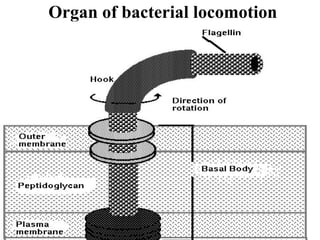
Flagella Cytoplasmic appendages protruding through cell wall. Thread or hair like structure- protein flagellin Organ of locomotion All motile bacteria except spirochaetes  Parts: Basal body: Embedded in cell envelope & consists of small,central rod surrounded by a series of rings Hook :Connects basal body with the filaments Filament or shaft: External to cell surface Composed of protein molecule flagellin
Organ of bacterial locomotion
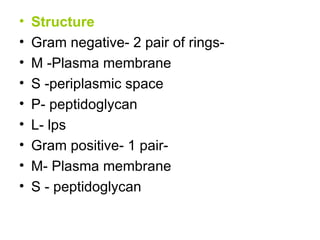
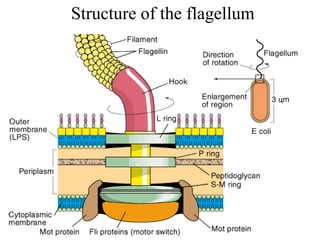
Structure  Gram negative- 2 pair of rings-  M -Plasma membrane S -periplasmic space P- peptidoglycan  L- lps Gram positive- 1 pair-  M- Plasma membrane S - peptidoglycan
Structure of the flagellum
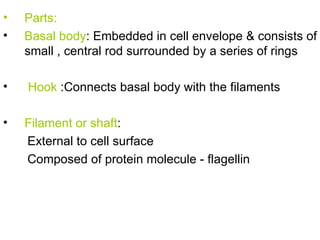
Parts: Basal body : Embedded in cell envelope & consists of small , central rod surrounded by a series of rings Hook  :Connects basal body with the filaments Filament or shaft : External to cell surface Composed of protein molecule - flagellin
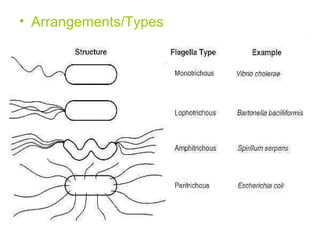
Arrangements/Types
Demonstration: Electron microscopy Silver impregnation methods Dark field microscopy Special stains eg Leifsons stain
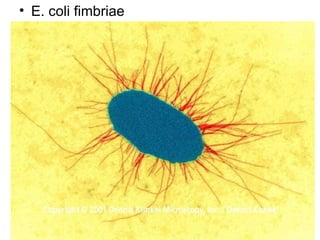
Fimbriae Hair like appendages projecting from cell surface as straight filaments. Also called pili 0.1-1um length and 10nm thick Gram negative bacteria Protein pilin Best seen in liquid cultures Antigenic
E. coli fimbriae
Types Common pili-  Adhesion to host cells Sex pili or F fertility pili-   Found on male or donor or + strains help  in attachment to female or recipient or – strains through conjugation tubes and aid in gene transfer.  Functions Adhesion, Transfer of genetic materials Demonstration Electron microscopy, Haemagglutination
Bacterial spores Highly resistant resting stages formed in unfavourable condition Formed inside the cells so called endospores Each form one spore, which on germination form a single vegetative cell Non metabolising and non reproducing Highly resistant to heat, UV radiation, mechanical disruption, chemical disinfectants etc
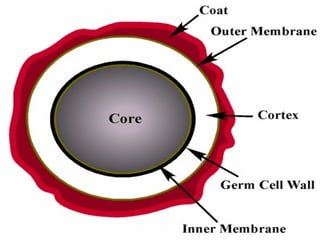
Structure The  core  of the fully developed spore has homogenous protoplasm, containing chromosome, enzymes of glycolysis and protein synthesis. Core is surrounded by  spore walls or inner membrane. Outside this spore wall is thick layer the cortex enclosed by  outer membrane . Spore coat  surrounds this spore wall. Some bacteria has additional loose outer covering  Exosporium.
 
Demonstration Gram stain- unstained. AFB stain- 0.25-0.5% H2So4- Red colour. Use Spores of bacillus stearothermophilus are employed as indicator of proper sterilisation.

Morphologyy

  • 1.
  • 2.
  • 3.
    Bacterial Cell StructureSurface layers -Cell wall, cell membrane, capsule Appendages - Flagella, pili or fimbriae Cytoplasm - Nuclear material, ribosome, mesosome, inclusions etc. Special structure - Endospore
  • 4.
    Cell envelope Variouslayers-Collectively cell envelope Gram positive- plasma memebrane, cell wall sometimes capsule Gram negative- plasma memebrane, cell wall , outer membrane sometimes capsule Plasma membrane in gram negative bacteria is sometimes called inner membrane Space between inner membrane and outer membrane is called Periplasmic space.
  • 5.
  • 6.
    Bacterial Cell Wall:10-25nm in thickness, Neg 10-15nm, Pos 20-25nm Functions Accounts shape of the cells Provides protection of the cells against Osmotic damage Confers rigidity Takes part in cell division Target site for antibiotic Carries bacterial antigens- virulence & immunity
  • 7.
    General structure : Chemically made up of Peptidoglycan. It is made by two hexose sugars N- acetylglucosamine [NAG] and N- acetylmuramic acid [NAM] in alternating chains interconnected by tri, tetra or penta pedtide chains.
  • 8.
    Gram positive cellwalls : a. Peptidoglycan-Thicker in gram positive b.Polysachharides –Teichoic acids- polymer of glycerol and ribitol phosphates Some gram positive bacteria eg Mycobacteria contain lipid- Mycolic acids
  • 9.
    Gram negative cellwalls Complex structure A. Lipoprotein layer- connects the peptidoglycan to outer membrane. B. Outer membrane- Outer membrane proteins-target site for antibiotics. C. Lipopolysachharides- This layer consists of lipid A to which is attached a polysachharide . D. Periplasmic space- Inner and outer membrane. E. Peptidoglycan
  • 10.
  • 11.
    Cytoplasmic membrane 5-10nmthick, elastic semipermeable layer which lies beneath cell wall Chemically consists of phospholipids and protein molecules Acts as osmotic barrier Consists of enzymes permease, oxidase and polymerase Contains enzymes of tricarboxylic acid cycle and enzyme necessary for cell wall synthesis. Bacterial electron transport system
  • 12.
    Cytoplasm Organic and inorganic solutes, water Lacks mitochondria and endoplasmic reticulum etc Contains ribosomes, mesosomes, vacuoles and inclusions.
  • 13.
    Ribosomes Centre ofprotein synthesis Composed of ribosomal RNA and robosomal proteins Two subunits 50s and 30s - 70s Mesosomes Centre for respiratory enzymes Septal and lateral Septal attached to bacterial chromosome involved in DNA segregation and formation of cross wall during binary fission.
  • 14.
    Inclusions Sources ofstored energy. May be present as polymetaphosphate,lipids and polysachharides and granules of sulphur. Nucleus No nuclear membrane and nucleolus. Dna doesn’t contain any basic proteins. Genomic DNA is double stranded in the form of circle.
  • 15.
    Plasmids Small circularcovalently closed double stranded DNA molecules found in cytoplasm. Not essential for life , confer on certain properties like drug resistance and toxigenecity. Can be transmitted from one bacteria to another by conjugation or by bacteriophage.
  • 16.
    CAPSULE AND SLIMELAYER Amorphous viscid bacterial secretion surrounding the bacteria Loose undemarcated secretion-slime layer Sharply defined structure – capsule Very thin- microcapsules Protects bacteria against phagocytes,adherence promote virulence, reservoir of food, Demonstrated by negative staining and capsule swelling reaction [ Quellung reaction].
  • 17.
    Flagella Cytoplasmic appendagesprotruding through cell wall. Thread or hair like structure- protein flagellin Organ of locomotion All motile bacteria except spirochaetes Parts: Basal body: Embedded in cell envelope & consists of small,central rod surrounded by a series of rings Hook :Connects basal body with the filaments Filament or shaft: External to cell surface Composed of protein molecule flagellin
  • 18.
  • 19.
    Structure Gramnegative- 2 pair of rings- M -Plasma membrane S -periplasmic space P- peptidoglycan L- lps Gram positive- 1 pair- M- Plasma membrane S - peptidoglycan
  • 20.
  • 21.
    Parts: Basal body: Embedded in cell envelope & consists of small , central rod surrounded by a series of rings Hook :Connects basal body with the filaments Filament or shaft : External to cell surface Composed of protein molecule - flagellin
  • 22.
  • 23.
    Demonstration: Electron microscopySilver impregnation methods Dark field microscopy Special stains eg Leifsons stain
  • 24.
    Fimbriae Hair likeappendages projecting from cell surface as straight filaments. Also called pili 0.1-1um length and 10nm thick Gram negative bacteria Protein pilin Best seen in liquid cultures Antigenic
  • 25.
  • 26.
    Types Common pili- Adhesion to host cells Sex pili or F fertility pili- Found on male or donor or + strains help in attachment to female or recipient or – strains through conjugation tubes and aid in gene transfer. Functions Adhesion, Transfer of genetic materials Demonstration Electron microscopy, Haemagglutination
  • 27.
    Bacterial spores Highlyresistant resting stages formed in unfavourable condition Formed inside the cells so called endospores Each form one spore, which on germination form a single vegetative cell Non metabolising and non reproducing Highly resistant to heat, UV radiation, mechanical disruption, chemical disinfectants etc
  • 28.
    Structure The core of the fully developed spore has homogenous protoplasm, containing chromosome, enzymes of glycolysis and protein synthesis. Core is surrounded by spore walls or inner membrane. Outside this spore wall is thick layer the cortex enclosed by outer membrane . Spore coat surrounds this spore wall. Some bacteria has additional loose outer covering Exosporium.
  • 29.
  • 30.
    Demonstration Gram stain-unstained. AFB stain- 0.25-0.5% H2So4- Red colour. Use Spores of bacillus stearothermophilus are employed as indicator of proper sterilisation.