ENERGY
Organisms obtain their energy by breaking down complex high-energy biomolecules  (otherwise known as food) AUTOTROPH Can utilize sunlight as an energy source Plants and photosynthetic bacteria & protists  HETEROTROPH Must consume organic matter to obtain energy (in the form of chemical energy) Animals, fungi and non-photosynthetic bacteria & protists
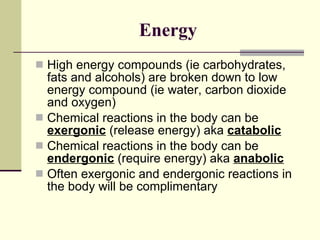
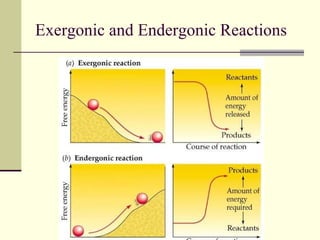
Energy High energy compounds (ie carbohydrates, fats and alcohols) are broken down to low energy compound (ie water, carbon dioxide and oxygen) Chemical reactions in the body can be  exergonic  (release energy) aka  catabolic Chemical reactions in the body can be  endergonic  (require energy) aka  anabolic Often exergonic and endergonic reactions in the body will be complimentary
Exergonic and Endergonic Reactions
Example of complimentary exergonic and endergonic reactions
ENZYMES
Enzyme Structure Some are pure proteins Some require COFACTORS to work (usually inorganic metal ions) Eg. iron, copper, calcium, zinc, potassium Some require COENZYMES to work (an organic substance) Eg. a vitamin
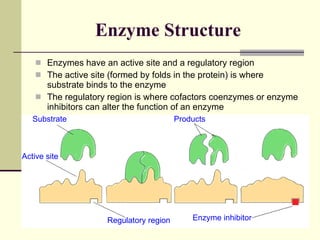
Enzyme Structure Enzymes have an active site and a regulatory region The active site (formed by folds in the protein) is where substrate binds to the enzyme The regulatory region is where cofactors coenzymes or enzyme inhibitors can alter the function of an enzyme Substrate Active site Regulatory region Products Enzyme inhibitor
Some quick facts. Enzymes … Act at both the intra and extracellular level Act on SUBSTRATE and yield PRODUCT Reduce the ACTIVATION energy required to start a reaction in the body Are very specific, each individual type of substrate is acted upon by a specific enzyme
The “Lock and Key” model of enzyme activity The enzyme provides a perfect fit for a particular substrate
The “Induced Fit” model of enzyme activity The substrate induces the enzyme to change shape to create a tighter fit
Factors Affecting Enzyme Activity pH Most biological enzymes operate at a neutral pH range of 6-8 If enzymes are at a pH outside their optimum range, their shape will change and they will be less efficient. 2.0 8.0 7.4 7.6 Opt. pH Stomach Small Intestine Blood Cells Location Pepsin Trypsin Carbonic Anhydrase Enzyme
Factors Affecting Enzyme Activity Temperature Most biological enzymes have an optimum temperature of 37° If an enzyme is exposed to temperatures higher than optimum, it will  permanently  denature. If an enzyme is exposed to temperatures lower than optimum, it will become inactive until temperature returns to optimum. The enzymes of other organisms have optimum temperatures suited to the environment in which they live
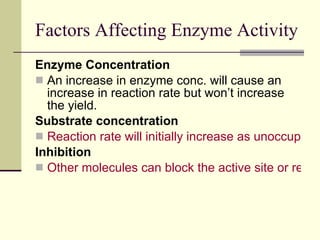
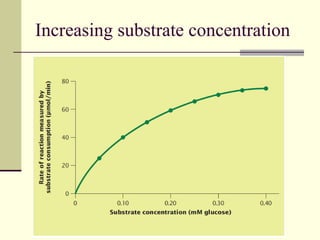
Factors Affecting Enzyme Activity Enzyme Concentration An increase in enzyme conc. will cause an increase in reaction rate but won’t increase the yield. Substrate concentration Reaction rate will initially increase as unoccupied enzymes take on substrate but will then plateau. Inhibition Other molecules can block the active site or regulatory region of an enzyme.
Increasing substrate concentration
Photosynthesis
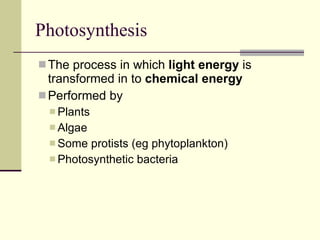
Photosynthesis The process in which  light energy  is transformed in to  chemical energy Performed by Plants Algae Some protists (eg phytoplankton) Photosynthetic bacteria
What makes leaves so ideal for photosynthesis? Flat = large surface area to volume ratio Many stomata = efficient import of CO 2  and export of O 2 Thin with many air chambers = diffusion of CO 2 Xylem = transports reactants in Phloem = transports products out Chloroplasts = photosynthetic pigment concentrated in dedicated organelles
Chloroplasts
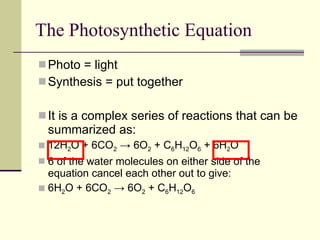
The Photosynthetic Equation Photo = light Synthesis = put together It is a complex series of reactions that can be summarized as: 12H 2 O + 6CO 2  -> 6O 2  + C 6 H 12 O 6  + 6H 2 O 6 of the water molecules on either side of the equation cancel each other out to give: 6H 2 O + 6CO 2  -> 6O 2  + C 6 H 12 O 6
 
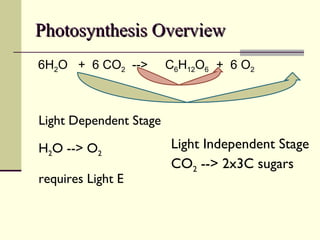
Photosynthesis Overview 6H 2 O  +  6 CO 2   -->  C 6 H 12 O 6  +  6 O 2 Light Dependent Stage H 2 O --> O 2 requires Light E Light Independent Stage CO 2  --> 2x3C sugars
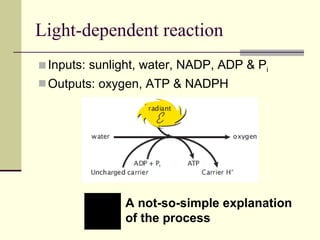
Light-dependent reaction Inputs: sunlight, water, NADP, ADP & P i Outputs: oxygen, ATP & NADPH A not-so-simple explanation  of the process
A simplified version of the process
Light-dependent reaction Occurs in the  grana Light energy is used to split water in to two H +  ions and O 2  gas The O 2  is released as waste With the power of the two free electrons One H +  ion fuses ADP to P i  to form ATP One H +  ion fuses to NADP to form NADPH
Inputs Outputs Water  H 2 O ATP Electron  e - NADPH NADP + ADP + P Oxygen (“waste”)
Light-independent stage Occurs in  Stroma Does not need light, but  NADPH  and  ATP  from previous stage Needs  CO 2   and  H +   ions  Sugar molecules are synthesised from CO 2 CO 2  = oxidised state  (low E compound) C(H 2 O)n = reduced  state (high E compound) NADPH (carrier H + ) is the reducing agent ATP is the energy source
Inputs Outputs ATP ADP + P NADPH NADP + 3C -> Glucose
Carbon reduction in  C 3  Plants Calvin Cycle Called C 3  plants as the end product is a 3-carbon compound (PGAL), that goes on to form glucose. Photosynthesis occurs in the mesophyll cells,
Carbon reduction in C 4  plants Plants in hot, dry habitats and important crop plants such as corn, sugar cane If light independent reaction took place in mesophyll cells, these plants would lose too much water from their open stomata. One step occurs (in the mesophyll cells) to transport CO 2  (in the form of oxaloacetate) to the bundle sheath cells,
Carbon reduction in C 4  plants CO 2  combines with the 3-carbon compound PEP (phophoenolpyruvic acid) to form oxaloacetate (4C) A further reaction converts oxaloacetate (4C) to malate (4C). Then a CO 2  molecule leaves the cycle to nter the Calvin cycle, whilst the remaining 3C pyruvate returns to reform PEP.
C 3  PLANTS C 4  PLANTS
Putting Photosynthesis together 2 x PGAL = fructose fructose = glucose fructose + glucose = sucrose glucose x  ∞   = starch
 
General Info on Cellular Respiration Organisms can’t use glucose (2800 kJ) as energy, needs to be broken down to approx 1/100 th  of its size – ATP (30 kJ). Breakdown is not 100% efficient (usually 36-38 ATP produced) Remainder is lost as heat. Endothermic organisms trap this heat with layers of fat to maintain body temperature.
General Info on Cellular Respiration The rate of respiration depends on the state of activity of the organism Respiration involves 2 coupled reactions Energy is released by the breakdown of glucose Energy is required for the production of ATP There are 2 types of respiration Aerobic respiration (requires oxygen) Anaerobic respiration (does not require oxygen)
Aerobic vs Anaerobic Respiration
Aerobic respiration C 6 H 12 O 6  + O 2  -> CO 2  + H 2 O Outside cells, to oxidise glucose need temp of 200° - Entire molecule oxidised simultaneously Inside cells, oxidised gradually in small steps Steps summarized in to 3 stages Glycolysis (produces pyruvate) Krebs Cycle (2 required per molecule of glucose) Electron transport (harvests H +  from carriers)
Glycolysis Occurs in cytosol – uses enzymes and vitamins as coenzymes 1 glucose (6C) converted to 2 pyruvate (3C) Forms 2 ATP & 2 NADH  (from NAD –  nicotamide  adenine  dinucleotide )
Krebs Cycle Occurs in mitochondria Pyruvate initially broken down in to CO 2  and Acetyl-coA Joins with 4C molecule to form 6 C molecule CO 2  to form 5 C molecule, then again to form 4 C molecule Further oxidation takes place to reform original 4C Throughout cycle, constant oxidation is fusing hydrogen to carrier molecules NAD -> NADH and FAD -> FADH 2
Electron Transport Occurs in inner membrane of mitochondria Produces 2-3 ATP per loaded receptor Electrons passed from one cytochrome to next until accepted by O 2-  to form water Return of released protons through ATP synthase carrier provides energy to produce ATP from ADP & P i  ( phosphorylation )
Summarising Aerobic Respiration Vocabulary Oxidation = removal of hydrogen Reduction = addition of hydrogen A total of 36 ATP are formed except in the cells of heart, liver and kidneys where 38 are formed
 
 
Anaerobic respiration (in humans) Occurs in muscles where oxygen supply exceeds demand The only stage that can occur is glycolysis So 1 glucose produces 2 ATP 2 NADH convert pyruvate to lactate (lactic acid) Lactate build up causes pH to fall and pain & muscle fatigue When activity returns to normal and oxygen becomes available, lactate converted back to pyruvate to enter the Krebs Cycle.
Anaerobic respiration (in yeast) Anaerobic respiration in yeast is called  fermentation Pyruvate is broken down in to CO 2  and ethanol (alcohol)
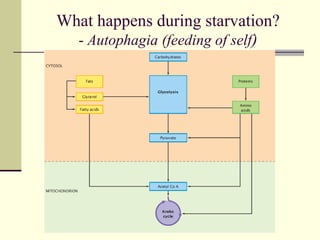
What happens during starvation? -  Autophagia (feeding of self )

3 - Biochemical processes in cells

  • 1.
  • 2.
    Organisms obtain theirenergy by breaking down complex high-energy biomolecules (otherwise known as food) AUTOTROPH Can utilize sunlight as an energy source Plants and photosynthetic bacteria & protists HETEROTROPH Must consume organic matter to obtain energy (in the form of chemical energy) Animals, fungi and non-photosynthetic bacteria & protists
  • 3.
    Energy High energycompounds (ie carbohydrates, fats and alcohols) are broken down to low energy compound (ie water, carbon dioxide and oxygen) Chemical reactions in the body can be exergonic (release energy) aka catabolic Chemical reactions in the body can be endergonic (require energy) aka anabolic Often exergonic and endergonic reactions in the body will be complimentary
  • 4.
  • 5.
    Example of complimentaryexergonic and endergonic reactions
  • 6.
    Example of complimentaryexergonic and endergonic reactions
  • 7.
  • 8.
    Enzyme Structure Someare pure proteins Some require COFACTORS to work (usually inorganic metal ions) Eg. iron, copper, calcium, zinc, potassium Some require COENZYMES to work (an organic substance) Eg. a vitamin
  • 9.
    Enzyme Structure Enzymeshave an active site and a regulatory region The active site (formed by folds in the protein) is where substrate binds to the enzyme The regulatory region is where cofactors coenzymes or enzyme inhibitors can alter the function of an enzyme Substrate Active site Regulatory region Products Enzyme inhibitor
  • 10.
    Some quick facts.Enzymes … Act at both the intra and extracellular level Act on SUBSTRATE and yield PRODUCT Reduce the ACTIVATION energy required to start a reaction in the body Are very specific, each individual type of substrate is acted upon by a specific enzyme
  • 11.
    The “Lock andKey” model of enzyme activity The enzyme provides a perfect fit for a particular substrate
  • 12.
    The “Induced Fit”model of enzyme activity The substrate induces the enzyme to change shape to create a tighter fit
  • 13.
    Factors Affecting EnzymeActivity pH Most biological enzymes operate at a neutral pH range of 6-8 If enzymes are at a pH outside their optimum range, their shape will change and they will be less efficient. 2.0 8.0 7.4 7.6 Opt. pH Stomach Small Intestine Blood Cells Location Pepsin Trypsin Carbonic Anhydrase Enzyme
  • 14.
    Factors Affecting EnzymeActivity Temperature Most biological enzymes have an optimum temperature of 37° If an enzyme is exposed to temperatures higher than optimum, it will permanently denature. If an enzyme is exposed to temperatures lower than optimum, it will become inactive until temperature returns to optimum. The enzymes of other organisms have optimum temperatures suited to the environment in which they live
  • 15.
    Factors Affecting EnzymeActivity Enzyme Concentration An increase in enzyme conc. will cause an increase in reaction rate but won’t increase the yield. Substrate concentration Reaction rate will initially increase as unoccupied enzymes take on substrate but will then plateau. Inhibition Other molecules can block the active site or regulatory region of an enzyme.
  • 16.
  • 17.
  • 18.
    Photosynthesis The processin which light energy is transformed in to chemical energy Performed by Plants Algae Some protists (eg phytoplankton) Photosynthetic bacteria
  • 19.
    What makes leavesso ideal for photosynthesis? Flat = large surface area to volume ratio Many stomata = efficient import of CO 2 and export of O 2 Thin with many air chambers = diffusion of CO 2 Xylem = transports reactants in Phloem = transports products out Chloroplasts = photosynthetic pigment concentrated in dedicated organelles
  • 20.
  • 21.
    The Photosynthetic EquationPhoto = light Synthesis = put together It is a complex series of reactions that can be summarized as: 12H 2 O + 6CO 2 -> 6O 2 + C 6 H 12 O 6 + 6H 2 O 6 of the water molecules on either side of the equation cancel each other out to give: 6H 2 O + 6CO 2 -> 6O 2 + C 6 H 12 O 6
  • 22.
  • 23.
    Photosynthesis Overview 6H2 O + 6 CO 2 --> C 6 H 12 O 6 + 6 O 2 Light Dependent Stage H 2 O --> O 2 requires Light E Light Independent Stage CO 2 --> 2x3C sugars
  • 24.
    Light-dependent reaction Inputs:sunlight, water, NADP, ADP & P i Outputs: oxygen, ATP & NADPH A not-so-simple explanation of the process
  • 25.
    A simplified versionof the process
  • 26.
    Light-dependent reaction Occursin the grana Light energy is used to split water in to two H + ions and O 2 gas The O 2 is released as waste With the power of the two free electrons One H + ion fuses ADP to P i to form ATP One H + ion fuses to NADP to form NADPH
  • 27.
    Inputs Outputs Water H 2 O ATP Electron e - NADPH NADP + ADP + P Oxygen (“waste”)
  • 28.
    Light-independent stage Occursin Stroma Does not need light, but NADPH and ATP from previous stage Needs CO 2 and H + ions Sugar molecules are synthesised from CO 2 CO 2 = oxidised state (low E compound) C(H 2 O)n = reduced state (high E compound) NADPH (carrier H + ) is the reducing agent ATP is the energy source
  • 29.
    Inputs Outputs ATPADP + P NADPH NADP + 3C -> Glucose
  • 30.
    Carbon reduction in C 3 Plants Calvin Cycle Called C 3 plants as the end product is a 3-carbon compound (PGAL), that goes on to form glucose. Photosynthesis occurs in the mesophyll cells,
  • 31.
    Carbon reduction inC 4 plants Plants in hot, dry habitats and important crop plants such as corn, sugar cane If light independent reaction took place in mesophyll cells, these plants would lose too much water from their open stomata. One step occurs (in the mesophyll cells) to transport CO 2 (in the form of oxaloacetate) to the bundle sheath cells,
  • 32.
    Carbon reduction inC 4 plants CO 2 combines with the 3-carbon compound PEP (phophoenolpyruvic acid) to form oxaloacetate (4C) A further reaction converts oxaloacetate (4C) to malate (4C). Then a CO 2 molecule leaves the cycle to nter the Calvin cycle, whilst the remaining 3C pyruvate returns to reform PEP.
  • 33.
    C 3 PLANTS C 4 PLANTS
  • 34.
    Putting Photosynthesis together2 x PGAL = fructose fructose = glucose fructose + glucose = sucrose glucose x ∞ = starch
  • 35.
  • 36.
    General Info onCellular Respiration Organisms can’t use glucose (2800 kJ) as energy, needs to be broken down to approx 1/100 th of its size – ATP (30 kJ). Breakdown is not 100% efficient (usually 36-38 ATP produced) Remainder is lost as heat. Endothermic organisms trap this heat with layers of fat to maintain body temperature.
  • 37.
    General Info onCellular Respiration The rate of respiration depends on the state of activity of the organism Respiration involves 2 coupled reactions Energy is released by the breakdown of glucose Energy is required for the production of ATP There are 2 types of respiration Aerobic respiration (requires oxygen) Anaerobic respiration (does not require oxygen)
  • 38.
  • 39.
    Aerobic respiration C6 H 12 O 6 + O 2 -> CO 2 + H 2 O Outside cells, to oxidise glucose need temp of 200° - Entire molecule oxidised simultaneously Inside cells, oxidised gradually in small steps Steps summarized in to 3 stages Glycolysis (produces pyruvate) Krebs Cycle (2 required per molecule of glucose) Electron transport (harvests H + from carriers)
  • 40.
    Glycolysis Occurs incytosol – uses enzymes and vitamins as coenzymes 1 glucose (6C) converted to 2 pyruvate (3C) Forms 2 ATP & 2 NADH (from NAD – nicotamide adenine dinucleotide )
  • 41.
    Krebs Cycle Occursin mitochondria Pyruvate initially broken down in to CO 2 and Acetyl-coA Joins with 4C molecule to form 6 C molecule CO 2 to form 5 C molecule, then again to form 4 C molecule Further oxidation takes place to reform original 4C Throughout cycle, constant oxidation is fusing hydrogen to carrier molecules NAD -> NADH and FAD -> FADH 2
  • 42.
    Electron Transport Occursin inner membrane of mitochondria Produces 2-3 ATP per loaded receptor Electrons passed from one cytochrome to next until accepted by O 2- to form water Return of released protons through ATP synthase carrier provides energy to produce ATP from ADP & P i ( phosphorylation )
  • 43.
    Summarising Aerobic RespirationVocabulary Oxidation = removal of hydrogen Reduction = addition of hydrogen A total of 36 ATP are formed except in the cells of heart, liver and kidneys where 38 are formed
  • 44.
  • 45.
  • 46.
    Anaerobic respiration (inhumans) Occurs in muscles where oxygen supply exceeds demand The only stage that can occur is glycolysis So 1 glucose produces 2 ATP 2 NADH convert pyruvate to lactate (lactic acid) Lactate build up causes pH to fall and pain & muscle fatigue When activity returns to normal and oxygen becomes available, lactate converted back to pyruvate to enter the Krebs Cycle.
  • 47.
    Anaerobic respiration (inyeast) Anaerobic respiration in yeast is called fermentation Pyruvate is broken down in to CO 2 and ethanol (alcohol)
  • 48.
    What happens duringstarvation? - Autophagia (feeding of self )