Meiosis,
Mechanism of
Crossover,
Significance in
evolution.
By-
AMIT KUMAR SAHOO
15151
What is Meiosis?
• Meiosis is a process where a single cell divides
twice to produce four cells containing half the
original amount of genetic information. These cells
are our sex cells – sperm in males, eggs in females.
• Meiosis can be divided into nine stages. These are
divided between the first time the cell divides
(meiosis I) and the second time it divides (meiosis
II).
We Are UNIQUE!
• One of the reasons for this genetic mix up or
uniqueness is by a process called Crossing Over
that occurs during meiosis.
What is Crossing over?
• Crossing over is the exchange of segments between the
non-sister chromatids of homologous chromosome.
• The term crossing over was coined by Morgan.
Origins:
There are two popular and overlapping theories
explaining the origins of crossing-over, coming from
the different theories on the origin of meiosis.
1. The first theory rests upon the idea that meiosis evolved as
another method of DNA repair, and thus crossing-over is a
novel way to replace possibly damaged sections of DNA.
2. The second theory comes from the idea that meiosis
evolved from bacterial transformation, with the function of
propagating diversity.
Mechanism of meiotic crossing
over.
The major steps in meiotic crossing over are
1 ) synapsis
2) duplication of chromosome
3) crossing over and
4) terminalisation.
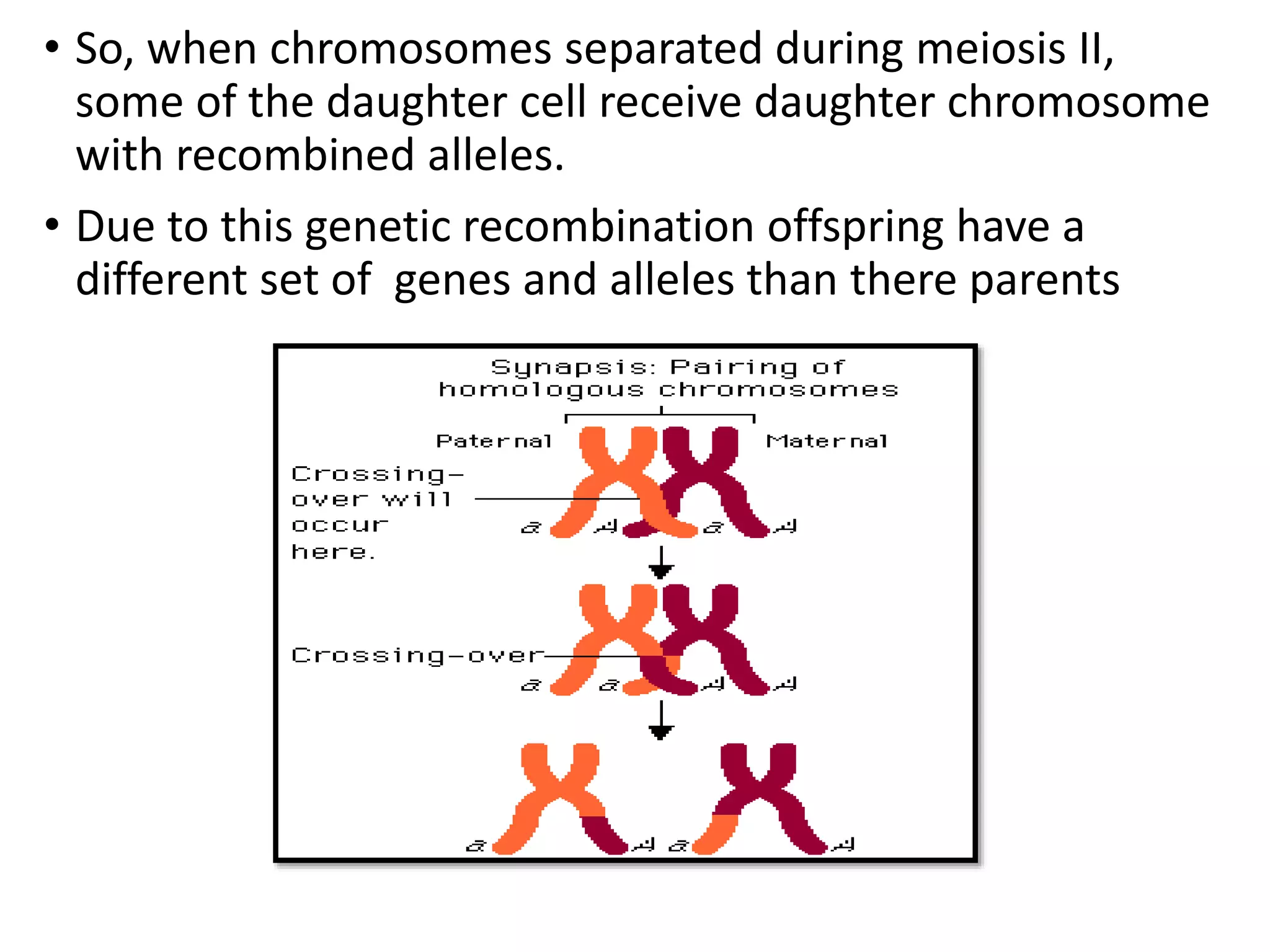
-Synapsis is the intimate pairing between the two
homologous chromosomes.
-Synapsis is followed by duplication of chromosome (in
pachytene).
-Crossing over or exchange of segments between the non-
sister chromatids of homologous chromosome occurs at
the tetrad stage.
-Crossing over can be divided into three major steps:
1 ) breakage of chromatid segments
2) their transposition (movement to the respective site)
3) fusion or joining.
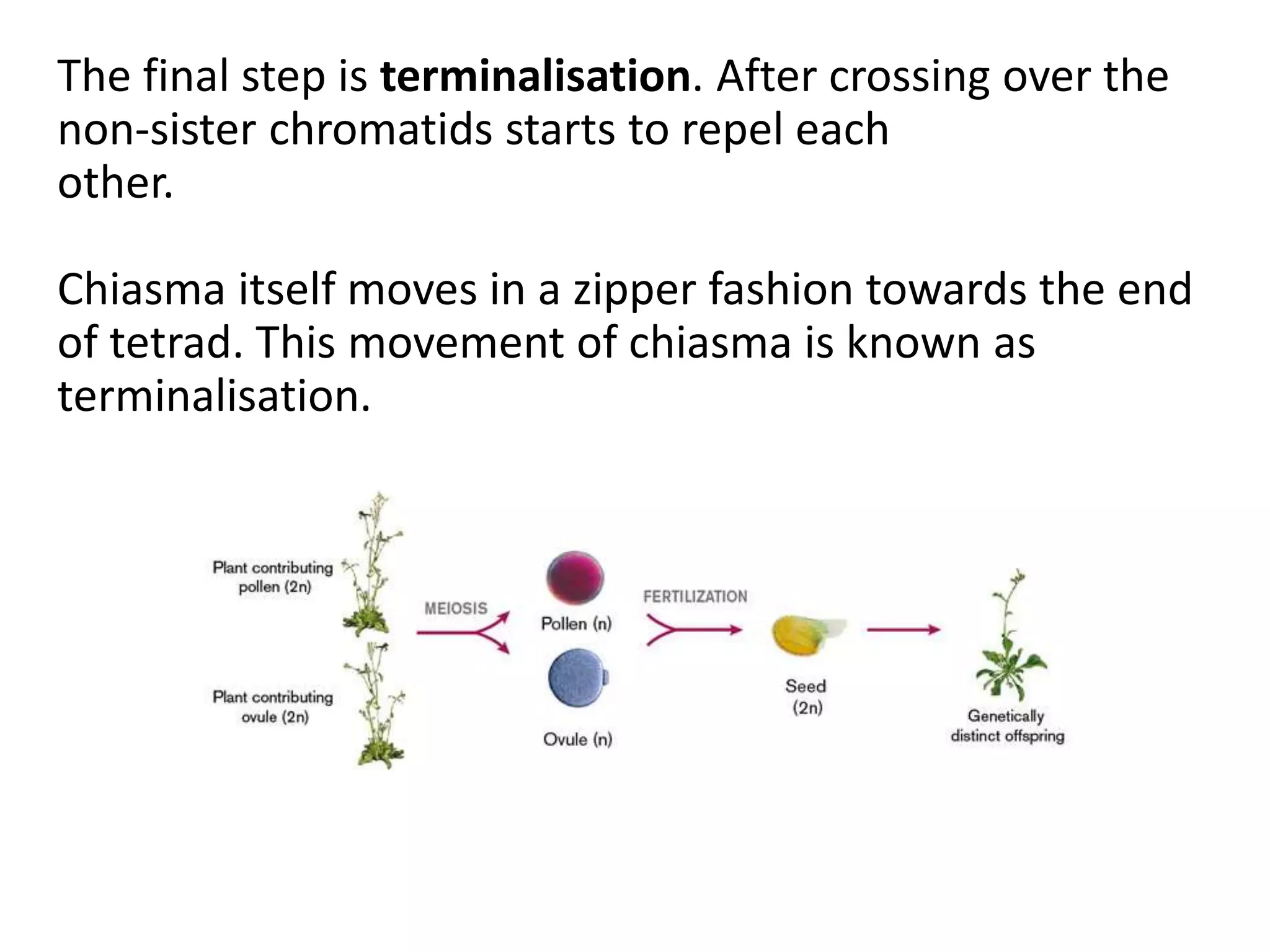
The final step is terminalisation. After crossing over the
non-sister chromatids starts to repel each
other.
Chiasma itself moves in a zipper fashion towards the end
of tetrad. This movement of chiasma is known as
terminalisation.
The Biology Underlying Mendelian Inheritance
• Mendel’s Laws can be derived directly from our understanding of Meiotic
cell division or Meiosis.
• The purpose of meiosis is to introduce further genetic diversity by creating
gametes, either egg
cells or sperm cells, that are genetically different from the parent cells.
What is the function of crossing-over?
• In species that reproduce sexually, offspring are genetically distinct
from their parents because they inherit genetic material from
both.
• Such genetic diversity is the product of meiosis, a type of cellular
division that creates reproductive cells from a parent cell.
• The paired chromosomes can exchange segments of DNA via a
mechanism called crossing-over.
Crossing-over has two main functions.
1. The first is to increase genetic recombination.
2. The second is to ensure that parental chromosomes are equitably distributed
among the reproductive cells produced by meiosis.
• Without crossing-over, the chromosomes would be distributed abruptly.
• Too many crossing over is also not good because could disrupt advantageous
gene combinations that have established themselves over evolutionary time.
Crossing over in favor of plant breeding.
• Increasing the number of crossing-over events could
lead to more genetic recombination and thus
novel gene combinations, a desirable outcome in the
context of plant breeding.
• Ex- Arabidopsis thaliana
Increasing genetic recombination by inhibiting
mechanisms that limit crossing-over.
Mechanism of Crossing Over:
• It occurs during Prophase I of Meiosis
• Genetic swapping occurs between paired homologous
chromosomes in our sex cells—The Egg and Sperm
Homologous Chromosomes Exchanging DNA
by Crossing Over
From: http://www.ultranet.com/~jkimball/BiologyPages/M/Meiosis.html#crossing_over
Its Why You and I Don’t Look
Alike
Crossing Over ensures a
combination of the maternal and
paternal genes we inherited
BOTTOM LINE
• So, when chromosomes separated during meiosis II,
some of the daughter cell receive daughter chromosome
with recombined alleles.
• Due to this genetic recombination offspring have a
different set of genes and alleles than there parents
Crossing over and Chiasmata
• Chiasmata is the point where two homologous non-
sister chromatids exchange genetic material during
crossing over during meiosis.
• Chiasmata becomes visible during diplotene stage
of prophase I during meiosis.
• But actual crossing over occcur during previous
pachytene stage. When each tetrad which is
composed of two pairs of sister chromatids begins
to split. Only point of contact is chaismata.
Crossing over and chaismata
Types of Crossing over
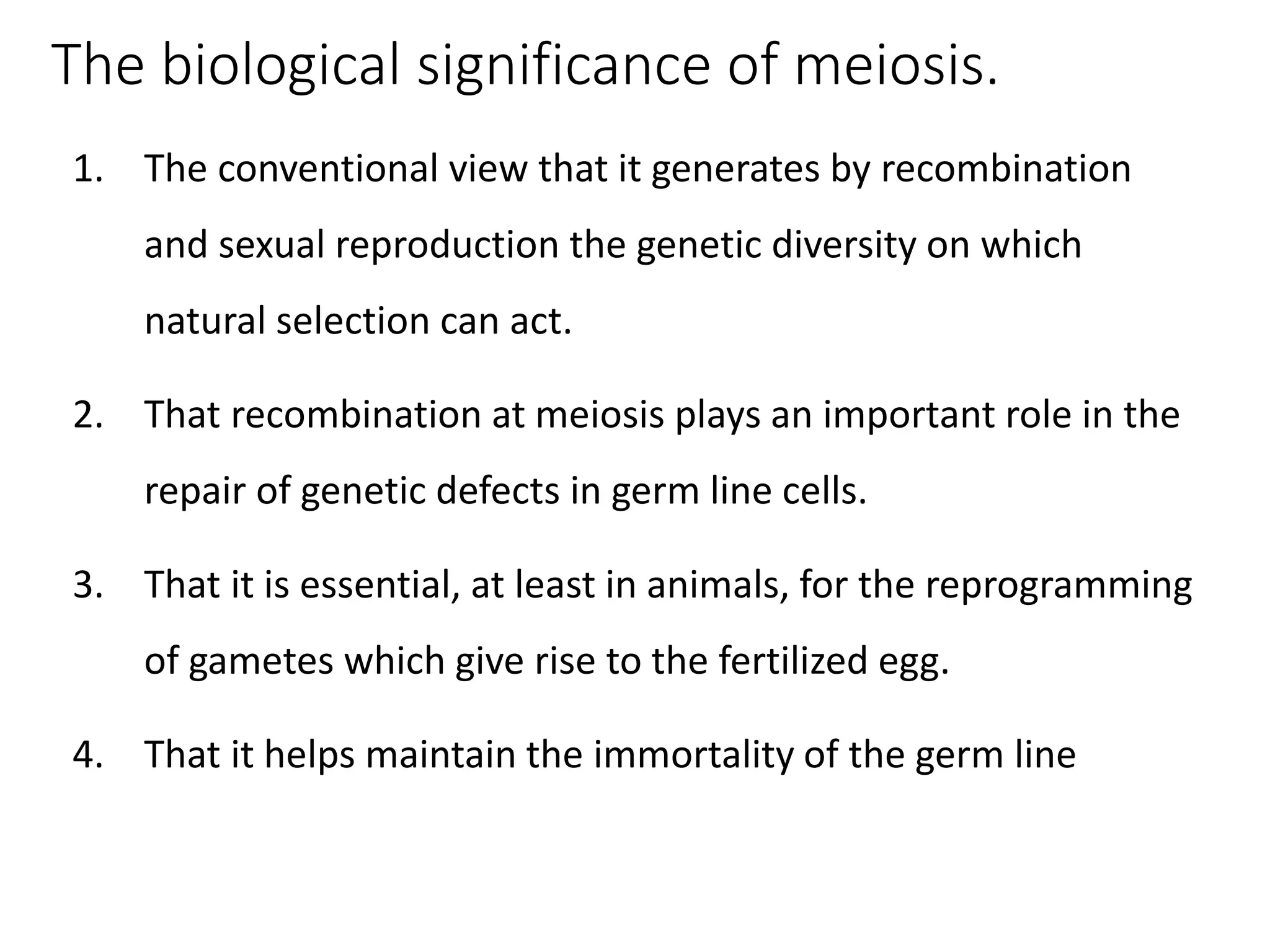
• Single crossing over:
Chromosomal crossover (or crossing over) is the
exchange of genetic material between homologous
chromosomes that results in recombinant
chromosomes. It is one of the final phases of genetic
recombination, which occurs during prophase I of
meiosis (pachytene) during a process called synapsis.
single crossing over
Double crossing over
It refers to formation of two chiasmata between non-sister chromatids of
homologous chromosomes.
Two simultaneous reciprocal breakage and reunion events between the same two
chromatids.
The biological significance of meiosis.
1. The conventional view that it generates by recombination
and sexual reproduction the genetic diversity on which
natural selection can act.
2. That recombination at meiosis plays an important role in the
repair of genetic defects in germ line cells.
3. That it is essential, at least in animals, for the reprogramming
of gametes which give rise to the fertilized egg.
4. That it helps maintain the immortality of the germ line
Significance of crossing over
• Crossing over is universal in occurrence, occurs in plants,
animals, bacteria, viruses and moulds.
• Meiotic crossing over allows a more independent selection
between the two alleles that occupy the positions of
single genes, as recombination shuffles the allele content
between sister chromatids
• Helps in proving linear arrangement of genes.
• Recombination does not have any influence on
the statistical probability that another offspring will have
the same combination. This theory of “independent
assortment” of alleles is fundamental to
genetic inheritance.
• Origin of new character.
• Necessary for natural selection, as it increases chances
of variation.
• Ex-Selection of useful recombination by geneticists has brought about green
revolution in our country.
Role of Crossing over in Evolution
• Crossing over allows genetic variants on the same chromosome to evolve
independently, which greatly increases an organism's evolutionary potential.
• (Explanation)
• If there were no crossing over, all genetic variants on a chromosome would be inherited
as a block. Image a chromosome copy which contains a good variant--let's say, flu
resistance--at one gene, and a bad variant--let's say, tapeworm susceptibility--at a
different gene. Without crossing over, the population has to choose between flu and
tapeworms. Crossing over can produce a chromosome with the good variant and
without the bad one, allowing the population to move toward a better solution. This
speeds up the rate of adaptation.
References:
• www.nature.com/scitable/topic/chromosomes-and-
cytogenetics-7
• www.plantphysiol.org/content/171/4/2294.full
• journals.plos.org/plosbiology/article?id=10.1371/journa
l.pbio.1000501
• bmcgenomics.biomedcentral.com/articles/10.1186/147
1-2164-13-53
• https://www.ncbi.nlm.nih.gov/books/NBK21870/
Meiosis, Crossing Over

Meiosis, Crossing Over

  • 1.
  • 2.
    What is Meiosis? •Meiosis is a process where a single cell divides twice to produce four cells containing half the original amount of genetic information. These cells are our sex cells – sperm in males, eggs in females. • Meiosis can be divided into nine stages. These are divided between the first time the cell divides (meiosis I) and the second time it divides (meiosis II).
  • 4.
    We Are UNIQUE! •One of the reasons for this genetic mix up or uniqueness is by a process called Crossing Over that occurs during meiosis.
  • 5.
    What is Crossingover? • Crossing over is the exchange of segments between the non-sister chromatids of homologous chromosome. • The term crossing over was coined by Morgan.
  • 6.
    Origins: There are twopopular and overlapping theories explaining the origins of crossing-over, coming from the different theories on the origin of meiosis. 1. The first theory rests upon the idea that meiosis evolved as another method of DNA repair, and thus crossing-over is a novel way to replace possibly damaged sections of DNA. 2. The second theory comes from the idea that meiosis evolved from bacterial transformation, with the function of propagating diversity.
  • 7.
    Mechanism of meioticcrossing over. The major steps in meiotic crossing over are 1 ) synapsis 2) duplication of chromosome 3) crossing over and 4) terminalisation.
  • 8.
    -Synapsis is theintimate pairing between the two homologous chromosomes. -Synapsis is followed by duplication of chromosome (in pachytene). -Crossing over or exchange of segments between the non- sister chromatids of homologous chromosome occurs at the tetrad stage. -Crossing over can be divided into three major steps: 1 ) breakage of chromatid segments 2) their transposition (movement to the respective site) 3) fusion or joining.
  • 9.
    The final stepis terminalisation. After crossing over the non-sister chromatids starts to repel each other. Chiasma itself moves in a zipper fashion towards the end of tetrad. This movement of chiasma is known as terminalisation.
  • 10.
    The Biology UnderlyingMendelian Inheritance • Mendel’s Laws can be derived directly from our understanding of Meiotic cell division or Meiosis. • The purpose of meiosis is to introduce further genetic diversity by creating gametes, either egg cells or sperm cells, that are genetically different from the parent cells.
  • 11.
    What is thefunction of crossing-over? • In species that reproduce sexually, offspring are genetically distinct from their parents because they inherit genetic material from both. • Such genetic diversity is the product of meiosis, a type of cellular division that creates reproductive cells from a parent cell. • The paired chromosomes can exchange segments of DNA via a mechanism called crossing-over.
  • 12.
    Crossing-over has twomain functions. 1. The first is to increase genetic recombination. 2. The second is to ensure that parental chromosomes are equitably distributed among the reproductive cells produced by meiosis. • Without crossing-over, the chromosomes would be distributed abruptly. • Too many crossing over is also not good because could disrupt advantageous gene combinations that have established themselves over evolutionary time.
  • 13.
    Crossing over infavor of plant breeding. • Increasing the number of crossing-over events could lead to more genetic recombination and thus novel gene combinations, a desirable outcome in the context of plant breeding. • Ex- Arabidopsis thaliana Increasing genetic recombination by inhibiting mechanisms that limit crossing-over.
  • 14.
    Mechanism of CrossingOver: • It occurs during Prophase I of Meiosis • Genetic swapping occurs between paired homologous chromosomes in our sex cells—The Egg and Sperm Homologous Chromosomes Exchanging DNA by Crossing Over From: http://www.ultranet.com/~jkimball/BiologyPages/M/Meiosis.html#crossing_over
  • 15.
    Its Why Youand I Don’t Look Alike Crossing Over ensures a combination of the maternal and paternal genes we inherited BOTTOM LINE
  • 16.
    • So, whenchromosomes separated during meiosis II, some of the daughter cell receive daughter chromosome with recombined alleles. • Due to this genetic recombination offspring have a different set of genes and alleles than there parents
  • 17.
    Crossing over andChiasmata • Chiasmata is the point where two homologous non- sister chromatids exchange genetic material during crossing over during meiosis. • Chiasmata becomes visible during diplotene stage of prophase I during meiosis. • But actual crossing over occcur during previous pachytene stage. When each tetrad which is composed of two pairs of sister chromatids begins to split. Only point of contact is chaismata.
  • 18.
  • 19.
    Types of Crossingover • Single crossing over: Chromosomal crossover (or crossing over) is the exchange of genetic material between homologous chromosomes that results in recombinant chromosomes. It is one of the final phases of genetic recombination, which occurs during prophase I of meiosis (pachytene) during a process called synapsis.
  • 20.
  • 21.
    Double crossing over Itrefers to formation of two chiasmata between non-sister chromatids of homologous chromosomes. Two simultaneous reciprocal breakage and reunion events between the same two chromatids.
  • 22.
    The biological significanceof meiosis. 1. The conventional view that it generates by recombination and sexual reproduction the genetic diversity on which natural selection can act. 2. That recombination at meiosis plays an important role in the repair of genetic defects in germ line cells. 3. That it is essential, at least in animals, for the reprogramming of gametes which give rise to the fertilized egg. 4. That it helps maintain the immortality of the germ line
  • 23.
    Significance of crossingover • Crossing over is universal in occurrence, occurs in plants, animals, bacteria, viruses and moulds. • Meiotic crossing over allows a more independent selection between the two alleles that occupy the positions of single genes, as recombination shuffles the allele content between sister chromatids • Helps in proving linear arrangement of genes. • Recombination does not have any influence on the statistical probability that another offspring will have the same combination. This theory of “independent assortment” of alleles is fundamental to genetic inheritance. • Origin of new character. • Necessary for natural selection, as it increases chances of variation. • Ex-Selection of useful recombination by geneticists has brought about green revolution in our country.
  • 24.
    Role of Crossingover in Evolution • Crossing over allows genetic variants on the same chromosome to evolve independently, which greatly increases an organism's evolutionary potential. • (Explanation) • If there were no crossing over, all genetic variants on a chromosome would be inherited as a block. Image a chromosome copy which contains a good variant--let's say, flu resistance--at one gene, and a bad variant--let's say, tapeworm susceptibility--at a different gene. Without crossing over, the population has to choose between flu and tapeworms. Crossing over can produce a chromosome with the good variant and without the bad one, allowing the population to move toward a better solution. This speeds up the rate of adaptation.
  • 25.
    References: • www.nature.com/scitable/topic/chromosomes-and- cytogenetics-7 • www.plantphysiol.org/content/171/4/2294.full •journals.plos.org/plosbiology/article?id=10.1371/journa l.pbio.1000501 • bmcgenomics.biomedcentral.com/articles/10.1186/147 1-2164-13-53 • https://www.ncbi.nlm.nih.gov/books/NBK21870/

Editor's Notes

  • #3 This process is required to produce egg and sperm cells for sexual reproduction. During reproduction, when the sperm and egg unite to form a single cell, the number of chromosomes is restored in the offspring
  • #23 For 4th pt possible by a process of rejuvenation involving the removal of faulty RNA and protein molecules, or by the elimination of defective meiocytes. The removal of epigenetic defects by recombination during meiosis therefore becomes an essential part of a reprogramming and rejuvenation process. Assuming some epigenetic defects are nevertheless transmitted to the next generation, sexual reproduction and outbreeding would be advantageous because they provide the opportunity for their removal at the next meiosis. Inbreeding would be disadvantageous, because it increases the probability that epigenetic defects would become homozygous and could no longer be removed by recombination.