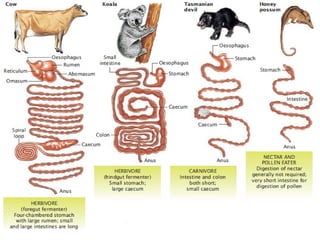
Comparative Digestion Herbivores (non-ruminants & ruminants), Carnivores, Nectar & Pollen feeders.
Herbivores … are designed to be able to consume the most indigestible foods. … can be divided in to two distinct categories: Hindgut fermenters (non-ruminants) Foregut fermenters (ruminants)
Hindgut Fermenters These animals have a very long and well developed large intestine (specifically the caecum) containing vast amounts of bacteria to aid digestion.
Foregut Fermenters …are called RUMINANTS as their major adaptation is an enlarged part of the oesophagus / stomach called the RUMEN.
Ruminant Digestion 1 Food is chewed and swallowed Bacterial fermentation in the rumen breaks down plant cellulose Food passes to the reticulum and is packaged in to wads and pushed back up the oesophagus to be re-chewed.
Ruminant Digestion 2 Food returns to the omasum Food continues to the abomasum which is the equivalent of our stomach. Here food is digested with stomach acids and other enzymes before passing to the small intestine.
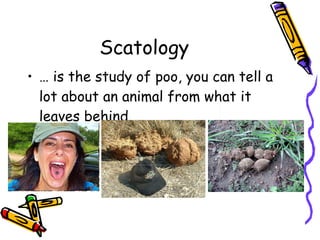
Scatology … is the study of poo, you can tell a lot about an animal from what it leaves behind.
 

12 Comparitive Digestion

  • 1.
    Comparative Digestion Herbivores(non-ruminants & ruminants), Carnivores, Nectar & Pollen feeders.
  • 2.
    Herbivores … aredesigned to be able to consume the most indigestible foods. … can be divided in to two distinct categories: Hindgut fermenters (non-ruminants) Foregut fermenters (ruminants)
  • 3.
    Hindgut Fermenters Theseanimals have a very long and well developed large intestine (specifically the caecum) containing vast amounts of bacteria to aid digestion.
  • 4.
    Foregut Fermenters …arecalled RUMINANTS as their major adaptation is an enlarged part of the oesophagus / stomach called the RUMEN.
  • 5.
    Ruminant Digestion 1Food is chewed and swallowed Bacterial fermentation in the rumen breaks down plant cellulose Food passes to the reticulum and is packaged in to wads and pushed back up the oesophagus to be re-chewed.
  • 6.
    Ruminant Digestion 2Food returns to the omasum Food continues to the abomasum which is the equivalent of our stomach. Here food is digested with stomach acids and other enzymes before passing to the small intestine.
  • 7.
    Scatology … isthe study of poo, you can tell a lot about an animal from what it leaves behind.
  • 8.