UNIT 5 – METABOLISM:
ENERGY AND ENZYMES
ENERGY
!  Energy – The ability to do work.
!  Living organisms need to acquire energy for survival
!  Cells require energy to:
!  Maintain organization
!  Carry out reactions
!  Develop, Grow and Reproduce
FORMS OF ENERGY
!  Kinetic Energy – energy of motion
!  Potential Energy – stored energy
!  Source of Potential Energy
!  FOOD – called Chemical Energy
!  Organisms convert chemical energy into a form of
kinetic energy called Mechanical Energy.
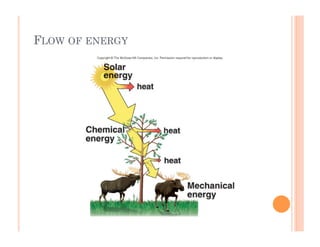
ENERGY FLOW
!  Is unidirectional in ecosystems (no cycling)
!  Law of thermodynamics explains this:
!  1st Law: Energy cannot be created or destroyed,
but can be transformed.
!  2nd Law: Energy transformation results in a loss
of usable energy.
!  Loss of usable energy is typically in the form of
heat.
6-5
FLOW OF ENERGY
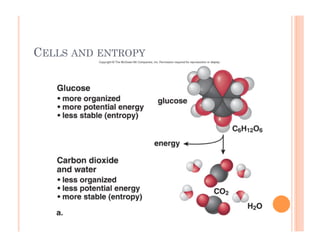
CELLS AND ENTROPY
! The term entropy is used to indicate the
relative state of disorganization.
! Cells need a constant supply of energy to
maintain their internal organization.
! Complex molecules tend to break apart into
their building blocks.
!  Ex: Glucose " Carbon Dioxide + Water
!  Greater Organization = less stable
! The result is a loss of potential energy and an
increase in entropy.
6-7
CELLS AND ENTROPY
METABOLIC REACTIONS AND
ENERGY TRANSFORMATIONS
!  Metabolism is the sum of all the chemical
reactions that occur in a cell.
!  Reactants are substances that participate in a
reaction; products are substances that form as a
result of a reaction.
!  A reaction will occur spontaneously if it increases
entropy.
!  Biologists use the term “free energy” instead of
entropy for cells.
!  Free energy, ∆G, is the amount of energy to do
work after a reaction has occurred.
6-9
!  ∆G (change in free energy) is calculated by
subtracting the free energy of reactants from that of
products.
!  A negative ∆G means the products have less free
energy than the reactants, and the reaction will occur
spontaneously.
!  Exergonic reactions have a negative ∆G and energy
is released. (EXIT)
!  Endergonic reactions have a positive ∆G and occur
only if there is an input of energy. (ENTER)
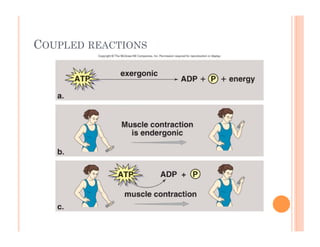
!  Energy released from exergonic reactions is used to
drive endergonic reactions inside cells.
!  ATP is the energy carrier between exergonic and
endergonic reactions.
ATP: ENERGY FOR CELLS
! ATP (adenosine triphosphate) is the energy
currency of cells.
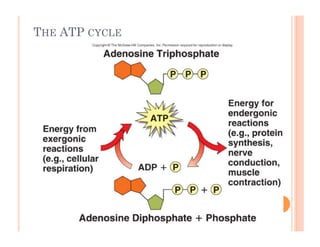
! ATP is constantly regenerated from ADP
(adenosine diphosphate) after energy is
expended by the cell.
! Use of ATP by the cell has advantages:
!  It can be used in many types of reactions.
!  When ATP --> ADP + P, energy released is
sufficient for cellular needs and little energy is
wasted.
!  ATP is coupled to endergonic reactions in such a
way that it minimizes energy loss.
THE ATP CYCLE
6-12
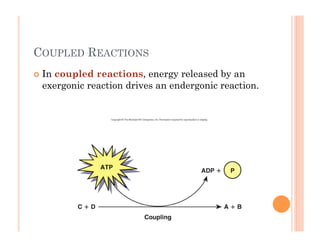
COUPLED REACTIONS
!  In coupled reactions, energy released by an
exergonic reaction drives an endergonic reaction.
COUPLED REACTIONS
FUNCTION OF ATP
!  Cells make use of ATP for:
1.  Chemical work – ATP supplies energy
to synthesize macromolecules, and
therefore the organism
2.  Transport work – ATP supplies energy
needed to pump substances across the
plasma membrane
3.  Mechanical work – ATP supplies
energy for cellular movements
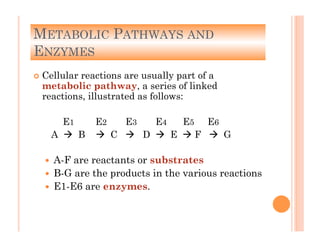
METABOLIC PATHWAYS AND
ENZYMES
!  Cellular reactions are usually part of a
metabolic pathway, a series of linked
reactions, illustrated as follows:
E1 E2 E3 E4 E5 E6
A " B " C " D " E " F " G
!  A-F are reactants or substrates
!  B-G are the products in the various reactions
!  E1-E6 are enzymes.
! An enzyme is a protein molecule that
functions as an organic catalyst to speed a
chemical reaction.
! An enzyme brings together specific molecules
and causes them to react.
! The reactants in an enzymatic reaction are
called the substrates for that enzyme.
ENERGY OF ACTIVATION
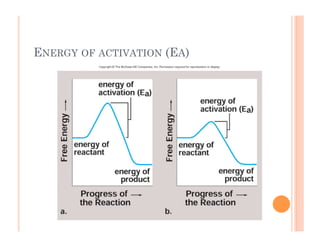
! The energy that must be added to cause
molecules to react with one another is
called the energy of activation (Eact).
! The addition of an enzyme does not
change the free energy of the reaction,
rather an enzyme lowers the energy of
activation.
6-18
ENERGY OF ACTIVATION (EA)
ENZYME-SUBSTRATE COMPLEXES
! Every reaction in a cell requires a specific
enzyme.
! Enzymes are named for their substrates:
SUBSTRATE ENZYME
Lipid Lipase
Urea Urease
Maltose Maltase
Ribonucleic acid Ribonuclease
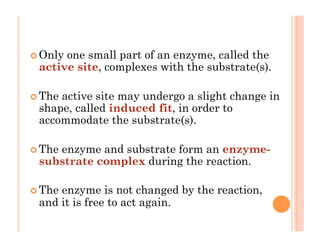
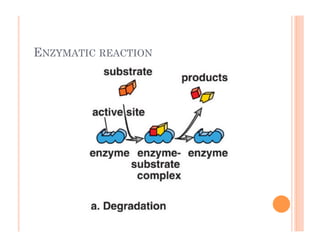
! Only one small part of an enzyme, called the
active site, complexes with the substrate(s).
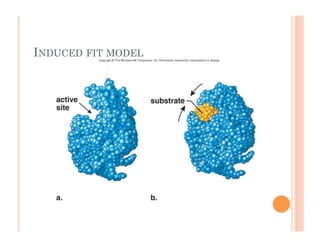
! The active site may undergo a slight change in
shape, called induced fit, in order to
accommodate the substrate(s).
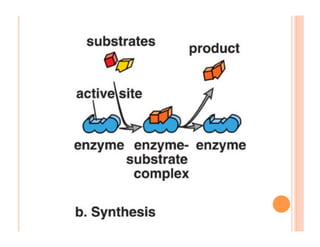
! The enzyme and substrate form an enzyme-
substrate complex during the reaction.
! The enzyme is not changed by the reaction,
and it is free to act again.
ENZYMATIC REACTION
INDUCED FIT MODEL
FACTORS AFFECTING ENZYMATIC
SPEED
!  Enzymatic reactions proceed with great speed
provided there is enough substrate to fill active
sites most of the time.
!  Enzyme activity increases as substrate
concentration increases because there are more
collisions between substrate molecules and the
enzyme.
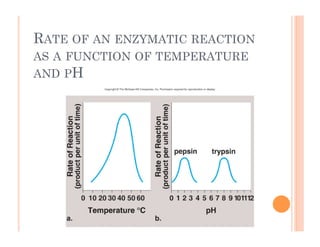
TEMPERATURE AND PH
! As the temperature rises, enzyme activity
increases because more collisions occur
between enzyme and substrate.
! If the temperature is too high, enzyme
activity levels out and then declines
rapidly because the enzyme is
denatured.
! Each enzyme has an optimal pH at which
the rate of reaction is highest.
RATE OF AN ENZYMATIC REACTION
AS A FUNCTION OF TEMPERATURE
AND PH
! A cell regulates which enzymes are present or
active at any one time.
! Genes must be turned on or off to regulate the
quantity of enzyme present.
! Another way to control enzyme activity is to
activate or deactivate the enzyme.
! Phosphorylation is one way to activate an
enzyme.
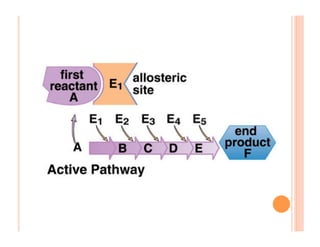
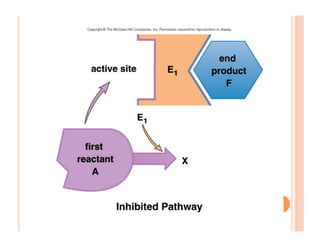
ENZYME INHIBITION
! Enzyme inhibition occurs when an active
enzyme is prevented from combining with its
substrate.
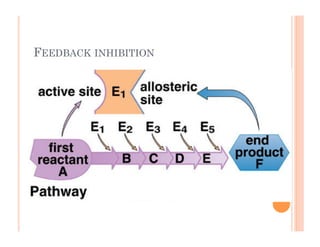
! When the product of a metabolic pathway is in
abundance, it binds competitively with the
enzyme’s active site, a simple form of
feedback inhibition.
! Other metabolic pathways are regulated by the
end product binding to an allosteric site on
the enzyme.
6-29
FEEDBACK INHIBITION
6-32
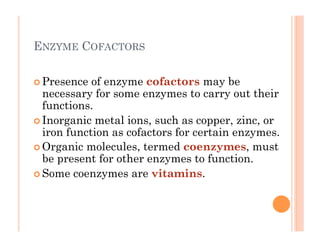
ENZYME COFACTORS
! Presence of enzyme cofactors may be
necessary for some enzymes to carry out their
functions.
! Inorganic metal ions, such as copper, zinc, or
iron function as cofactors for certain enzymes.
! Organic molecules, termed coenzymes, must
be present for other enzymes to function.
! Some coenzymes are vitamins.
6-33
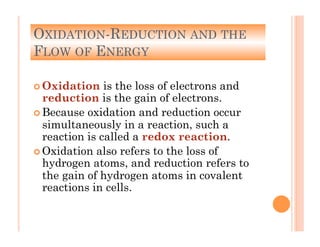
OXIDATION-REDUCTION AND THE
FLOW OF ENERGY
! Oxidation is the loss of electrons and
reduction is the gain of electrons.
! Because oxidation and reduction occur
simultaneously in a reaction, such a
reaction is called a redox reaction.
! Oxidation also refers to the loss of
hydrogen atoms, and reduction refers to
the gain of hydrogen atoms in covalent
reactions in cells.
! These types of oxidation-reduction, or redox,
reactions are exemplified by the overall
reactions of photosynthesis and cellular
respiration.
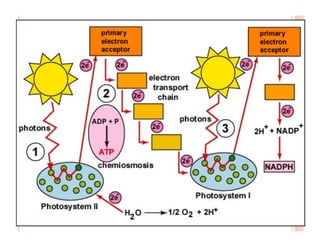
! The two pathways of photosynthesis and
cellular respiration permit the flow of energy
from the sun though all living things.
6-35
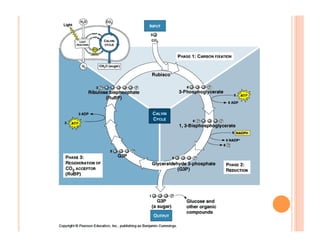
PHOTOSYNTHESIS
! The overall reaction for photosynthesis can be
written:
6CO2 + 6H2O + energy ---> C6H12O6 + 6O2
! During photosynthesis, hydrogen atoms are
transferred from water to carbon dioxide, and
glucose is formed.
! Water has been oxidized; carbon dioxide has
been reduced.
! Energy to form glucose comes from the sun.
6-39
CELLULAR RESPIRATION
! The overall equation for cellular respiration is
opposite that of photosynthesis:
C6H12O6 + 6O2 --> 6CO2 + 6H2O + Energy
! In this reaction, glucose is oxidized and oxygen
is reduced to become water.
! The complete oxidation of a mol of glucose
releases 686 kcal of energy that is used to
synthesize ATP.
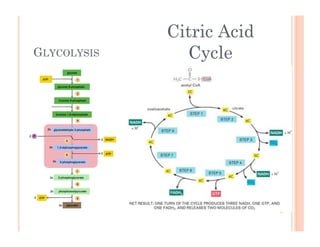
GLYCOLYSIS
Citric Acid
Cycle
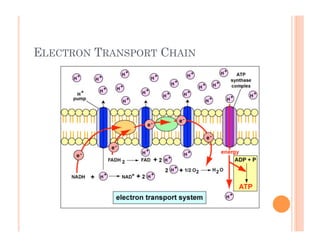
ELECTRON TRANSPORT CHAIN
6-43
ORGANELLES AND THE FLOW OF
ENERGY
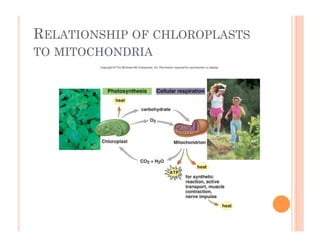
! During photosynthesis, chloroplasts
capture solar energy and use it to convert
water and carbon dioxide into
carbohydrates that provide food for other
living things.
! Cellular respiration, the breakdown of
glucose into carbon dioxide and water,
occurs in mitochondria.
! It is the cycling of molecules between
chloroplasts and mitochondria that allows
a flow of energy from the sun through all
living things.
6-44
RELATIONSHIP OF CHLOROPLASTS
TO MITOCHONDRIA
6-45
CHAPTER SUMMARY
!  Two laws of thermodynamics state that energy
cannot be created or destroyed, and energy
transformations result in a loss of energy, usually
as heat.
!  As a result of these laws, we know the entropy of
the universe is ever increasing, and that it takes
energy to maintain the organization of living
things.
6-46
!  Metabolism refers to all the chemical reactions in the
cell.
!  Only reactions with a negative free energy occur
spontaneously.
!  Endergonic reactions are thus coupled with exergonic
reactions.
!  Energy is stored in cells in ATP molecules.
!  Metabolic pathways are a series of enzyme-catalyzed
reactions.
6-47
!  Each reaction requires a specific enzyme.
!  Substrate concentration, temperature, pH, and
enzyme concentration affect the rates of reactions.
!  Most metabolic pathways are regulated by feedback
inhibition.
!  Photosynthesis and cellular respiration involve
oxidation-reduction reactions and account for the flow
of energy through all living things.

Metabolism Presentation

  • 1.
    UNIT 5 –METABOLISM: ENERGY AND ENZYMES
  • 2.
    ENERGY !  Energy –The ability to do work. !  Living organisms need to acquire energy for survival !  Cells require energy to: !  Maintain organization !  Carry out reactions !  Develop, Grow and Reproduce
  • 3.
    FORMS OF ENERGY ! Kinetic Energy – energy of motion !  Potential Energy – stored energy !  Source of Potential Energy !  FOOD – called Chemical Energy !  Organisms convert chemical energy into a form of kinetic energy called Mechanical Energy.
  • 4.
    ENERGY FLOW !  Isunidirectional in ecosystems (no cycling) !  Law of thermodynamics explains this: !  1st Law: Energy cannot be created or destroyed, but can be transformed. !  2nd Law: Energy transformation results in a loss of usable energy. !  Loss of usable energy is typically in the form of heat.
  • 5.
  • 6.
    CELLS AND ENTROPY ! Theterm entropy is used to indicate the relative state of disorganization. ! Cells need a constant supply of energy to maintain their internal organization. ! Complex molecules tend to break apart into their building blocks. !  Ex: Glucose " Carbon Dioxide + Water !  Greater Organization = less stable ! The result is a loss of potential energy and an increase in entropy.
  • 7.
  • 8.
    METABOLIC REACTIONS AND ENERGYTRANSFORMATIONS !  Metabolism is the sum of all the chemical reactions that occur in a cell. !  Reactants are substances that participate in a reaction; products are substances that form as a result of a reaction. !  A reaction will occur spontaneously if it increases entropy. !  Biologists use the term “free energy” instead of entropy for cells. !  Free energy, ∆G, is the amount of energy to do work after a reaction has occurred.
  • 9.
    6-9 !  ∆G (changein free energy) is calculated by subtracting the free energy of reactants from that of products. !  A negative ∆G means the products have less free energy than the reactants, and the reaction will occur spontaneously. !  Exergonic reactions have a negative ∆G and energy is released. (EXIT) !  Endergonic reactions have a positive ∆G and occur only if there is an input of energy. (ENTER) !  Energy released from exergonic reactions is used to drive endergonic reactions inside cells. !  ATP is the energy carrier between exergonic and endergonic reactions.
  • 10.
    ATP: ENERGY FORCELLS ! ATP (adenosine triphosphate) is the energy currency of cells. ! ATP is constantly regenerated from ADP (adenosine diphosphate) after energy is expended by the cell. ! Use of ATP by the cell has advantages: !  It can be used in many types of reactions. !  When ATP --> ADP + P, energy released is sufficient for cellular needs and little energy is wasted. !  ATP is coupled to endergonic reactions in such a way that it minimizes energy loss.
  • 11.
  • 12.
    6-12 COUPLED REACTIONS !  Incoupled reactions, energy released by an exergonic reaction drives an endergonic reaction.
  • 13.
  • 14.
    FUNCTION OF ATP ! Cells make use of ATP for: 1.  Chemical work – ATP supplies energy to synthesize macromolecules, and therefore the organism 2.  Transport work – ATP supplies energy needed to pump substances across the plasma membrane 3.  Mechanical work – ATP supplies energy for cellular movements
  • 15.
    METABOLIC PATHWAYS AND ENZYMES ! Cellular reactions are usually part of a metabolic pathway, a series of linked reactions, illustrated as follows: E1 E2 E3 E4 E5 E6 A " B " C " D " E " F " G !  A-F are reactants or substrates !  B-G are the products in the various reactions !  E1-E6 are enzymes.
  • 16.
    ! An enzyme isa protein molecule that functions as an organic catalyst to speed a chemical reaction. ! An enzyme brings together specific molecules and causes them to react. ! The reactants in an enzymatic reaction are called the substrates for that enzyme.
  • 17.
    ENERGY OF ACTIVATION ! Theenergy that must be added to cause molecules to react with one another is called the energy of activation (Eact). ! The addition of an enzyme does not change the free energy of the reaction, rather an enzyme lowers the energy of activation.
  • 18.
  • 19.
    ENZYME-SUBSTRATE COMPLEXES ! Every reactionin a cell requires a specific enzyme. ! Enzymes are named for their substrates: SUBSTRATE ENZYME Lipid Lipase Urea Urease Maltose Maltase Ribonucleic acid Ribonuclease
  • 20.
    ! Only one smallpart of an enzyme, called the active site, complexes with the substrate(s). ! The active site may undergo a slight change in shape, called induced fit, in order to accommodate the substrate(s). ! The enzyme and substrate form an enzyme- substrate complex during the reaction. ! The enzyme is not changed by the reaction, and it is free to act again.
  • 21.
  • 23.
  • 24.
    FACTORS AFFECTING ENZYMATIC SPEED ! Enzymatic reactions proceed with great speed provided there is enough substrate to fill active sites most of the time. !  Enzyme activity increases as substrate concentration increases because there are more collisions between substrate molecules and the enzyme.
  • 25.
    TEMPERATURE AND PH ! Asthe temperature rises, enzyme activity increases because more collisions occur between enzyme and substrate. ! If the temperature is too high, enzyme activity levels out and then declines rapidly because the enzyme is denatured. ! Each enzyme has an optimal pH at which the rate of reaction is highest.
  • 26.
    RATE OF ANENZYMATIC REACTION AS A FUNCTION OF TEMPERATURE AND PH
  • 27.
    ! A cell regulateswhich enzymes are present or active at any one time. ! Genes must be turned on or off to regulate the quantity of enzyme present. ! Another way to control enzyme activity is to activate or deactivate the enzyme. ! Phosphorylation is one way to activate an enzyme.
  • 28.
    ENZYME INHIBITION ! Enzyme inhibitionoccurs when an active enzyme is prevented from combining with its substrate. ! When the product of a metabolic pathway is in abundance, it binds competitively with the enzyme’s active site, a simple form of feedback inhibition. ! Other metabolic pathways are regulated by the end product binding to an allosteric site on the enzyme.
  • 29.
  • 32.
    6-32 ENZYME COFACTORS ! Presence ofenzyme cofactors may be necessary for some enzymes to carry out their functions. ! Inorganic metal ions, such as copper, zinc, or iron function as cofactors for certain enzymes. ! Organic molecules, termed coenzymes, must be present for other enzymes to function. ! Some coenzymes are vitamins.
  • 33.
    6-33 OXIDATION-REDUCTION AND THE FLOWOF ENERGY ! Oxidation is the loss of electrons and reduction is the gain of electrons. ! Because oxidation and reduction occur simultaneously in a reaction, such a reaction is called a redox reaction. ! Oxidation also refers to the loss of hydrogen atoms, and reduction refers to the gain of hydrogen atoms in covalent reactions in cells.
  • 34.
    ! These types ofoxidation-reduction, or redox, reactions are exemplified by the overall reactions of photosynthesis and cellular respiration. ! The two pathways of photosynthesis and cellular respiration permit the flow of energy from the sun though all living things.
  • 35.
    6-35 PHOTOSYNTHESIS ! The overall reactionfor photosynthesis can be written: 6CO2 + 6H2O + energy ---> C6H12O6 + 6O2 ! During photosynthesis, hydrogen atoms are transferred from water to carbon dioxide, and glucose is formed. ! Water has been oxidized; carbon dioxide has been reduced. ! Energy to form glucose comes from the sun.
  • 39.
    6-39 CELLULAR RESPIRATION ! The overallequation for cellular respiration is opposite that of photosynthesis: C6H12O6 + 6O2 --> 6CO2 + 6H2O + Energy ! In this reaction, glucose is oxidized and oxygen is reduced to become water. ! The complete oxidation of a mol of glucose releases 686 kcal of energy that is used to synthesize ATP.
  • 40.
  • 41.
  • 43.
    6-43 ORGANELLES AND THEFLOW OF ENERGY ! During photosynthesis, chloroplasts capture solar energy and use it to convert water and carbon dioxide into carbohydrates that provide food for other living things. ! Cellular respiration, the breakdown of glucose into carbon dioxide and water, occurs in mitochondria. ! It is the cycling of molecules between chloroplasts and mitochondria that allows a flow of energy from the sun through all living things.
  • 44.
  • 45.
    6-45 CHAPTER SUMMARY !  Twolaws of thermodynamics state that energy cannot be created or destroyed, and energy transformations result in a loss of energy, usually as heat. !  As a result of these laws, we know the entropy of the universe is ever increasing, and that it takes energy to maintain the organization of living things.
  • 46.
    6-46 !  Metabolism refersto all the chemical reactions in the cell. !  Only reactions with a negative free energy occur spontaneously. !  Endergonic reactions are thus coupled with exergonic reactions. !  Energy is stored in cells in ATP molecules. !  Metabolic pathways are a series of enzyme-catalyzed reactions.
  • 47.
    6-47 !  Each reactionrequires a specific enzyme. !  Substrate concentration, temperature, pH, and enzyme concentration affect the rates of reactions. !  Most metabolic pathways are regulated by feedback inhibition. !  Photosynthesis and cellular respiration involve oxidation-reduction reactions and account for the flow of energy through all living things.