PolysaccharidesPolysaccharides
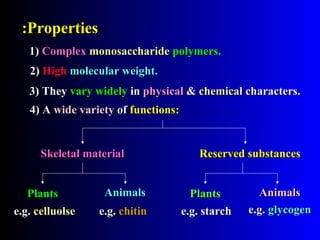
PropertiesProperties::
4) A4) A wide varietywide variety ofof functionsfunctions::
e.g.e.g. chitinchitin
2)2) HighHigh molecular weight.molecular weight.
1)1) ComplexComplex monosaccharidemonosaccharide polymers.polymers.
Skeletal materialSkeletal material
PlantsPlants
e.g.e.g. celluolsecelluolse
AnimalsAnimals
Reserved substancesReserved substances
e.g.e.g. glycogenglycogen
PlantsPlants AnimalsAnimals
e.g. starche.g. starch
3)3) TheyThey vary widelyvary widely inin physicalphysical && chemicalchemical characters.characters.
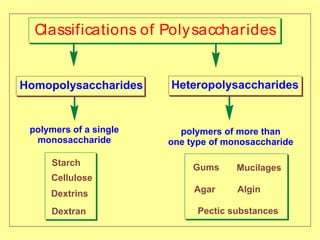
Classifications of Polysaccharides
polymers of more than
one type of monosaccharide
Homopolysaccharides Heteropolysaccharides
polymers of a single
monosaccharide
Starch
Cellulose
Dextrins
Dextran
Gums Mucilages
Agar Algin
Pectic substances
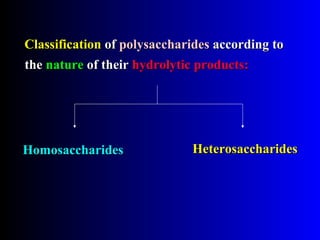
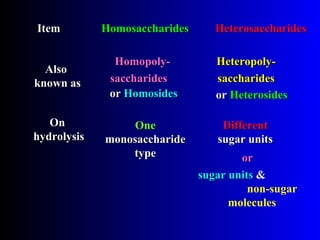
ClassificationClassification ofof ppolysaccharidesolysaccharides according toaccording to
HomosaccharidesHomosaccharides HeterosaccharidesHeterosaccharides
thethe naturenature of theirof their hydrolytic productshydrolytic products::
ItemItem HomosaccharidesHomosaccharides HeterosaccharidesHeterosaccharides
AlsoAlso
known asknown as
Homopoly-Homopoly-
saccharidessaccharides
Heteropoly-Heteropoly-
saccharidessaccharides
oror HomosidesHomosides oror HeterosidesHeterosides
OnOn
hydrolysishydrolysis
OneOne
monosaccharidemonosaccharide
typetype
DifferentDifferent
sugar unitssugar units
sugar unitssugar units &
non-sugar
molecules
oror
I. HomosaccharidesI. Homosaccharides
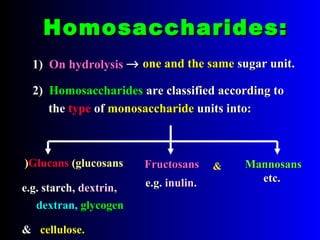
Homosaccharides:Homosaccharides:
FructosansFructosans
1)1) On hydrolysisOn hydrolysis →→ one and the sameone and the same sugar unit.sugar unit.
e.g.e.g. inulin.inulin.
2)2) HomosaccharidesHomosaccharides are classified according toare classified according to
thethe typetype ofof monosaccharidemonosaccharide units into:units into:
GlucansGlucans (glucosans(glucosans))
e.g. starch,e.g. starch, dextrin,dextrin,
dextran,dextran, glycogenglycogen
&& cellulose.cellulose.
MannosansMannosans
etc.etc.
&
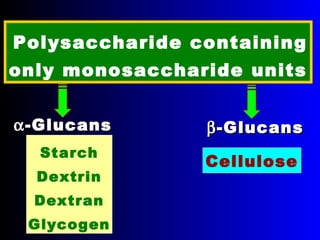
Polysaccharide containing
only monosaccharide units
αα-Glucans-Glucans ββ-Glucans-Glucans
Starch
Dextrin
Dextran
Glycogen
Cellulose
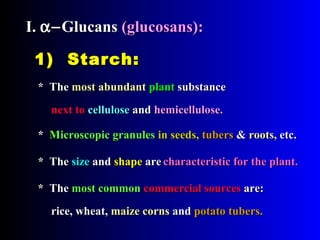
1) Starch:1) Starch:
* The* The most abundantmost abundant plantplant substancesubstance
** Microscopic granulesMicroscopic granules in seeds,in seeds, tuberstubers && roots,roots, etc.etc.
* The* The most commonmost common commercial sourcescommercial sources are:are:
rice, wheat,rice, wheat, maize cornsmaize corns andand potato tubers.potato tubers.
* The* The sizesize andand shapeshape areare
I.I. α−α−GlucansGlucans (glucosans):(glucosans):
next tonext to cellulosecellulose andand hemicellulose.hemicellulose.
characteristic for the plant.characteristic for the plant.
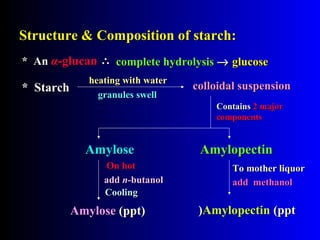
Structure & Composition of starch:Structure & Composition of starch:
* An* An αα-glucan-glucan complete hydrolysiscomplete hydrolysis →→ glucoseglucose
* Starch* Starch
ContainsContains 2 major2 major
componentscomponents
AmylopectinAmylopectin
CoolingCooling
∴∴
colloidal suspensioncolloidal suspensionheating with waterheating with water
granules swellgranules swell
On hotOn hot
addadd nn-butanol-butanol
AmyloseAmylose (ppt)(ppt)
To mother liquorTo mother liquor
add methanoladd methanol
AmylopectinAmylopectin (ppt(ppt))
AmyloseAmylose
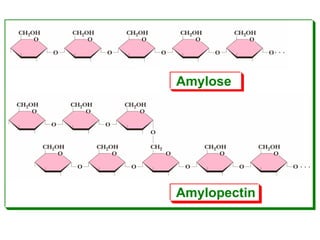
Amylose
Amylopectin
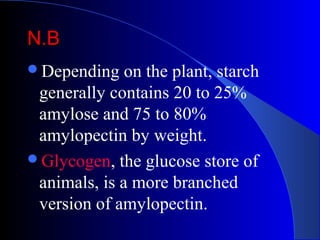
N.BN.B
Depending on the plant, starch
generally contains 20 to 25%
amylose and 75 to 80%
amylopectin by weight.
Glycogen, the glucose store of
animals, is a more branched
version of amylopectin.
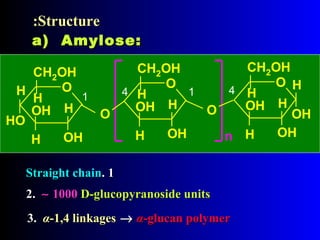
a) Amylose:a) Amylose:
11..Straight chainStraight chain
3.3. αα-1,4 linkages-1,4 linkages
StructureStructure::
2.2. ∼∼ 10001000 D-glucopyranoside unitsD-glucopyranoside units
→→ αα-glucan polymer-glucan polymer
O
n
CH2OH
OH
OH
H
H
H
O
CH2OH
OH
OH
H
H
H
O
O
CH2OH
OH
OH
H
H
H
H
HO O OH
H
1 4 1 4
N.BN.B
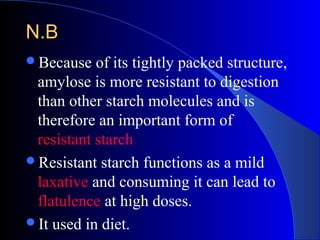
Because of its tightly packed structure,
amylose is more resistant to digestion
than other starch molecules and is
therefore an important form of
resistant starch
Resistant starch functions as a mild
laxative and consuming it can lead to
flatulence at high doses.
It used in diet.
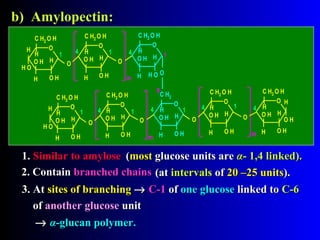
b) Amylopectin:b) Amylopectin:
1.1. SSimilar to amyloseimilar to amylose
2. Contain2. Contain brbranched chainsanched chains
3. At3. At sites of branchingsites of branching →→ C-1C-1 ofof one glucoseone glucose linked tolinked to C-6C-6
ofof anotheranother glucoseglucose unitunit
(at(at intervalsintervals ofof 20 –25 units20 –25 units))..
((mostmost glucose units areglucose units are αα- 1,4 linked- 1,4 linked))..
→→ αα-glucan polymer-glucan polymer..
O
m
C H2 O H
O H
O H
H
H
H
O
C H2 O H
O H
O H
H
H
H
O
O
C H2
O H
O H
H
H
H
O O H
HO
m
C H2 O H
O H
O H
H
H
H
O
O
C H2 O H
O H
O H
H
H
H
H
H O
O
C H2 O H
O H H
H
H
O
O
m
C H2 O H
O H
O H
H
H
O
O
C H2 O H
O H
O H
H
H
H
H
O
H O
H O
1 1
1
14 4
4
4
6
11 14
O
H
4
No.No. ItemItem AmyloseAmylose AmylopectinAmylopectin
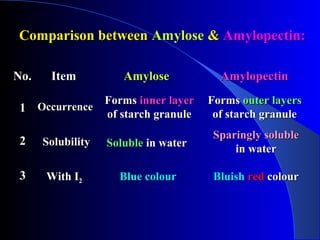
Comparison betweenComparison between AmyloseAmylose && Amylopectin:Amylopectin:
With IWith I22
SolubilitySolubility
OccurrenceOccurrence
Blue colourBlue colour BluishBluish redred colourcolour
FormsForms inner layerinner layer
of starch granuleof starch granule
FormsForms outer layersouter layers
of starch granuleof starch granule
SolubleSoluble in waterin water
Sparingly solubleSparingly soluble
in waterin water
11
22
33
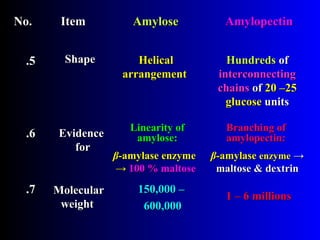
No.No. ItemItem AmyloseAmylose AmylopectinAmylopectin
ShapeShape HelicalHelical
arrangementarrangement
HundredsHundreds ofof
interconnectinginterconnecting
chainschains ofof 20 –2520 –25
glucoseglucose unitsunits
EvidenceEvidence
forfor
Linearity ofLinearity of
amylose:amylose:
Branching ofBranching of
amylopectin:amylopectin:
MolecularMolecular
weightweight
150,000 –150,000 –
600,000600,000
1 – 6 millions1 – 6 millions
55..
66..
77..
ββ-amylase enzyme-amylase enzyme
→→ 100 % maltose100 % maltose
ββ-amylase-amylase enzymeenzyme →→
maltose &maltose & dextrindextrin
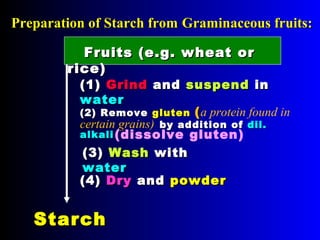
Preparation of Starch fromPreparation of Starch from GGraminaceous fruits:raminaceous fruits:
(1)(1) GrindGrind andand suspendsuspend inin
waterwater
(2) Remove(2) Remove glutengluten ((a protein found in
certain grains) byby addition ofaddition of dil.dil.
alkalialkali
StarchStarch
((44)) DryDry andand powderpowder
(dissolve gluten)
((33)) WashWash withwith
waterwater
Fruits (e.g. wFruits (e.g. w heat orheat or
rriceice))
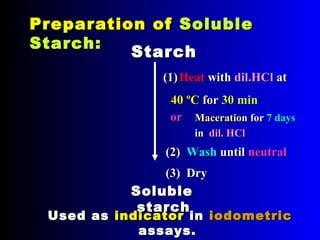
Preparation ofPreparation of SolubleSoluble
Starch:Starch:
StarchStarch
(1)(1) HeatHeat withwith dil.HCldil.HCl atat
MacerationMaceration forfor 7 days7 days
inin dil. HCldil. HCl
(2)(2) WashWash untiluntil neutralneutral
(3) Dry(3) Dry
SolubleSoluble
starchstarch
Used asUsed as indicatorindicator inin iodometriciodometric
assays.assays.
4040 ºCºC forfor 30 min30 min
oror
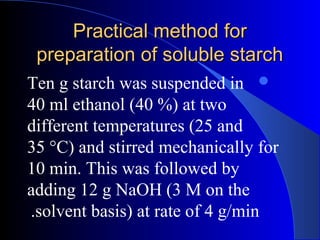
Practical method forPractical method for
preparation of soluble starchpreparation of soluble starch
Ten g starch was suspended in
40 ml ethanol (40 %) at two
different temperatures (25 and
35 °C) and stirred mechanically for
10 min. This was followed by
adding 12 g NaOH (3 M on the
solvent basis) at rate of 4 g/min.
The suspension was gently stirred for 15 min;
afterwards an additional 40 ml ethanol (40 %)
was added slowly and stirred for another
10 min. The slurry was left at room
temperature (25 °C) for 30 min in order to
give sufficient time for the treated starch to
settle down. The settled granules were
washed with fresh ethanol solution (40 %),
neutralized with 3 M HCl in absolute ethanol,
and then washed with 60 % and 95 % ethanol
solutions. The obtained starch was
dehydrated with absolute ethanol, and finally
oven-dried at 80 °C for 3 h.
How soluble starch formedHow soluble starch formed??
It has been suggested that alkali condition
opens up the starch granule structure,
resulting in breaking the intermolecular
hydrogen bonds thereby enhancing the
water solubility. The presence of alcohol
not only restricts the swelling of granules
by decreasing the effective water
concentration but also acts as a complexing
agent to stabilize the dissociated starch
molecules and conserve the granules
integrity.
Uses of Starch:Uses of Starch:
1) Antidote for iodine poisoning.
3)3) NutrientNutrient andand demulcentdemulcent..
2)2) DiluentDiluent inin powderspowders andand tablettablet
manufacture.manufacture.
4)4) Starting materialStarting material in thein the
manufacturemanufacture
ofof::glucose,glucose, maltose,maltose, andand dextrins.dextrins.
Drugs derived from starch
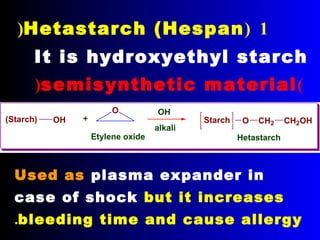
22))DextrinsDextrins1)Hetastarch
It is hydroxyethyl starch
)semisynthetic material(
1(Hetastarch (Hespan(
(Starch) OH +
O OH
alkali
Starch O CH2 CH2OH
Etylene oxide Hetastarch
Used as plasma expander in
case of shock but it increases
bleeding time and cause allergy.
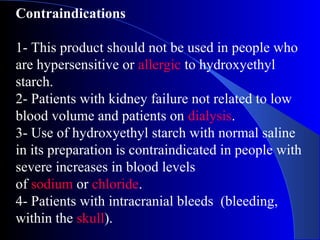
Contraindications
1- This product should not be used in people who
are hypersensitive or allergic to hydroxyethyl
starch.
2- Patients with kidney failure not related to low
blood volume and patients on dialysis.
3- Use of hydroxyethyl starch with normal saline
in its preparation is contraindicated in people with
severe increases in blood levels
of sodium or chloride.
4- Patients with intracranial bleeds (bleeding,
within the skull).
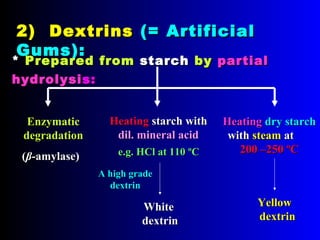
2) Dextrins2) Dextrins (= Artificial(= Artificial
Gums):Gums):
** PPreparedrepared fromfrom starchstarch byby partialpartial
hydrolysihydrolysis:s:
EnzymaticEnzymatic
degradationdegradation
e.g. HCl at 110e.g. HCl at 110 ºCºC
WhiteWhite
dextrindextrin
A high gradeA high grade
dextrindextrin
HeatingHeating dry starchdry starch
withwith steamsteam atat
200 –250200 –250 ºCºC
YellowYellow
dextrindextrin
))ββ-amylase-amylase((
HeatingHeating starch withstarch with
dil. mineral aciddil. mineral acid
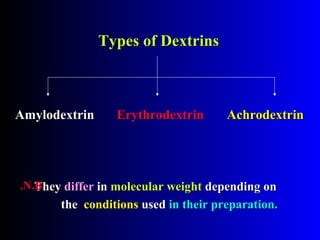
Types of DextrinsTypes of Dextrins
AmylodextrinAmylodextrin
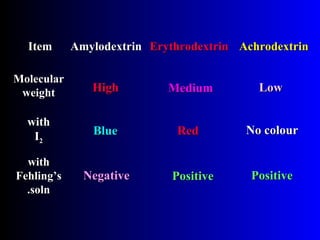
TheyThey differdiffer inin molecular weightmolecular weight depending ondepending on
thethe conditionsconditions useusedd in their preparation.in their preparation.
ErythrodextrinErythrodextrin AAchrochrodextrindextrin
N.BN.B..
ItemItem AmylodextrinAmylodextrin ErythrodextrinErythrodextrin AchrodextrinAchrodextrin
withwith
II22
withwith
Fehling’sFehling’s
solnsoln..
MolecularMolecular
weightweight HighHigh MediumMedium LowLow
BlueBlue RedRed No colourNo colour
NegativeNegative PositivePositive PositivePositive
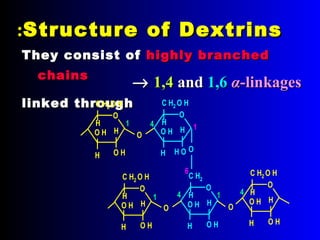
They consist ofThey consist of highly branchedhighly branched
chainschains
linked throughlinked through
Structure of DextrinsStructure of Dextrins::
→→ 1,41,4 andand 1,61,6 αα-linkages-linkages
C H2 O H
O H
O H
H
H
H
O
C H2
O H
O H
H
H
H
O
C H2 O H
O H
O H
H
H
H
O
C H2 O H
O H H
H
H
O
C H2 O H
O H
O H
H
H
O
H O
1 14
4
4
6
11
O
H
OO
O
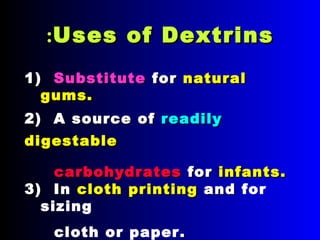
Uses of DextrinsUses of Dextrins::
1)1) SubstituteSubstitute forfor naturalnatural
gums.gums.
2) A source of2) A source of readilyreadily
digestabledigestable
carbohydratescarbohydrates forfor infants.infants.
3) In3) In clothcloth printingprinting andand for
sizing
cloth or paper ..
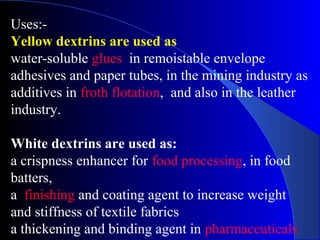
Uses:-
Yellow dextrins are used as
water-soluble glues in remoistable envelope
adhesives and paper tubes, in the mining industry as
additives in froth flotation, and also in the leather
industry.
White dextrins are used as:
a crispness enhancer for food processing, in food
batters,
a finishing and coating agent to increase weight
and stiffness of textile fabrics
a thickening and binding agent in pharmaceuticals
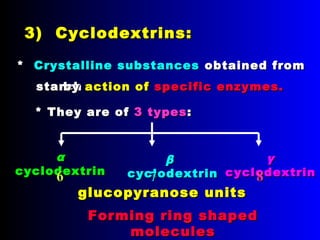
3) Cyclodextrins:3) Cyclodextrins:
** Crystalline substancesCrystalline substances obtained fromobtained from
starchstarch
* They are of* They are of 3 types3 types::
αα
cyclodextrincyclodextrin
ββ
cyclodextrincyclodextrin
γγ
cyclodextrincyclodextrin
glucopyranose unitsglucopyranose units
66 77 88
byby action ofaction of specific enzymes.specific enzymes.
Forming ring shapedForming ring shaped
moleculesmolecules
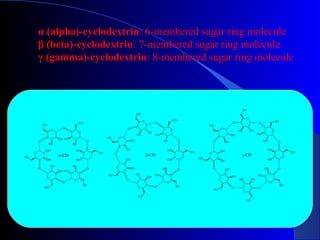
α )alpha(-cyclodextrin: 6-membered sugar ring molecule
β )beta(-cyclodextrin: 7-membered sugar ring molecule
γ )gamma(-cyclodextrin: 8-membered sugar ring molecule
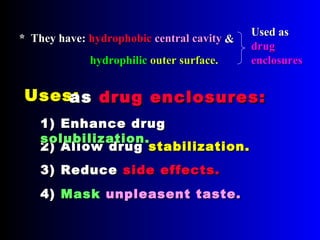
* They have:* They have: hydrophobichydrophobic central cavitycentral cavity
Uses:Uses:
Used asUsed as
drugdrug
enclosuresenclosures
3) Reduce3) Reduce side effects.side effects.
4)4) MaskMask unpleasent taste.unpleasent taste.
2) Allow drug2) Allow drug stabilization.stabilization.
1) Enhance drug1) Enhance drug
solubilization.solubilization.
hydrophilichydrophilic outer surface.outer surface.
&&
asas drug enclosures:drug enclosures:
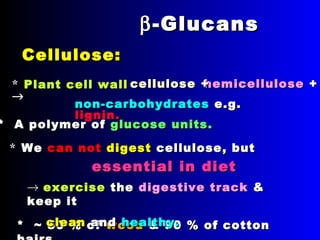
ββ -Glucans-Glucans
Cellulose:Cellulose:
** Plant cell wallPlant cell wall
→→
** ~~ 50 % of50 % of woodwood & 90 % of cotton& 90 % of cotton
* A polymer of* A polymer of glucoseglucose unitsunits ..
** WeWe cacan notn not digestdigest cellulosecellulose , but, but
essential in dietessential in diet
→ eexercisexercise thethe digestive trackdigestive track &&
keep itkeep it
cleanclean andand healthy.healthy.
non-carbohydratesnon-carbohydrates e.g.e.g.
lignin.lignin.
hemicellulosehemicellulose ++cellulosecellulose ++
O
CH2OH
OH
OH
H
H
H
H
HO
O
n
CH2OH
OH
OH
H
H
H
O
O
CH2OH
OH
OH
H
H
H
O
OH
H
1
4
1
4
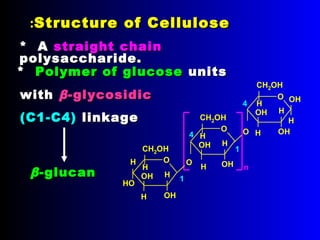
Structure of CelluloseStructure of Cellulose::
ββ-glucan-glucan
** Polymer of glucosePolymer of glucose unitsunits
withwith ββ-glycosidic-glycosidic
(C1-C4)(C1-C4) linkagelinkage
* A* A straight chainstraight chain
polysaccharide.polysaccharide.
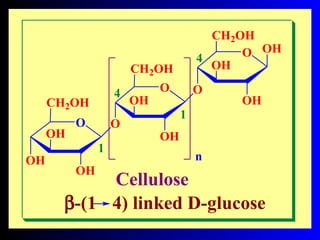
β-)1 4( linked D-glucose
O
OH
O
OH
CH2OH
O
OH
OH
CH2OH
O
O OH
OH
OH
CH2OH
OH
1
4
4
1
n
Cellulose
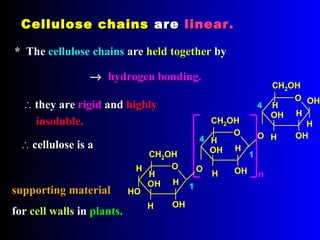
* The* The cellulose chainscellulose chains areare held togetherheld together byby
∴∴ they arethey are rigidrigid andand highlyhighly
insoluble.insoluble.
∴∴ cellulose is acellulose is a
Cellulose chainsCellulose chains areare linear.linear.
→→ hydrogen bonding.hydrogen bonding.
O
CH2OH
OH
OH
H
H
H
H
HO
O
n
CH2OH
OH
OH
H
H
H
O
O
CH2OH
OH
OH
H
H
H
O
OH
H
1
4
1
4
supporting materialsupporting material
forfor cell wallscell walls inin plants.plants.
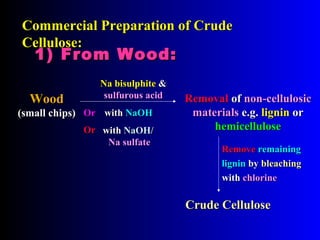
Commercial Preparation of CrudeCommercial Preparation of Crude
Cellulose:Cellulose:
Crude CelluloseCrude Cellulose
WoodWood
)small chips()small chips(
RemovalRemoval ofof non-cellulosicnon-cellulosic
materialsmaterials e.g.e.g. ligninlignin oror
hemicellulosehemicellulose
Na bisulphiteNa bisulphite &&
sulfurous acidsulfurous acid
withwith NaOHNaOH
RemoveRemove remainingremaining
ligninlignin byby bleachingbleaching
withwith chlorinechlorine
1) From Wood:1) From Wood:
OrOr
OrOr withwith NaOH/NaOH/
Na sulfateNa sulfate
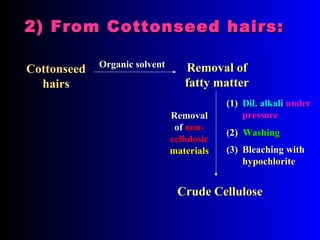
CottonseedCottonseed
hairshairs
Organic solventOrganic solvent Removal ofRemoval of
fatty matterfatty matter
RemovalRemoval
ofof non-non-
cellulosiccellulosic
materialsmaterials
)1()1( Dil. alkaliDil. alkali underunder
pressurepressure
)2()2( WashingWashing
)3()3( Bleaching withBleaching with
hypochloritehypochlorite
2) From Cottonseed hairs:2) From Cottonseed hairs:
Crude CelluloseCrude Cellulose
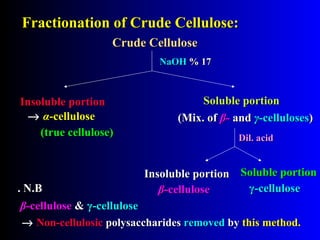
Fractionation of Crude Cellulose:Fractionation of Crude Cellulose:
Crude CelluloseCrude Cellulose
1717%%NaOHNaOH
Insoluble portionInsoluble portion
)Mix. of)Mix. of ββ-- andand γγ-celluloses-celluloses((
Dil. acidDil. acid
ββ-cellulose-cellulose γ-celluloseγ-cellulose
Soluble portionSoluble portion
Insoluble portionInsoluble portion Soluble portionSoluble portion
→→ αα-cellulose-cellulose
)true cellulose()true cellulose(
N.BN.B..
ββ-cellulose-cellulose && γ-celluloseγ-cellulose
→→ Non-cellulosicNon-cellulosic polysaccharidespolysaccharides removedremoved byby this method.this method.
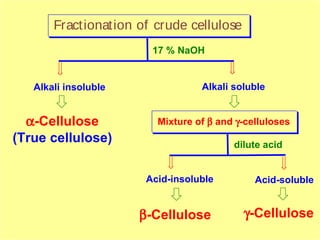
Fractionation of crude cellulose
17 % NaOH
Alkali insoluble
α-Cellulose
(True cellulose)
Alkali soluble
Mixture of β and γ-celluloses
dilute acid
Acid-insoluble Acid-soluble
β-Cellulose γ-Cellulose
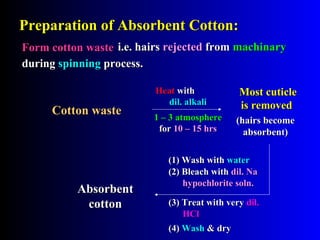
Form cotton wasteForm cotton waste
Cotton wasteCotton waste
HeatHeat withwith
dil. alkalidil. alkali
1 – 3 atmosphere1 – 3 atmosphere
forfor 10 – 15 hrs10 – 15 hrs
Most cuticleMost cuticle
is removedis removed
)1( Wash with)1( Wash with waterwater
)2( Bleach with)2( Bleach with dil. Nadil. Na
hypochlorite soln.hypochlorite soln.
)3( Treat with very)3( Treat with very dil.dil.
HClHCl
AbsorbentAbsorbent
cottoncotton
Preparation of Absorbent Cotton:Preparation of Absorbent Cotton:
i.e. hairsi.e. hairs rejectedrejected fromfrom machinarymachinary
duringduring spinningspinning process.process.
)hairs become)hairs become
absorbenabsorbentt((
)4()4( WashWash & dry& dry
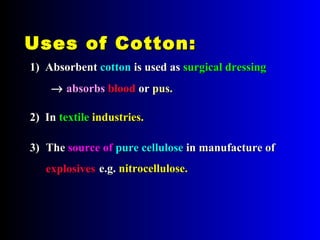
Uses of Cotton:Uses of Cotton:
2( In2( In textiletextile industries.industries.
3(3( TheThe source ofsource of pure cellulosepure cellulose in manufacture ofin manufacture of
explosivesexplosives e.g.e.g. nitrocellulose.nitrocellulose.
1( Absorbent1( Absorbent cottoncotton is used asis used as surgical dressingsurgical dressing
→→ absorbsabsorbs bloodblood oror pus.pus.
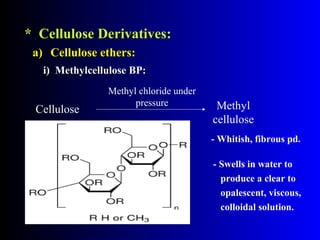
* Cellulose Derivatives:* Cellulose Derivatives:
a(a( Cellulose ethers:Cellulose ethers:
i( Methylcellulose BP:i( Methylcellulose BP:
Cellulose
Methyl chloride under
pressure Methyl
cellulose
- Whitish, fibrous pd.
- Swells in water to
produce a clear to
opalescent, viscous,
colloidal solution.
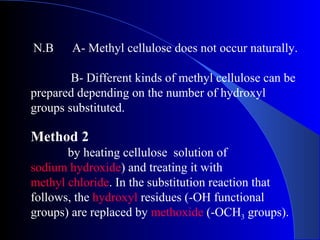
N.B A- Methyl cellulose does not occur naturally.
B- Different kinds of methyl cellulose can be
prepared depending on the number of hydroxyl
groups substituted.
Method 2
by heating cellulose solution of
sodium hydroxide) and treating it with
methyl chloride. In the substitution reaction that
follows, the hydroxyl residues (-OH functional
groups) are replaced by methoxide (-OCH3 groups).
MethylcelluloseMethylcellulose is used:
1) To increase the viscosity & to stabilize lotions,
suspensions, pastes, and some ointments and
ophthalmic preparations.
2) As bulk laxative in chronic constipation & in
treatment of obesity.
3) The lubricating property of methyl cellulose is
of particular benefit in the treatment of dry
eyes & mouth . (used as a tear & saliva
substitute).
Gives feeling of fullness
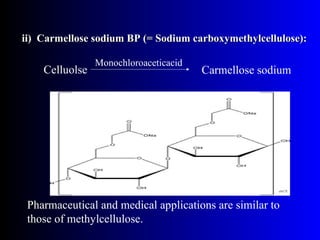
ii) Carmellose sodium BP (= Sodium carboxymethylcellulose):ii) Carmellose sodium BP (= Sodium carboxymethylcellulose):
Celluolse
Monochloroaceticacid
Carmellose sodium
Pharmaceutical and medical applications are similar to
those of methylcellulose.
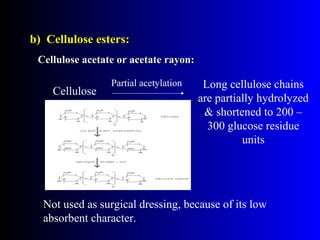
b) Cellulose esters:b) Cellulose esters:
Cellulose acetate or acetate rayon:Cellulose acetate or acetate rayon:
Cellulose
Partial acetylation Long cellulose chains
are partially hydrolyzed
& shortened to 200 –
300 glucose residue
units
Not used as surgical dressing, because of its low
absorbent character.
Uses:
4-As a component of plastic bandage
1- as a component in some coatings.
2- frame material for eyeglasses.
3- synthetic fiber in the manufacture of
cigarette filters and playing cards. In
photographic film.
N.B Cellulose acetate replaced nitrate film in the
1950s due to being far less flammable as well as
cheaper to produce.
Glycogen (= Animal starch):Glycogen (= Animal starch):
• It is the principal reserve
polysaccharide of animals
(used to store energy), found in
muscles and liver.
Source:Source:
Another polymer of glucose.
• Formed of α-D-glucose units
linked by α-1,4 & α-1,6 linkages.
• Hydrolyzed by β-amylase into
maltose.
Structure:Structure:
* Highly branched chains.
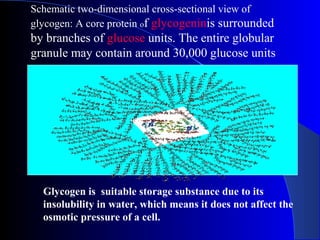
Schematic two-dimensional cross-sectional view of
glycogen: A core protein of glycogeninis surrounded
by branches of glucose units. The entire globular
granule may contain around 30,000 glucose units
Glycogen is suitable storage substance due to its
insolubility in water, which means it does not affect the
osmotic pressure of a cell.
Glycogen phosphorylase is the primary enzyme of
glycogen breakdown.
Glucagon is a peptide hormone, produced by alpha cells
of the pancreas, that raises the concentration of glucose
in the bloodstream. Its effect is opposite that of insulin,
which lowers the glucose concentration. The pancreas
releases glucagon when the concentration of glucose in
the bloodstream falls too low. Glucagon causes the liver
to convert stored glycogen into glucose, which is
released into the bloodstream. High blood glucose levels
stimulate the release of insulin.
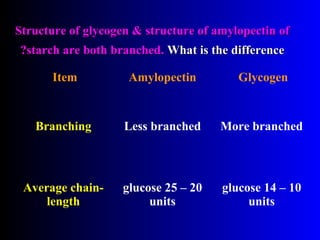
Structure of glycogen & structure of amylopectin ofStructure of glycogen & structure of amylopectin of
starch are both branched.starch are both branched. What is the differenceWhat is the difference??
Item Amylopectin Glycogen
Branching Less branched More branched
Average chain-
length
20–25glucose
units
10–14glucose
units
Dextran:Dextran:
• Obtained from sucrose by the
action of bacterial enzyme
obtained from
Leuconostic mesenteroides.
Source:Source:
An example of biochemical
conversion of a disaccharide into a
Dextran is synthesized from sucrose by
certain lactic acid bacteria, the best-
known Leuconostoc mesenteroides
andStreptococcus mutans.
Dental plaque is rich in dextrans.
Dextran was first discovered by Louis
Pasteur as a microbial product in wine.
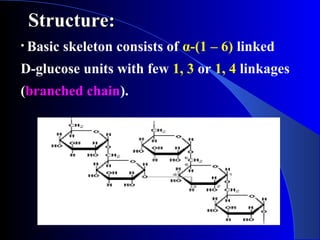
Structure:Structure:
• Basic skeleton consists of α-(1 – 6) linked
D-glucose units with few 1, 3 or 1, 4 linkages
(branched chain).
Uses:Uses:
1) As plasma extender for
emergency treatment in cases of
shock due to hemorrhage, or
severe burns.
2)Dextran sulphates can be used as:
- anticoagulants
- in treatment of ulcer and in
preparation of sephadex.
Side effects
Although relatively few side effects are
associated with dextran use, these side effects
can be very serious. These include :
1- Anaphylaxis.
2- Pulmonary edema.
3- Cerebral edema, or platelet dysfunction.
An uncommon but significant complication of
dextran osmotic effect is acute renal failure.
Inulin:Inulin:
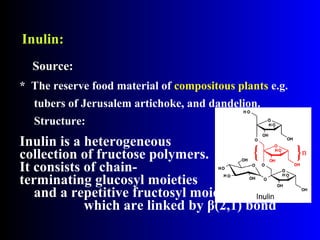
* The reserve food material of compositous plants e.g.
tubers of Jerusalem artichoke, and dandelion.
Structure:
Inulin is a heterogeneous
collection of fructose polymers.
It consists of chain-
terminating glucosyl moieties
and a repetitive fructosyl moiety,
which are linked by β(2,1) bond
Source:Source:
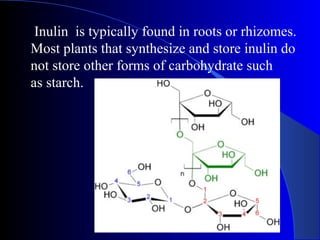
Inulin is typically found in roots or rhizomes.
Most plants that synthesize and store inulin do
not store other forms of carbohydrate such
as starch.
Uses
1-preparation of culture media as a
fermentative identifying agent for
certain bacteria.
2-diagnostic agent for evaluation of
renal function.
3-decrease the level of triglycerides
and cholesterol after a meal.
Heteropolysaccharides
A) Gums
■Plant gums are polysaccharides exuded from certain
plants as pathological products, e.g. gum arabic
and gum tragacanth.
■They are a heterogeneous group of acidic
substances, which swell in water to form viscous
or sticky solutions.
■Acid hydrolysis of gums → a complex mixture of
uronic acids, generally (D-glucuronic or
galacturonic) acid, together with D-galactose, L-
arabinose D-mannose, xylose, L-rhamnose and L-
fucose.
Gum Arabic (gum
acacia)
and
Gum Tragacanth
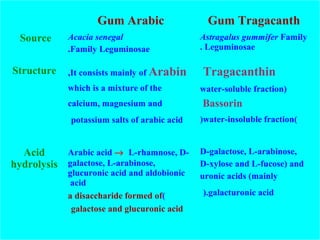
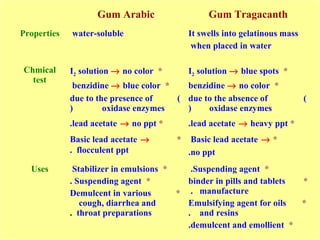
Gum Arabic Gum Tragacanth
Source Acacia senegal
Family Leguminosae.
Astragalus gummifer Family
Leguminosae.
Structure It consists mainly of Arabin,
which is a mixture of the
calcium, magnesium and
potassium salts of arabic acid
Tragacanthin
water-soluble fraction)
Bassorin
(water-insoluble fraction)
Acid
hydrolysis
Arabic acid → L-rhamnose, D-
galactose, L-arabinose,
glucuronic acid and aldobionic
acid
(a disaccharide formed of
galactose and glucuronic acid
D-galactose, L-arabinose,
D-xylose and L-fucose) and
uronic acids (mainly
galacturonic acid).
Gum Arabic Gum Tragacanth
Properties water-soluble It swells into gelatinous mass
when placed in water
Chmical
test
*I2 solution → no color
*benzidine → blue color
(due to the presence of
oxidase enzymes)
*lead acetate → no ppt.
*Basic lead acetate →
flocculent ppt.
*I2 solution → blue spots
*benzidine → no color
(due to the absence of
oxidase enzymes)
*lead acetate → heavy ppt.
*Basic lead acetate →
no ppt.
Uses *Stabilizer in emulsions
*Suspending agent.
*Demulcent in various
cough, diarrhea and
throat preparations.
*Suspending agent.
*binder in pills and tablets
manufacture.
*Emulsifying agent for oils
and resins.
*demulcent and emollient.
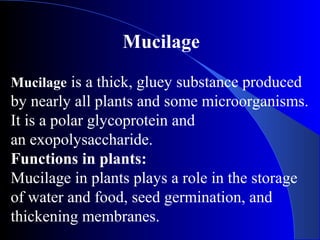
Mucilage
Mucilage is a thick, gluey substance produced
by nearly all plants and some microorganisms.
It is a polar glycoprotein and
an exopolysaccharide.
Functions in plants:
Mucilage in plants plays a role in the storage
of water and food, seed germination, and
thickening membranes.
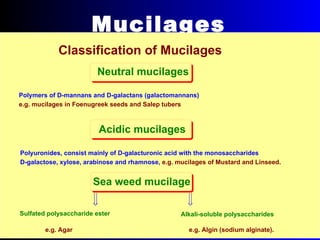
Mucilages
Classification of Mucilages
Polymers of D-mannans and D-galactans (galactomannans)
e.g. mucilages in Foenugreek seeds and Salep tubers
Neutral mucilages
Acidic mucilages
Polyuronides, consist mainly of D-galacturonic acid with the monosaccharides
D-galactose, xylose, arabinose and rhamnose, e.g. mucilages of Mustard and Linseed.
Sea weed mucilage
Sulfated polysaccharide ester
e.g. Agar
Alkali-soluble polysaccharides
e.g. Algin (sodium alginate).
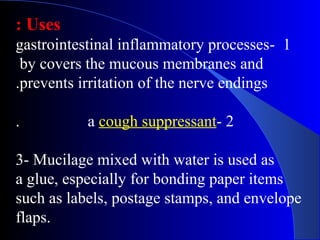
Uses:
1-gastrointestinal inflammatory processes
by covers the mucous membranes and
prevents irritation of the nerve endings.
2-a cough suppressant.
3- Mucilage mixed with water is used as
a glue, especially for bonding paper items
such as labels, postage stamps, and envelope
flaps.
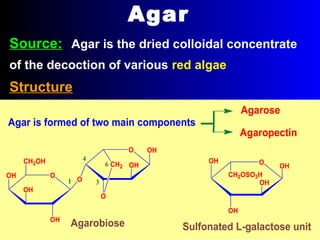
Agar
Source: Agar is the dried colloidal concentrate
of the decoction of various red algae
Structure
Agar is formed of two main components
OOH
O
OH
OH
CH2OH
O
CH2
O
OH
OH6
1
4
3
Agarobiose
O
CH2OSO3H
OH
OH
OH
Sulfonated L-galactose unit
OH
Agaropectin
Agarose
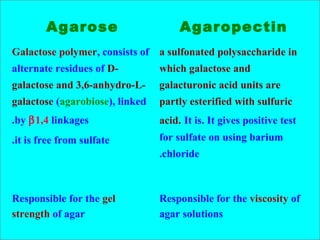
Agarose Agaropectin
Galactose polymer, consists of
alternate residues of D-
galactose and 3,6-anhydro-L-
galactose (agarobiose), linked
by β1,4 linkages.
it is free from sulfate.
a sulfonated polysaccharide in
which galactose and
galacturonic acid units are
partly esterified with sulfuric
acid. It is. It gives positive test
for sulfate on using barium
chloride.
Responsible for the gel
strength of agar
Responsible for the viscosity of
agar solutions
Uses:
• Preparation of
bacteriological culture
media,
• As emulsifier.
• Thickener for ice cream.
• Treatment of ulcers and
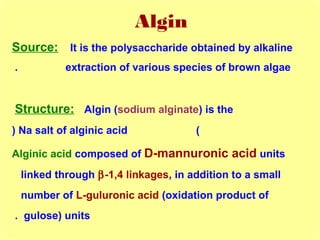
Algin
Source: It is the polysaccharide obtained by alkaline
extraction of various species of brown algae.
Structure: Algin (sodium alginate) is the
(Na salt of alginic acid)
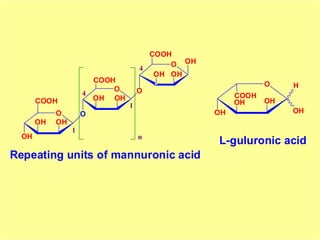
Alginic acid composed of D-mannuronic acid units
linked through β-1,4 linkages, in addition to a small
number of L-guluronic acid (oxidation product of
gulose) units.
O
OH
O
OH
COOH
O O
OHOH
COOH
O OH
OH
COOH
OH
1
4
4
1
n
Repeating units of mannuronic acid
O
OH
OH
COOH
H
OH
OH
OH
L-guluronic acid
Uses of algin
■Stabilizer, thickener, emulsifier, and jelling
■It is used in dentistry, food and cosmetic
industries.
■It has important pharmaceutical applications
in formulation of creams, ointments, pastes,
jellies and tablets.
Pectic substances
■ Pectic substances are colloidal polyuronides of
high molecular weight.
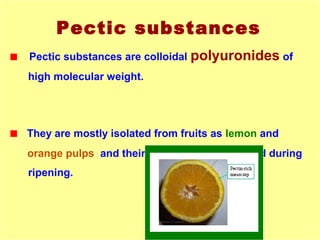
■ They are mostly isolated from fruits as lemon and
orange pulps and their structures are changed during
ripening.
Structure
Pectins consist of three components:
Galacturonans: (α-1,4 D-galacturonic acid residues
esterified with methanol. The polymer chains are
interrupted by rhamnose units.
Arabinans: (α-1, 5-linked L-arabinofuranose units).
Galactans: (β-1, 4-linked D-galactopyranose units).
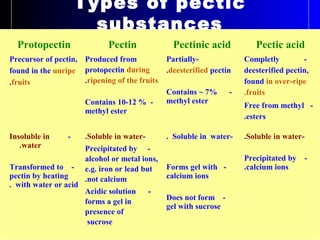
Types of pectic
substances
Protopectin Pectin Pectinic acid Pectic acid
Precursor of pectin,
found in the unripe
fruits.
Produced from
protopectin during
ripening of the fruits.
-Contains 10-12 %
methyl ester
-Partially
deesterified pectin.
-Contains ~ 7%
methyl ester
-Completly
deesterified pectin,
found in over-ripe
fruits.
-Free from methyl
esters.
-Insoluble in
water.
-Transformed to
pectin by heating
with water or acid.
-Soluble in water.
-Precipitated by
alcohol or metal ions,
e.g. iron or lead but
not calcium.
-Acidic solution
forms a gel in
presence of
sucrose
-Soluble in water.
-Forms gel with
calcium ions
-Does not form
gel with sucrose
-Soluble in water.
-Precipitated by
calcium ions.
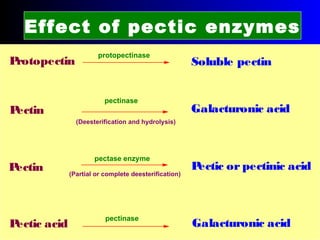
Effect of pectic enzymes
Protopectin
Pectin
Pectic acid
protopectinase
Soluble pectin
pectinase
Galacturonic acid
(Deesterification and hydrolysis)
Pectin Pectic or pectinic acid
pectase enzyme
(Partial or complete deesterification)
pectinase
Galacturonic acid
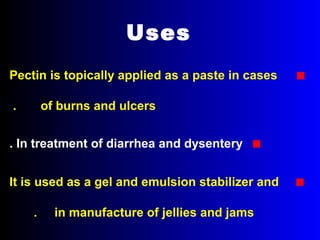
Uses
■Pectin is topically applied as a paste in cases
of burns and ulcers.
■In treatment of diarrhea and dysentery.
■It is used as a gel and emulsion stabilizer and
in manufacture of jellies and jams.
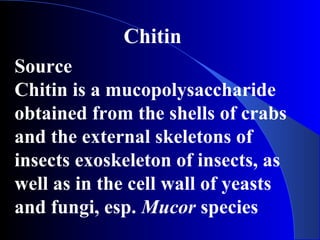
Chitin
Source
Chitin is a mucopolysaccharide
obtained from the shells of crabs
and the external skeletons of
insects exoskeleton of insects, as
well as in the cell wall of yeasts
and fungi, esp. Mucor species
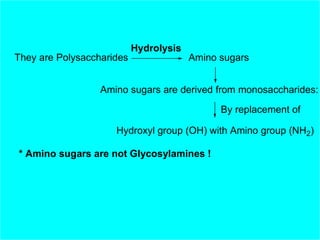
They are Polysaccharides
Hydrolysis
Amino sugars
Amino sugars are derived from monosaccharides:
By replacement of
Hydroxyl group (OH) with Amino group (NH2)
* Amino sugars are not Glycosylamines !
O
HO
HO
NHCOCH3
O
OH
O
OH
NHCOCH3
OH
CH2OH
O
1) HCl
2) wash with H2O
3) dil. NaOH (deproteination)
CaCO3 & proteins are removed
1) wash with H2O
2) wash with organic solvent
(to remove pigments,[ carotenoids])
3) dry
Chitin is a linear polymer of chitobiose
The most important sources of chitin are the large amounts of waste crab
and krill shells from the fishing industry,
Waste products of crab shells are decalcified by
Production of chitin
2
O
NHCOCH3
OH
CH2OH
OH
4
1
O
HO
NHCOCH3
OH
OH
Chitobiose
2-acetamido-2-dioxy-D-glucose Chitin
2 molecules of N-acetyl-D- glucosamine with β-(1-4) linkage
Acid hydrolysis
Enzymatic hydrolysis
Acetic acid + D-glucosamine (= 2-aminoglucose)
N-acetyl-D-glucosamine
Uses of chitin:
Medicine and health care: Lowering of serum
lipids Bone regeneration; treatment of
rheumatoid diseases, wound care, artificial skin,
hemostasis
Pharmaceutical: Sustained release
formulations, transmucosal drug delivery; drug
targeting
Cosmetics Skin moisturing ingredient; hair
shampoos, hair styling, dentrifices
Acidic Polysaccharides
1- Heparin
Structure
Heparin is a homogeneous mixture of variably sulfonated
linear polysaccharide chains,
Uses
Heparin and heparin analogues are primary used as
anticoagulants for blood
transfusions.
2- Hyaluronic acid
polysaccharide present in connective tissue.
lubricant of joints in the body
Biologically Active Carbohydrates
Acarbose (Glucobay®)
is a complex oligosaccharide containing
amino sugars, Closely related to the
aminoglycoside antibiotics isolated from
Actinoplanes and Streptomyces spp
4- Laxatives
Lactulose [4-(β-D-
galactopyranosyl)-β-D-fructofuranose
is used in treatment of hepatic coma
and chronic constipation.
Sucralfate is an aluminum
hydroxide complex of sucrose
sulfate that is used in the therapy
of duodenal ulcers.
Thank You
&
My Best Wishes

Polysaccharides

  • 1.
  • 2.
    PropertiesProperties:: 4) A4) Awide varietywide variety ofof functionsfunctions:: e.g.e.g. chitinchitin 2)2) HighHigh molecular weight.molecular weight. 1)1) ComplexComplex monosaccharidemonosaccharide polymers.polymers. Skeletal materialSkeletal material PlantsPlants e.g.e.g. celluolsecelluolse AnimalsAnimals Reserved substancesReserved substances e.g.e.g. glycogenglycogen PlantsPlants AnimalsAnimals e.g. starche.g. starch 3)3) TheyThey vary widelyvary widely inin physicalphysical && chemicalchemical characters.characters.
  • 3.
    Classifications of Polysaccharides polymersof more than one type of monosaccharide Homopolysaccharides Heteropolysaccharides polymers of a single monosaccharide Starch Cellulose Dextrins Dextran Gums Mucilages Agar Algin Pectic substances
  • 4.
    ClassificationClassification ofof ppolysaccharidesolysaccharidesaccording toaccording to HomosaccharidesHomosaccharides HeterosaccharidesHeterosaccharides thethe naturenature of theirof their hydrolytic productshydrolytic products::
  • 5.
    ItemItem HomosaccharidesHomosaccharides HeterosaccharidesHeterosaccharides AlsoAlso knownasknown as Homopoly-Homopoly- saccharidessaccharides Heteropoly-Heteropoly- saccharidessaccharides oror HomosidesHomosides oror HeterosidesHeterosides OnOn hydrolysishydrolysis OneOne monosaccharidemonosaccharide typetype DifferentDifferent sugar unitssugar units sugar unitssugar units & non-sugar molecules oror
  • 6.
  • 7.
    Homosaccharides:Homosaccharides: FructosansFructosans 1)1) On hydrolysisOnhydrolysis →→ one and the sameone and the same sugar unit.sugar unit. e.g.e.g. inulin.inulin. 2)2) HomosaccharidesHomosaccharides are classified according toare classified according to thethe typetype ofof monosaccharidemonosaccharide units into:units into: GlucansGlucans (glucosans(glucosans)) e.g. starch,e.g. starch, dextrin,dextrin, dextran,dextran, glycogenglycogen && cellulose.cellulose. MannosansMannosans etc.etc. &
  • 8.
    Polysaccharide containing only monosaccharideunits αα-Glucans-Glucans ββ-Glucans-Glucans Starch Dextrin Dextran Glycogen Cellulose
  • 9.
    1) Starch:1) Starch: *The* The most abundantmost abundant plantplant substancesubstance ** Microscopic granulesMicroscopic granules in seeds,in seeds, tuberstubers && roots,roots, etc.etc. * The* The most commonmost common commercial sourcescommercial sources are:are: rice, wheat,rice, wheat, maize cornsmaize corns andand potato tubers.potato tubers. * The* The sizesize andand shapeshape areare I.I. α−α−GlucansGlucans (glucosans):(glucosans): next tonext to cellulosecellulose andand hemicellulose.hemicellulose. characteristic for the plant.characteristic for the plant.
  • 10.
    Structure & Compositionof starch:Structure & Composition of starch: * An* An αα-glucan-glucan complete hydrolysiscomplete hydrolysis →→ glucoseglucose * Starch* Starch ContainsContains 2 major2 major componentscomponents AmylopectinAmylopectin CoolingCooling ∴∴ colloidal suspensioncolloidal suspensionheating with waterheating with water granules swellgranules swell On hotOn hot addadd nn-butanol-butanol AmyloseAmylose (ppt)(ppt) To mother liquorTo mother liquor add methanoladd methanol AmylopectinAmylopectin (ppt(ppt)) AmyloseAmylose
  • 11.
  • 12.
    N.BN.B Depending on theplant, starch generally contains 20 to 25% amylose and 75 to 80% amylopectin by weight. Glycogen, the glucose store of animals, is a more branched version of amylopectin.
  • 13.
    a) Amylose:a) Amylose: 11..StraightchainStraight chain 3.3. αα-1,4 linkages-1,4 linkages StructureStructure:: 2.2. ∼∼ 10001000 D-glucopyranoside unitsD-glucopyranoside units →→ αα-glucan polymer-glucan polymer O n CH2OH OH OH H H H O CH2OH OH OH H H H O O CH2OH OH OH H H H H HO O OH H 1 4 1 4
  • 14.
    N.BN.B Because of itstightly packed structure, amylose is more resistant to digestion than other starch molecules and is therefore an important form of resistant starch Resistant starch functions as a mild laxative and consuming it can lead to flatulence at high doses. It used in diet.
  • 15.
    b) Amylopectin:b) Amylopectin: 1.1.SSimilar to amyloseimilar to amylose 2. Contain2. Contain brbranched chainsanched chains 3. At3. At sites of branchingsites of branching →→ C-1C-1 ofof one glucoseone glucose linked tolinked to C-6C-6 ofof anotheranother glucoseglucose unitunit (at(at intervalsintervals ofof 20 –25 units20 –25 units)).. ((mostmost glucose units areglucose units are αα- 1,4 linked- 1,4 linked)).. →→ αα-glucan polymer-glucan polymer.. O m C H2 O H O H O H H H H O C H2 O H O H O H H H H O O C H2 O H O H H H H O O H HO m C H2 O H O H O H H H H O O C H2 O H O H O H H H H H H O O C H2 O H O H H H H O O m C H2 O H O H O H H H O O C H2 O H O H O H H H H H O H O H O 1 1 1 14 4 4 4 6 11 14 O H 4
  • 16.
    No.No. ItemItem AmyloseAmyloseAmylopectinAmylopectin Comparison betweenComparison between AmyloseAmylose && Amylopectin:Amylopectin: With IWith I22 SolubilitySolubility OccurrenceOccurrence Blue colourBlue colour BluishBluish redred colourcolour FormsForms inner layerinner layer of starch granuleof starch granule FormsForms outer layersouter layers of starch granuleof starch granule SolubleSoluble in waterin water Sparingly solubleSparingly soluble in waterin water 11 22 33
  • 17.
    No.No. ItemItem AmyloseAmyloseAmylopectinAmylopectin ShapeShape HelicalHelical arrangementarrangement HundredsHundreds ofof interconnectinginterconnecting chainschains ofof 20 –2520 –25 glucoseglucose unitsunits EvidenceEvidence forfor Linearity ofLinearity of amylose:amylose: Branching ofBranching of amylopectin:amylopectin: MolecularMolecular weightweight 150,000 –150,000 – 600,000600,000 1 – 6 millions1 – 6 millions 55.. 66.. 77.. ββ-amylase enzyme-amylase enzyme →→ 100 % maltose100 % maltose ββ-amylase-amylase enzymeenzyme →→ maltose &maltose & dextrindextrin
  • 18.
    Preparation of StarchfromPreparation of Starch from GGraminaceous fruits:raminaceous fruits: (1)(1) GrindGrind andand suspendsuspend inin waterwater (2) Remove(2) Remove glutengluten ((a protein found in certain grains) byby addition ofaddition of dil.dil. alkalialkali StarchStarch ((44)) DryDry andand powderpowder (dissolve gluten) ((33)) WashWash withwith waterwater Fruits (e.g. wFruits (e.g. w heat orheat or rriceice))
  • 19.
    Preparation ofPreparation ofSolubleSoluble Starch:Starch: StarchStarch (1)(1) HeatHeat withwith dil.HCldil.HCl atat MacerationMaceration forfor 7 days7 days inin dil. HCldil. HCl (2)(2) WashWash untiluntil neutralneutral (3) Dry(3) Dry SolubleSoluble starchstarch Used asUsed as indicatorindicator inin iodometriciodometric assays.assays. 4040 ºCºC forfor 30 min30 min oror
  • 20.
    Practical method forPracticalmethod for preparation of soluble starchpreparation of soluble starch Ten g starch was suspended in 40 ml ethanol (40 %) at two different temperatures (25 and 35 °C) and stirred mechanically for 10 min. This was followed by adding 12 g NaOH (3 M on the solvent basis) at rate of 4 g/min.
  • 21.
    The suspension wasgently stirred for 15 min; afterwards an additional 40 ml ethanol (40 %) was added slowly and stirred for another 10 min. The slurry was left at room temperature (25 °C) for 30 min in order to give sufficient time for the treated starch to settle down. The settled granules were washed with fresh ethanol solution (40 %), neutralized with 3 M HCl in absolute ethanol, and then washed with 60 % and 95 % ethanol solutions. The obtained starch was dehydrated with absolute ethanol, and finally oven-dried at 80 °C for 3 h.
  • 22.
    How soluble starchformedHow soluble starch formed?? It has been suggested that alkali condition opens up the starch granule structure, resulting in breaking the intermolecular hydrogen bonds thereby enhancing the water solubility. The presence of alcohol not only restricts the swelling of granules by decreasing the effective water concentration but also acts as a complexing agent to stabilize the dissociated starch molecules and conserve the granules integrity.
  • 23.
    Uses of Starch:Usesof Starch: 1) Antidote for iodine poisoning. 3)3) NutrientNutrient andand demulcentdemulcent.. 2)2) DiluentDiluent inin powderspowders andand tablettablet manufacture.manufacture. 4)4) Starting materialStarting material in thein the manufacturemanufacture ofof::glucose,glucose, maltose,maltose, andand dextrins.dextrins.
  • 24.
    Drugs derived fromstarch 22))DextrinsDextrins1)Hetastarch
  • 25.
    It is hydroxyethylstarch )semisynthetic material( 1(Hetastarch (Hespan( (Starch) OH + O OH alkali Starch O CH2 CH2OH Etylene oxide Hetastarch Used as plasma expander in case of shock but it increases bleeding time and cause allergy.
  • 26.
    Contraindications 1- This productshould not be used in people who are hypersensitive or allergic to hydroxyethyl starch. 2- Patients with kidney failure not related to low blood volume and patients on dialysis. 3- Use of hydroxyethyl starch with normal saline in its preparation is contraindicated in people with severe increases in blood levels of sodium or chloride. 4- Patients with intracranial bleeds (bleeding, within the skull).
  • 27.
    2) Dextrins2) Dextrins(= Artificial(= Artificial Gums):Gums): ** PPreparedrepared fromfrom starchstarch byby partialpartial hydrolysihydrolysis:s: EnzymaticEnzymatic degradationdegradation e.g. HCl at 110e.g. HCl at 110 ºCºC WhiteWhite dextrindextrin A high gradeA high grade dextrindextrin HeatingHeating dry starchdry starch withwith steamsteam atat 200 –250200 –250 ºCºC YellowYellow dextrindextrin ))ββ-amylase-amylase(( HeatingHeating starch withstarch with dil. mineral aciddil. mineral acid
  • 28.
    Types of DextrinsTypesof Dextrins AmylodextrinAmylodextrin TheyThey differdiffer inin molecular weightmolecular weight depending ondepending on thethe conditionsconditions useusedd in their preparation.in their preparation. ErythrodextrinErythrodextrin AAchrochrodextrindextrin N.BN.B..
  • 29.
    ItemItem AmylodextrinAmylodextrin ErythrodextrinErythrodextrinAchrodextrinAchrodextrin withwith II22 withwith Fehling’sFehling’s solnsoln.. MolecularMolecular weightweight HighHigh MediumMedium LowLow BlueBlue RedRed No colourNo colour NegativeNegative PositivePositive PositivePositive
  • 30.
    They consist ofTheyconsist of highly branchedhighly branched chainschains linked throughlinked through Structure of DextrinsStructure of Dextrins:: →→ 1,41,4 andand 1,61,6 αα-linkages-linkages C H2 O H O H O H H H H O C H2 O H O H H H H O C H2 O H O H O H H H H O C H2 O H O H H H H O C H2 O H O H O H H H O H O 1 14 4 4 6 11 O H OO O
  • 31.
    Uses of DextrinsUsesof Dextrins:: 1)1) SubstituteSubstitute forfor naturalnatural gums.gums. 2) A source of2) A source of readilyreadily digestabledigestable carbohydratescarbohydrates forfor infants.infants. 3) In3) In clothcloth printingprinting andand for sizing cloth or paper ..
  • 32.
    Uses:- Yellow dextrins areused as water-soluble glues in remoistable envelope adhesives and paper tubes, in the mining industry as additives in froth flotation, and also in the leather industry. White dextrins are used as: a crispness enhancer for food processing, in food batters, a finishing and coating agent to increase weight and stiffness of textile fabrics a thickening and binding agent in pharmaceuticals
  • 33.
    3) Cyclodextrins:3) Cyclodextrins: **Crystalline substancesCrystalline substances obtained fromobtained from starchstarch * They are of* They are of 3 types3 types:: αα cyclodextrincyclodextrin ββ cyclodextrincyclodextrin γγ cyclodextrincyclodextrin glucopyranose unitsglucopyranose units 66 77 88 byby action ofaction of specific enzymes.specific enzymes. Forming ring shapedForming ring shaped moleculesmolecules
  • 34.
    α )alpha(-cyclodextrin: 6-memberedsugar ring molecule β )beta(-cyclodextrin: 7-membered sugar ring molecule γ )gamma(-cyclodextrin: 8-membered sugar ring molecule
  • 35.
    * They have:*They have: hydrophobichydrophobic central cavitycentral cavity Uses:Uses: Used asUsed as drugdrug enclosuresenclosures 3) Reduce3) Reduce side effects.side effects. 4)4) MaskMask unpleasent taste.unpleasent taste. 2) Allow drug2) Allow drug stabilization.stabilization. 1) Enhance drug1) Enhance drug solubilization.solubilization. hydrophilichydrophilic outer surface.outer surface. && asas drug enclosures:drug enclosures:
  • 36.
    ββ -Glucans-Glucans Cellulose:Cellulose: ** Plantcell wallPlant cell wall →→ ** ~~ 50 % of50 % of woodwood & 90 % of cotton& 90 % of cotton * A polymer of* A polymer of glucoseglucose unitsunits .. ** WeWe cacan notn not digestdigest cellulosecellulose , but, but essential in dietessential in diet → eexercisexercise thethe digestive trackdigestive track && keep itkeep it cleanclean andand healthy.healthy. non-carbohydratesnon-carbohydrates e.g.e.g. lignin.lignin. hemicellulosehemicellulose ++cellulosecellulose ++
  • 37.
    O CH2OH OH OH H H H H HO O n CH2OH OH OH H H H O O CH2OH OH OH H H H O OH H 1 4 1 4 Structure of CelluloseStructureof Cellulose:: ββ-glucan-glucan ** Polymer of glucosePolymer of glucose unitsunits withwith ββ-glycosidic-glycosidic (C1-C4)(C1-C4) linkagelinkage * A* A straight chainstraight chain polysaccharide.polysaccharide.
  • 38.
    β-)1 4( linkedD-glucose O OH O OH CH2OH O OH OH CH2OH O O OH OH OH CH2OH OH 1 4 4 1 n Cellulose
  • 39.
    * The* Thecellulose chainscellulose chains areare held togetherheld together byby ∴∴ they arethey are rigidrigid andand highlyhighly insoluble.insoluble. ∴∴ cellulose is acellulose is a Cellulose chainsCellulose chains areare linear.linear. →→ hydrogen bonding.hydrogen bonding. O CH2OH OH OH H H H H HO O n CH2OH OH OH H H H O O CH2OH OH OH H H H O OH H 1 4 1 4 supporting materialsupporting material forfor cell wallscell walls inin plants.plants.
  • 40.
    Commercial Preparation ofCrudeCommercial Preparation of Crude Cellulose:Cellulose: Crude CelluloseCrude Cellulose WoodWood )small chips()small chips( RemovalRemoval ofof non-cellulosicnon-cellulosic materialsmaterials e.g.e.g. ligninlignin oror hemicellulosehemicellulose Na bisulphiteNa bisulphite && sulfurous acidsulfurous acid withwith NaOHNaOH RemoveRemove remainingremaining ligninlignin byby bleachingbleaching withwith chlorinechlorine 1) From Wood:1) From Wood: OrOr OrOr withwith NaOH/NaOH/ Na sulfateNa sulfate
  • 41.
    CottonseedCottonseed hairshairs Organic solventOrganic solventRemoval ofRemoval of fatty matterfatty matter RemovalRemoval ofof non-non- cellulosiccellulosic materialsmaterials )1()1( Dil. alkaliDil. alkali underunder pressurepressure )2()2( WashingWashing )3()3( Bleaching withBleaching with hypochloritehypochlorite 2) From Cottonseed hairs:2) From Cottonseed hairs: Crude CelluloseCrude Cellulose
  • 42.
    Fractionation of CrudeCellulose:Fractionation of Crude Cellulose: Crude CelluloseCrude Cellulose 1717%%NaOHNaOH Insoluble portionInsoluble portion )Mix. of)Mix. of ββ-- andand γγ-celluloses-celluloses(( Dil. acidDil. acid ββ-cellulose-cellulose γ-celluloseγ-cellulose Soluble portionSoluble portion Insoluble portionInsoluble portion Soluble portionSoluble portion →→ αα-cellulose-cellulose )true cellulose()true cellulose( N.BN.B.. ββ-cellulose-cellulose && γ-celluloseγ-cellulose →→ Non-cellulosicNon-cellulosic polysaccharidespolysaccharides removedremoved byby this method.this method.
  • 43.
    Fractionation of crudecellulose 17 % NaOH Alkali insoluble α-Cellulose (True cellulose) Alkali soluble Mixture of β and γ-celluloses dilute acid Acid-insoluble Acid-soluble β-Cellulose γ-Cellulose
  • 44.
    Form cotton wasteFormcotton waste Cotton wasteCotton waste HeatHeat withwith dil. alkalidil. alkali 1 – 3 atmosphere1 – 3 atmosphere forfor 10 – 15 hrs10 – 15 hrs Most cuticleMost cuticle is removedis removed )1( Wash with)1( Wash with waterwater )2( Bleach with)2( Bleach with dil. Nadil. Na hypochlorite soln.hypochlorite soln. )3( Treat with very)3( Treat with very dil.dil. HClHCl AbsorbentAbsorbent cottoncotton Preparation of Absorbent Cotton:Preparation of Absorbent Cotton: i.e. hairsi.e. hairs rejectedrejected fromfrom machinarymachinary duringduring spinningspinning process.process. )hairs become)hairs become absorbenabsorbentt(( )4()4( WashWash & dry& dry
  • 45.
    Uses of Cotton:Usesof Cotton: 2( In2( In textiletextile industries.industries. 3(3( TheThe source ofsource of pure cellulosepure cellulose in manufacture ofin manufacture of explosivesexplosives e.g.e.g. nitrocellulose.nitrocellulose. 1( Absorbent1( Absorbent cottoncotton is used asis used as surgical dressingsurgical dressing →→ absorbsabsorbs bloodblood oror pus.pus.
  • 46.
    * Cellulose Derivatives:*Cellulose Derivatives: a(a( Cellulose ethers:Cellulose ethers: i( Methylcellulose BP:i( Methylcellulose BP: Cellulose Methyl chloride under pressure Methyl cellulose - Whitish, fibrous pd. - Swells in water to produce a clear to opalescent, viscous, colloidal solution.
  • 47.
    N.B A- Methylcellulose does not occur naturally. B- Different kinds of methyl cellulose can be prepared depending on the number of hydroxyl groups substituted. Method 2 by heating cellulose solution of sodium hydroxide) and treating it with methyl chloride. In the substitution reaction that follows, the hydroxyl residues (-OH functional groups) are replaced by methoxide (-OCH3 groups).
  • 48.
    MethylcelluloseMethylcellulose is used: 1)To increase the viscosity & to stabilize lotions, suspensions, pastes, and some ointments and ophthalmic preparations. 2) As bulk laxative in chronic constipation & in treatment of obesity. 3) The lubricating property of methyl cellulose is of particular benefit in the treatment of dry eyes & mouth . (used as a tear & saliva substitute). Gives feeling of fullness
  • 49.
    ii) Carmellose sodiumBP (= Sodium carboxymethylcellulose):ii) Carmellose sodium BP (= Sodium carboxymethylcellulose): Celluolse Monochloroaceticacid Carmellose sodium Pharmaceutical and medical applications are similar to those of methylcellulose.
  • 50.
    b) Cellulose esters:b)Cellulose esters: Cellulose acetate or acetate rayon:Cellulose acetate or acetate rayon: Cellulose Partial acetylation Long cellulose chains are partially hydrolyzed & shortened to 200 – 300 glucose residue units Not used as surgical dressing, because of its low absorbent character.
  • 51.
    Uses: 4-As a componentof plastic bandage 1- as a component in some coatings. 2- frame material for eyeglasses. 3- synthetic fiber in the manufacture of cigarette filters and playing cards. In photographic film. N.B Cellulose acetate replaced nitrate film in the 1950s due to being far less flammable as well as cheaper to produce.
  • 52.
    Glycogen (= Animalstarch):Glycogen (= Animal starch): • It is the principal reserve polysaccharide of animals (used to store energy), found in muscles and liver. Source:Source: Another polymer of glucose.
  • 53.
    • Formed ofα-D-glucose units linked by α-1,4 & α-1,6 linkages. • Hydrolyzed by β-amylase into maltose. Structure:Structure: * Highly branched chains.
  • 54.
    Schematic two-dimensional cross-sectionalview of glycogen: A core protein of glycogeninis surrounded by branches of glucose units. The entire globular granule may contain around 30,000 glucose units Glycogen is suitable storage substance due to its insolubility in water, which means it does not affect the osmotic pressure of a cell.
  • 55.
    Glycogen phosphorylase isthe primary enzyme of glycogen breakdown. Glucagon is a peptide hormone, produced by alpha cells of the pancreas, that raises the concentration of glucose in the bloodstream. Its effect is opposite that of insulin, which lowers the glucose concentration. The pancreas releases glucagon when the concentration of glucose in the bloodstream falls too low. Glucagon causes the liver to convert stored glycogen into glucose, which is released into the bloodstream. High blood glucose levels stimulate the release of insulin.
  • 56.
    Structure of glycogen& structure of amylopectin ofStructure of glycogen & structure of amylopectin of starch are both branched.starch are both branched. What is the differenceWhat is the difference?? Item Amylopectin Glycogen Branching Less branched More branched Average chain- length 20–25glucose units 10–14glucose units
  • 57.
    Dextran:Dextran: • Obtained fromsucrose by the action of bacterial enzyme obtained from Leuconostic mesenteroides. Source:Source: An example of biochemical conversion of a disaccharide into a
  • 58.
    Dextran is synthesizedfrom sucrose by certain lactic acid bacteria, the best- known Leuconostoc mesenteroides andStreptococcus mutans. Dental plaque is rich in dextrans. Dextran was first discovered by Louis Pasteur as a microbial product in wine.
  • 59.
    Structure:Structure: • Basic skeletonconsists of α-(1 – 6) linked D-glucose units with few 1, 3 or 1, 4 linkages (branched chain).
  • 60.
    Uses:Uses: 1) As plasmaextender for emergency treatment in cases of shock due to hemorrhage, or severe burns. 2)Dextran sulphates can be used as: - anticoagulants - in treatment of ulcer and in preparation of sephadex.
  • 61.
    Side effects Although relativelyfew side effects are associated with dextran use, these side effects can be very serious. These include : 1- Anaphylaxis. 2- Pulmonary edema. 3- Cerebral edema, or platelet dysfunction. An uncommon but significant complication of dextran osmotic effect is acute renal failure.
  • 62.
    Inulin:Inulin: * The reservefood material of compositous plants e.g. tubers of Jerusalem artichoke, and dandelion. Structure: Inulin is a heterogeneous collection of fructose polymers. It consists of chain- terminating glucosyl moieties and a repetitive fructosyl moiety, which are linked by β(2,1) bond Source:Source:
  • 63.
    Inulin is typicallyfound in roots or rhizomes. Most plants that synthesize and store inulin do not store other forms of carbohydrate such as starch.
  • 64.
    Uses 1-preparation of culturemedia as a fermentative identifying agent for certain bacteria. 2-diagnostic agent for evaluation of renal function. 3-decrease the level of triglycerides and cholesterol after a meal.
  • 65.
    Heteropolysaccharides A) Gums ■Plant gumsare polysaccharides exuded from certain plants as pathological products, e.g. gum arabic and gum tragacanth. ■They are a heterogeneous group of acidic substances, which swell in water to form viscous or sticky solutions. ■Acid hydrolysis of gums → a complex mixture of uronic acids, generally (D-glucuronic or galacturonic) acid, together with D-galactose, L- arabinose D-mannose, xylose, L-rhamnose and L- fucose.
  • 66.
  • 67.
    Gum Arabic GumTragacanth Source Acacia senegal Family Leguminosae. Astragalus gummifer Family Leguminosae. Structure It consists mainly of Arabin, which is a mixture of the calcium, magnesium and potassium salts of arabic acid Tragacanthin water-soluble fraction) Bassorin (water-insoluble fraction) Acid hydrolysis Arabic acid → L-rhamnose, D- galactose, L-arabinose, glucuronic acid and aldobionic acid (a disaccharide formed of galactose and glucuronic acid D-galactose, L-arabinose, D-xylose and L-fucose) and uronic acids (mainly galacturonic acid).
  • 68.
    Gum Arabic GumTragacanth Properties water-soluble It swells into gelatinous mass when placed in water Chmical test *I2 solution → no color *benzidine → blue color (due to the presence of oxidase enzymes) *lead acetate → no ppt. *Basic lead acetate → flocculent ppt. *I2 solution → blue spots *benzidine → no color (due to the absence of oxidase enzymes) *lead acetate → heavy ppt. *Basic lead acetate → no ppt. Uses *Stabilizer in emulsions *Suspending agent. *Demulcent in various cough, diarrhea and throat preparations. *Suspending agent. *binder in pills and tablets manufacture. *Emulsifying agent for oils and resins. *demulcent and emollient.
  • 69.
    Mucilage Mucilage is athick, gluey substance produced by nearly all plants and some microorganisms. It is a polar glycoprotein and an exopolysaccharide. Functions in plants: Mucilage in plants plays a role in the storage of water and food, seed germination, and thickening membranes.
  • 70.
    Mucilages Classification of Mucilages Polymersof D-mannans and D-galactans (galactomannans) e.g. mucilages in Foenugreek seeds and Salep tubers Neutral mucilages Acidic mucilages Polyuronides, consist mainly of D-galacturonic acid with the monosaccharides D-galactose, xylose, arabinose and rhamnose, e.g. mucilages of Mustard and Linseed. Sea weed mucilage Sulfated polysaccharide ester e.g. Agar Alkali-soluble polysaccharides e.g. Algin (sodium alginate).
  • 71.
    Uses: 1-gastrointestinal inflammatory processes bycovers the mucous membranes and prevents irritation of the nerve endings. 2-a cough suppressant. 3- Mucilage mixed with water is used as a glue, especially for bonding paper items such as labels, postage stamps, and envelope flaps.
  • 72.
    Agar Source: Agar isthe dried colloidal concentrate of the decoction of various red algae Structure Agar is formed of two main components OOH O OH OH CH2OH O CH2 O OH OH6 1 4 3 Agarobiose O CH2OSO3H OH OH OH Sulfonated L-galactose unit OH Agaropectin Agarose
  • 73.
    Agarose Agaropectin Galactose polymer,consists of alternate residues of D- galactose and 3,6-anhydro-L- galactose (agarobiose), linked by β1,4 linkages. it is free from sulfate. a sulfonated polysaccharide in which galactose and galacturonic acid units are partly esterified with sulfuric acid. It is. It gives positive test for sulfate on using barium chloride. Responsible for the gel strength of agar Responsible for the viscosity of agar solutions
  • 74.
    Uses: • Preparation of bacteriologicalculture media, • As emulsifier. • Thickener for ice cream. • Treatment of ulcers and
  • 75.
    Algin Source: It isthe polysaccharide obtained by alkaline extraction of various species of brown algae. Structure: Algin (sodium alginate) is the (Na salt of alginic acid) Alginic acid composed of D-mannuronic acid units linked through β-1,4 linkages, in addition to a small number of L-guluronic acid (oxidation product of gulose) units.
  • 76.
    O OH O OH COOH O O OHOH COOH O OH OH COOH OH 1 4 4 1 n Repeatingunits of mannuronic acid O OH OH COOH H OH OH OH L-guluronic acid
  • 77.
    Uses of algin ■Stabilizer,thickener, emulsifier, and jelling ■It is used in dentistry, food and cosmetic industries. ■It has important pharmaceutical applications in formulation of creams, ointments, pastes, jellies and tablets.
  • 78.
    Pectic substances ■ Pecticsubstances are colloidal polyuronides of high molecular weight. ■ They are mostly isolated from fruits as lemon and orange pulps and their structures are changed during ripening.
  • 79.
    Structure Pectins consist ofthree components: Galacturonans: (α-1,4 D-galacturonic acid residues esterified with methanol. The polymer chains are interrupted by rhamnose units. Arabinans: (α-1, 5-linked L-arabinofuranose units). Galactans: (β-1, 4-linked D-galactopyranose units).
  • 80.
    Types of pectic substances ProtopectinPectin Pectinic acid Pectic acid Precursor of pectin, found in the unripe fruits. Produced from protopectin during ripening of the fruits. -Contains 10-12 % methyl ester -Partially deesterified pectin. -Contains ~ 7% methyl ester -Completly deesterified pectin, found in over-ripe fruits. -Free from methyl esters. -Insoluble in water. -Transformed to pectin by heating with water or acid. -Soluble in water. -Precipitated by alcohol or metal ions, e.g. iron or lead but not calcium. -Acidic solution forms a gel in presence of sucrose -Soluble in water. -Forms gel with calcium ions -Does not form gel with sucrose -Soluble in water. -Precipitated by calcium ions.
  • 81.
    Effect of pecticenzymes Protopectin Pectin Pectic acid protopectinase Soluble pectin pectinase Galacturonic acid (Deesterification and hydrolysis) Pectin Pectic or pectinic acid pectase enzyme (Partial or complete deesterification) pectinase Galacturonic acid
  • 82.
    Uses ■Pectin is topicallyapplied as a paste in cases of burns and ulcers. ■In treatment of diarrhea and dysentery. ■It is used as a gel and emulsion stabilizer and in manufacture of jellies and jams.
  • 83.
    Chitin Source Chitin is amucopolysaccharide obtained from the shells of crabs and the external skeletons of insects exoskeleton of insects, as well as in the cell wall of yeasts and fungi, esp. Mucor species
  • 84.
    They are Polysaccharides Hydrolysis Aminosugars Amino sugars are derived from monosaccharides: By replacement of Hydroxyl group (OH) with Amino group (NH2) * Amino sugars are not Glycosylamines !
  • 85.
    O HO HO NHCOCH3 O OH O OH NHCOCH3 OH CH2OH O 1) HCl 2) washwith H2O 3) dil. NaOH (deproteination) CaCO3 & proteins are removed 1) wash with H2O 2) wash with organic solvent (to remove pigments,[ carotenoids]) 3) dry Chitin is a linear polymer of chitobiose The most important sources of chitin are the large amounts of waste crab and krill shells from the fishing industry, Waste products of crab shells are decalcified by Production of chitin 2 O NHCOCH3 OH CH2OH OH 4 1 O HO NHCOCH3 OH OH Chitobiose 2-acetamido-2-dioxy-D-glucose Chitin 2 molecules of N-acetyl-D- glucosamine with β-(1-4) linkage Acid hydrolysis Enzymatic hydrolysis Acetic acid + D-glucosamine (= 2-aminoglucose) N-acetyl-D-glucosamine
  • 86.
    Uses of chitin: Medicineand health care: Lowering of serum lipids Bone regeneration; treatment of rheumatoid diseases, wound care, artificial skin, hemostasis Pharmaceutical: Sustained release formulations, transmucosal drug delivery; drug targeting Cosmetics Skin moisturing ingredient; hair shampoos, hair styling, dentrifices
  • 87.
    Acidic Polysaccharides 1- Heparin Structure Heparinis a homogeneous mixture of variably sulfonated linear polysaccharide chains,
  • 88.
    Uses Heparin and heparinanalogues are primary used as anticoagulants for blood transfusions.
  • 89.
    2- Hyaluronic acid polysaccharidepresent in connective tissue. lubricant of joints in the body
  • 90.
    Biologically Active Carbohydrates Acarbose(Glucobay®) is a complex oligosaccharide containing amino sugars, Closely related to the aminoglycoside antibiotics isolated from Actinoplanes and Streptomyces spp
  • 91.
    4- Laxatives Lactulose [4-(β-D- galactopyranosyl)-β-D-fructofuranose isused in treatment of hepatic coma and chronic constipation.
  • 92.
    Sucralfate is analuminum hydroxide complex of sucrose sulfate that is used in the therapy of duodenal ulcers.
  • 93.