Transport of waste in animals - nitrogenous waste The Renal System  (aka the urinary system)
Nitrogenous waste When animals metabolise proteins we produce large quantities of nitrogen containing compounds (mainly ammonia). Ammonia is toxic to cells and a sufficient build-up will kill the organism. The ammonia is immediately converted in to the less toxic compound; urea. Urea is mixed with water to form uric acid.
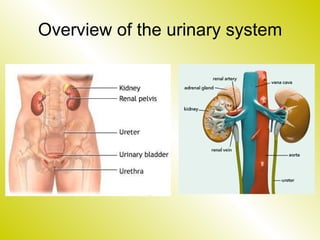
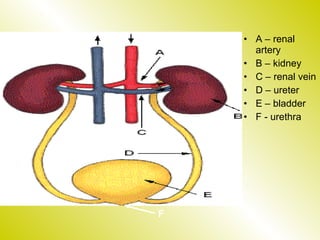
Overview of the urinary system
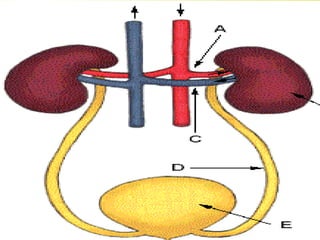
The Kidney The function of the kidney itself is very simple. Blood enters via the RENAL ARTERY, is filtered and leaves via the RENAL VEIN. The substances filtered out of the blood drain in to the bladder via the ureter. Once approx. 500ml has collected in the bladder, urine is excreted via the urethra.
A – renal artery B – kidney C – renal vein D – ureter E – bladder F - urethra F
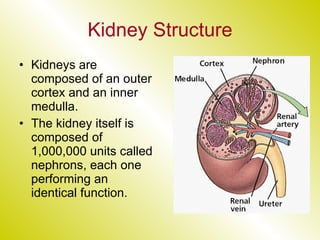
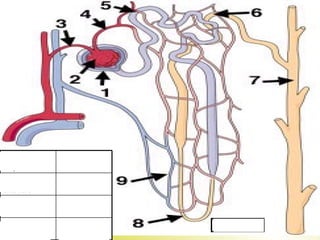
Kidney Structure Kidneys are composed of an outer cortex and an inner medulla. The kidney itself is composed of 1,000,000 units called nephrons, each one performing an identical function.
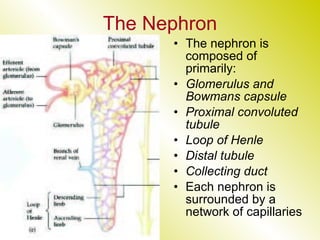
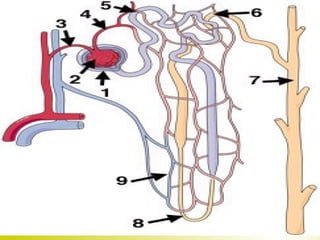
The Nephron The nephron is composed of primarily: Glomerulus and Bowmans capsule Proximal convoluted tubule Loop of Henle Distal tubule Collecting duct Each nephron is surrounded by a network of capillaries
9. Capillaries 8. Loop of Henle 7. Collecting duct 6. Distal tubule 5. Proximal tubule 4. Efferent arteriole 3. Afferent arteriole 2. Glomerulus 1. Bowmans Capsule
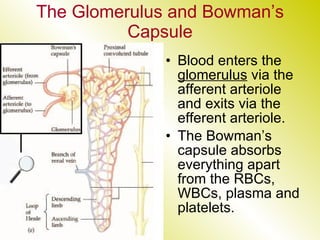
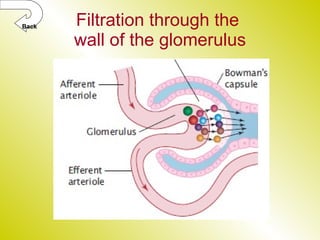
The Glomerulus and Bowman’s Capsule Blood enters the  glomerulus  via the afferent arteriole and exits via the efferent arteriole. The Bowman’s capsule absorbs everything apart from the RBCs, WBCs, plasma and platelets.
Filtration through the  wall of the glomerulus Back
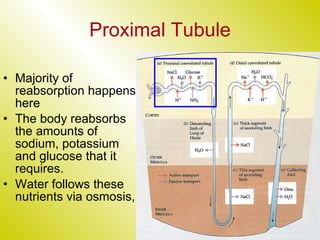
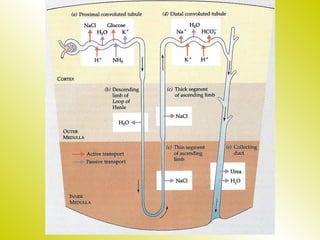
Proximal Tubule Majority of reabsorption happens here The body reabsorbs the amounts of sodium, potassium and glucose that it requires. Water follows these nutrients via osmosis,
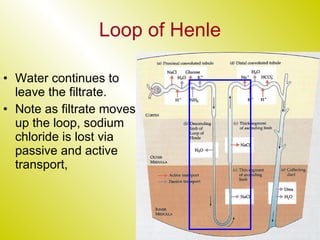
Loop of Henle Water continues to leave the filtrate. Note as filtrate moves up the loop, sodium chloride is lost via passive and active transport,
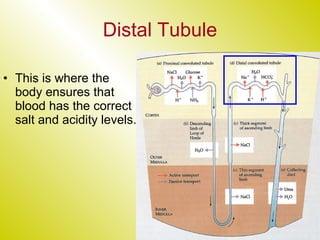
Distal Tubule This is where the body ensures that blood has the correct salt and acidity levels.
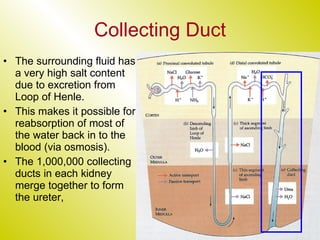
Collecting Duct The surrounding fluid has a very high salt content due to excretion from Loop of Henle. This makes it possible for reabsorption of most of the water back in to the blood (via osmosis). The 1,000,000 collecting ducts in each kidney merge together to form the ureter,
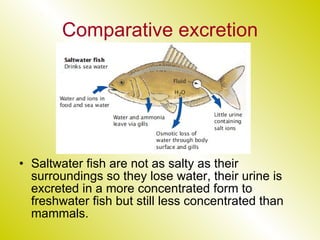
Comparative excretion Saltwater fish are not as salty as their surroundings so they lose water, their urine is excreted in a more concentrated form to freshwater fish but still less concentrated than mammals.
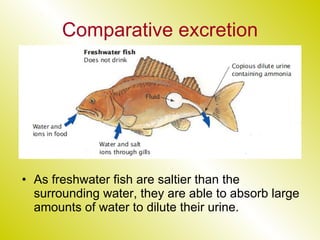
Comparative excretion As freshwater fish are saltier than the surrounding water, they are able to absorb large amounts of water to dilute their urine.
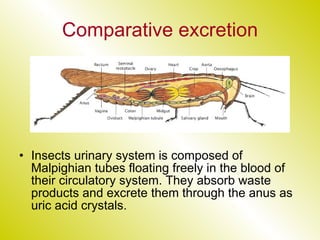
Comparative excretion Insects urinary system is composed of Malpighian tubes floating freely in the blood of their circulatory system. They absorb waste products and excrete them through the anus as uric acid crystals.
Words for glossary Hypertonic – more concentrated Hypotonic – less concentrated Isotonic – equal concentration In the case of the renal system this refers to urine in comparison to body fluids.
Substances excreted by different species Humans excrete a hypertonic solution of urea. Freshwater fish excrete a hypotonic solution of ammonia Saltwater fish excrete an isotonic solution of ammonia Insects excrete solid crystals (extremely hypertonic) of uric acid.


16 Renal System

  • 1.
    Transport of wastein animals - nitrogenous waste The Renal System (aka the urinary system)
  • 2.
    Nitrogenous waste Whenanimals metabolise proteins we produce large quantities of nitrogen containing compounds (mainly ammonia). Ammonia is toxic to cells and a sufficient build-up will kill the organism. The ammonia is immediately converted in to the less toxic compound; urea. Urea is mixed with water to form uric acid.
  • 3.
    Overview of theurinary system
  • 4.
    The Kidney Thefunction of the kidney itself is very simple. Blood enters via the RENAL ARTERY, is filtered and leaves via the RENAL VEIN. The substances filtered out of the blood drain in to the bladder via the ureter. Once approx. 500ml has collected in the bladder, urine is excreted via the urethra.
  • 5.
    A – renalartery B – kidney C – renal vein D – ureter E – bladder F - urethra F
  • 6.
    Kidney Structure Kidneysare composed of an outer cortex and an inner medulla. The kidney itself is composed of 1,000,000 units called nephrons, each one performing an identical function.
  • 7.
    The Nephron Thenephron is composed of primarily: Glomerulus and Bowmans capsule Proximal convoluted tubule Loop of Henle Distal tubule Collecting duct Each nephron is surrounded by a network of capillaries
  • 8.
    9. Capillaries 8.Loop of Henle 7. Collecting duct 6. Distal tubule 5. Proximal tubule 4. Efferent arteriole 3. Afferent arteriole 2. Glomerulus 1. Bowmans Capsule
  • 9.
    The Glomerulus andBowman’s Capsule Blood enters the glomerulus via the afferent arteriole and exits via the efferent arteriole. The Bowman’s capsule absorbs everything apart from the RBCs, WBCs, plasma and platelets.
  • 10.
    Filtration through the wall of the glomerulus Back
  • 11.
    Proximal Tubule Majorityof reabsorption happens here The body reabsorbs the amounts of sodium, potassium and glucose that it requires. Water follows these nutrients via osmosis,
  • 12.
    Loop of HenleWater continues to leave the filtrate. Note as filtrate moves up the loop, sodium chloride is lost via passive and active transport,
  • 13.
    Distal Tubule Thisis where the body ensures that blood has the correct salt and acidity levels.
  • 14.
    Collecting Duct Thesurrounding fluid has a very high salt content due to excretion from Loop of Henle. This makes it possible for reabsorption of most of the water back in to the blood (via osmosis). The 1,000,000 collecting ducts in each kidney merge together to form the ureter,
  • 15.
    Comparative excretion Saltwaterfish are not as salty as their surroundings so they lose water, their urine is excreted in a more concentrated form to freshwater fish but still less concentrated than mammals.
  • 16.
    Comparative excretion Asfreshwater fish are saltier than the surrounding water, they are able to absorb large amounts of water to dilute their urine.
  • 17.
    Comparative excretion Insectsurinary system is composed of Malpighian tubes floating freely in the blood of their circulatory system. They absorb waste products and excrete them through the anus as uric acid crystals.
  • 18.
    Words for glossaryHypertonic – more concentrated Hypotonic – less concentrated Isotonic – equal concentration In the case of the renal system this refers to urine in comparison to body fluids.
  • 19.
    Substances excreted bydifferent species Humans excrete a hypertonic solution of urea. Freshwater fish excrete a hypotonic solution of ammonia Saltwater fish excrete an isotonic solution of ammonia Insects excrete solid crystals (extremely hypertonic) of uric acid.
  • 20.
  • 21.
  • 22.