ANALYSIS OF BOILING CURVE AND
FORCED CONVECTION BOILING
ARUN. S
202112018
Department of Chemical Engineering
NITT
4/22/2013

1
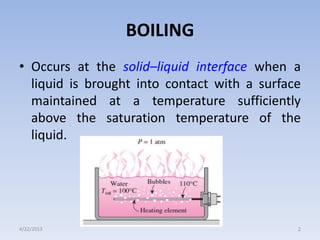
BOILING
• Occurs at the solid–liquid interface when a
liquid is brought into contact with a surface
maintained at a temperature sufficiently
above the saturation temperature of the
liquid.

4/22/2013

2
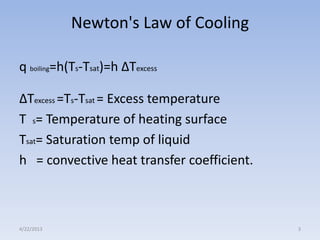
Newton's Law of Cooling
q boiling=h(Ts-Tsat)=h ∆Texcess
∆Texcess =Ts-Tsat = Excess temperature
T s= Temperature of heating surface
Tsat= Saturation temp of liquid
h = convective heat transfer coefficient.

4/22/2013

3
Classification of Boiling
1) Based on Bulk Fluid Motion
a. Pool Boiling
b. Flow Boiling
2) Based on Bulk liquid temperature
a. Sub-cooled Boiling
b. Saturated Boiling
4/22/2013

4
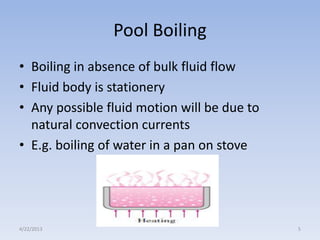
Pool Boiling
• Boiling in absence of bulk fluid flow
• Fluid body is stationery
• Any possible fluid motion will be due to
natural convection currents
• E.g. boiling of water in a pan on stove

4/22/2013

5
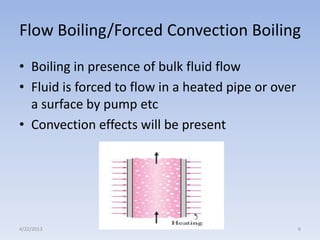
Flow Boiling/Forced Convection Boiling
• Boiling in presence of bulk fluid flow
• Fluid is forced to flow in a heated pipe or over
a surface by pump etc
• Convection effects will be present

4/22/2013

6
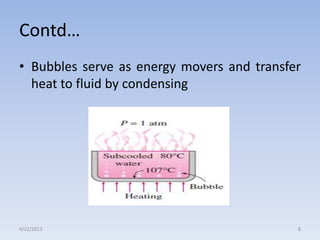
Sub-cooled Boiling
• Boiling is sub-cooled if temperature of main body
of fluid is below the saturation temp Tsat (i.e. bulk
of liquid is sub-cooled)

• It occurs at early stages of boiling
• Bubbles formation and disappearance near hot
surface
• Bubbles disappear as they transfer heat to
surrounding sub-cooled liquid
• Boiling is confined to locality of hot surface so
also called local boiling
4/22/2013

7
Contd…
• Bubbles serve as energy movers and transfer
heat to fluid by condensing

4/22/2013

8
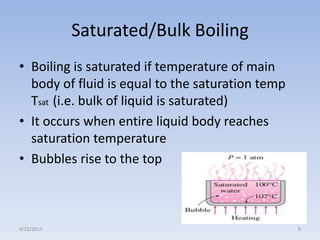
Saturated/Bulk Boiling
• Boiling is saturated if temperature of main
body of fluid is equal to the saturation temp
Tsat (i.e. bulk of liquid is saturated)
• It occurs when entire liquid body reaches
saturation temperature
• Bubbles rise to the top

4/22/2013

9
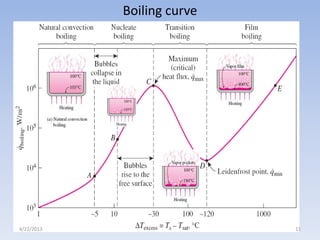
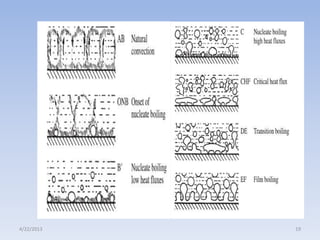
Boiling Curve for Pool Boiling
Four regimes/phases of pool boiling with change
in excess temperature :
1. Natural Convection Boiling

2. Nucleate Boiling
3. Transition Boiling

4. Film Boiling
4/22/2013

10
Boiling curve

4/22/2013

11
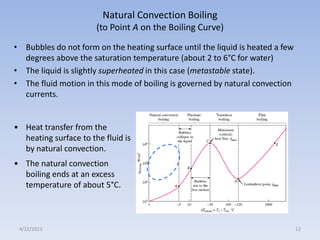
Natural Convection Boiling
(to Point A on the Boiling Curve)
• Bubbles do not form on the heating surface until the liquid is heated a few
degrees above the saturation temperature (about 2 to 6°C for water)
• The liquid is slightly superheated in this case (metastable state).
• The fluid motion in this mode of boiling is governed by natural convection
currents.

• Heat transfer from the
heating surface to the fluid is
by natural convection.
• The natural convection
boiling ends at an excess
temperature of about 5°C.

4/22/2013

12
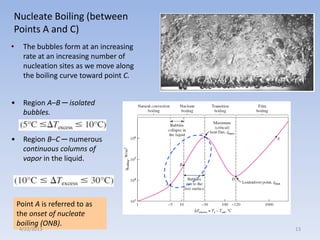
Nucleate Boiling (between
Points A and C)
•

The bubbles form at an increasing
rate at an increasing number of
nucleation sites as we move along
the boiling curve toward point C.

•

Region A–B ─ isolated
bubbles.

•

Region B–C ─ numerous
continuous columns of
vapor in the liquid.

Point A is referred to as
the onset of nucleate
boiling (ONB).
4/22/2013

13
•

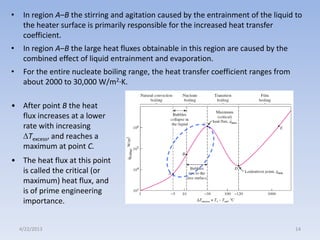
In region A–B the stirring and agitation caused by the entrainment of the liquid to
the heater surface is primarily responsible for the increased heat transfer
coefficient.

•

In region A–B the large heat fluxes obtainable in this region are caused by the
combined effect of liquid entrainment and evaporation.

•

For the entire nucleate boiling range, the heat transfer coefficient ranges from
about 2000 to 30,000 W/m2·K.

• After point B the heat
flux increases at a lower
rate with increasing
Texcess, and reaches a
maximum at point C.
• The heat flux at this point
is called the critical (or
maximum) heat flux, and
is of prime engineering
importance.

4/22/2013

14
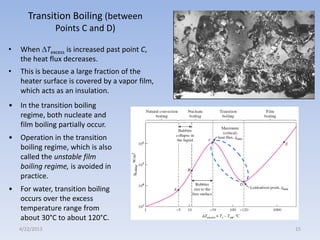
Transition Boiling (between
Points C and D)
•

When Texcess is increased past point C,
the heat flux decreases.

•

This is because a large fraction of the
heater surface is covered by a vapor film,
which acts as an insulation.

•

In the transition boiling
regime, both nucleate and
film boiling partially occur.

•

Operation in the transition
boiling regime, which is also
called the unstable film
boiling regime, is avoided in
practice.

•

For water, transition boiling
occurs over the excess
temperature range from
about 30°C to about 120°C.
4/22/2013

15
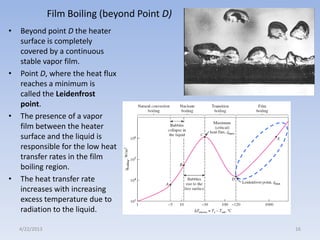
Film Boiling (beyond Point D)
•

•

•

•

Beyond point D the heater
surface is completely
covered by a continuous
stable vapor film.
Point D, where the heat flux
reaches a minimum is
called the Leidenfrost
point.
The presence of a vapor
film between the heater
surface and the liquid is
responsible for the low heat
transfer rates in the film
boiling region.
The heat transfer rate
increases with increasing
excess temperature due to
radiation to the liquid.
4/22/2013

16
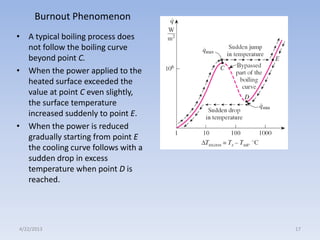
Burnout Phenomenon
• A typical boiling process does
not follow the boiling curve
beyond point C.
• When the power applied to the
heated surface exceeded the
value at point C even slightly,
the surface temperature
increased suddenly to point E.
• When the power is reduced
gradually starting from point E
the cooling curve follows with a
sudden drop in excess
temperature when point D is
reached.

4/22/2013

17
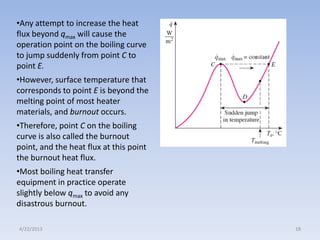
•Any attempt to increase the heat
flux beyond qmax will cause the
operation point on the boiling curve
to jump suddenly from point C to
point E.
•However, surface temperature that
corresponds to point E is beyond the
melting point of most heater
materials, and burnout occurs.
•Therefore, point C on the boiling
curve is also called the burnout
point, and the heat flux at this point
the burnout heat flux.
•Most boiling heat transfer
equipment in practice operate
slightly below qmax to avoid any
disastrous burnout.
4/22/2013

18
4/22/2013

19
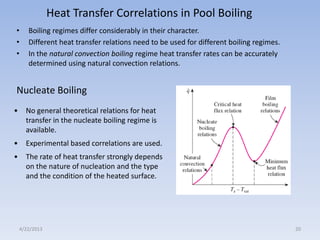
Heat Transfer Correlations in Pool Boiling
•
•
•

Boiling regimes differ considerably in their character.
Different heat transfer relations need to be used for different boiling regimes.
In the natural convection boiling regime heat transfer rates can be accurately
determined using natural convection relations.

Nucleate Boiling
•

No general theoretical relations for heat
transfer in the nucleate boiling regime is
available.

•

Experimental based correlations are used.

•

The rate of heat transfer strongly depends
on the nature of nucleation and the type
and the condition of the heated surface.

4/22/2013

20
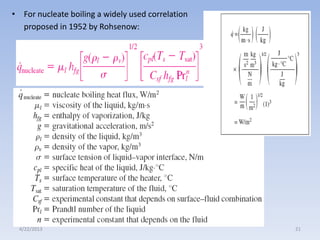
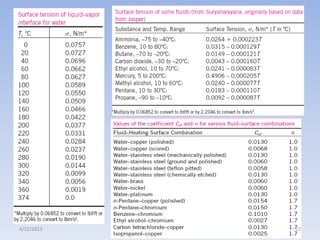
• For nucleate boiling a widely used correlation
proposed in 1952 by Rohsenow:

4/22/2013

21
4/22/2013

22
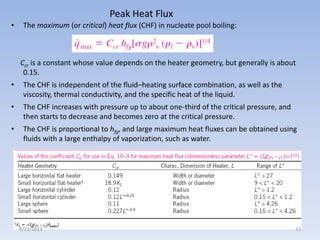
Peak Heat Flux
•

The maximum (or critical) heat flux (CHF) in nucleate pool boiling:

Ccr is a constant whose value depends on the heater geometry, but generally is about
0.15.

•

The CHF is independent of the fluid–heating surface combination, as well as the
viscosity, thermal conductivity, and the specific heat of the liquid.

•

The CHF increases with pressure up to about one-third of the critical pressure, and
then starts to decrease and becomes zero at the critical pressure.

•

The CHF is proportional to hfg, and large maximum heat fluxes can be obtained using
fluids with a large enthalpy of vaporization, such as water.

4/22/2013

23
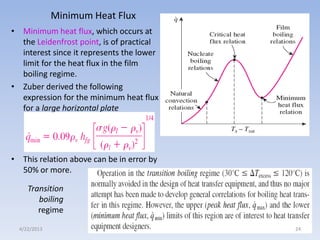
Minimum Heat Flux
• Minimum heat flux, which occurs at
the Leidenfrost point, is of practical
interest since it represents the lower
limit for the heat flux in the film
boiling regime.
• Zuber derived the following
expression for the minimum heat flux
for a large horizontal plate

• This relation above can be in error by
50% or more.

Transition
boiling
regime
4/22/2013

24
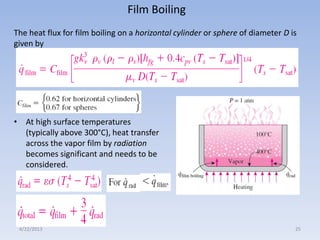
Film Boiling
The heat flux for film boiling on a horizontal cylinder or sphere of diameter D is
given by

• At high surface temperatures
(typically above 300°C), heat transfer
across the vapor film by radiation
becomes significant and needs to be
considered.

4/22/2013

25
FLOW BOILING
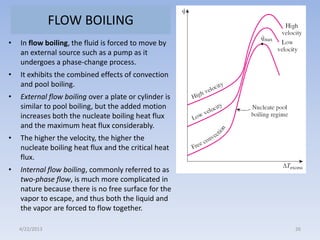
•

In flow boiling, the fluid is forced to move by
an external source such as a pump as it
undergoes a phase-change process.

•

It exhibits the combined effects of convection
and pool boiling.

•

External flow boiling over a plate or cylinder is
similar to pool boiling, but the added motion
increases both the nucleate boiling heat flux
and the maximum heat flux considerably.

•

The higher the velocity, the higher the
nucleate boiling heat flux and the critical heat
flux.

•

Internal flow boiling, commonly referred to as
two-phase flow, is much more complicated in
nature because there is no free surface for the
vapor to escape, and thus both the liquid and
the vapor are forced to flow together.
4/22/2013

26
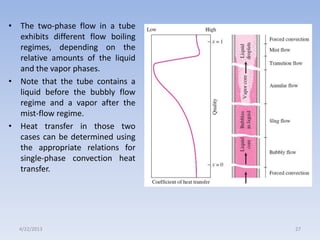
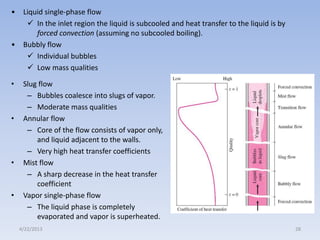
• The two-phase flow in a tube
exhibits different flow boiling
regimes, depending on the
relative amounts of the liquid
and the vapor phases.
• Note that the tube contains a
liquid before the bubbly flow
regime and a vapor after the
mist-flow regime.
• Heat transfer in those two
cases can be determined using
the appropriate relations for
single-phase convection heat
transfer.

4/22/2013

27
•

•

•

•

•

•

Liquid single-phase flow
 In the inlet region the liquid is subcooled and heat transfer to the liquid is by
forced convection (assuming no subcooled boiling).
Bubbly flow
 Individual bubbles
 Low mass qualities

Slug flow
– Bubbles coalesce into slugs of vapor.
– Moderate mass qualities
Annular flow
– Core of the flow consists of vapor only,
and liquid adjacent to the walls.
– Very high heat transfer coefficients
Mist flow
– A sharp decrease in the heat transfer
coefficient
Vapor single-phase flow
– The liquid phase is completely
evaporated and vapor is superheated.
4/22/2013

28
REFERENCES
•Fundamentals of Engineering Heat and Mass Transfer by R.C. Sachdeva .
•Heat ,Mass and Momentum Transfer by Warren M. Rohsenow and

Harry Y Choi .

4/22/2013

29
4/22/2013

30
4/22/2013

31

ANALYSIS OF BOILING CURVE AND FORCED CONVECTION BOILING

  • 1.
    ANALYSIS OF BOILINGCURVE AND FORCED CONVECTION BOILING ARUN. S 202112018 Department of Chemical Engineering NITT 4/22/2013 1
  • 2.
    BOILING • Occurs atthe solid–liquid interface when a liquid is brought into contact with a surface maintained at a temperature sufficiently above the saturation temperature of the liquid. 4/22/2013 2
  • 3.
    Newton's Law ofCooling q boiling=h(Ts-Tsat)=h ∆Texcess ∆Texcess =Ts-Tsat = Excess temperature T s= Temperature of heating surface Tsat= Saturation temp of liquid h = convective heat transfer coefficient. 4/22/2013 3
  • 4.
    Classification of Boiling 1)Based on Bulk Fluid Motion a. Pool Boiling b. Flow Boiling 2) Based on Bulk liquid temperature a. Sub-cooled Boiling b. Saturated Boiling 4/22/2013 4
  • 5.
    Pool Boiling • Boilingin absence of bulk fluid flow • Fluid body is stationery • Any possible fluid motion will be due to natural convection currents • E.g. boiling of water in a pan on stove 4/22/2013 5
  • 6.
    Flow Boiling/Forced ConvectionBoiling • Boiling in presence of bulk fluid flow • Fluid is forced to flow in a heated pipe or over a surface by pump etc • Convection effects will be present 4/22/2013 6
  • 7.
    Sub-cooled Boiling • Boilingis sub-cooled if temperature of main body of fluid is below the saturation temp Tsat (i.e. bulk of liquid is sub-cooled) • It occurs at early stages of boiling • Bubbles formation and disappearance near hot surface • Bubbles disappear as they transfer heat to surrounding sub-cooled liquid • Boiling is confined to locality of hot surface so also called local boiling 4/22/2013 7
  • 8.
    Contd… • Bubbles serveas energy movers and transfer heat to fluid by condensing 4/22/2013 8
  • 9.
    Saturated/Bulk Boiling • Boilingis saturated if temperature of main body of fluid is equal to the saturation temp Tsat (i.e. bulk of liquid is saturated) • It occurs when entire liquid body reaches saturation temperature • Bubbles rise to the top 4/22/2013 9
  • 10.
    Boiling Curve forPool Boiling Four regimes/phases of pool boiling with change in excess temperature : 1. Natural Convection Boiling 2. Nucleate Boiling 3. Transition Boiling 4. Film Boiling 4/22/2013 10
  • 11.
  • 12.
    Natural Convection Boiling (toPoint A on the Boiling Curve) • Bubbles do not form on the heating surface until the liquid is heated a few degrees above the saturation temperature (about 2 to 6°C for water) • The liquid is slightly superheated in this case (metastable state). • The fluid motion in this mode of boiling is governed by natural convection currents. • Heat transfer from the heating surface to the fluid is by natural convection. • The natural convection boiling ends at an excess temperature of about 5°C. 4/22/2013 12
  • 13.
    Nucleate Boiling (between PointsA and C) • The bubbles form at an increasing rate at an increasing number of nucleation sites as we move along the boiling curve toward point C. • Region A–B ─ isolated bubbles. • Region B–C ─ numerous continuous columns of vapor in the liquid. Point A is referred to as the onset of nucleate boiling (ONB). 4/22/2013 13
  • 14.
    • In region A–Bthe stirring and agitation caused by the entrainment of the liquid to the heater surface is primarily responsible for the increased heat transfer coefficient. • In region A–B the large heat fluxes obtainable in this region are caused by the combined effect of liquid entrainment and evaporation. • For the entire nucleate boiling range, the heat transfer coefficient ranges from about 2000 to 30,000 W/m2·K. • After point B the heat flux increases at a lower rate with increasing Texcess, and reaches a maximum at point C. • The heat flux at this point is called the critical (or maximum) heat flux, and is of prime engineering importance. 4/22/2013 14
  • 15.
    Transition Boiling (between PointsC and D) • When Texcess is increased past point C, the heat flux decreases. • This is because a large fraction of the heater surface is covered by a vapor film, which acts as an insulation. • In the transition boiling regime, both nucleate and film boiling partially occur. • Operation in the transition boiling regime, which is also called the unstable film boiling regime, is avoided in practice. • For water, transition boiling occurs over the excess temperature range from about 30°C to about 120°C. 4/22/2013 15
  • 16.
    Film Boiling (beyondPoint D) • • • • Beyond point D the heater surface is completely covered by a continuous stable vapor film. Point D, where the heat flux reaches a minimum is called the Leidenfrost point. The presence of a vapor film between the heater surface and the liquid is responsible for the low heat transfer rates in the film boiling region. The heat transfer rate increases with increasing excess temperature due to radiation to the liquid. 4/22/2013 16
  • 17.
    Burnout Phenomenon • Atypical boiling process does not follow the boiling curve beyond point C. • When the power applied to the heated surface exceeded the value at point C even slightly, the surface temperature increased suddenly to point E. • When the power is reduced gradually starting from point E the cooling curve follows with a sudden drop in excess temperature when point D is reached. 4/22/2013 17
  • 18.
    •Any attempt toincrease the heat flux beyond qmax will cause the operation point on the boiling curve to jump suddenly from point C to point E. •However, surface temperature that corresponds to point E is beyond the melting point of most heater materials, and burnout occurs. •Therefore, point C on the boiling curve is also called the burnout point, and the heat flux at this point the burnout heat flux. •Most boiling heat transfer equipment in practice operate slightly below qmax to avoid any disastrous burnout. 4/22/2013 18
  • 19.
  • 20.
    Heat Transfer Correlationsin Pool Boiling • • • Boiling regimes differ considerably in their character. Different heat transfer relations need to be used for different boiling regimes. In the natural convection boiling regime heat transfer rates can be accurately determined using natural convection relations. Nucleate Boiling • No general theoretical relations for heat transfer in the nucleate boiling regime is available. • Experimental based correlations are used. • The rate of heat transfer strongly depends on the nature of nucleation and the type and the condition of the heated surface. 4/22/2013 20
  • 21.
    • For nucleateboiling a widely used correlation proposed in 1952 by Rohsenow: 4/22/2013 21
  • 22.
  • 23.
    Peak Heat Flux • Themaximum (or critical) heat flux (CHF) in nucleate pool boiling: Ccr is a constant whose value depends on the heater geometry, but generally is about 0.15. • The CHF is independent of the fluid–heating surface combination, as well as the viscosity, thermal conductivity, and the specific heat of the liquid. • The CHF increases with pressure up to about one-third of the critical pressure, and then starts to decrease and becomes zero at the critical pressure. • The CHF is proportional to hfg, and large maximum heat fluxes can be obtained using fluids with a large enthalpy of vaporization, such as water. 4/22/2013 23
  • 24.
    Minimum Heat Flux •Minimum heat flux, which occurs at the Leidenfrost point, is of practical interest since it represents the lower limit for the heat flux in the film boiling regime. • Zuber derived the following expression for the minimum heat flux for a large horizontal plate • This relation above can be in error by 50% or more. Transition boiling regime 4/22/2013 24
  • 25.
    Film Boiling The heatflux for film boiling on a horizontal cylinder or sphere of diameter D is given by • At high surface temperatures (typically above 300°C), heat transfer across the vapor film by radiation becomes significant and needs to be considered. 4/22/2013 25
  • 26.
    FLOW BOILING • In flowboiling, the fluid is forced to move by an external source such as a pump as it undergoes a phase-change process. • It exhibits the combined effects of convection and pool boiling. • External flow boiling over a plate or cylinder is similar to pool boiling, but the added motion increases both the nucleate boiling heat flux and the maximum heat flux considerably. • The higher the velocity, the higher the nucleate boiling heat flux and the critical heat flux. • Internal flow boiling, commonly referred to as two-phase flow, is much more complicated in nature because there is no free surface for the vapor to escape, and thus both the liquid and the vapor are forced to flow together. 4/22/2013 26
  • 27.
    • The two-phaseflow in a tube exhibits different flow boiling regimes, depending on the relative amounts of the liquid and the vapor phases. • Note that the tube contains a liquid before the bubbly flow regime and a vapor after the mist-flow regime. • Heat transfer in those two cases can be determined using the appropriate relations for single-phase convection heat transfer. 4/22/2013 27
  • 28.
    • • • • • • Liquid single-phase flow In the inlet region the liquid is subcooled and heat transfer to the liquid is by forced convection (assuming no subcooled boiling). Bubbly flow  Individual bubbles  Low mass qualities Slug flow – Bubbles coalesce into slugs of vapor. – Moderate mass qualities Annular flow – Core of the flow consists of vapor only, and liquid adjacent to the walls. – Very high heat transfer coefficients Mist flow – A sharp decrease in the heat transfer coefficient Vapor single-phase flow – The liquid phase is completely evaporated and vapor is superheated. 4/22/2013 28
  • 29.
    REFERENCES •Fundamentals of EngineeringHeat and Mass Transfer by R.C. Sachdeva . •Heat ,Mass and Momentum Transfer by Warren M. Rohsenow and Harry Y Choi . 4/22/2013 29
  • 30.
  • 31.