PRESENTED BY:
ASHOK A MULE
PRESENTATION OUTLINE
 Introduction
 Working
 Applications
 Advantages
 Disadvantages
 Future uses
 Conclusion
What is RFID?
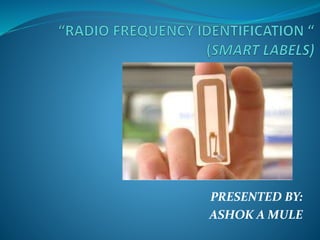
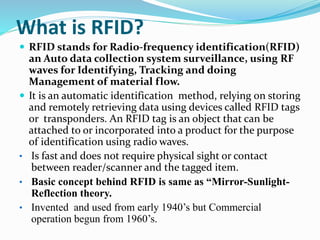
 RFID stands for Radio-frequency identification(RFID)
an Auto data collection system surveillance, using RF
waves for Identifying, Tracking and doing
Management of material flow.
 It is an automatic identification method, relying on storing
and remotely retrieving data using devices called RFID tags
or transponders. An RFID tag is an object that can be
attached to or incorporated into a product for the purpose
of identification using radio waves.
• Is fast and does not require physical sight or contact
between reader/scanner and the tagged item.
• Basic concept behind RFID is same as “Mirror-Sunlight-
Reflection theory.
• Invented and used from early 1940’s but Commercial
operation begun from 1960’s.
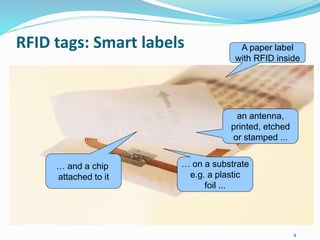
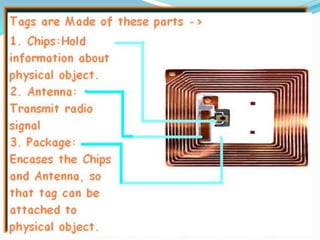
RFID tags: Smart labels
4
… and a chip
attached to it
… on a substrate
e.g. a plastic
foil ...
an antenna,
printed, etched
or stamped ...
A paper label
with RFID inside
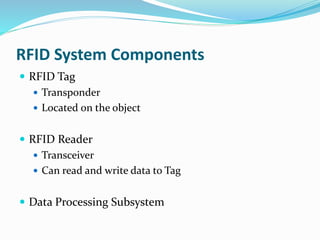
RFID System Components
 RFID Tag
 Transponder
 Located on the object
 RFID Reader
 Transceiver
 Can read and write data to Tag
 Data Processing Subsystem
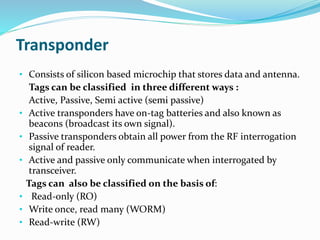
Transponder
• Consists of silicon based microchip that stores data and antenna.
Tags can be classified in three different ways :
Active, Passive, Semi active (semi passive)
• Active transponders have on-tag batteries and also known as
beacons (broadcast its own signal).
• Passive transponders obtain all power from the RF interrogation
signal of reader.
• Active and passive only communicate when interrogated by
transceiver.
Tags can also be classified on the basis of:
• Read-only (RO)
• Write once, read many (WORM)
• Read-write (RW)
SMART LABELS (tags)
 Typical Frequency: 13.56 MHz-HF system uses passive tags
- a worldwide standardized frequency
 Libraries use high frequency passive tags
 In our library we paste these tags on the preface page of the
book
Presently four main frequency bands used in RFID systems
 Low Frequency band: 125/134 KHz
 High Frequency band: 13.56 MHz
 Ultra High Frequency band: 800-900 MHz
 Microwave band: 2.4-5.8 GHz
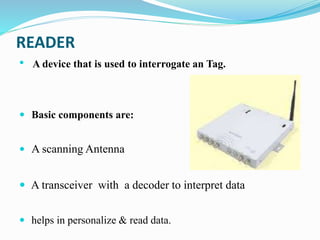
READER
• A device that is used to interrogate an Tag.
 Basic components are:
 A scanning Antenna
 A transceiver with a decoder to interpret data
 helps in personalize & read data.
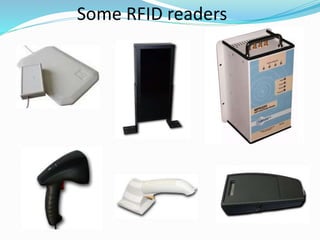
Some RFID readers
Data Processing Subsystem
 Backend System
 Connected via high-speed network
 Computers used for business planning (ERP)
 Database storage
 Can be as simple as a reader attached to a cash
register
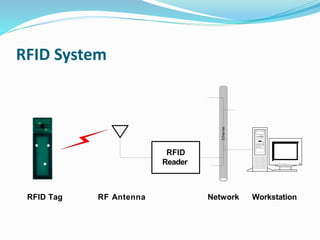
RFID System
Ethernet
RFID
Reader
RFID Tag RF Antenna Network Workstation
How does RFID work?
working
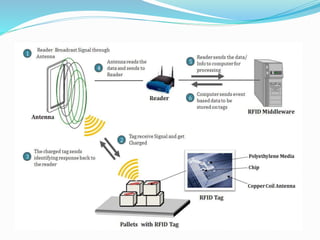
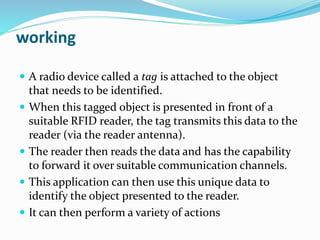
 A radio device called a tag is attached to the object
that needs to be identified.
 When this tagged object is presented in front of a
suitable RFID reader, the tag transmits this data to the
reader (via the reader antenna).
 The reader then reads the data and has the capability
to forward it over suitable communication channels.
 This application can then use this unique data to
identify the object presented to the reader.
 It can then perform a variety of actions
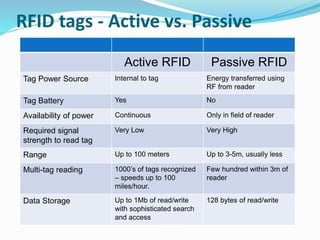
RFID tags - Active vs. Passive
Active RFID Passive RFID
Tag Power Source Internal to tag Energy transferred using
RF from reader
Tag Battery Yes No
Availability of power Continuous Only in field of reader
Required signal
strength to read tag
Very Low Very High
Range Up to 100 meters Up to 3-5m, usually less
Multi-tag reading 1000’s of tags recognized
– speeds up to 100
miles/hour.
Few hundred within 3m of
reader
Data Storage Up to 1Mb of read/write
with sophisticated search
and access
128 bytes of read/write
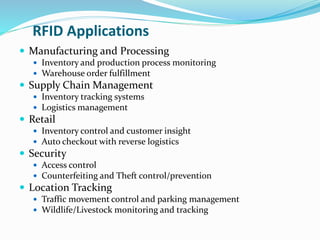
RFID Applications
 Manufacturing and Processing
 Inventory and production process monitoring
 Warehouse order fulfillment
 Supply Chain Management
 Inventory tracking systems
 Logistics management
 Retail
 Inventory control and customer insight
 Auto checkout with reverse logistics
 Security
 Access control
 Counterfeiting and Theft control/prevention
 Location Tracking
 Traffic movement control and parking management
 Wildlife/Livestock monitoring and tracking
continued……….
Inventory Monitoring
 Library book and bookstore tracking
 Pallet tracking (Wal-Mart and the Dept. of Defense)
Access Control
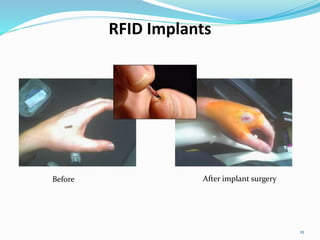
 Hand Implants
 ID badges
Payment Systems
 The American Express Blue Card, a feature they call Express Pay
 Exxon Mobile Speed Pass Airline baggage tracking
 Cell phones are including RFID tags built in
 Electronic payment – credit card companies moving to RFID-enabled
cards to increase efficiency and reduce time at point-of-sale for
customer, merchant, and card issuer.
Commercially for truck and trailer tracking in shipping yards
Long range access control for vehicles
 Entry gates
 Electronic toll collection
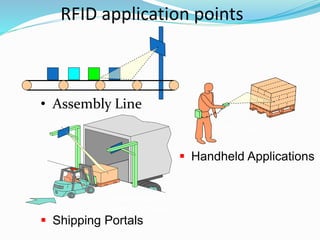
RFID application points
• Assembly Line
 Shipping Portals
 Handheld Applications
Bill of Lading
Material Tracking
Wireless
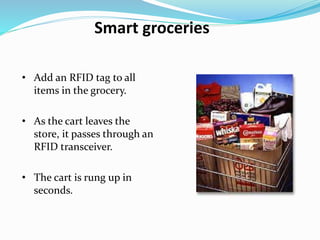
Smart groceries
• Add an RFID tag to all
items in the grocery.
• As the cart leaves the
store, it passes through an
RFID transceiver.
• The cart is rung up in
seconds.
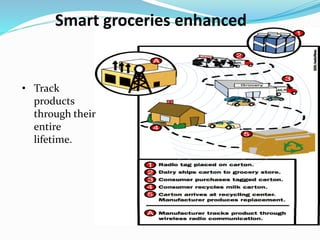
Smart groceries enhanced
• Track
products
through their
entire
lifetime.
21
RFID Implants
Before After implant surgery
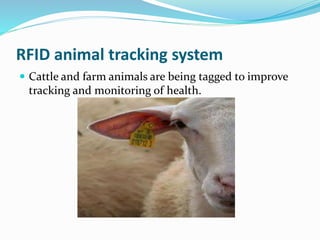
RFID animal tracking system
 Cattle and farm animals are being tagged to improve
tracking and monitoring of health.
Advantages
 Contactless. An RFID tag can be read without any physical
contact between the tag and the reader.
 Writable data. The data of a read-write (RW) RFID tag can be
rewritten a large number of times.
 Absence of line of sight. A line of sight is generally not
required for an RFID reader to read an RFID tag.
 Variety of read ranges.
 Wide data-capacity range.
 Support for multiple tag reads.
 Perform smart tasks.
 Better collection management
 Improved productivity and services.
Inventory Management
 Read/Write
- Ability to add information directly to tags enables each
unique asset to carry its own unique history
 Non-contact Reads
- Ability to read tags at a distance, under a variety of
environmental conditions, without physical manipulation
of the asset
 Fast Read
- Ability to simultaneously read large numbers (1000-1750
tags/sec) of items
 Automation
- Requires less human intervention
 Authenticity
- Each RFID chip is unique and can not be replicated
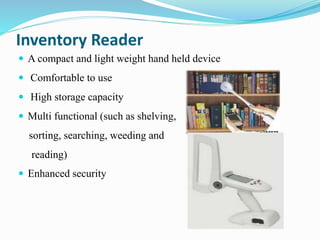
Inventory Reader
 A compact and light weight hand held device
 Comfortable to use
 High storage capacity
 Multi functional (such as shelving,
sorting, searching, weeding and
reading)
 Enhanced security
Disadvantages
 Poor performance with RF-opaque and RF-absorbent
objects.
 Impacted by environmental factors.
 Impacted by hardware interference.
 Cost factors: Implementation and on going system cost.
 It is a controversial technology
Future of RFID
 Medical
 Drug Counterfeiting
 Tracking & Tracing
 Medical “Passports”
 Foster Care System
 Food Chain Precautions
 Shopping
 Cashier-less check out and payment
 Household Technology
 Smart keys
 Intelligent washing machines
 Monitoring refrigerators
 Intelligent ovens/microwaves
Conclusion
RFID is a Supporting Technology not a Competing
technology………..
 Slowly becoming an industry standard
 Speeds up the supply chain process
 Easier to manage inventory
 Continually evolving
THANK YOU

ashok mule rfid presentation

  • 1.
  • 2.
    PRESENTATION OUTLINE  Introduction Working  Applications  Advantages  Disadvantages  Future uses  Conclusion
  • 3.
    What is RFID? RFID stands for Radio-frequency identification(RFID) an Auto data collection system surveillance, using RF waves for Identifying, Tracking and doing Management of material flow.  It is an automatic identification method, relying on storing and remotely retrieving data using devices called RFID tags or transponders. An RFID tag is an object that can be attached to or incorporated into a product for the purpose of identification using radio waves. • Is fast and does not require physical sight or contact between reader/scanner and the tagged item. • Basic concept behind RFID is same as “Mirror-Sunlight- Reflection theory. • Invented and used from early 1940’s but Commercial operation begun from 1960’s.
  • 4.
    RFID tags: Smartlabels 4 … and a chip attached to it … on a substrate e.g. a plastic foil ... an antenna, printed, etched or stamped ... A paper label with RFID inside
  • 6.
    RFID System Components RFID Tag  Transponder  Located on the object  RFID Reader  Transceiver  Can read and write data to Tag  Data Processing Subsystem
  • 7.
    Transponder • Consists ofsilicon based microchip that stores data and antenna. Tags can be classified in three different ways : Active, Passive, Semi active (semi passive) • Active transponders have on-tag batteries and also known as beacons (broadcast its own signal). • Passive transponders obtain all power from the RF interrogation signal of reader. • Active and passive only communicate when interrogated by transceiver. Tags can also be classified on the basis of: • Read-only (RO) • Write once, read many (WORM) • Read-write (RW)
  • 8.
    SMART LABELS (tags) Typical Frequency: 13.56 MHz-HF system uses passive tags - a worldwide standardized frequency  Libraries use high frequency passive tags  In our library we paste these tags on the preface page of the book Presently four main frequency bands used in RFID systems  Low Frequency band: 125/134 KHz  High Frequency band: 13.56 MHz  Ultra High Frequency band: 800-900 MHz  Microwave band: 2.4-5.8 GHz
  • 9.
    READER • A devicethat is used to interrogate an Tag.  Basic components are:  A scanning Antenna  A transceiver with a decoder to interpret data  helps in personalize & read data.
  • 10.
  • 11.
    Data Processing Subsystem Backend System  Connected via high-speed network  Computers used for business planning (ERP)  Database storage  Can be as simple as a reader attached to a cash register
  • 12.
    RFID System Ethernet RFID Reader RFID TagRF Antenna Network Workstation
  • 13.
  • 14.
    working  A radiodevice called a tag is attached to the object that needs to be identified.  When this tagged object is presented in front of a suitable RFID reader, the tag transmits this data to the reader (via the reader antenna).  The reader then reads the data and has the capability to forward it over suitable communication channels.  This application can then use this unique data to identify the object presented to the reader.  It can then perform a variety of actions
  • 15.
    RFID tags -Active vs. Passive Active RFID Passive RFID Tag Power Source Internal to tag Energy transferred using RF from reader Tag Battery Yes No Availability of power Continuous Only in field of reader Required signal strength to read tag Very Low Very High Range Up to 100 meters Up to 3-5m, usually less Multi-tag reading 1000’s of tags recognized – speeds up to 100 miles/hour. Few hundred within 3m of reader Data Storage Up to 1Mb of read/write with sophisticated search and access 128 bytes of read/write
  • 16.
    RFID Applications  Manufacturingand Processing  Inventory and production process monitoring  Warehouse order fulfillment  Supply Chain Management  Inventory tracking systems  Logistics management  Retail  Inventory control and customer insight  Auto checkout with reverse logistics  Security  Access control  Counterfeiting and Theft control/prevention  Location Tracking  Traffic movement control and parking management  Wildlife/Livestock monitoring and tracking
  • 17.
    continued………. Inventory Monitoring  Librarybook and bookstore tracking  Pallet tracking (Wal-Mart and the Dept. of Defense) Access Control  Hand Implants  ID badges Payment Systems  The American Express Blue Card, a feature they call Express Pay  Exxon Mobile Speed Pass Airline baggage tracking  Cell phones are including RFID tags built in  Electronic payment – credit card companies moving to RFID-enabled cards to increase efficiency and reduce time at point-of-sale for customer, merchant, and card issuer. Commercially for truck and trailer tracking in shipping yards Long range access control for vehicles  Entry gates  Electronic toll collection
  • 18.
    RFID application points •Assembly Line  Shipping Portals  Handheld Applications Bill of Lading Material Tracking Wireless
  • 19.
    Smart groceries • Addan RFID tag to all items in the grocery. • As the cart leaves the store, it passes through an RFID transceiver. • The cart is rung up in seconds.
  • 20.
    Smart groceries enhanced •Track products through their entire lifetime.
  • 21.
  • 22.
    RFID animal trackingsystem  Cattle and farm animals are being tagged to improve tracking and monitoring of health.
  • 23.
    Advantages  Contactless. AnRFID tag can be read without any physical contact between the tag and the reader.  Writable data. The data of a read-write (RW) RFID tag can be rewritten a large number of times.  Absence of line of sight. A line of sight is generally not required for an RFID reader to read an RFID tag.  Variety of read ranges.  Wide data-capacity range.  Support for multiple tag reads.  Perform smart tasks.  Better collection management  Improved productivity and services.
  • 24.
    Inventory Management  Read/Write -Ability to add information directly to tags enables each unique asset to carry its own unique history  Non-contact Reads - Ability to read tags at a distance, under a variety of environmental conditions, without physical manipulation of the asset  Fast Read - Ability to simultaneously read large numbers (1000-1750 tags/sec) of items  Automation - Requires less human intervention  Authenticity - Each RFID chip is unique and can not be replicated
  • 25.
    Inventory Reader  Acompact and light weight hand held device  Comfortable to use  High storage capacity  Multi functional (such as shelving, sorting, searching, weeding and reading)  Enhanced security
  • 26.
    Disadvantages  Poor performancewith RF-opaque and RF-absorbent objects.  Impacted by environmental factors.  Impacted by hardware interference.  Cost factors: Implementation and on going system cost.  It is a controversial technology
  • 27.
    Future of RFID Medical  Drug Counterfeiting  Tracking & Tracing  Medical “Passports”  Foster Care System  Food Chain Precautions  Shopping  Cashier-less check out and payment  Household Technology  Smart keys  Intelligent washing machines  Monitoring refrigerators  Intelligent ovens/microwaves
  • 28.
    Conclusion RFID is aSupporting Technology not a Competing technology………..  Slowly becoming an industry standard  Speeds up the supply chain process  Easier to manage inventory  Continually evolving
  • 29.