-By Rajani Bansari
Presentation Outline
Introduction
Key components of RFID
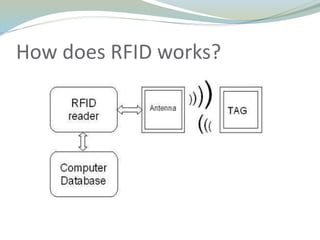
How does RFID works?
Applications of RFID
RFID v/s barcode
Advantages
Disadvantages
Concern surrounding RFID
RFID applications in India
Introduction
Technology that uses radio-
frequency waves to transfer
data between a reader and a
movable item to identify,
categorize, track...
Fast
Reliable
Does not require physical
sight or contact between
reader/scanner and the
tagged item.
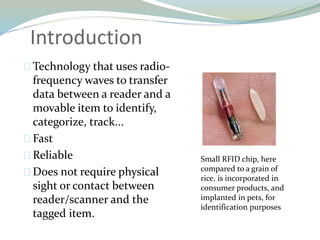
Small RFID chip, here
compared to a grain of
rice, is incorporated in
consumer products, and
implanted in pets, for
identification purposes
Key components of RFID
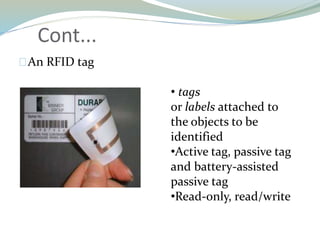
An RFID tag
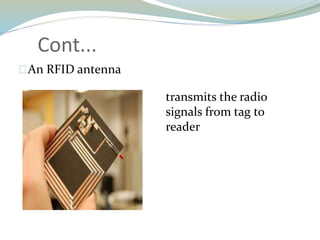
An RFID antenna
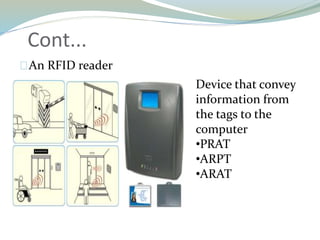
An RFID reader
Cont...
An RFID tag
• tags
or labels attached to
the objects to be
identified
•Active tag, passive tag
and battery-assisted
passive tag
•Read-only, read/write
Cont...
An RFID antenna
transmits the radio
signals from tag to
reader
Cont...
An RFID reader
Device that convey
information from
the tags to the
computer
•PRAT
•ARPT
•ARAT
How does RFID works?
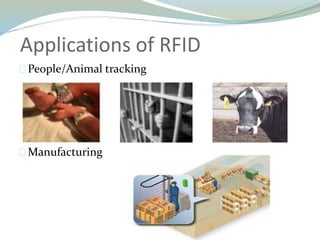
Applications of RFID
People/Animal tracking
Manufacturing
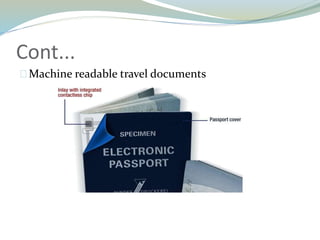
Cont...
Machine readable travel documents
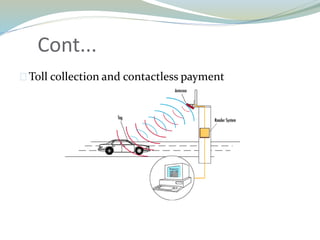
Cont...
Toll collection and contactless payment
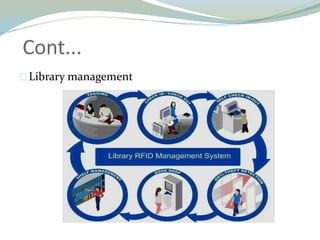
Cont...
Library management
RFID v/s Barcode
RFID is more effective
Barcodes have limited information
Read/write capability
RFID tags can be read at much distance
Advantage
The RFID tags can store data up to 2 kb.
Cannot be easily replicated and therefore, it increases
the security of the product.
Simple to install/inject inside the body of
animals/human beings
Speed
Robust
Disadvantage
Doesn’t work properly on liquids and metal products.
More expensive than barcode system
Harder to understand
Tags are usually larger than barcode labels
Possibility of unauthorized reading of passports and
credit cards
Concerns surrounding RFID
High investment
Limited range
Health concerns
RFID applications in INDIA
Department of road transport and highways
Centre for railway information systems(CRIS)
Apparel Tracking Using RFID

Rfid radio frequency identification