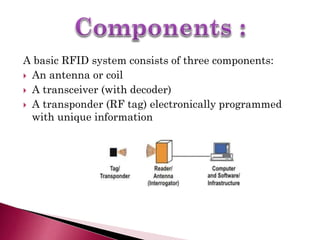
A basic RFID system consists of three components:
 An antenna or coil
 A transceiver (with decoder)
 A transponder (RF tag) electronically programmed
with unique information
There are two type of RFID tag:
1. Active RFID Tag –
 Their own power source.
 reader can be much farther away and still get the
signal.
 limited life spans.
2. Passive RFID Tag –
 Do not require power source.
 Smaller in size.
 Unlimited life span.
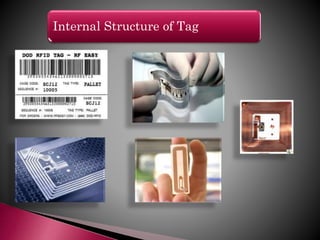
Internal Structure of Tag
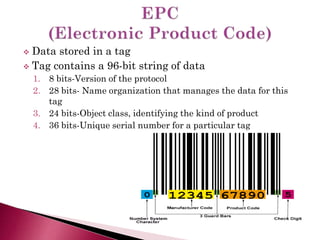
 Data stored in a tag
 Tag contains a 96-bit string of data
1. 8 bits-Version of the protocol
2. 28 bits- Name organization that manages the data for this
tag
3. 24 bits-Object class, identifying the kind of product
4. 36 bits-Unique serial number for a particular tag
1.Barcode readers require a direct line of
sight to the printed barcode. 2.The
range to read a barcode is much less,
typically no more than fifteen feet.
3.Not more expensive . 4.Barcodes
have no read/write capability
information can not added in barcode.
1.Do not require a direct line of sight .
2.RFID tags can be read at much
greater distances up to 300 feet. 3.RFID
tags are typically more expensive
4.RFID tags, can be read/write
information can be added
Barcode RFID
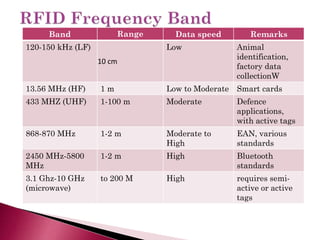
Band Range Data speed Remarks
120-150 kHz (LF)
10 cm
Low Animal
identification,
factory data
collectionW
13.56 MHz (HF) 1 m Low to Moderate Smart cards
433 MHZ (UHF) 1-100 m Moderate Defence
applications,
with active tags
868-870 MHz 1-2 m Moderate to
High
EAN, various
standards
2450 MHz-5800
MHz
1-2 m High Bluetooth
standards
3.1 Ghz-10 GHz
(microwave)
to 200 M High requires semi-
active or active
tags
 Access control
 Manufacturing
 Libraries
 Identification
 Security access control
 Airport baggage
 Global standardization
 Security concerns
 Exploitation
 shielding
 Temperature exposure`
 Main advantage is their low price and the usually
employed offline preaggregation of data to the class
level.
 Optical RFID operates in the electromagnetic
spectrum
 Optical RFID provides much more protection
against than RFID
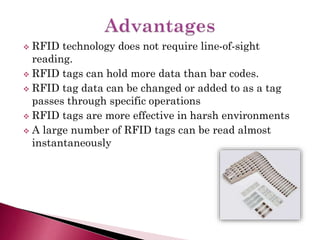
 RFID technology does not require line-of-sight
reading.
 RFID tags can hold more data than bar codes.
 RFID tag data can be changed or added to as a tag
passes through specific operations
 RFID tags are more effective in harsh environments
 A large number of RFID tags can be read almost
instantaneously
 RFIDs are easy to conceal or incorporate in other
items. For example, in 2009 researchers at Bristol
University successfully glued RFID micro-
transponders to live ants in order to study their
behavior.
 Hitachi holds the record for the smallest RFID chip,
at 0.05mm × 0.05mm. This is 1/64th the size of the
previous record holder.Manufacture is enabled by
using the silicon-on-insulator (SOI) process. These
dust-sized chips can store 38-digit numbers using 128-
bit (ROM).
 100,000 times the indoor receiver sensitivity of previous RFID
solutions
 20 times the read range of conventional passive RFID readers
 100 times greater coverage than conventional systems
 Verification of 100 percent of tags on RF-challenged goods
 Non line-of-sight read capability
 One multi-purpose system to read, locate and secure RFID tag
data.
Presentation  RFID

Presentation RFID

  • 4.
    A basic RFIDsystem consists of three components:  An antenna or coil  A transceiver (with decoder)  A transponder (RF tag) electronically programmed with unique information
  • 6.
    There are twotype of RFID tag: 1. Active RFID Tag –  Their own power source.  reader can be much farther away and still get the signal.  limited life spans. 2. Passive RFID Tag –  Do not require power source.  Smaller in size.  Unlimited life span.
  • 7.
  • 8.
     Data storedin a tag  Tag contains a 96-bit string of data 1. 8 bits-Version of the protocol 2. 28 bits- Name organization that manages the data for this tag 3. 24 bits-Object class, identifying the kind of product 4. 36 bits-Unique serial number for a particular tag
  • 9.
    1.Barcode readers requirea direct line of sight to the printed barcode. 2.The range to read a barcode is much less, typically no more than fifteen feet. 3.Not more expensive . 4.Barcodes have no read/write capability information can not added in barcode. 1.Do not require a direct line of sight . 2.RFID tags can be read at much greater distances up to 300 feet. 3.RFID tags are typically more expensive 4.RFID tags, can be read/write information can be added Barcode RFID
  • 10.
    Band Range Dataspeed Remarks 120-150 kHz (LF) 10 cm Low Animal identification, factory data collectionW 13.56 MHz (HF) 1 m Low to Moderate Smart cards 433 MHZ (UHF) 1-100 m Moderate Defence applications, with active tags 868-870 MHz 1-2 m Moderate to High EAN, various standards 2450 MHz-5800 MHz 1-2 m High Bluetooth standards 3.1 Ghz-10 GHz (microwave) to 200 M High requires semi- active or active tags
  • 11.
     Access control Manufacturing  Libraries  Identification  Security access control  Airport baggage
  • 13.
     Global standardization Security concerns  Exploitation  shielding  Temperature exposure`
  • 14.
     Main advantageis their low price and the usually employed offline preaggregation of data to the class level.  Optical RFID operates in the electromagnetic spectrum  Optical RFID provides much more protection against than RFID
  • 15.
     RFID technologydoes not require line-of-sight reading.  RFID tags can hold more data than bar codes.  RFID tag data can be changed or added to as a tag passes through specific operations  RFID tags are more effective in harsh environments  A large number of RFID tags can be read almost instantaneously
  • 16.
     RFIDs areeasy to conceal or incorporate in other items. For example, in 2009 researchers at Bristol University successfully glued RFID micro- transponders to live ants in order to study their behavior.  Hitachi holds the record for the smallest RFID chip, at 0.05mm × 0.05mm. This is 1/64th the size of the previous record holder.Manufacture is enabled by using the silicon-on-insulator (SOI) process. These dust-sized chips can store 38-digit numbers using 128- bit (ROM).
  • 17.
     100,000 timesthe indoor receiver sensitivity of previous RFID solutions  20 times the read range of conventional passive RFID readers  100 times greater coverage than conventional systems  Verification of 100 percent of tags on RF-challenged goods  Non line-of-sight read capability  One multi-purpose system to read, locate and secure RFID tag data.