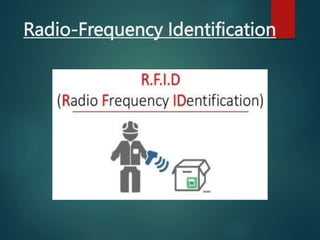
Radio-Frequency Identification
PRESENTATION OUTLINE
⚫Introduction
⚫Working
⚫Applications
⚫Advantages
⚫Disadvantages
⚫Differences
⚫Future uses
⚫Conclusion
What is RFID?
 RFID stands for Radio-frequency identification (RFID) an Auto-ID
data collection system surveillance, using RF waves for Identifying,
Tracking, and doing Management of material flow.
 It is an automatic identification method, relying on storing and
remotely retrieving data using devices called RFID tags or
transponders. An RFID tag is an object that can be attached to or
incorporated into a product for the purpose of identification using
radio waves.
 Is fast and does not require physical sight or contact between the
reader/scanner and the tagged item.
 Basic concept behind RFID is the same as “Mirror-Sunlight-
Reflection theory.
 Invented and used in the early 1940s but Commercial operation
began in the 1960s.
RFID tags: Smart labels
4
… and a chip
attached to it
… on a substrate
e.g. a plastic
foil ...
an antenna,
printed, etched
or stamped ...
A paper label
with RFID inside
RFID System Components
 RFID Tag
 Transponder
 Located on the object
 RFID Reader
 Transceiver
 Can read and write data to Tag
 Data Processing Subsystem
Transponder
• Consistsof a silicon-based microchip thatstoresdataand antenna.
Tagscan be classified in three different ways :
1. Active
2. Passive
3. Semi-active (semi-passive)
1. Active transponder hason-tag batteriesand isalso known as
beacons (broadcast theirown signal).
2. Passive transponders obtain all power from the RF interrogation
signal of the reader.
3. Active and passiveonly communicatewhen interrogated by
a transceiver.
Tagscan also beclassified on the basisof:
• Read-only (RO)
• Writeonce, read many (WORM)
• Read-write (RW)
SMART LABELS (tags)
 Typical Frequency: 13.56 MHz-HF system uses passive tags
 - a worldwide standardized frequency
 Libraries use high-frequency passive tags
 In our library we paste these tags on the preface page of the
 Book
 Presently four main frequency bands are used in RFID systems
 Low-Frequency band: 125/134 kHz
 High-Frequency band: 13.56 MHz
 Ultra High-Frequency band: 800-900 MHz
 Microwave band: 2.4-5.8 GHz
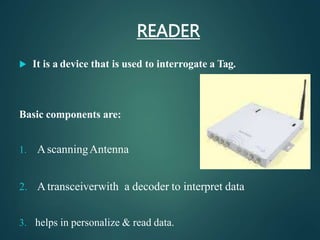
READER
 It is a device that is used to interrogate a Tag.
Basic components are:
1. AscanningAntenna
2. Atransceiverwith a decoder to interpret data
3. helps in personalize & read data.
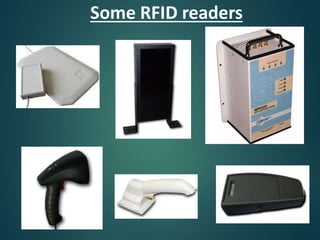
Some RFID readers
Data Processing Subsystem
 Backend System
 Connected via a high-speed network
 Computers used for business planning (ERP)
 Databasestorage
 Can beas simpleas a readerattached toa
cash register
RFID System
Ethernet
RFID
Reader
RFID Tag RF Antenna Network Workstation
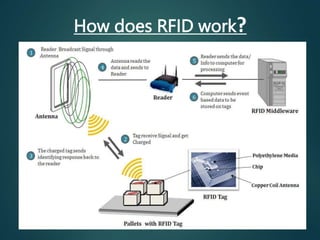
How does RFID work?
working
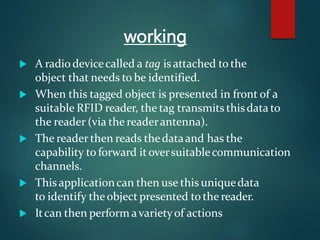
 A radio devicecalled a tag is attached to the
object that needs to be identified.
 When this tagged object is presented in front of a
suitable RFID reader, the tag transmits thisdata to
the reader (via the readerantenna).
 The reader then reads thedataand has the
capability to forward itoversuitablecommunication
channels.
 This applicationcan then use this uniquedata
to identify theobject presented tothe reader.
 Itcan then perform avarietyof actions
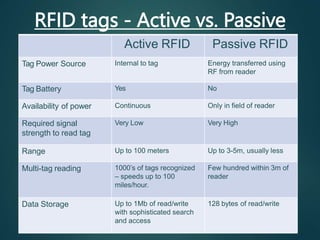
RFID tags - Active vs. Passive
Active RFID Passive RFID
Tag Power Source Internal to tag Energy transferred using
RF from reader
Tag Battery Yes No
Availability of power Continuous Only in field of reader
Required signal
strength to read tag
Very Low Very High
Range Up to 100 meters Up to 3-5m, usually less
Multi-tag reading 1000’s of tags recognized
– speeds up to 100
miles/hour.
Few hundred within 3m of
reader
Data Storage Up to 1Mb of read/write
with sophisticated search
and access
128 bytes of read/write
RFID Applications
 Manufacturing and Processing
⚫ Inventoryand production process monitoring
⚫ Warehouseorder fulfillment
 Supply Chain Management
⚫ Inventorytracking systems
⚫ Logistics management
 Retail
⚫ Inventorycontrol and customerinsight
⚫ Autocheckoutwith reverse logistics
 Security
⚫ Access control
⚫ Counterfeiting and Theftcontrol/prevention
 Location Tracking
⚫ Traffic movementcontrol and parking management
⚫ Wildlife/Livestock monitoring and tracking
continued……….
 Inventory Monitoring
⚫ Library book and bookstore tracking
⚫ Pallet tracking (Wal-Martand the Dept. of Defense)
 Access Control
⚫ Hand Implants
⚫ ID badges
 Payment Systems
⚫ TheAmerican Express Blue Card, a feature theycall Express Pay
⚫ Exxon Mobile Speed Pass Airline baggage tracking
⚫ Cell phonesare including RFID tags built-in
⚫ Electronicpayment – creditcard companies moving to RFID-enabled
cards to increase efficiency and reduce time at point-of-sale for
customers, merchants, and card issuers.
 Commercially for truck and trailer tracking in shipping
yards Long range accesscontrol forvehicles
⚫ Entry gates
⚫ Electronic toll collection
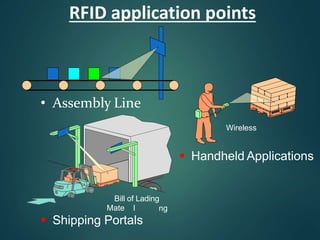
RFID application points
• Assembly Line
 Handheld Applications
Bill of Lading
Mate l
 Shipping Portals
ng
Wireless
Smart groceries
• Add an RFID tag toall
items in thegrocery.
• As the cart leaves the
store, it passes through an
RFID transceiver.
• Thecart is rung up in
seconds.
Smart groceries enhanced
• Track
products
through their
entire
lifetime.
21
RFID Implants
Before After implantsurgery
RFID animal tracking system
⚫Cattleand farm animalsare being tagged to improve
tracking and monitoring of health.
Advantages
 Contactless. An RFID tag can be read withoutany physical
contact between the tag and the reader.
 Writable data. The dataof a read-write (RW) RFID tag can be
rewrittena large numberof times.
 Absenceof lineof sight. A lineof sight is generally not
required foran RFID readerto read an RFID tag.
 Varietyof reading ranges.
 Widedata-capacityrange.
 Support formultiple tags reads.
 Perform smart tasks.
 Bettercollection management
 Improved productivityand services.
Disadvantages
 Poor performancewith RF-opaqueand RF-absorbent
objects.
 Impacted byenvironmental factors.
 Impacted by hardware interference.
 Cost factors: Implementation and on going system cost.
 It isacontroversial technology:
Continued…..
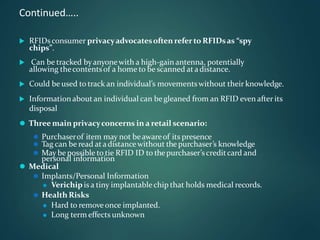
 RFIDsconsumer privacyadvocatesoftenreferto RFIDsas “spy
chips”.
 Can be tracked byanyonewith a high-gain antenna, potentially
allowing thecontentsof a home to be scanned at adistance.
 Could be used to track an individual’s movementswithout their knowledge.
 Information about an individual can begleaned from an RFID even after its
disposal
⚫ Three main privacyconcerns in a retail scenario:
⚫ Purchaserof item may not beawareof its presence
⚫ Tag can be read atadistance without the purchaser’s knowledge
⚫ May be possible to tie RFID ID to thepurchaser’screditcard and
personal information
⚫ Medical
⚫ Implants/Personal Information
⚫ Verichip is a tiny implantablechip that holds medical records.
⚫ Health Risks
⚫ Hard to remove once implanted.
⚫ Long term effects unknown
BARCODE Vs RFID
Library book management and
Security
book and borrowercard
2
1
scanner
3
librarysystem
4
check-outrecord
Book Drop Reader
Self Checks-in books
when patrons drop
them in book-drop …..
SECURITY GATE
⚫ Verify that all books leaving the library
have been checked out.
⚫ Detect Theft and
⚫ Prevent unauthorized removal
of material
Key Agenda and Concern for library
KeyAgenda
⚫Material security
⚫Financial liabilities
⚫Personal comfortand safety
⚫Privacyand problem patrons
key concern
⚫ To increase productivity
⚫ Improvecustomerservices
⚫ maintaincurrent staff level
Inventory Management
⚫Read/Write
-Ability toadd informationdirectly to tags enables each
uniqueasset tocarry itsown unique history
⚫Non-contact Reads
-Ability to read tags at a distance, under a variety of
environmental conditions, without physical manipulation
of theasset
⚫Fast Read
- Ability to simultaneouslyread large numbers (1000-1750
tags/sec) of items
⚫Automation
- Requires less human intervention
⚫Authenticity
- Each RFID chip is uniqueand can not be replicated
Inventory Reader
⚫ A compact and lightweight handheld device
⚫ Comfortable to use
⚫ High storage capacity
⚫ Multi-functional (such as shelving,
sorting, searching, weeding, and
reading)
⚫ Enhanced security
Future of RFID
⚫Medical
⚫Drug Counterfeiting
⚫ Tracking & Tracing
⚫Medical “Passports”
⚫ Foster Care System
⚫Food Chain Precautions
⚫Shopping
⚫Cashier-lesscheck outand payment
⚫Household Technology
⚫Smart keys
⚫Intelligentwashing machines
⚫Monitoring refrigerators
⚫Intelligentovens/microwaves
Conclusion
RFID is a Supporting Technology not a Competing technology………..
⚫ Slowly becoming an industrystandard
⚫ Speeds up the supply chain process
⚫ Easierto manage inventory
⚫ Continuallyevolving
It is easy to envision that, the RFID tags contents will increase in
power, prices are expected to decline and tag will dramatically
improve its efficiency, security and accuracy.
THANK YOU

Radio-Frequency IDentification ppt.pptx

  • 1.
  • 2.
  • 3.
    What is RFID? RFID stands for Radio-frequency identification (RFID) an Auto-ID data collection system surveillance, using RF waves for Identifying, Tracking, and doing Management of material flow.  It is an automatic identification method, relying on storing and remotely retrieving data using devices called RFID tags or transponders. An RFID tag is an object that can be attached to or incorporated into a product for the purpose of identification using radio waves.  Is fast and does not require physical sight or contact between the reader/scanner and the tagged item.  Basic concept behind RFID is the same as “Mirror-Sunlight- Reflection theory.  Invented and used in the early 1940s but Commercial operation began in the 1960s.
  • 4.
    RFID tags: Smartlabels 4 … and a chip attached to it … on a substrate e.g. a plastic foil ... an antenna, printed, etched or stamped ... A paper label with RFID inside
  • 5.
    RFID System Components RFID Tag  Transponder  Located on the object  RFID Reader  Transceiver  Can read and write data to Tag  Data Processing Subsystem
  • 6.
    Transponder • Consistsof asilicon-based microchip thatstoresdataand antenna. Tagscan be classified in three different ways : 1. Active 2. Passive 3. Semi-active (semi-passive) 1. Active transponder hason-tag batteriesand isalso known as beacons (broadcast theirown signal). 2. Passive transponders obtain all power from the RF interrogation signal of the reader. 3. Active and passiveonly communicatewhen interrogated by a transceiver. Tagscan also beclassified on the basisof: • Read-only (RO) • Writeonce, read many (WORM) • Read-write (RW)
  • 8.
    SMART LABELS (tags) Typical Frequency: 13.56 MHz-HF system uses passive tags  - a worldwide standardized frequency  Libraries use high-frequency passive tags  In our library we paste these tags on the preface page of the  Book  Presently four main frequency bands are used in RFID systems  Low-Frequency band: 125/134 kHz  High-Frequency band: 13.56 MHz  Ultra High-Frequency band: 800-900 MHz  Microwave band: 2.4-5.8 GHz
  • 9.
    READER  It isa device that is used to interrogate a Tag. Basic components are: 1. AscanningAntenna 2. Atransceiverwith a decoder to interpret data 3. helps in personalize & read data.
  • 10.
  • 11.
    Data Processing Subsystem Backend System  Connected via a high-speed network  Computers used for business planning (ERP)  Databasestorage  Can beas simpleas a readerattached toa cash register
  • 12.
    RFID System Ethernet RFID Reader RFID TagRF Antenna Network Workstation
  • 13.
  • 14.
    working  A radiodevicecalled a tag is attached to the object that needs to be identified.  When this tagged object is presented in front of a suitable RFID reader, the tag transmits thisdata to the reader (via the readerantenna).  The reader then reads thedataand has the capability to forward itoversuitablecommunication channels.  This applicationcan then use this uniquedata to identify theobject presented tothe reader.  Itcan then perform avarietyof actions
  • 15.
    RFID tags -Active vs. Passive Active RFID Passive RFID Tag Power Source Internal to tag Energy transferred using RF from reader Tag Battery Yes No Availability of power Continuous Only in field of reader Required signal strength to read tag Very Low Very High Range Up to 100 meters Up to 3-5m, usually less Multi-tag reading 1000’s of tags recognized – speeds up to 100 miles/hour. Few hundred within 3m of reader Data Storage Up to 1Mb of read/write with sophisticated search and access 128 bytes of read/write
  • 16.
    RFID Applications  Manufacturingand Processing ⚫ Inventoryand production process monitoring ⚫ Warehouseorder fulfillment  Supply Chain Management ⚫ Inventorytracking systems ⚫ Logistics management  Retail ⚫ Inventorycontrol and customerinsight ⚫ Autocheckoutwith reverse logistics  Security ⚫ Access control ⚫ Counterfeiting and Theftcontrol/prevention  Location Tracking ⚫ Traffic movementcontrol and parking management ⚫ Wildlife/Livestock monitoring and tracking
  • 17.
    continued……….  Inventory Monitoring ⚫Library book and bookstore tracking ⚫ Pallet tracking (Wal-Martand the Dept. of Defense)  Access Control ⚫ Hand Implants ⚫ ID badges  Payment Systems ⚫ TheAmerican Express Blue Card, a feature theycall Express Pay ⚫ Exxon Mobile Speed Pass Airline baggage tracking ⚫ Cell phonesare including RFID tags built-in ⚫ Electronicpayment – creditcard companies moving to RFID-enabled cards to increase efficiency and reduce time at point-of-sale for customers, merchants, and card issuers.  Commercially for truck and trailer tracking in shipping yards Long range accesscontrol forvehicles ⚫ Entry gates ⚫ Electronic toll collection
  • 18.
    RFID application points •Assembly Line  Handheld Applications Bill of Lading Mate l  Shipping Portals ng Wireless
  • 19.
    Smart groceries • Addan RFID tag toall items in thegrocery. • As the cart leaves the store, it passes through an RFID transceiver. • Thecart is rung up in seconds.
  • 20.
    Smart groceries enhanced •Track products through their entire lifetime.
  • 21.
  • 22.
    RFID animal trackingsystem ⚫Cattleand farm animalsare being tagged to improve tracking and monitoring of health.
  • 23.
    Advantages  Contactless. AnRFID tag can be read withoutany physical contact between the tag and the reader.  Writable data. The dataof a read-write (RW) RFID tag can be rewrittena large numberof times.  Absenceof lineof sight. A lineof sight is generally not required foran RFID readerto read an RFID tag.  Varietyof reading ranges.  Widedata-capacityrange.  Support formultiple tags reads.  Perform smart tasks.  Bettercollection management  Improved productivityand services.
  • 24.
    Disadvantages  Poor performancewithRF-opaqueand RF-absorbent objects.  Impacted byenvironmental factors.  Impacted by hardware interference.  Cost factors: Implementation and on going system cost.  It isacontroversial technology:
  • 25.
    Continued…..  RFIDsconsumer privacyadvocatesoftenrefertoRFIDsas “spy chips”.  Can be tracked byanyonewith a high-gain antenna, potentially allowing thecontentsof a home to be scanned at adistance.  Could be used to track an individual’s movementswithout their knowledge.  Information about an individual can begleaned from an RFID even after its disposal ⚫ Three main privacyconcerns in a retail scenario: ⚫ Purchaserof item may not beawareof its presence ⚫ Tag can be read atadistance without the purchaser’s knowledge ⚫ May be possible to tie RFID ID to thepurchaser’screditcard and personal information ⚫ Medical ⚫ Implants/Personal Information ⚫ Verichip is a tiny implantablechip that holds medical records. ⚫ Health Risks ⚫ Hard to remove once implanted. ⚫ Long term effects unknown
  • 26.
  • 27.
    Library book managementand Security book and borrowercard 2 1 scanner 3 librarysystem 4 check-outrecord
  • 29.
    Book Drop Reader SelfChecks-in books when patrons drop them in book-drop …..
  • 30.
    SECURITY GATE ⚫ Verifythat all books leaving the library have been checked out. ⚫ Detect Theft and ⚫ Prevent unauthorized removal of material
  • 31.
    Key Agenda andConcern for library KeyAgenda ⚫Material security ⚫Financial liabilities ⚫Personal comfortand safety ⚫Privacyand problem patrons key concern ⚫ To increase productivity ⚫ Improvecustomerservices ⚫ maintaincurrent staff level
  • 32.
    Inventory Management ⚫Read/Write -Ability toaddinformationdirectly to tags enables each uniqueasset tocarry itsown unique history ⚫Non-contact Reads -Ability to read tags at a distance, under a variety of environmental conditions, without physical manipulation of theasset ⚫Fast Read - Ability to simultaneouslyread large numbers (1000-1750 tags/sec) of items ⚫Automation - Requires less human intervention ⚫Authenticity - Each RFID chip is uniqueand can not be replicated
  • 33.
    Inventory Reader ⚫ Acompact and lightweight handheld device ⚫ Comfortable to use ⚫ High storage capacity ⚫ Multi-functional (such as shelving, sorting, searching, weeding, and reading) ⚫ Enhanced security
  • 34.
    Future of RFID ⚫Medical ⚫DrugCounterfeiting ⚫ Tracking & Tracing ⚫Medical “Passports” ⚫ Foster Care System ⚫Food Chain Precautions ⚫Shopping ⚫Cashier-lesscheck outand payment ⚫Household Technology ⚫Smart keys ⚫Intelligentwashing machines ⚫Monitoring refrigerators ⚫Intelligentovens/microwaves
  • 35.
    Conclusion RFID is aSupporting Technology not a Competing technology……….. ⚫ Slowly becoming an industrystandard ⚫ Speeds up the supply chain process ⚫ Easierto manage inventory ⚫ Continuallyevolving It is easy to envision that, the RFID tags contents will increase in power, prices are expected to decline and tag will dramatically improve its efficiency, security and accuracy.
  • 36.