+
RFID Technology Next
Generation Application :
Solutions
 About RFID ..
 How does RFID works..?
 RFID Sensors..
 Applications & Solutions..
 Advantage..
 Conclusion..
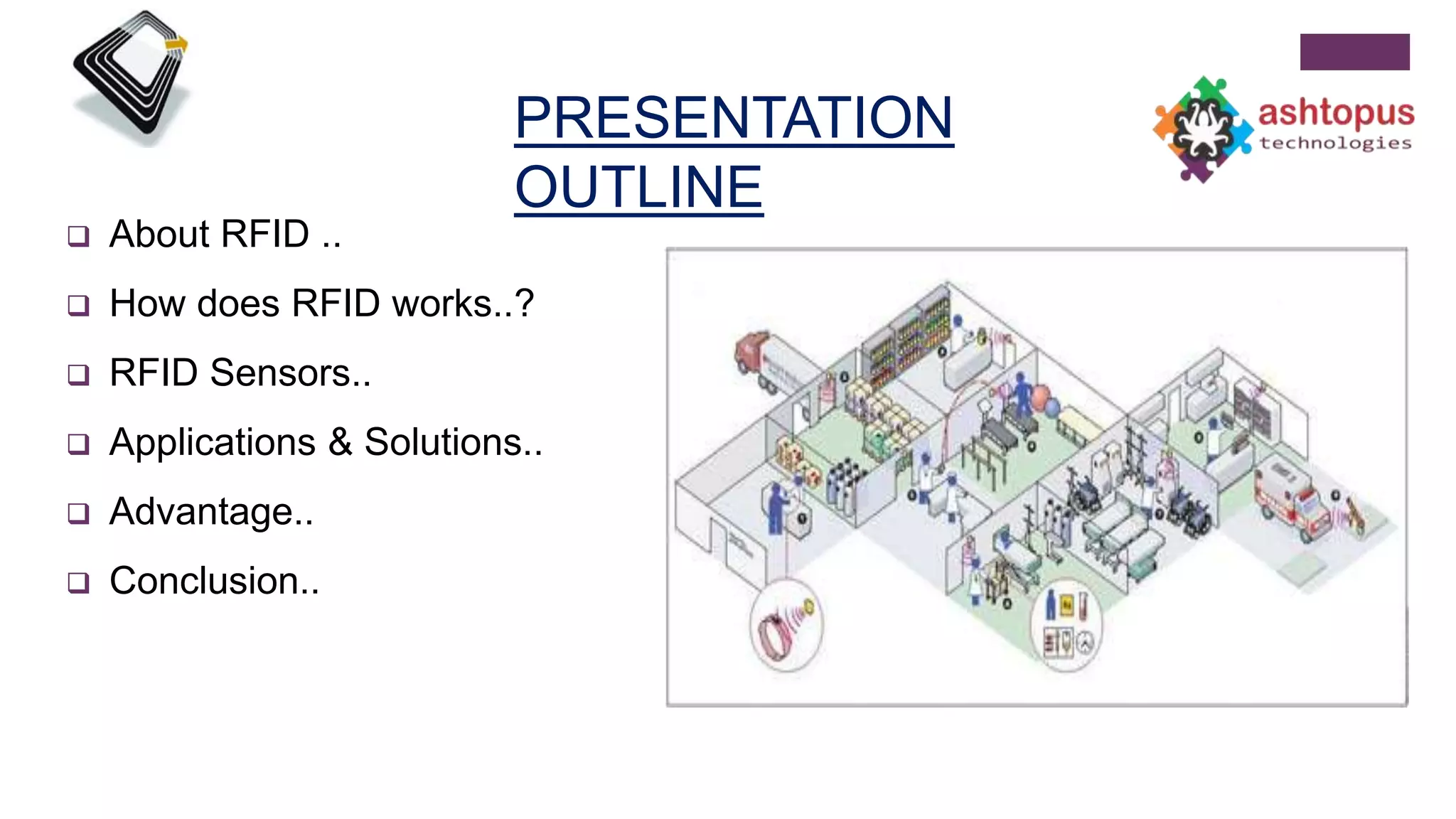
PRESENTATION
OUTLINE
Introduction To RFID
Radio Frequency Identification :Technology that uses radio-waves to
transfer data between a reader and a movable items to identify,
categorize track.
-It is an automatic identification method, relying on storing and remotely
retrieving data using devices called RFID tags or transponders.
-RFID (radio frequency identification) is a technology that incorporates
the use of electromagnetic or electrostatic coupling in the radio
frequency (RF) portion of the electromagnetic spectrum to uniquely
identify an object, animal, or person.
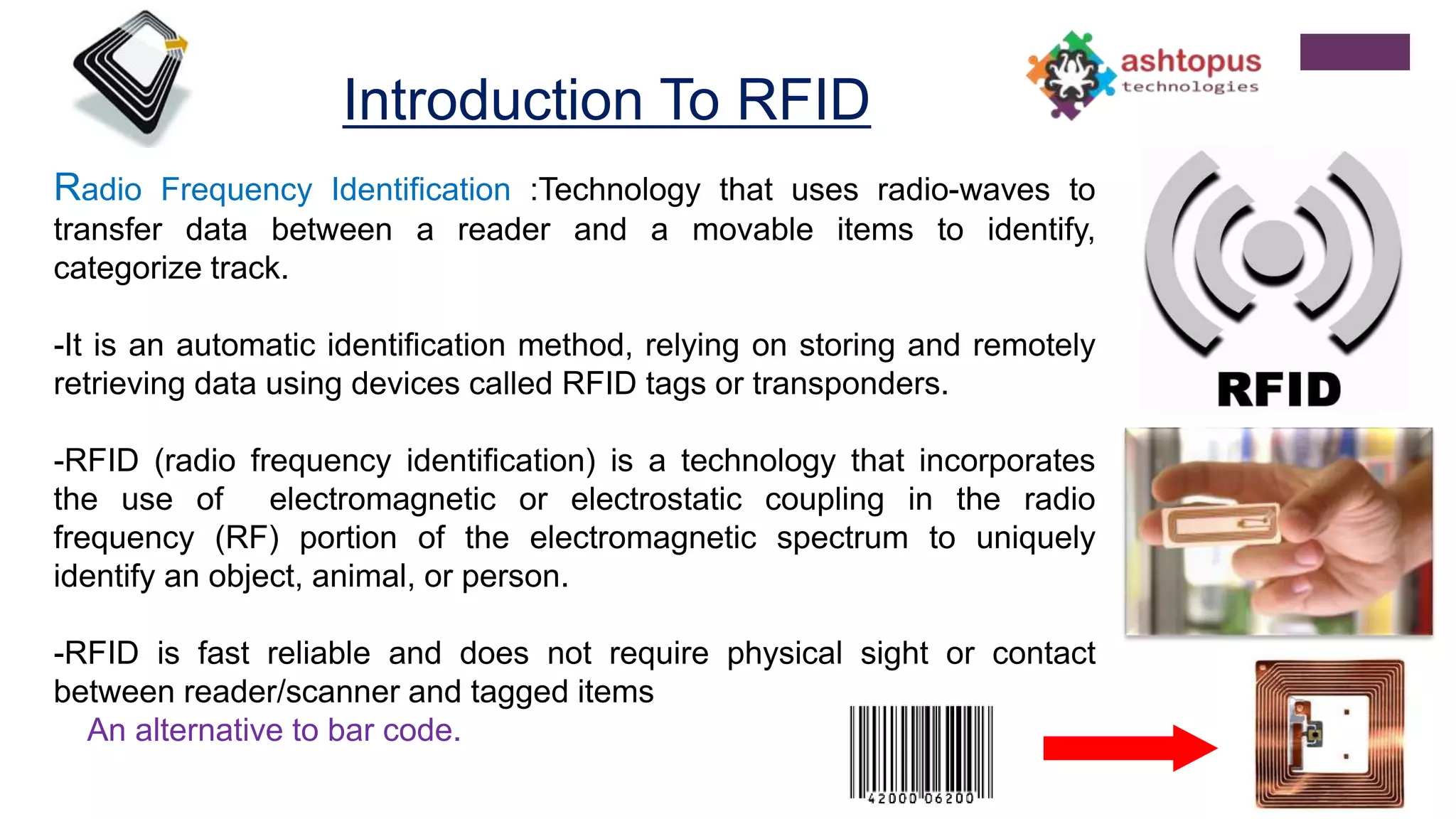
-RFID is fast reliable and does not require physical sight or contact
between reader/scanner and tagged items
An alternative to bar code.
How does a RFID system work ?
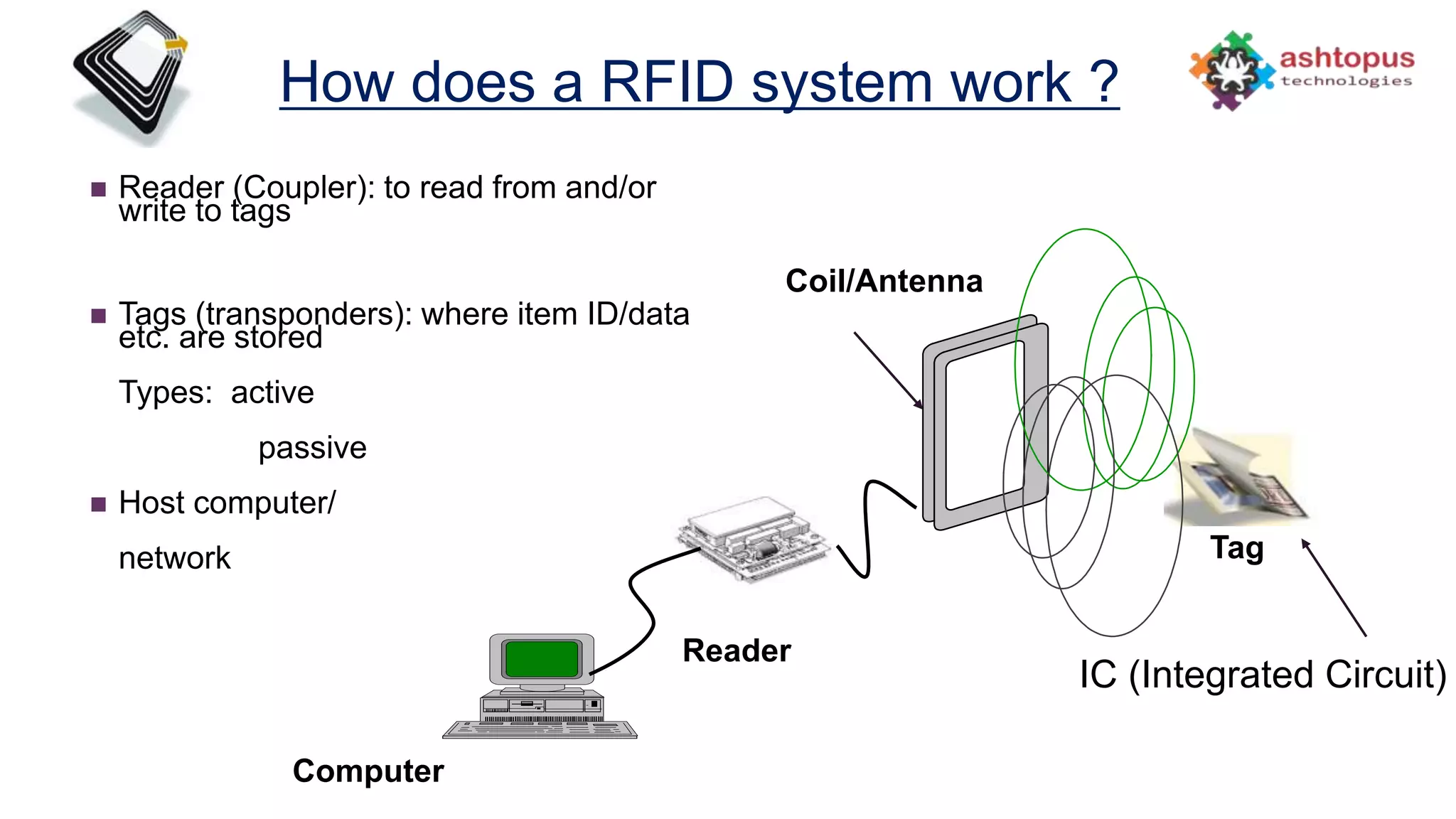
 Reader (Coupler): to read from and/or
write to tags
 Tags (transponders): where item ID/data
etc. are stored
Types: active
passive
 Host computer/
network
Reader
Coil/Antenna
Tag
Computer
IC (Integrated Circuit)
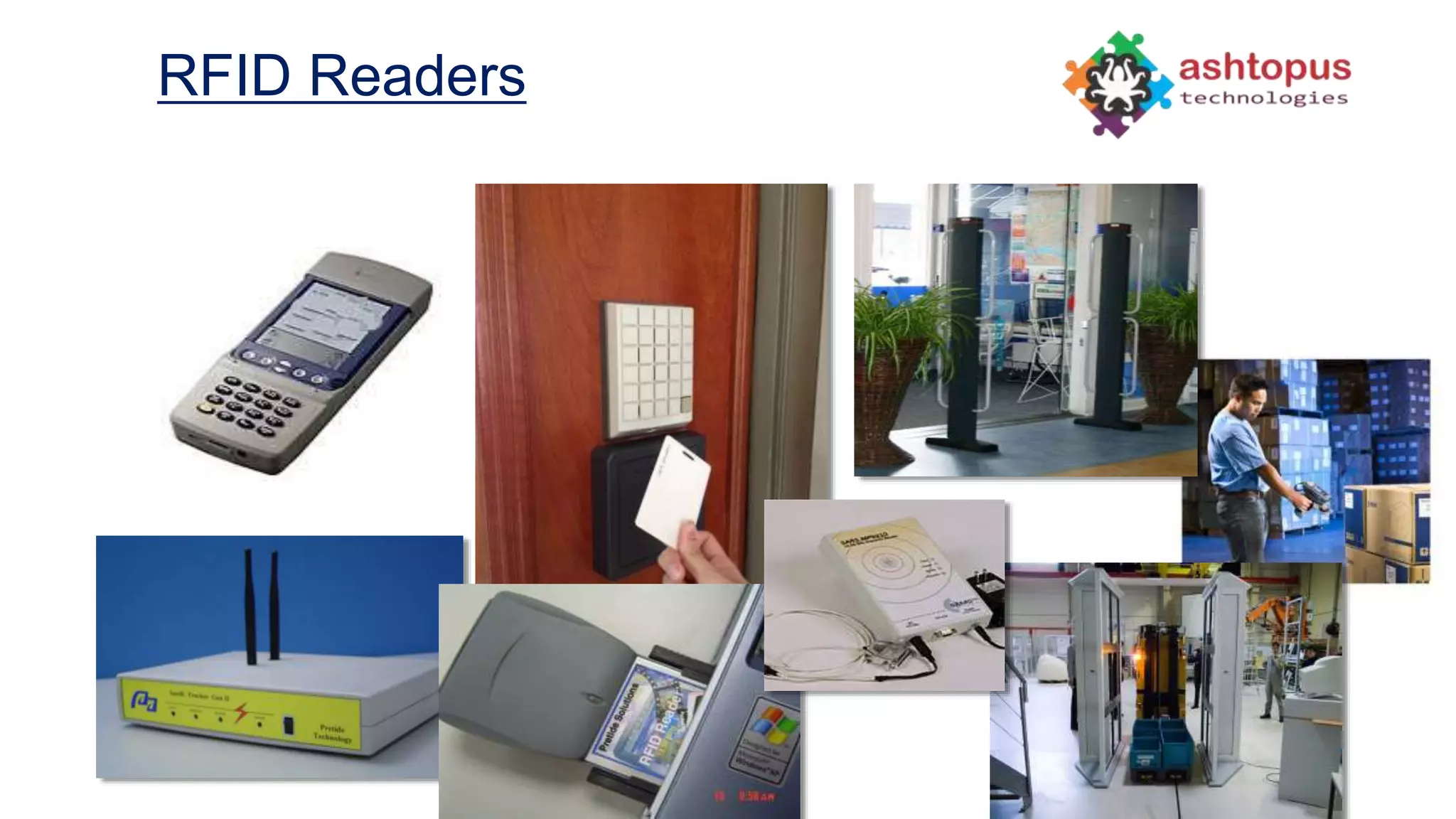
RFID Readers
RFID Sensors Tag
There are two broad categories of RFID systems
 Active Tag
 Passive Tag
Passive Tag:
The passive tags, or called backscatters, have neither own power resource nor RF
transmitter, they use inductive/propagation coupling to connect with the reader antenna, this
means that the passive tags just simply reflect back the signal emitted by the reader. These
passive tags are simpler and cheaper but have a much shorter reading range in comparison
to active tag.
Types of Passive Tag
Passive RFID tags generally operate at three distinct frequencies:
1-Low Frequency (LF) 125 -134 kHz
2- High Frequency (HF) 13.56 MHz
3-Ultra High Frequency (UHF) 856 MHz to 960 MHz
RFID Sensors Tag
Active RFID Tag : The active tags have transmitters and usually a battery as their power
resource; they transmit their ID codes through transmitters, thus a wide reading range can
be achieved.
Active RFID systems use self-powered RFID tags that continuously broadcast their own
signal. Active RFID tags are commonly used as “beacons” to accurately track the real-time
location of assets or in high speed environments such as tolling. Active tags provide a much
longer read range than passive tags.
Types of Active Tag
Two different types of active RFID tags are available on today’s market –
 1-Transponders
 2-Beacon
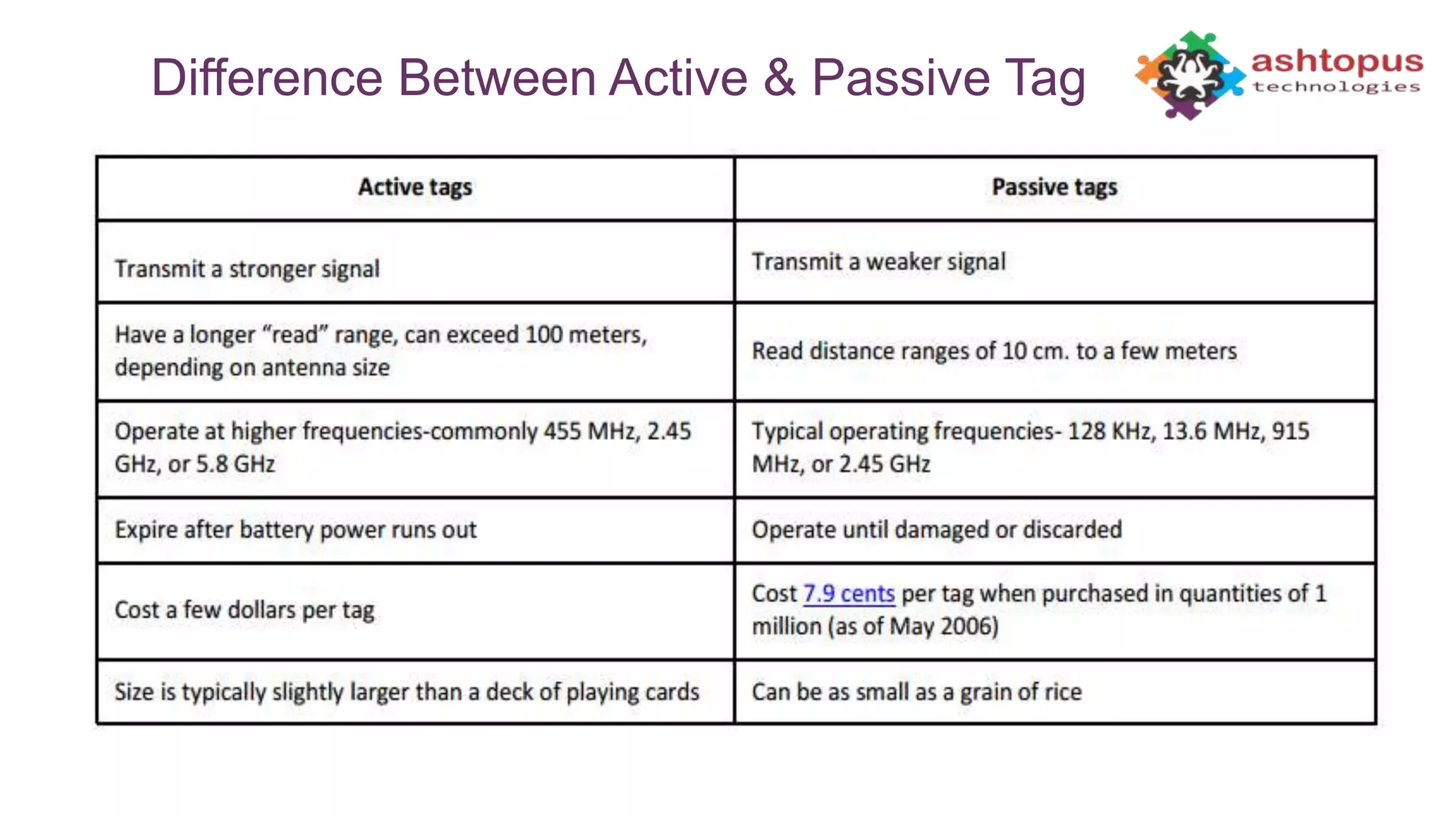
Difference Between Active & Passive Tag
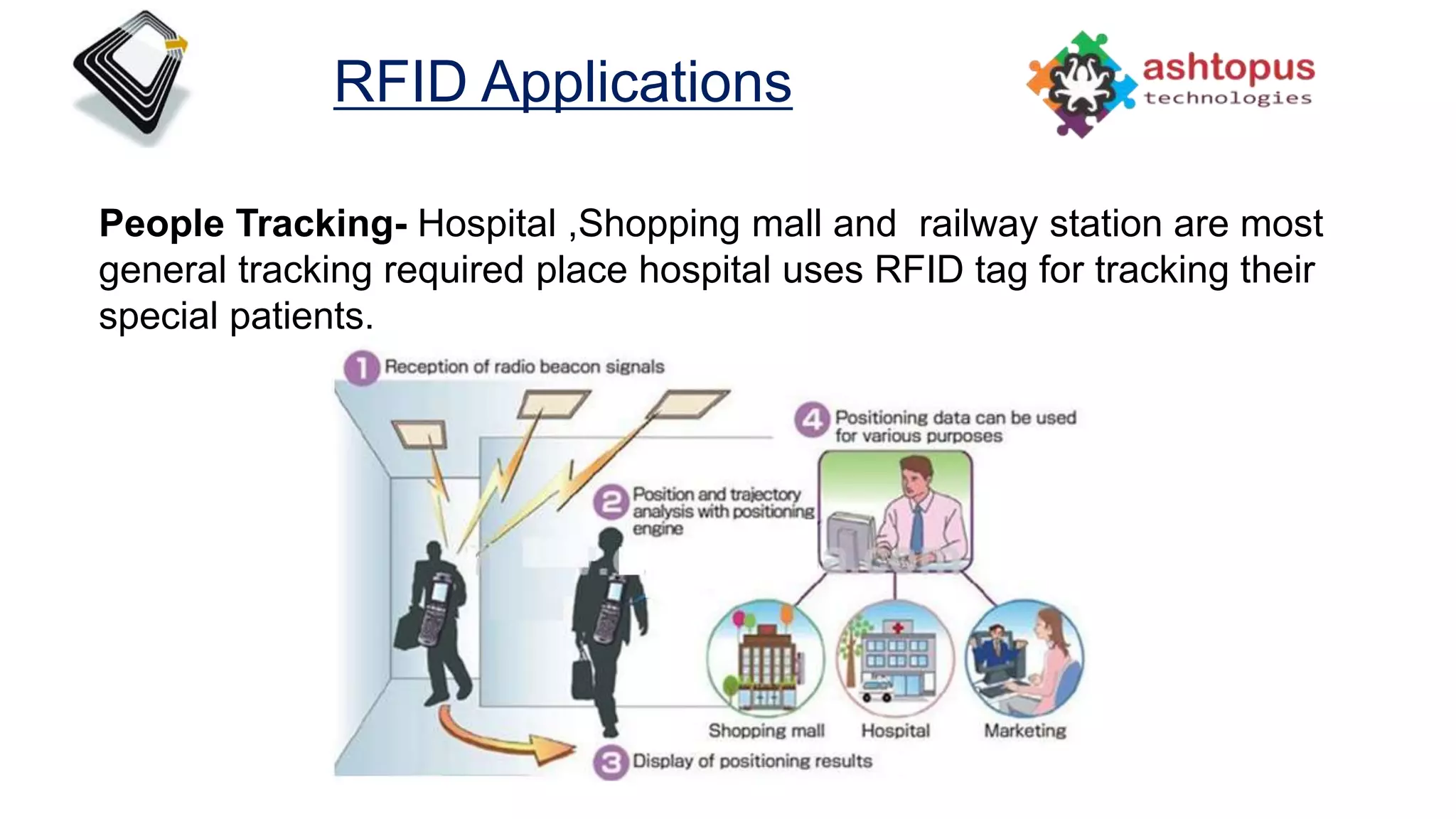
People Tracking- Hospital ,Shopping mall and railway station are most
general tracking required place hospital uses RFID tag for tracking their
special patients.
RFID Applications
RFID Applications
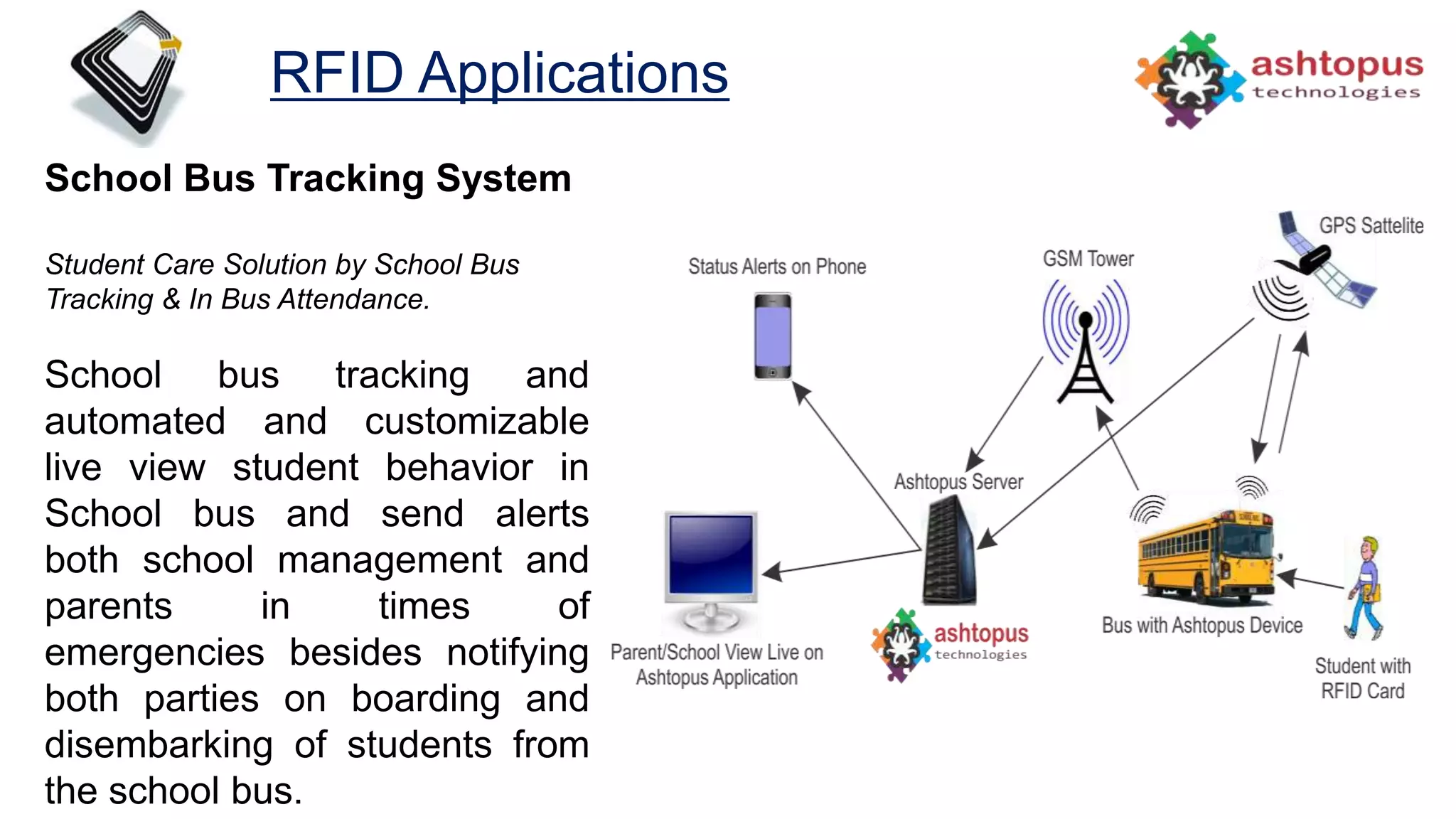
School Bus Tracking System
Student Care Solution by School Bus
Tracking & In Bus Attendance.
School bus tracking and
automated and customizable
live view student behavior in
School bus and send alerts
both school management and
parents in times of
emergencies besides notifying
both parties on boarding and
disembarking of students from
the school bus.
RFID Applications
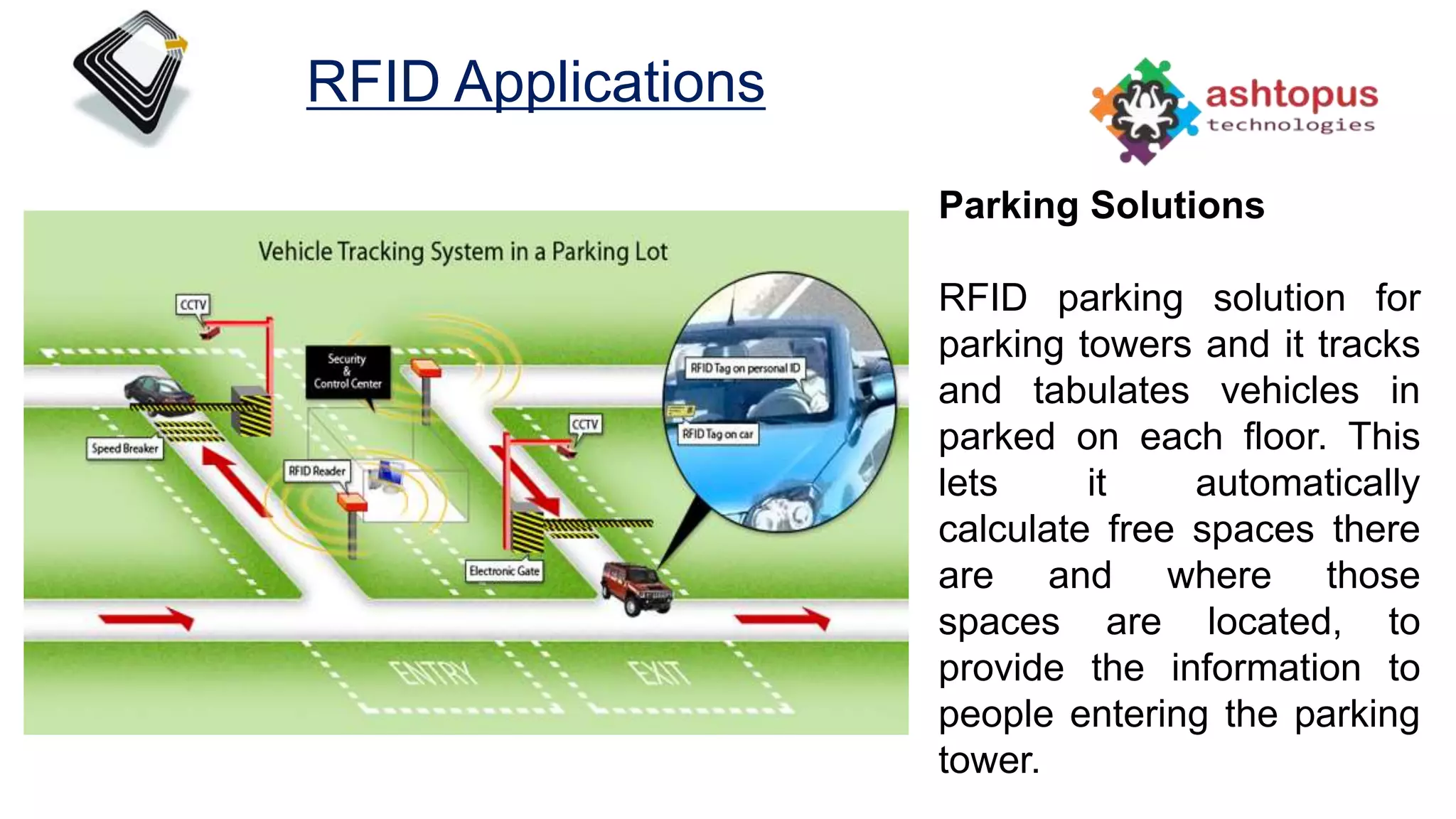
Parking Solutions
RFID parking solution for
parking towers and it tracks
and tabulates vehicles in
parked on each floor. This
lets it automatically
calculate free spaces there
are and where those
spaces are located, to
provide the information to
people entering the parking
tower.
RFID Applications
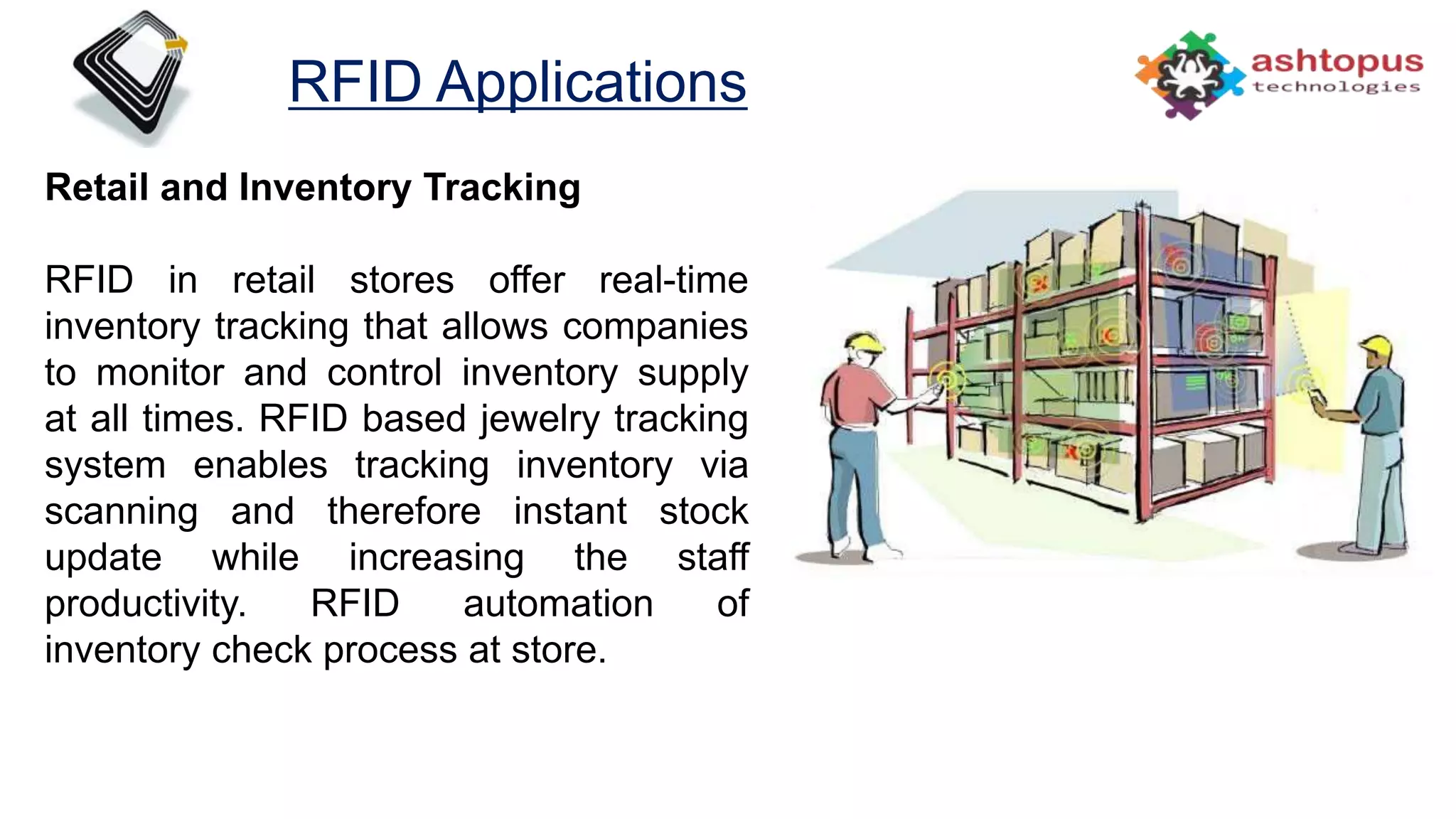
Retail and Inventory Tracking
RFID in retail stores offer real-time
inventory tracking that allows companies
to monitor and control inventory supply
at all times. RFID based jewelry tracking
system enables tracking inventory via
scanning and therefore instant stock
update while increasing the staff
productivity. RFID automation of
inventory check process at store.
RFID Applications
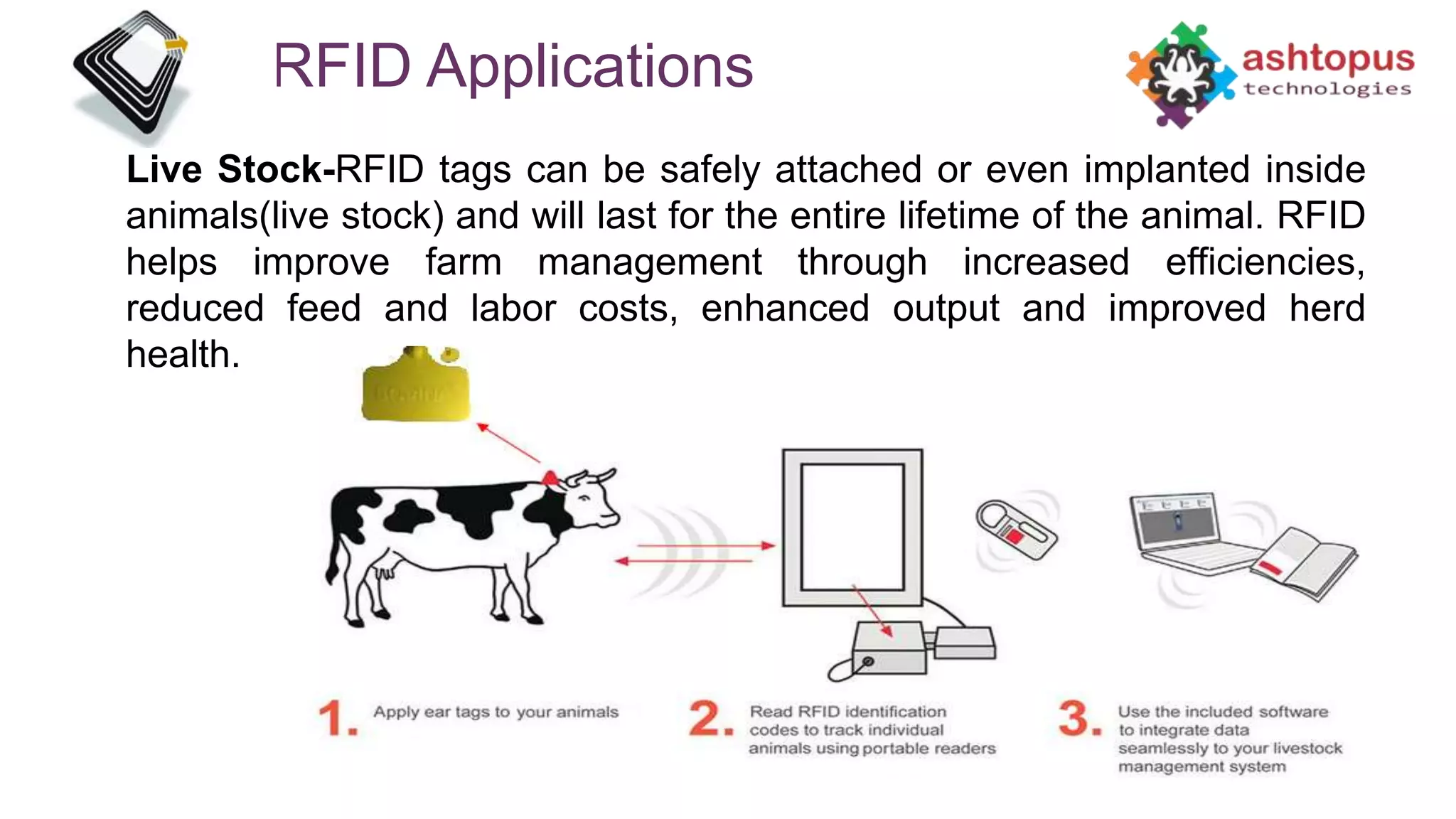
Live Stock-RFID tags can be safely attached or even implanted inside
animals(live stock) and will last for the entire lifetime of the animal. RFID
helps improve farm management through increased efficiencies,
reduced feed and labor costs, enhanced output and improved herd
health.
RFID Applications
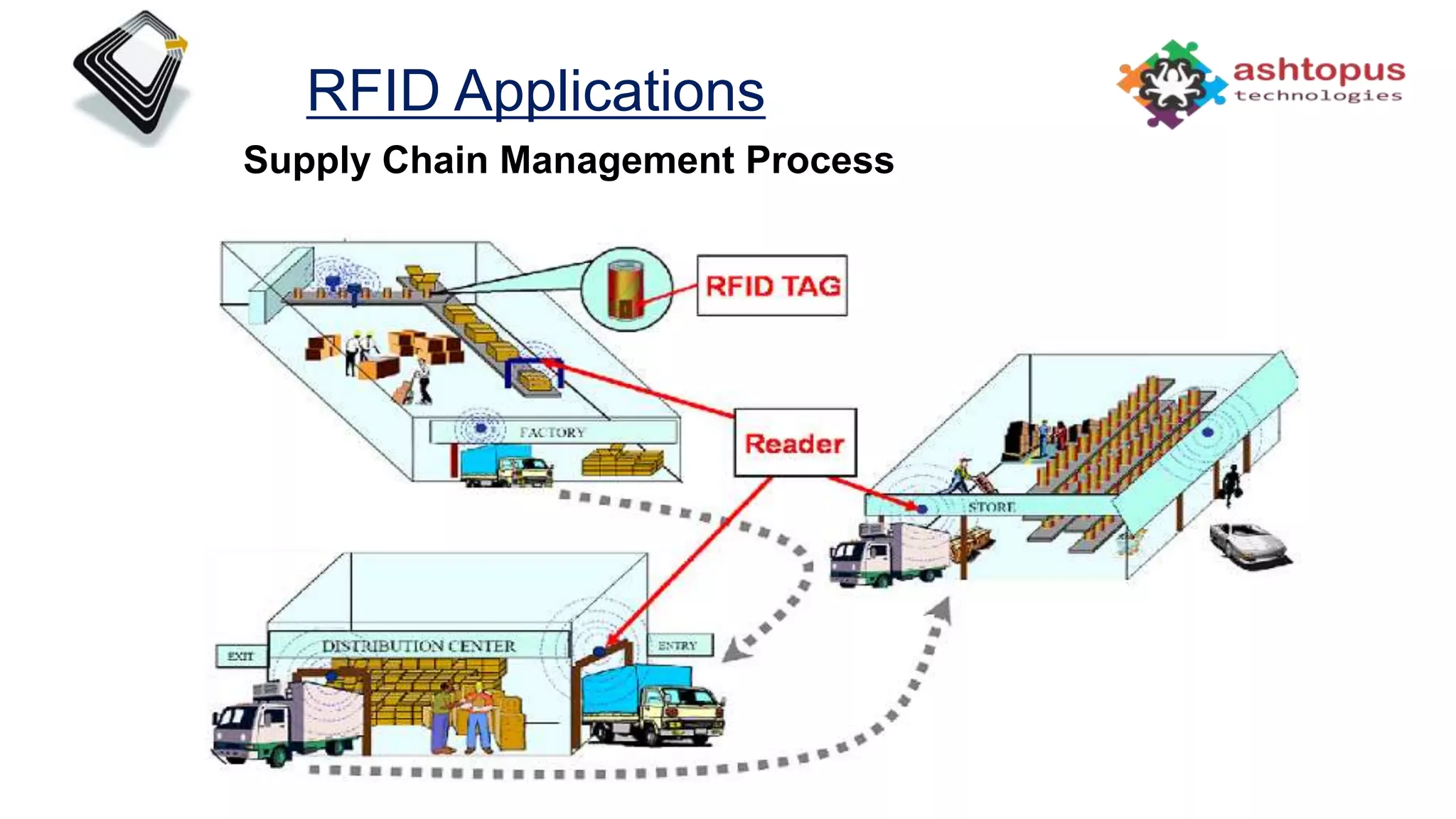
Supply Chain Management Process
RFID Applications
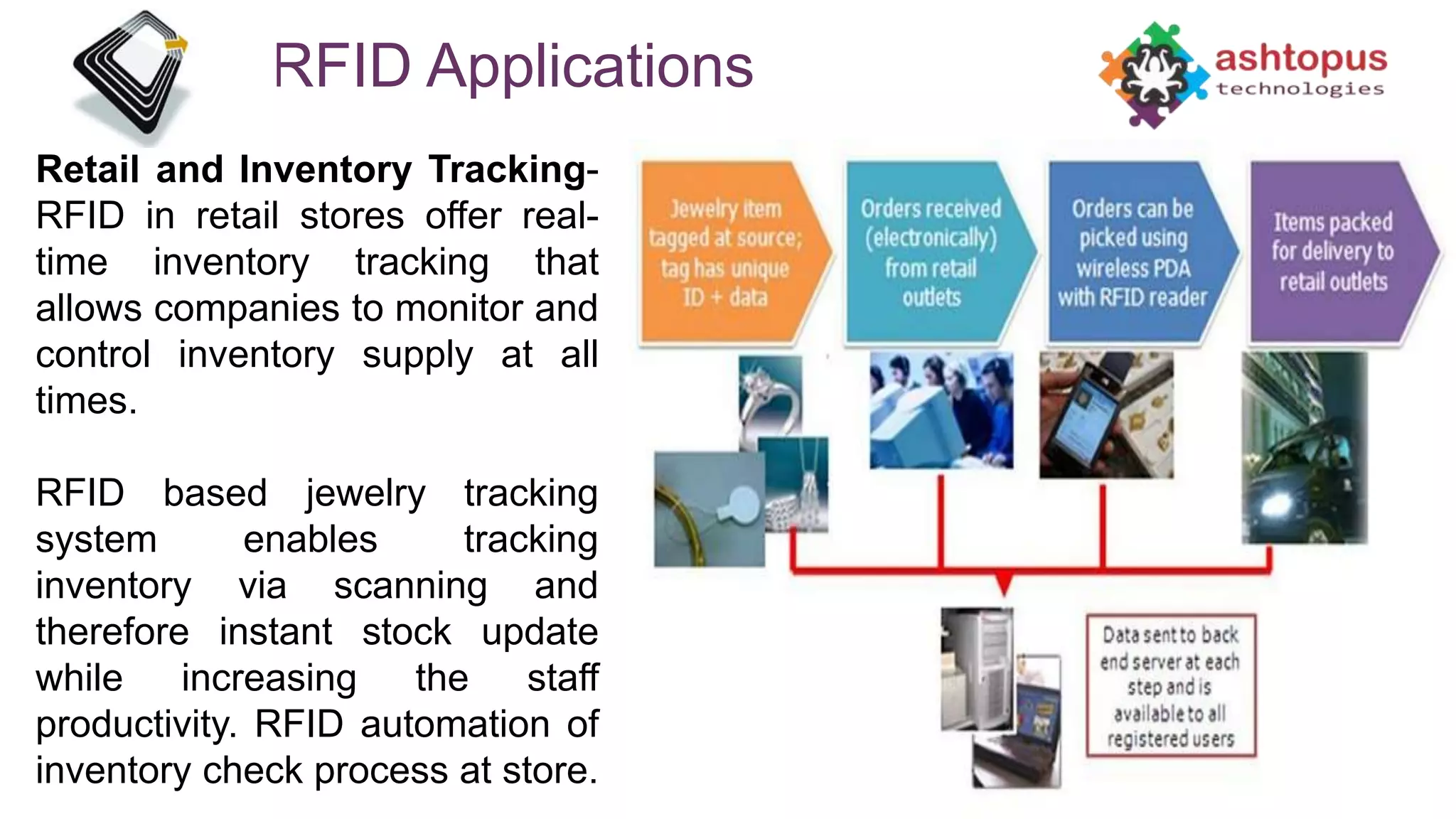
Retail and Inventory Tracking-
RFID in retail stores offer real-
time inventory tracking that
allows companies to monitor and
control inventory supply at all
times.
RFID based jewelry tracking
system enables tracking
inventory via scanning and
therefore instant stock update
while increasing the staff
productivity. RFID automation of
inventory check process at store.
RFID Applications
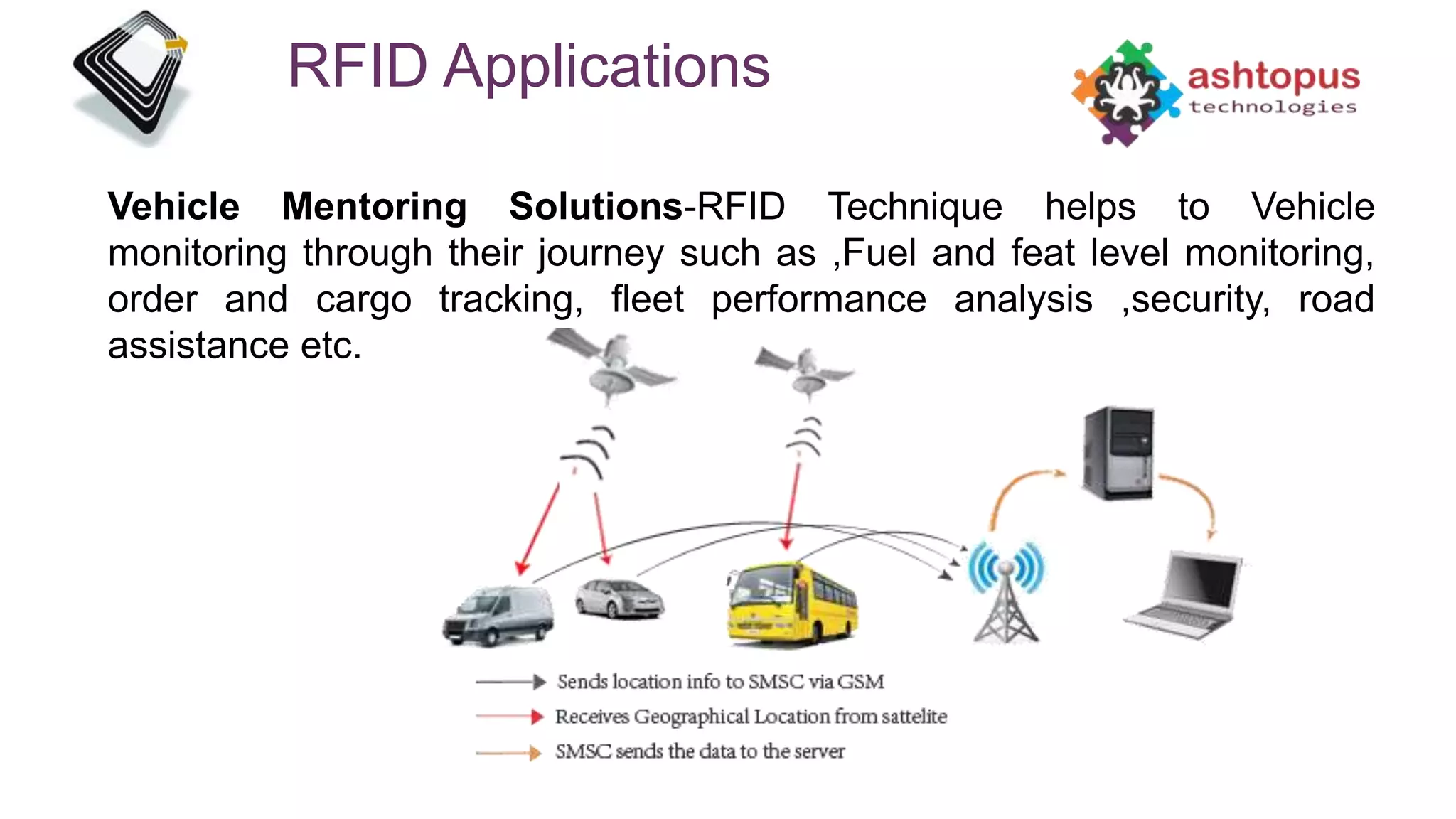
Vehicle Mentoring Solutions-RFID Technique helps to Vehicle
monitoring through their journey such as ,Fuel and feat level monitoring,
order and cargo tracking, fleet performance analysis ,security, road
assistance etc.
RFID Applications
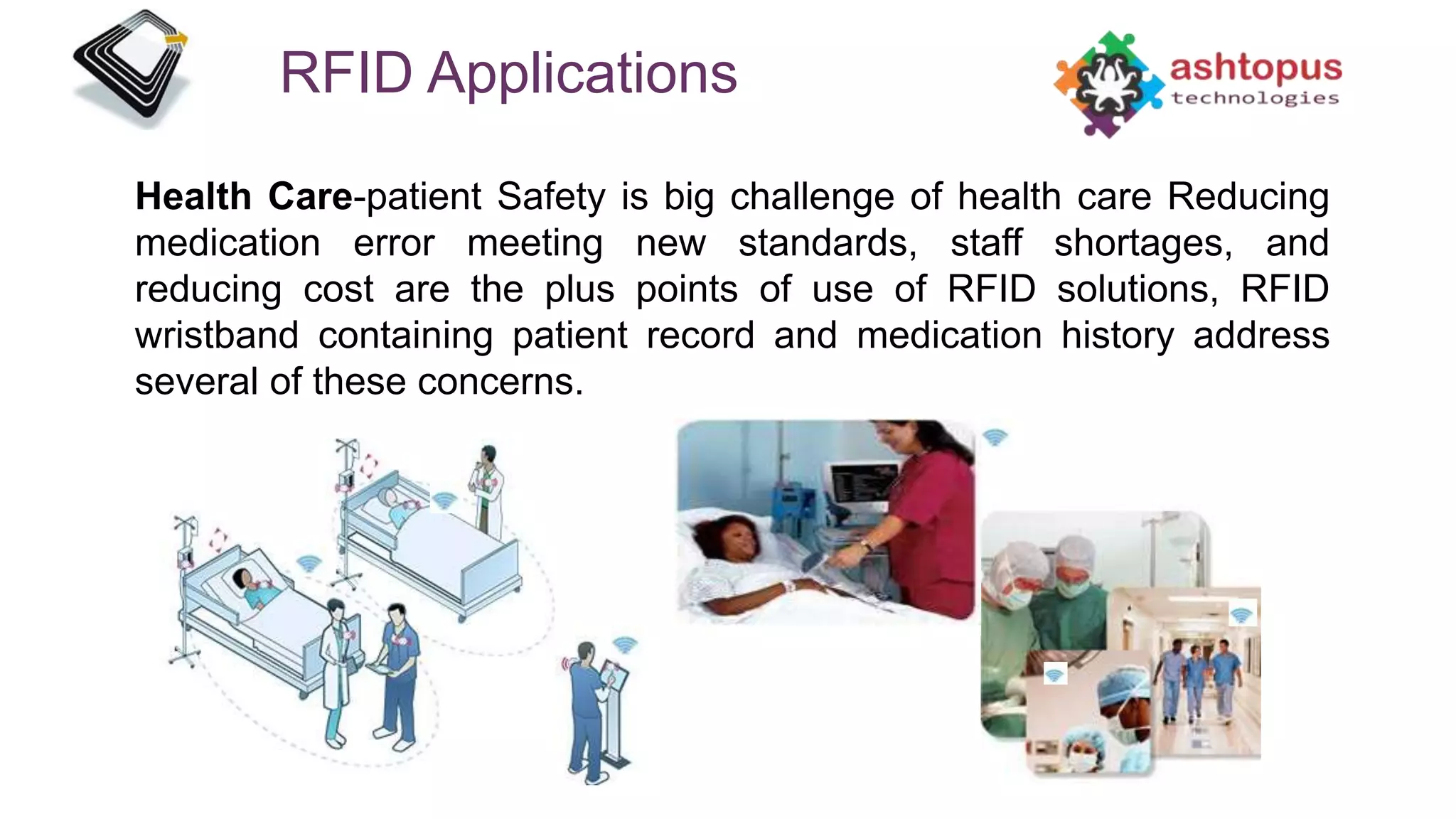
Health Care-patient Safety is big challenge of health care Reducing
medication error meeting new standards, staff shortages, and
reducing cost are the plus points of use of RFID solutions, RFID
wristband containing patient record and medication history address
several of these concerns.
RFID Applications
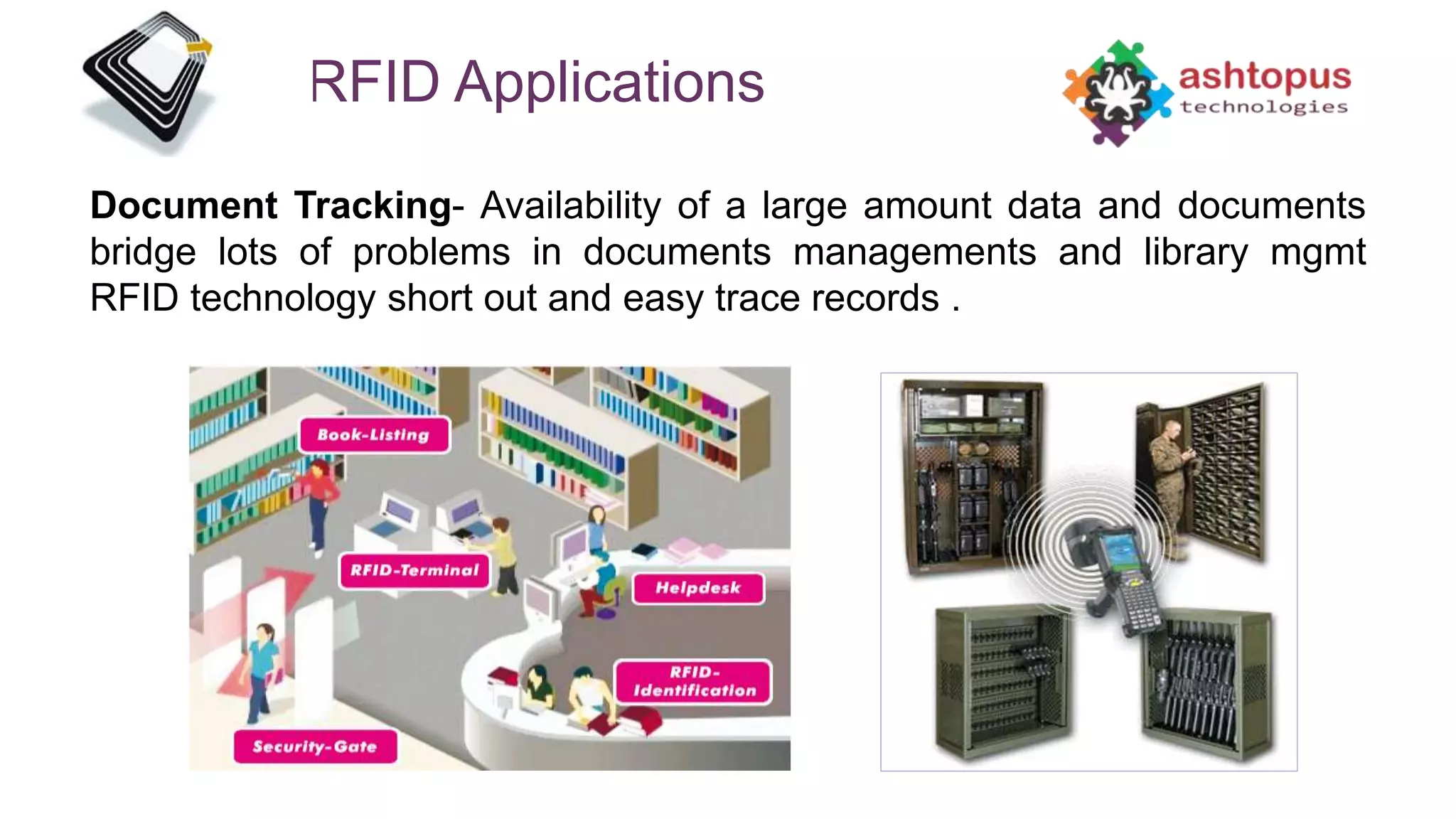
Document Tracking- Availability of a large amount data and documents
bridge lots of problems in documents managements and library mgmt
RFID technology short out and easy trace records .
RFID Applications
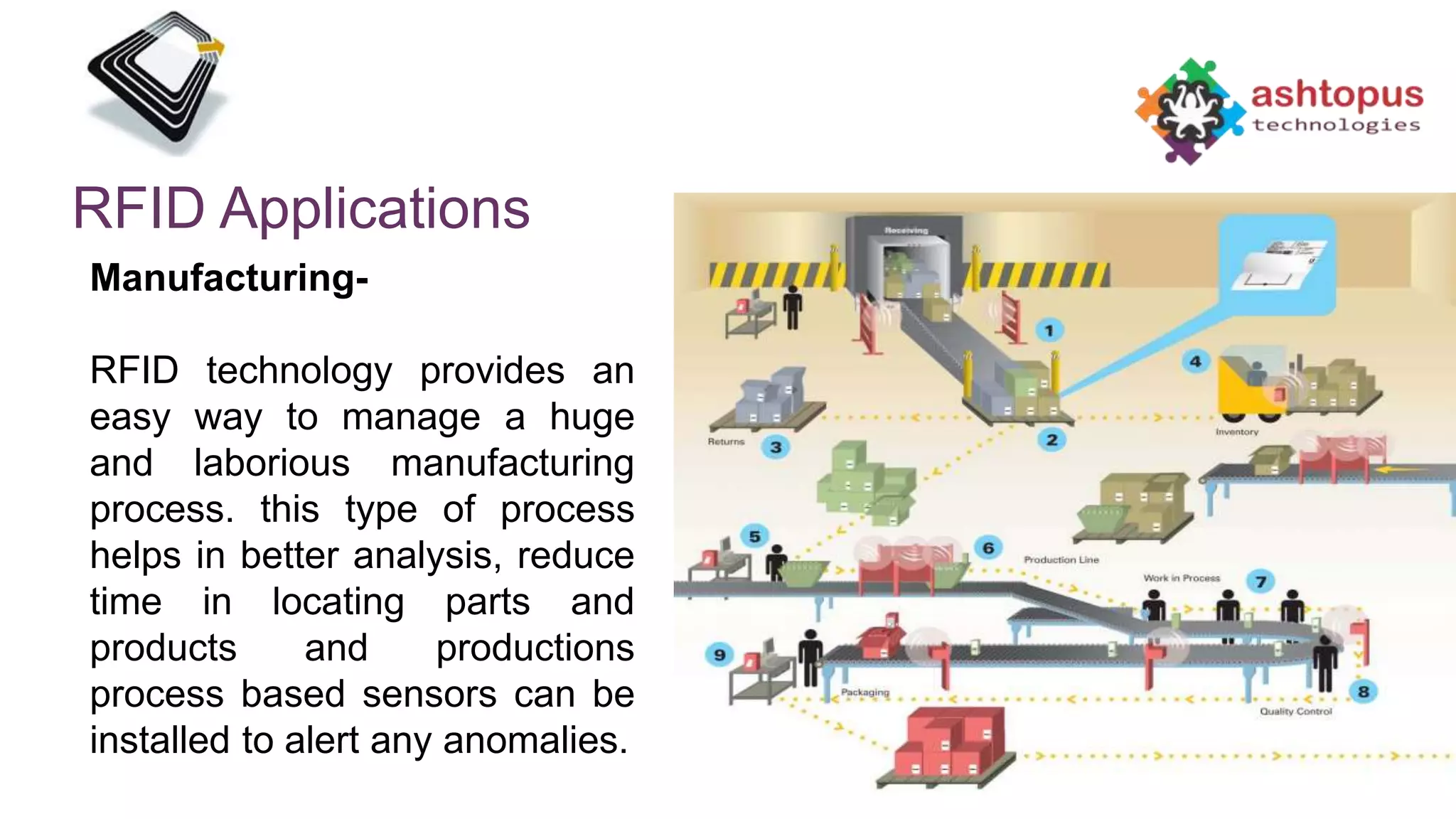
Manufacturing-
RFID technology provides an
easy way to manage a huge
and laborious manufacturing
process. this type of process
helps in better analysis, reduce
time in locating parts and
products and productions
process based sensors can be
installed to alert any anomalies.
Advantage & Disadvantage
Conclusion
RFID technology can be used to track products in a manner similar to using
bar codes for product identification, Today the RFID-technology stands for an
“enhanced range of application at decreasing prices“, tomorrow for a
standard!
RFID technology is taking off in many places like in shopping malls, libraries,
supply chain management, tracking household pets, accessing office
buildings, and vehicles on roadways. RFID is used to automatically identify
people, objects, and animals using short range radio technology it’s
increasingly rapid pace. RFID tags contents will increase in power, prices are
expected to decline and tag will dramatically improve its efficiency, security
and accuracy.
So that it will change our personal and work lives and adorns the
conventional management with a new idea and usher for a bright future.
+
Ashtopus Consulting AB
Karl XI gatan 19
222 20 Lund, Sweden
Ashtopus Consulting Pvt Ltd
1590, FF, Madarsa Road,
Kashmere Gate, Delhi 100006, INDIA
info@ashtopus.com
Ajay.sharma@ashtopus.com
www.ashtopustech.com

Rfid technology next generation application solutions

  • 1.
    + RFID Technology Next GenerationApplication : Solutions
  • 2.
     About RFID..  How does RFID works..?  RFID Sensors..  Applications & Solutions..  Advantage..  Conclusion.. PRESENTATION OUTLINE
  • 3.
    Introduction To RFID RadioFrequency Identification :Technology that uses radio-waves to transfer data between a reader and a movable items to identify, categorize track. -It is an automatic identification method, relying on storing and remotely retrieving data using devices called RFID tags or transponders. -RFID (radio frequency identification) is a technology that incorporates the use of electromagnetic or electrostatic coupling in the radio frequency (RF) portion of the electromagnetic spectrum to uniquely identify an object, animal, or person. -RFID is fast reliable and does not require physical sight or contact between reader/scanner and tagged items An alternative to bar code.
  • 4.
    How does aRFID system work ?  Reader (Coupler): to read from and/or write to tags  Tags (transponders): where item ID/data etc. are stored Types: active passive  Host computer/ network Reader Coil/Antenna Tag Computer IC (Integrated Circuit)
  • 5.
  • 6.
    RFID Sensors Tag Thereare two broad categories of RFID systems  Active Tag  Passive Tag Passive Tag: The passive tags, or called backscatters, have neither own power resource nor RF transmitter, they use inductive/propagation coupling to connect with the reader antenna, this means that the passive tags just simply reflect back the signal emitted by the reader. These passive tags are simpler and cheaper but have a much shorter reading range in comparison to active tag. Types of Passive Tag Passive RFID tags generally operate at three distinct frequencies: 1-Low Frequency (LF) 125 -134 kHz 2- High Frequency (HF) 13.56 MHz 3-Ultra High Frequency (UHF) 856 MHz to 960 MHz
  • 7.
    RFID Sensors Tag ActiveRFID Tag : The active tags have transmitters and usually a battery as their power resource; they transmit their ID codes through transmitters, thus a wide reading range can be achieved. Active RFID systems use self-powered RFID tags that continuously broadcast their own signal. Active RFID tags are commonly used as “beacons” to accurately track the real-time location of assets or in high speed environments such as tolling. Active tags provide a much longer read range than passive tags. Types of Active Tag Two different types of active RFID tags are available on today’s market –  1-Transponders  2-Beacon
  • 8.
  • 9.
    People Tracking- Hospital,Shopping mall and railway station are most general tracking required place hospital uses RFID tag for tracking their special patients. RFID Applications
  • 10.
    RFID Applications School BusTracking System Student Care Solution by School Bus Tracking & In Bus Attendance. School bus tracking and automated and customizable live view student behavior in School bus and send alerts both school management and parents in times of emergencies besides notifying both parties on boarding and disembarking of students from the school bus.
  • 11.
    RFID Applications Parking Solutions RFIDparking solution for parking towers and it tracks and tabulates vehicles in parked on each floor. This lets it automatically calculate free spaces there are and where those spaces are located, to provide the information to people entering the parking tower.
  • 12.
    RFID Applications Retail andInventory Tracking RFID in retail stores offer real-time inventory tracking that allows companies to monitor and control inventory supply at all times. RFID based jewelry tracking system enables tracking inventory via scanning and therefore instant stock update while increasing the staff productivity. RFID automation of inventory check process at store.
  • 13.
    RFID Applications Live Stock-RFIDtags can be safely attached or even implanted inside animals(live stock) and will last for the entire lifetime of the animal. RFID helps improve farm management through increased efficiencies, reduced feed and labor costs, enhanced output and improved herd health.
  • 14.
  • 15.
    RFID Applications Retail andInventory Tracking- RFID in retail stores offer real- time inventory tracking that allows companies to monitor and control inventory supply at all times. RFID based jewelry tracking system enables tracking inventory via scanning and therefore instant stock update while increasing the staff productivity. RFID automation of inventory check process at store.
  • 16.
    RFID Applications Vehicle MentoringSolutions-RFID Technique helps to Vehicle monitoring through their journey such as ,Fuel and feat level monitoring, order and cargo tracking, fleet performance analysis ,security, road assistance etc.
  • 17.
    RFID Applications Health Care-patientSafety is big challenge of health care Reducing medication error meeting new standards, staff shortages, and reducing cost are the plus points of use of RFID solutions, RFID wristband containing patient record and medication history address several of these concerns.
  • 18.
    RFID Applications Document Tracking-Availability of a large amount data and documents bridge lots of problems in documents managements and library mgmt RFID technology short out and easy trace records .
  • 19.
    RFID Applications Manufacturing- RFID technologyprovides an easy way to manage a huge and laborious manufacturing process. this type of process helps in better analysis, reduce time in locating parts and products and productions process based sensors can be installed to alert any anomalies.
  • 20.
  • 21.
    Conclusion RFID technology canbe used to track products in a manner similar to using bar codes for product identification, Today the RFID-technology stands for an “enhanced range of application at decreasing prices“, tomorrow for a standard! RFID technology is taking off in many places like in shopping malls, libraries, supply chain management, tracking household pets, accessing office buildings, and vehicles on roadways. RFID is used to automatically identify people, objects, and animals using short range radio technology it’s increasingly rapid pace. RFID tags contents will increase in power, prices are expected to decline and tag will dramatically improve its efficiency, security and accuracy. So that it will change our personal and work lives and adorns the conventional management with a new idea and usher for a bright future.
  • 23.
    + Ashtopus Consulting AB KarlXI gatan 19 222 20 Lund, Sweden Ashtopus Consulting Pvt Ltd 1590, FF, Madarsa Road, Kashmere Gate, Delhi 100006, INDIA info@ashtopus.com Ajay.sharma@ashtopus.com www.ashtopustech.com