 Introduction
 Brief history about RFID
 Components Of RFID
 Applications of RFID
 Advantages of RFID
 Disadvantages of RFID
 Conclusion
Radio-frequency identification
(RFID) is the wireless non-contact
use of radio-frequency
electromagnetic fields to transfer
data, for the purposes of
automatically identifying and
tracking tags attached to objects.
J.F.McCarthy et al. (2003)
 Invented in 1948 by Harry Stockman.
H.Stockman, 1948
 The first application of RFID was during
World War II when it was used in conjunction
with rader technology for Friend and Enemy
identification
K.Dittmer,2004
 Came into commercial use only in 1990s.
J.Landt ,2005
RFID system consists of four
components:
 The tag (transponder )
 The reader
 The RFID software and
 The communication network
A tag is a transponder which receives
a radio signal and in response to it
sends out a radio signal.
Tag can be programmed at
manufacturing or on installation
There are three types of tag
(transponder ):
1. Passive tag.
2. Active tag.
3. Semi-passive tag.
 Passive tags do not carry on-board power
i.e; these are operated without battery.
 Derive power from the field generated
by the reader to enable reading and
writing on tag
 Less expensive .
 Unlimited life.
 Subject to noise.
 Require more powerful reader.
 Powered by an external battery
 Finite lifetime (because of battery)
 Greater range
 Better noise immunity
 Higher data transmission rates
RFID tags are divided into three frequency
regions:
 Low frequency (LF, 30-50 kHz)
 High frequency ( HF, 10-15 MHz)
 Ultra high frequency ( UHF, 850-950 MHz)
Low frequency tags are cheaper than all high
frequency tags. These tags are less influenced by
the presence of fluids or metals and disadvantage
of their low transmission speed.
[M.Ward et al.,2006]
High frequency tags have higher
transmission speed but they are expensive
than LF tags.
Ultra high frequency tags have the
highest rank of all tags.Their transmission
speed is extremely high .But these are
expensive than other high frequency and
low frequency tags
[M.Ward et al., 2006]
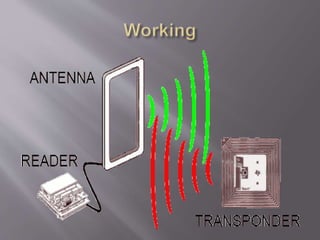
RFID reader is a device that is used to
interrogate an RFID tag. The reader has an
antenna that emits radio waves ; the tag
responds by sending back its data.
[ Wisner et al.,]
Two main types of readers are:
1. Portable reader.
2. Fixed reader.
Portable readers can read or
write data almost anywhere and are
mobile.
Fixed readers are installed at
one place eg., in the doors for the for the
identification of people,goods or vehicles.
 RFID Software is the most critical piece
of an RFID application. It determines
what kind of hardware is required to
complete your system. Whether you are
tracking assets,preventing theft or
conducting inventory, we have the RFID
Software to meet your needs.
 Communication network is necessary to
allow companies to interact with each
other. It also helps to solve problems
with security and authentication.
 Identification of the instance
 Location identification
 Monitoring of resources
 Management of the supply chain
 Retail trade
 Production
 Security and access control
 The tag does not need to be in line of sight with
the receiver to be read.
[Shepard ,2004 , p.58.]
 RFID tags can store a lot of information.
 Labour reduction . [Keith et al.,2002]
 Asset tracking and Returnable items.
[Luke et al.,2005]
 Active RFID can be expensive because of
batteries.
 There still needs regulations about RFID
guidelines.
 It takes a lengthy time to program
RFID devices.
 After examining the three fields Health
care, Games and Human Activity
Detection with
regard to the usage of RFID technology
we will now try to present the overall
observations and draw some
conclusions.
 Above all there is the need for small tags
but especially for smaller readers.
 Konstantinis Domdouzis ,Bimal kumar—Radio
frequency identification application (2006).
 Jongsawas,Chongwatol, RFID enabled track &
tracebility (2012).
 Myo min Aung- Temperature management for
the quality assurance of a perishable food
supply chain.
 Tchane Bosona- Food traceability as an integral
part of logistics management in food &
agricultural supply chain (2013)
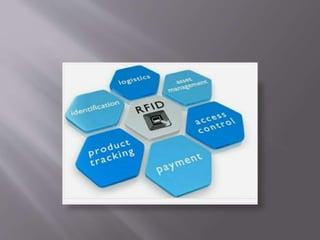
RFID Technology in Food Systems

RFID Technology in Food Systems

  • 2.
     Introduction  Briefhistory about RFID  Components Of RFID  Applications of RFID  Advantages of RFID  Disadvantages of RFID  Conclusion
  • 3.
    Radio-frequency identification (RFID) isthe wireless non-contact use of radio-frequency electromagnetic fields to transfer data, for the purposes of automatically identifying and tracking tags attached to objects. J.F.McCarthy et al. (2003)
  • 4.
     Invented in1948 by Harry Stockman. H.Stockman, 1948  The first application of RFID was during World War II when it was used in conjunction with rader technology for Friend and Enemy identification K.Dittmer,2004  Came into commercial use only in 1990s. J.Landt ,2005
  • 5.
    RFID system consistsof four components:  The tag (transponder )  The reader  The RFID software and  The communication network
  • 6.
    A tag isa transponder which receives a radio signal and in response to it sends out a radio signal. Tag can be programmed at manufacturing or on installation
  • 7.
    There are threetypes of tag (transponder ): 1. Passive tag. 2. Active tag. 3. Semi-passive tag.
  • 8.
     Passive tagsdo not carry on-board power i.e; these are operated without battery.  Derive power from the field generated by the reader to enable reading and writing on tag  Less expensive .  Unlimited life.  Subject to noise.  Require more powerful reader.
  • 9.
     Powered byan external battery  Finite lifetime (because of battery)  Greater range  Better noise immunity  Higher data transmission rates
  • 10.
    RFID tags aredivided into three frequency regions:  Low frequency (LF, 30-50 kHz)  High frequency ( HF, 10-15 MHz)  Ultra high frequency ( UHF, 850-950 MHz) Low frequency tags are cheaper than all high frequency tags. These tags are less influenced by the presence of fluids or metals and disadvantage of their low transmission speed. [M.Ward et al.,2006]
  • 11.
    High frequency tagshave higher transmission speed but they are expensive than LF tags. Ultra high frequency tags have the highest rank of all tags.Their transmission speed is extremely high .But these are expensive than other high frequency and low frequency tags [M.Ward et al., 2006]
  • 12.
    RFID reader isa device that is used to interrogate an RFID tag. The reader has an antenna that emits radio waves ; the tag responds by sending back its data. [ Wisner et al.,]
  • 13.
    Two main typesof readers are: 1. Portable reader. 2. Fixed reader. Portable readers can read or write data almost anywhere and are mobile. Fixed readers are installed at one place eg., in the doors for the for the identification of people,goods or vehicles.
  • 14.
     RFID Softwareis the most critical piece of an RFID application. It determines what kind of hardware is required to complete your system. Whether you are tracking assets,preventing theft or conducting inventory, we have the RFID Software to meet your needs.
  • 15.
     Communication networkis necessary to allow companies to interact with each other. It also helps to solve problems with security and authentication.
  • 17.
     Identification ofthe instance  Location identification  Monitoring of resources  Management of the supply chain  Retail trade  Production  Security and access control
  • 18.
     The tagdoes not need to be in line of sight with the receiver to be read. [Shepard ,2004 , p.58.]  RFID tags can store a lot of information.  Labour reduction . [Keith et al.,2002]  Asset tracking and Returnable items. [Luke et al.,2005]
  • 19.
     Active RFIDcan be expensive because of batteries.  There still needs regulations about RFID guidelines.  It takes a lengthy time to program RFID devices.
  • 20.
     After examiningthe three fields Health care, Games and Human Activity Detection with regard to the usage of RFID technology we will now try to present the overall observations and draw some conclusions.  Above all there is the need for small tags but especially for smaller readers.
  • 21.
     Konstantinis Domdouzis,Bimal kumar—Radio frequency identification application (2006).  Jongsawas,Chongwatol, RFID enabled track & tracebility (2012).  Myo min Aung- Temperature management for the quality assurance of a perishable food supply chain.  Tchane Bosona- Food traceability as an integral part of logistics management in food & agricultural supply chain (2013)