By Mandar Jagtap
ME (Manufacturing Systems)
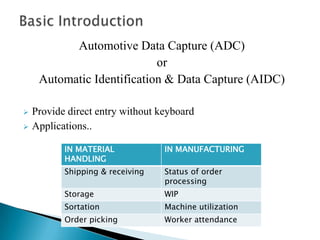
Automotive Data Capture (ADC)
or
Automatic Identification & Data Capture (AIDC)
Provide direct entry without keyboard
 Applications..


IN MATERIAL
HANDLING

IN MANUFACTURING

Shipping & receiving

Status of order
processing

Storage

WIP

Sortation

Machine utilization

Order picking

Worker attendance
Drawbacks of manual data entry
 Average error rate is 1 error/300
characters[1]
 Time factor
ADC
 Labor cost
Technology

Optical

Magnetic

Electromagnetic

Smart card

Why RFID??
Out of all the ADC technologies
available, RFID is one of the fastest
& accurate technology !

Touch
technique

Biometric

RFID
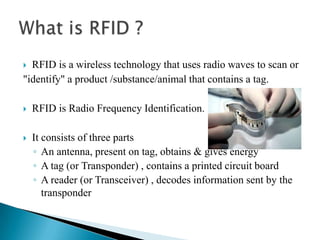
RFID is a wireless technology that uses radio waves to scan or
"identify" a product /substance/animal that contains a tag.




RFID is Radio Frequency Identification.



It consists of three parts
◦ An antenna, present on tag, obtains & gives energy
◦ A tag (or Transponder) , contains a printed circuit board
◦ A reader (or Transceiver) , decodes information sent by the
transponder
o
o
o
o
o

Used in early 1900’s & was used in World War II[2]
In 1970’s, A noticeable development work started
By 1980’s, the full implementation of the technology
In 1990’s, the deployment of applications with RFID
21st century, the pace of development in RFID
• RFID in Retail
• RFID in Logistics, Transportation, and Warehousing
• RFID in Assembly, Manufacturing, and Configuration
Management
• RFID in Asset Tracking and Locating Objects
• RFID in Authentication, Counterfeit Protection, and Security
• RFID with Environment Sensors
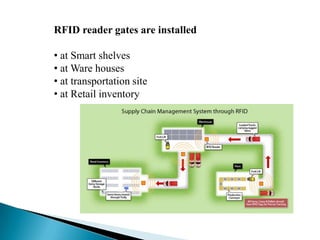
RFID reader gates are installed
• at Smart shelves
• at Ware houses
• at transportation site
• at Retail inventory
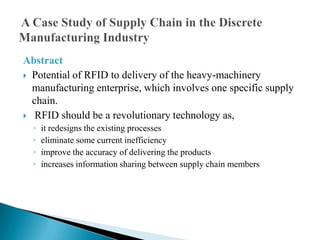
Abstract
 Potential of RFID to delivery of the heavy-machinery
manufacturing enterprise, which involves one specific supply
chain.
 RFID should be a revolutionary technology as,
◦
◦
◦
◦

it redesigns the existing processes
eliminate some current inefficiency
improve the accuracy of delivering the products
increases information sharing between supply chain members


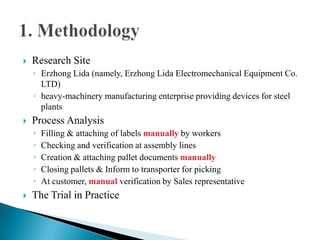
Research Site
◦ Erzhong Lida (namely, Erzhong Lida Electromechanical Equipment Co.
LTD)
◦ heavy-machinery manufacturing enterprise providing devices for steel
plants



Process Analysis
◦
◦
◦
◦
◦



Filling & attaching of labels manually by workers
Checking and verification at assembly lines
Creation & attaching pallet documents manually
Closing pallets & Inform to transporter for picking
At customer, manual verification by Sales representative

The Trial in Practice
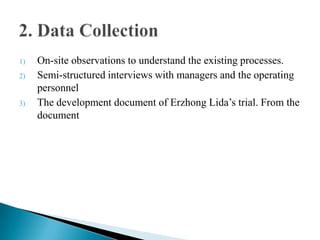
1)
2)

3)

On-site observations to understand the existing processes.
Semi-structured interviews with managers and the operating
personnel
The development document of Erzhong Lida’s trial. From the
document


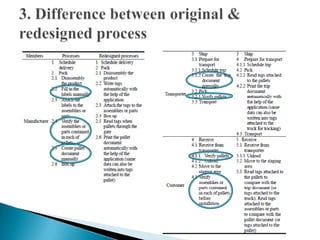
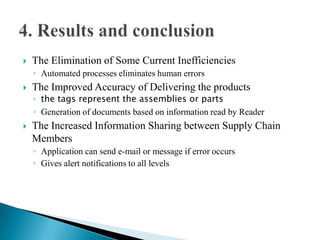
The Elimination of Some Current Inefficiencies
◦ Automated processes eliminates human errors



The Improved Accuracy of Delivering the products

◦ the tags represent the assemblies or parts
◦ Generation of documents based on information read by Reader



The Increased Information Sharing between Supply Chain
Members
◦ Application can send e-mail or message if error occurs
◦ Gives alert notifications to all levels




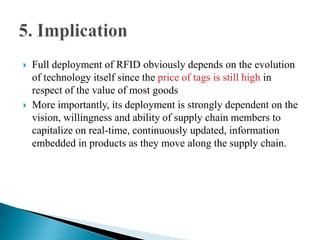
Full deployment of RFID obviously depends on the evolution
of technology itself since the price of tags is still high in
respect of the value of most goods
More importantly, its deployment is strongly dependent on the
vision, willingness and ability of supply chain members to
capitalize on real-time, continuously updated, information
embedded in products as they move along the supply chain.
In this topic we introduced RFID , its usefulness in
manufacturing and supply chain management.
We also analyzed a case-study illustrates effects of
Application of RFID in supply chains of different
manufacturing sector.
ise.tamu.edu/.../Applications%20of%20RFID%20in%20Supply%20Chain
/Applications of RFID in Supply Chains (Gary M. Gaukler & Ralf W.
Seifert)
 Elsevier.com/RFID Application Strategy in Agri-Food Supply Chain
Based on Safety and Benefit Analysis (Min Zhang, Peichong Li)
 Elsevier.com/Supply chain management with lean production and
RFID application: A case study(James C. Chen , Chen-Huan Cheng ,
PoTsang B. Huang )
 Elsevier.com/RFID potential impacts and future evolution for green
projects (Yvan Duroc and Darine Kaddour)

Journal of Electronic Science and Technology of China /Vol.4 No.4
/RFID’s Impacts on Business Value: A Case Study of Supply Chain in
the Discrete Manufacturing Industry ( LIU Yun,SHAO Pei-ji, MO Zhiwu, WANG Tao, SUN Shu)
[1]- Automation, Production Systems and Computer-Integrated
Manufacturing by Mikell P. Groover
[2]ise.tamu.edu/.../Applications%20of%20RFID%20in%20Supply%20Chain
/Applications of RFID in Supply Chains (Gary M. Gaukler & Ralf W.
Seifert)/1.1.1/Paragraph no. 3

Applications of rfid

Applications of rfid

  • 1.
    By Mandar Jagtap ME(Manufacturing Systems)
  • 2.
    Automotive Data Capture(ADC) or Automatic Identification & Data Capture (AIDC) Provide direct entry without keyboard  Applications..  IN MATERIAL HANDLING IN MANUFACTURING Shipping & receiving Status of order processing Storage WIP Sortation Machine utilization Order picking Worker attendance
  • 3.
    Drawbacks of manualdata entry  Average error rate is 1 error/300 characters[1]  Time factor ADC  Labor cost Technology Optical Magnetic Electromagnetic Smart card Why RFID?? Out of all the ADC technologies available, RFID is one of the fastest & accurate technology ! Touch technique Biometric RFID
  • 4.
    RFID is awireless technology that uses radio waves to scan or "identify" a product /substance/animal that contains a tag.   RFID is Radio Frequency Identification.  It consists of three parts ◦ An antenna, present on tag, obtains & gives energy ◦ A tag (or Transponder) , contains a printed circuit board ◦ A reader (or Transceiver) , decodes information sent by the transponder
  • 6.
    o o o o o Used in early1900’s & was used in World War II[2] In 1970’s, A noticeable development work started By 1980’s, the full implementation of the technology In 1990’s, the deployment of applications with RFID 21st century, the pace of development in RFID
  • 7.
    • RFID inRetail • RFID in Logistics, Transportation, and Warehousing • RFID in Assembly, Manufacturing, and Configuration Management • RFID in Asset Tracking and Locating Objects • RFID in Authentication, Counterfeit Protection, and Security • RFID with Environment Sensors
  • 8.
    RFID reader gatesare installed • at Smart shelves • at Ware houses • at transportation site • at Retail inventory
  • 9.
    Abstract  Potential ofRFID to delivery of the heavy-machinery manufacturing enterprise, which involves one specific supply chain.  RFID should be a revolutionary technology as, ◦ ◦ ◦ ◦ it redesigns the existing processes eliminate some current inefficiency improve the accuracy of delivering the products increases information sharing between supply chain members
  • 10.
     Research Site ◦ ErzhongLida (namely, Erzhong Lida Electromechanical Equipment Co. LTD) ◦ heavy-machinery manufacturing enterprise providing devices for steel plants  Process Analysis ◦ ◦ ◦ ◦ ◦  Filling & attaching of labels manually by workers Checking and verification at assembly lines Creation & attaching pallet documents manually Closing pallets & Inform to transporter for picking At customer, manual verification by Sales representative The Trial in Practice
  • 11.
    1) 2) 3) On-site observations tounderstand the existing processes. Semi-structured interviews with managers and the operating personnel The development document of Erzhong Lida’s trial. From the document
  • 13.
     The Elimination ofSome Current Inefficiencies ◦ Automated processes eliminates human errors  The Improved Accuracy of Delivering the products ◦ the tags represent the assemblies or parts ◦ Generation of documents based on information read by Reader  The Increased Information Sharing between Supply Chain Members ◦ Application can send e-mail or message if error occurs ◦ Gives alert notifications to all levels
  • 14.
      Full deployment ofRFID obviously depends on the evolution of technology itself since the price of tags is still high in respect of the value of most goods More importantly, its deployment is strongly dependent on the vision, willingness and ability of supply chain members to capitalize on real-time, continuously updated, information embedded in products as they move along the supply chain.
  • 15.
    In this topicwe introduced RFID , its usefulness in manufacturing and supply chain management. We also analyzed a case-study illustrates effects of Application of RFID in supply chains of different manufacturing sector.
  • 16.
    ise.tamu.edu/.../Applications%20of%20RFID%20in%20Supply%20Chain /Applications of RFIDin Supply Chains (Gary M. Gaukler & Ralf W. Seifert)  Elsevier.com/RFID Application Strategy in Agri-Food Supply Chain Based on Safety and Benefit Analysis (Min Zhang, Peichong Li)  Elsevier.com/Supply chain management with lean production and RFID application: A case study(James C. Chen , Chen-Huan Cheng , PoTsang B. Huang )  Elsevier.com/RFID potential impacts and future evolution for green projects (Yvan Duroc and Darine Kaddour)  Journal of Electronic Science and Technology of China /Vol.4 No.4 /RFID’s Impacts on Business Value: A Case Study of Supply Chain in the Discrete Manufacturing Industry ( LIU Yun,SHAO Pei-ji, MO Zhiwu, WANG Tao, SUN Shu) [1]- Automation, Production Systems and Computer-Integrated Manufacturing by Mikell P. Groover [2]ise.tamu.edu/.../Applications%20of%20RFID%20in%20Supply%20Chain /Applications of RFID in Supply Chains (Gary M. Gaukler & Ralf W. Seifert)/1.1.1/Paragraph no. 3 