RADIO FREQUENCY
IDENTIFICATION &
DETECTION (RFID)
 (TECHNOLOGY IN
   MARKETING)


   Phaneendra kumar


   Haritha VSG


   Greeshma gopal
   Radio frequency identification (RFID) is
    an automatic identification method based
    on radio waves
   RFID relies on storing and retrieving data
    using devices called RFID tags
   An RFID tag is applied to (or)
    incorporated into a product
 The information in the tag can be read by
using a reader.
A  reader is used to identify all tags within its
reception coverage area.
 Information transmitted from the tag can be
interpreted by reading the data directly from
the reader itself or through a software based
interface
IN MARKETING –
   (Warehouse)
It has three divisions
1. A scanning antenna
2. A transceiver with decoder
    to interpret the data
3. A tag (or) transponder
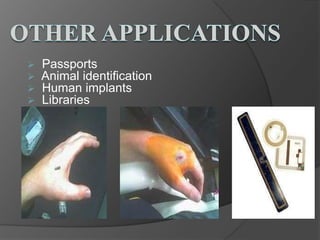
   Passports
   Animal identification
   Human implants
   Libraries
    Line of sight
   RFID tags can be read at much greater
    distances

   Read / write capability
 RFID is said by many in the industry to be front
run technology
 The biggest, as of unproven, benefit would
ultimately be in the consumer goods supply chain
 With rates of simulation such as silicon coming
down the cost of tags & readers also come down
 Once the production of tags & readers is done
on a mass scale their individual cost is bound to
come down
 With the above factors in mind we conclude
that RFID will be nothing less than a revolution
QUERIES ???
Rfid seminar (1)

Rfid seminar (1)

  • 1.
    RADIO FREQUENCY IDENTIFICATION & DETECTION(RFID) (TECHNOLOGY IN MARKETING) Phaneendra kumar Haritha VSG Greeshma gopal
  • 2.
    Radio frequency identification (RFID) is an automatic identification method based on radio waves  RFID relies on storing and retrieving data using devices called RFID tags  An RFID tag is applied to (or) incorporated into a product
  • 3.
     The informationin the tag can be read by using a reader. A reader is used to identify all tags within its reception coverage area.  Information transmitted from the tag can be interpreted by reading the data directly from the reader itself or through a software based interface
  • 4.
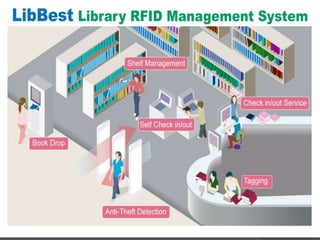
    IN MARKETING – (Warehouse)
  • 7.
    It has threedivisions 1. A scanning antenna 2. A transceiver with decoder to interpret the data 3. A tag (or) transponder
  • 11.
    Passports  Animal identification  Human implants  Libraries
  • 12.
    Line of sight  RFID tags can be read at much greater distances  Read / write capability
  • 13.
     RFID issaid by many in the industry to be front run technology  The biggest, as of unproven, benefit would ultimately be in the consumer goods supply chain  With rates of simulation such as silicon coming down the cost of tags & readers also come down  Once the production of tags & readers is done on a mass scale their individual cost is bound to come down  With the above factors in mind we conclude that RFID will be nothing less than a revolution
  • 14.