


ECE-B
I
K.V.RAVI TEJA
13331A0461
CONTENTS
 Evolution of RFID
 The RFID tag
 The RFID system
 RFID antenna’s
 Applications of RFID
 RFID in Transportation
 RFID in hospitals
 RFID in toll collection
 Advantages/Disadvantages of RFID
 Conclusion
THE EVOLUTION
 The roots of RFID technology can be traced back
to World War II . It was just during that time that
RADAR evolved, but the problem was it was
difficult to identify which planes belonged to
enemy and which were a country’s pilots
 The British developed the first active identify
friend or foe system .They’ve installed a
transmitter in each plane . They’ve had a base
station that would transmit signals when the
aircrafts would receive the signals they would
broadcast a signal back that identified the system
as friendly. RFID works on the same principle
RFID-THE DEFINITION
 RFID is a remote/self powered asset tracking
technology. It uses an antenna with a resonant field
frequency that generates a charge to a microprocessor
that send encrypted bits of data back to reader . The
great thing is that uses radio frequency(FM waves).
 The first experiment on these RFID systems was done
in an antitheft system ,every object in the shop would
have a tag , a radio wave transmitter would be used to
determine whether an item has been paid or not, they
have a 1 bit data tag .The bit is either ON or OFF in
accordance to the payment.
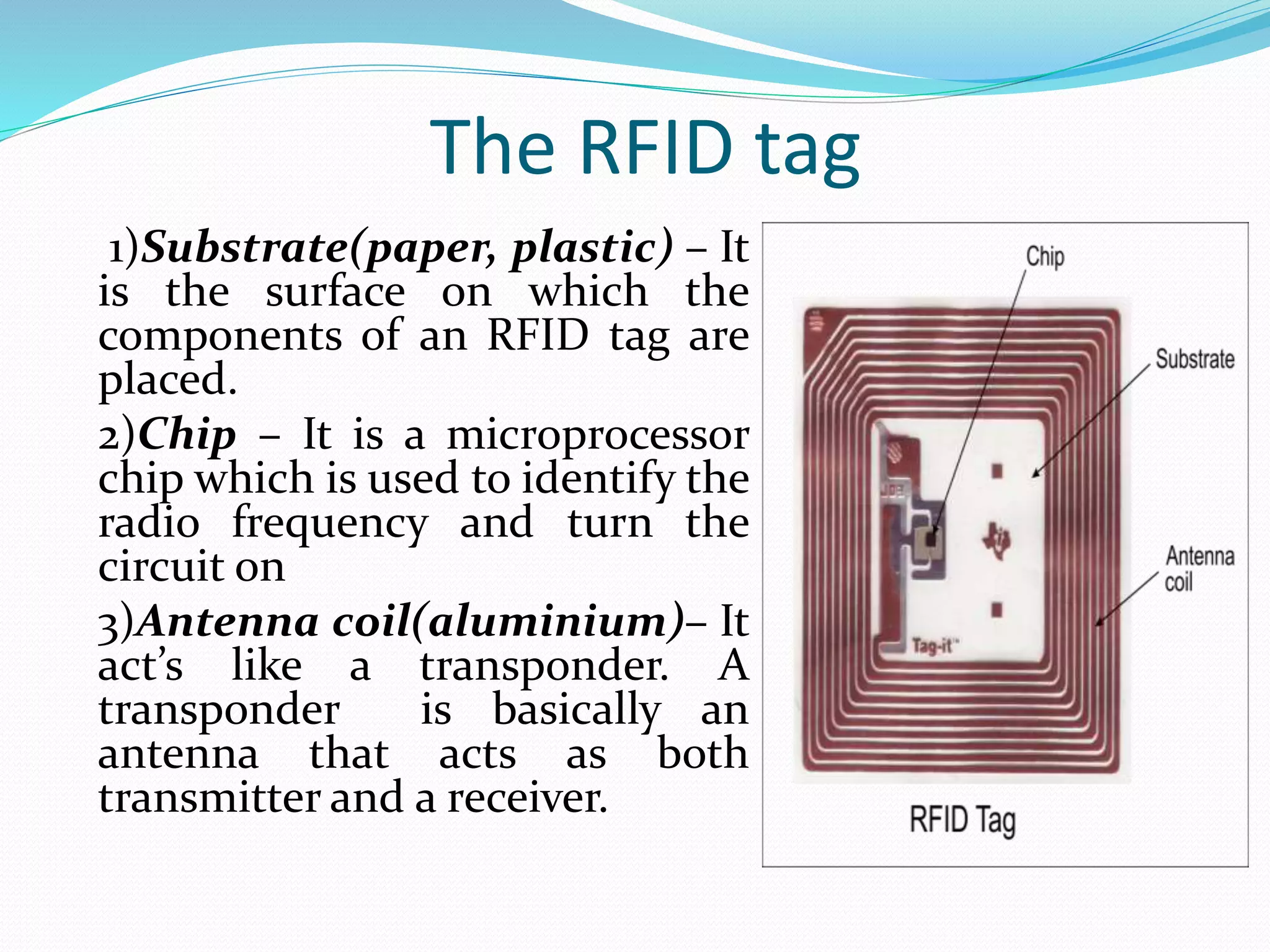
The RFID tag
1)Substrate(paper, plastic) – It
is the surface on which the
components of an RFID tag are
placed.
2)Chip – It is a microprocessor
chip which is used to identify the
radio frequency and turn the
circuit on
3)Antenna coil(aluminium)– It
act’s like a transponder. A
transponder is basically an
antenna that acts as both
transmitter and a receiver.
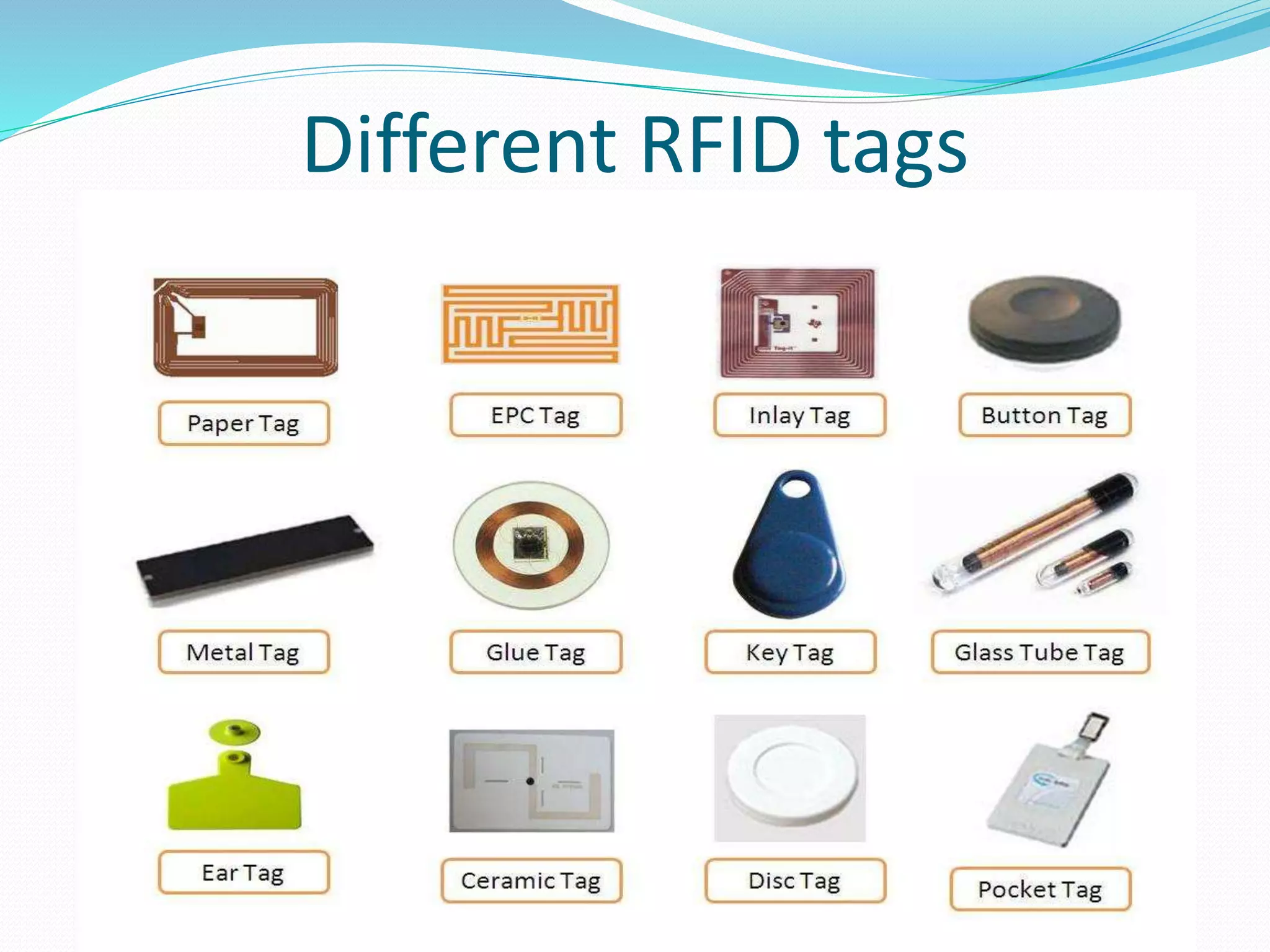
Different RFID tags
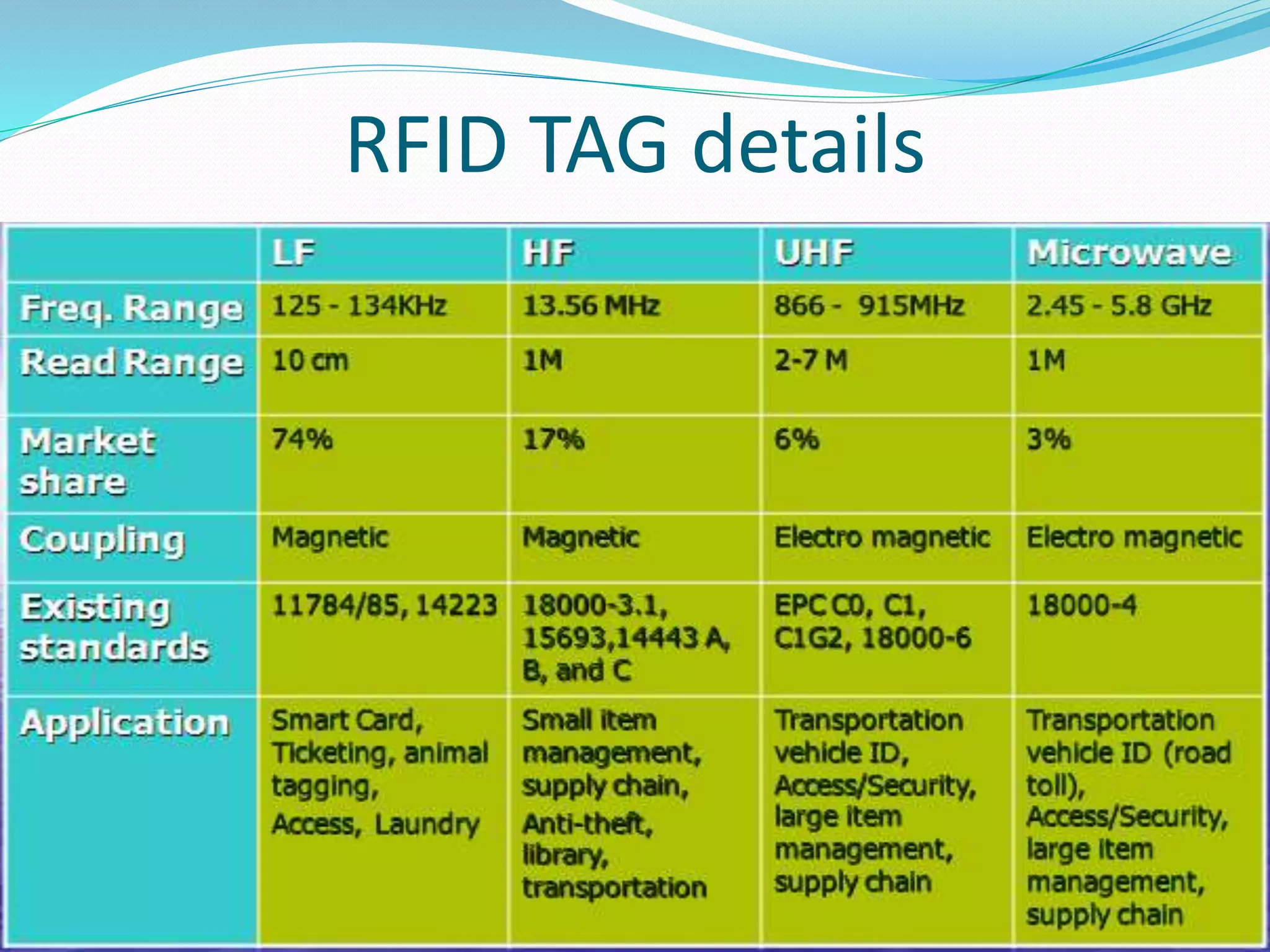
RFID TAG details
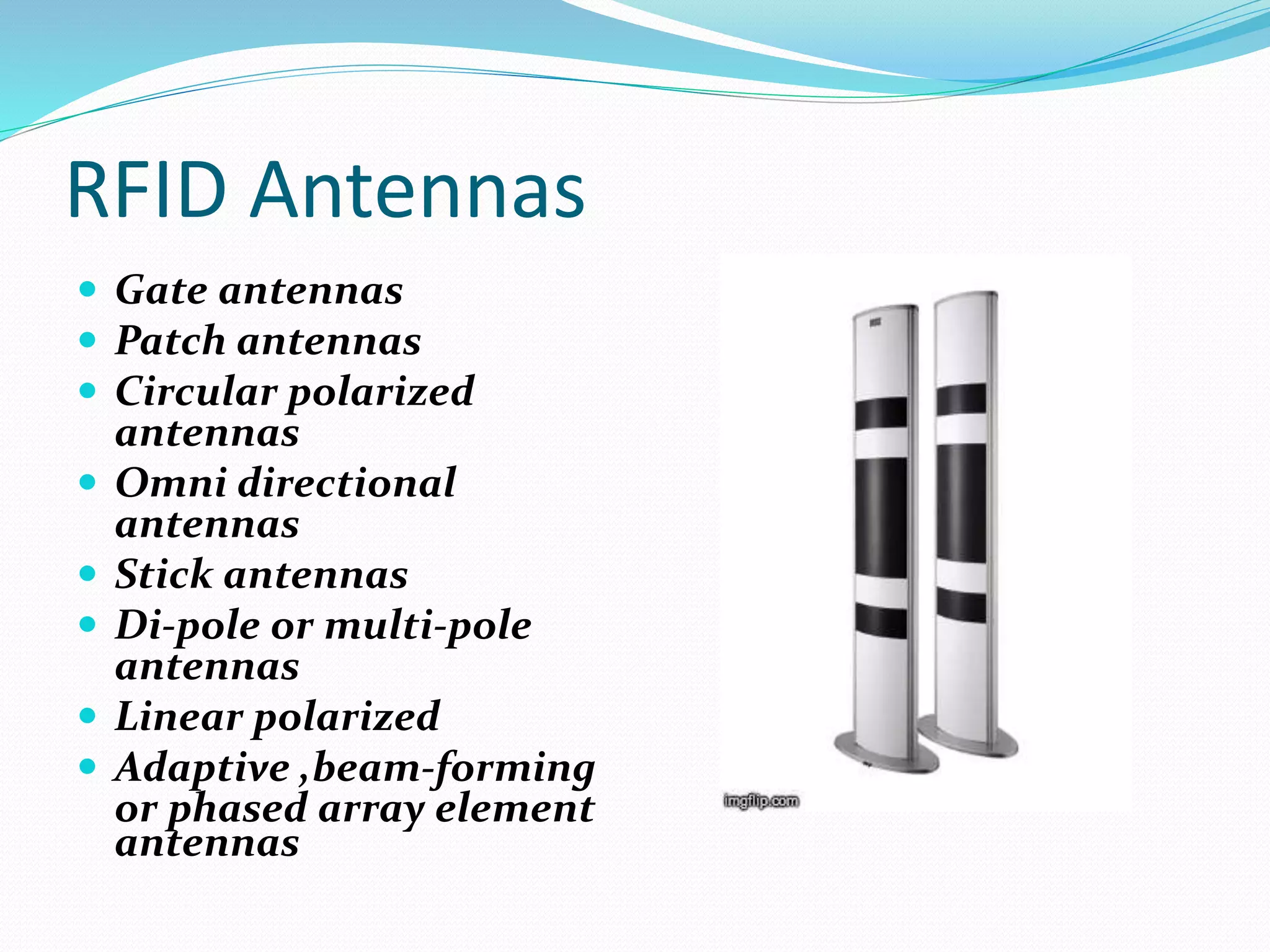
RFID Antennas
 Gate antennas
 Patch antennas
 Circular polarized
antennas
 Omni directional
antennas
 Stick antennas
 Di-pole or multi-pole
antennas
 Linear polarized
 Adaptive ,beam-forming
or phased array element
antennas
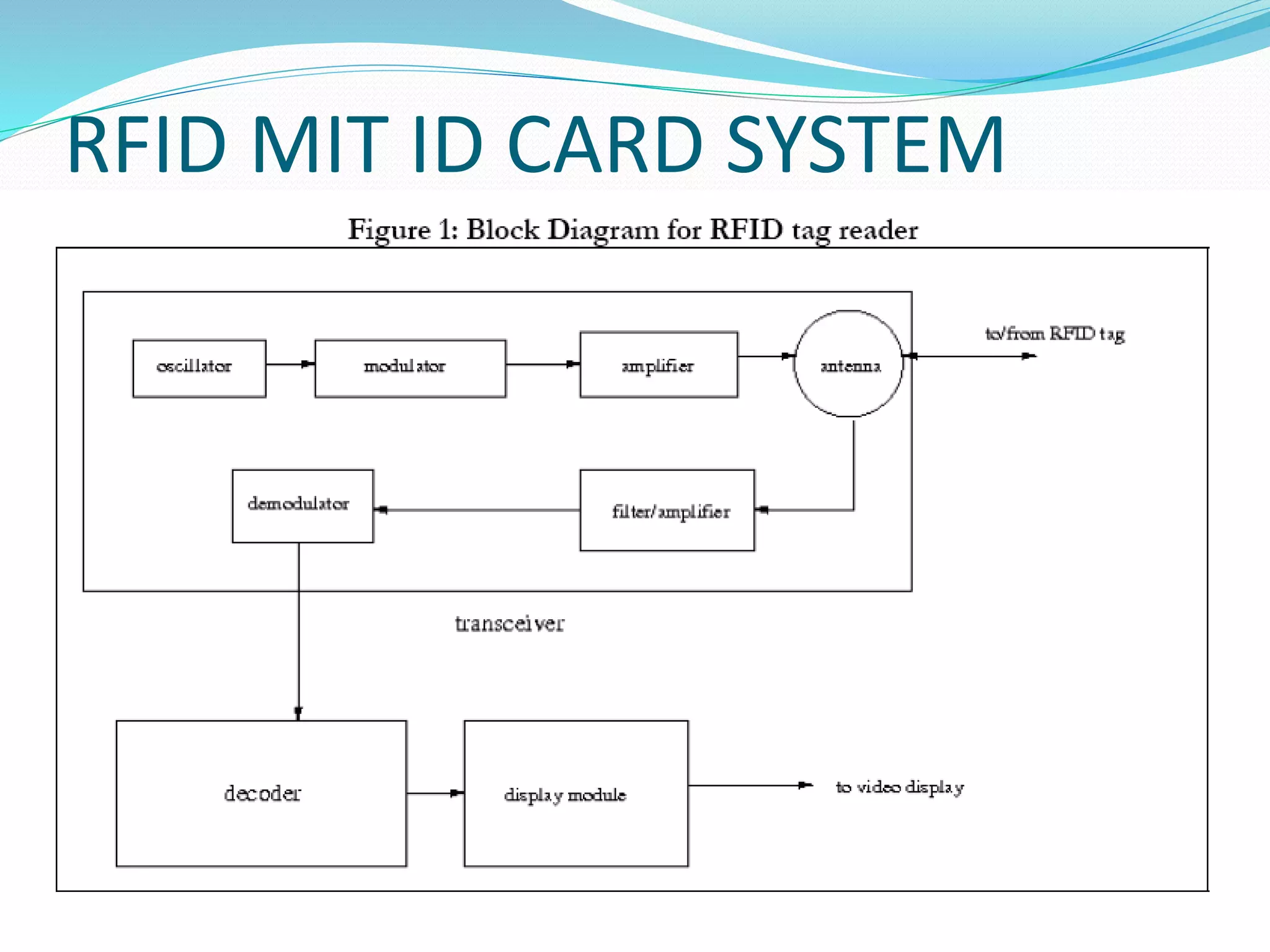
The RFID system
RFID MIT ID CARD SYSTEM
Applications of RFID tags
 It can be used in TRANSPORTATION
 It can be used in SHOPPING MALLS
 It can be used in BANK WITHDRAWALS
 It can be used in RAIL ROADS
 It can be used in HOSPITALS
 It can be used in TOLL COLLECTION
 It can be used in FIELD NAVIGATION FOR BLIND
 It can be used in WASTE DISPOSAL
 It can be used in CLOTHING
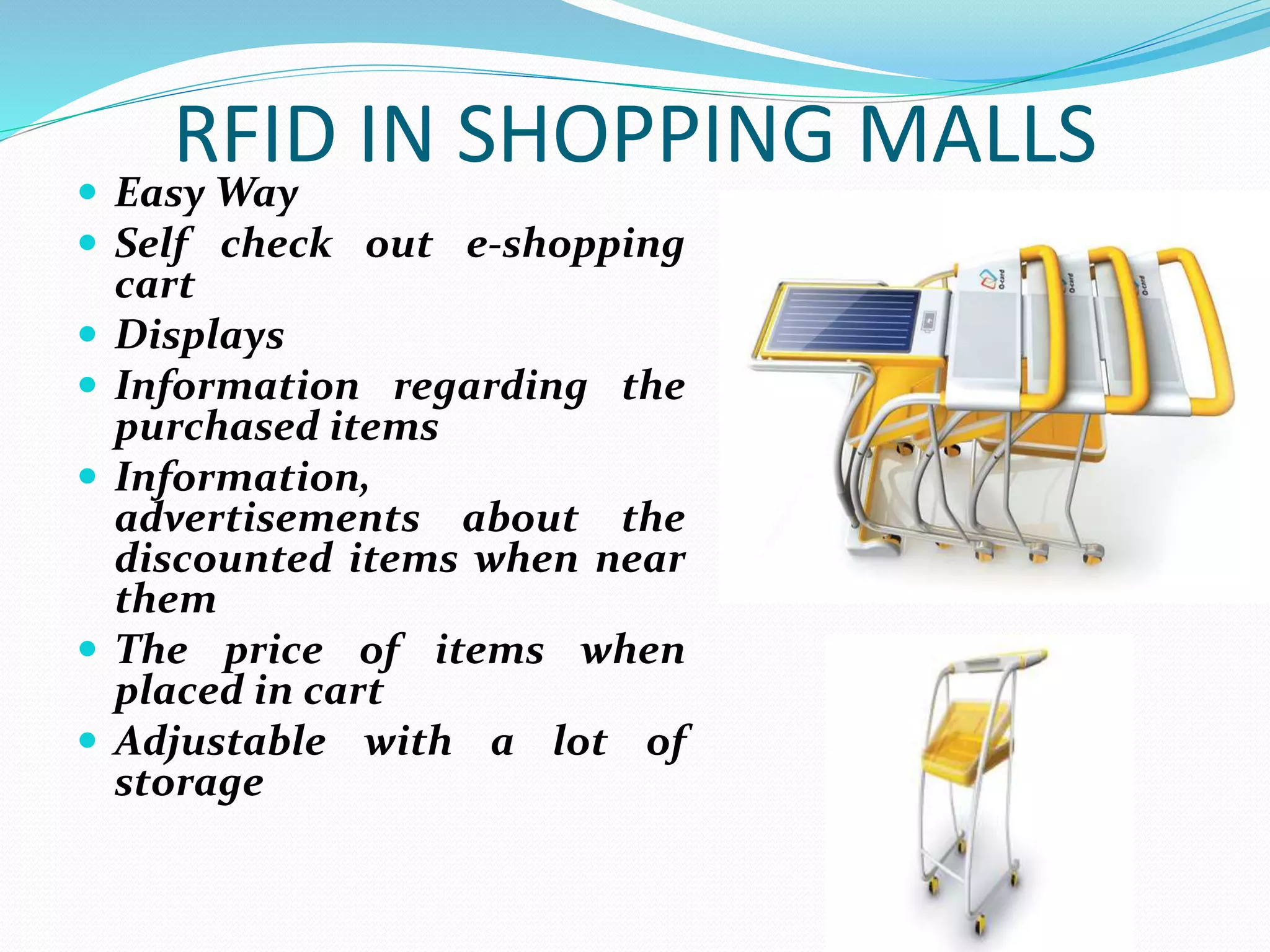
RFID IN SHOPPING MALLS
 Easy Way
 Self check out e-shopping
cart
 Displays
 Information regarding the
purchased items
 Information,
advertisements about the
discounted items when near
them
 The price of items when
placed in cart
 Adjustable with a lot of
storage
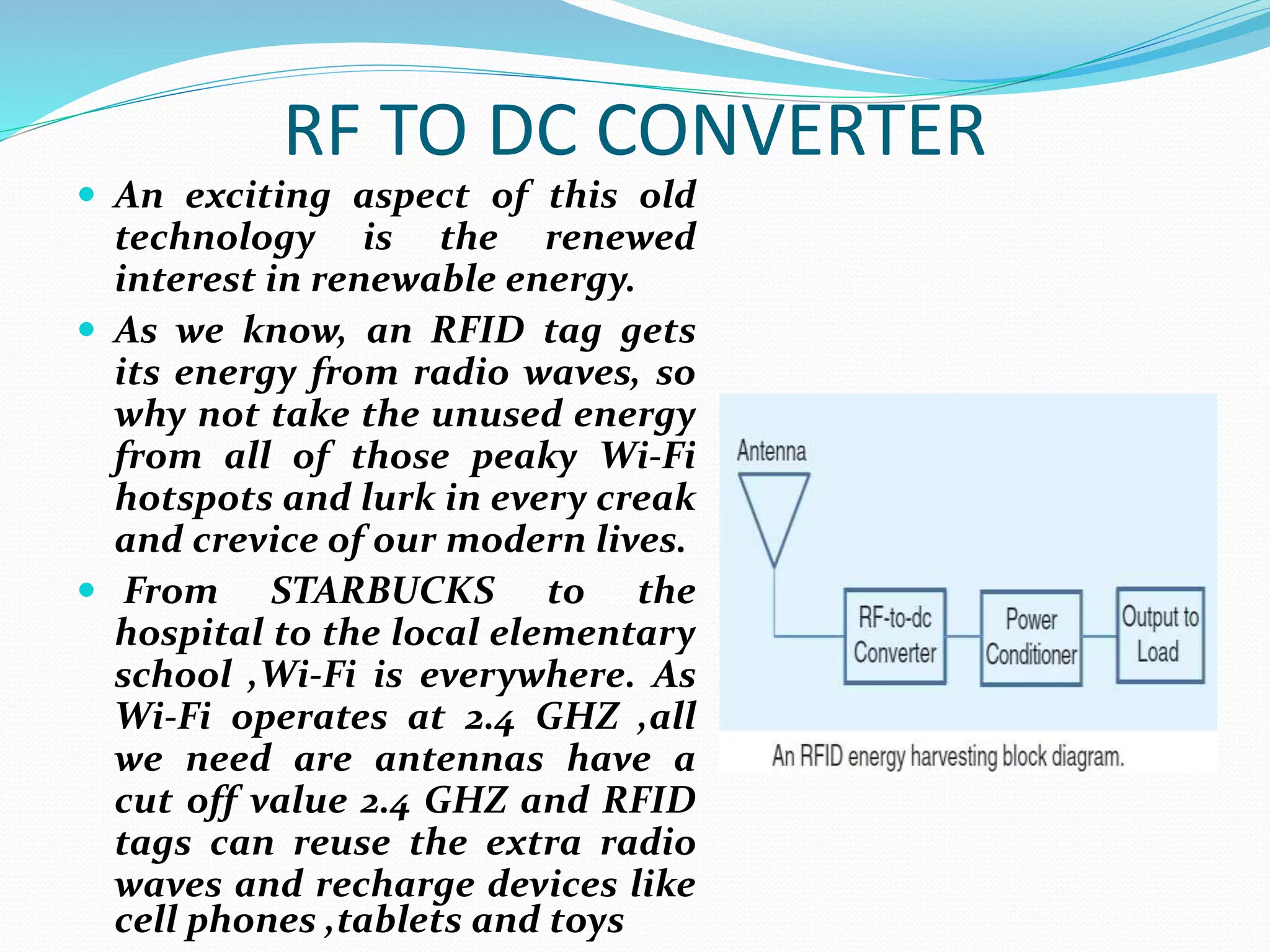
RF TO DC CONVERTER
 An exciting aspect of this old
technology is the renewed
interest in renewable energy.
 As we know, an RFID tag gets
its energy from radio waves, so
why not take the unused energy
from all of those peaky Wi-Fi
hotspots and lurk in every creak
and crevice of our modern lives.
 From STARBUCKS to the
hospital to the local elementary
school ,Wi-Fi is everywhere. As
Wi-Fi operates at 2.4 GHZ ,all
we need are antennas have a
cut off value 2.4 GHZ and RFID
tags can reuse the extra radio
waves and recharge devices like
cell phones ,tablets and toys
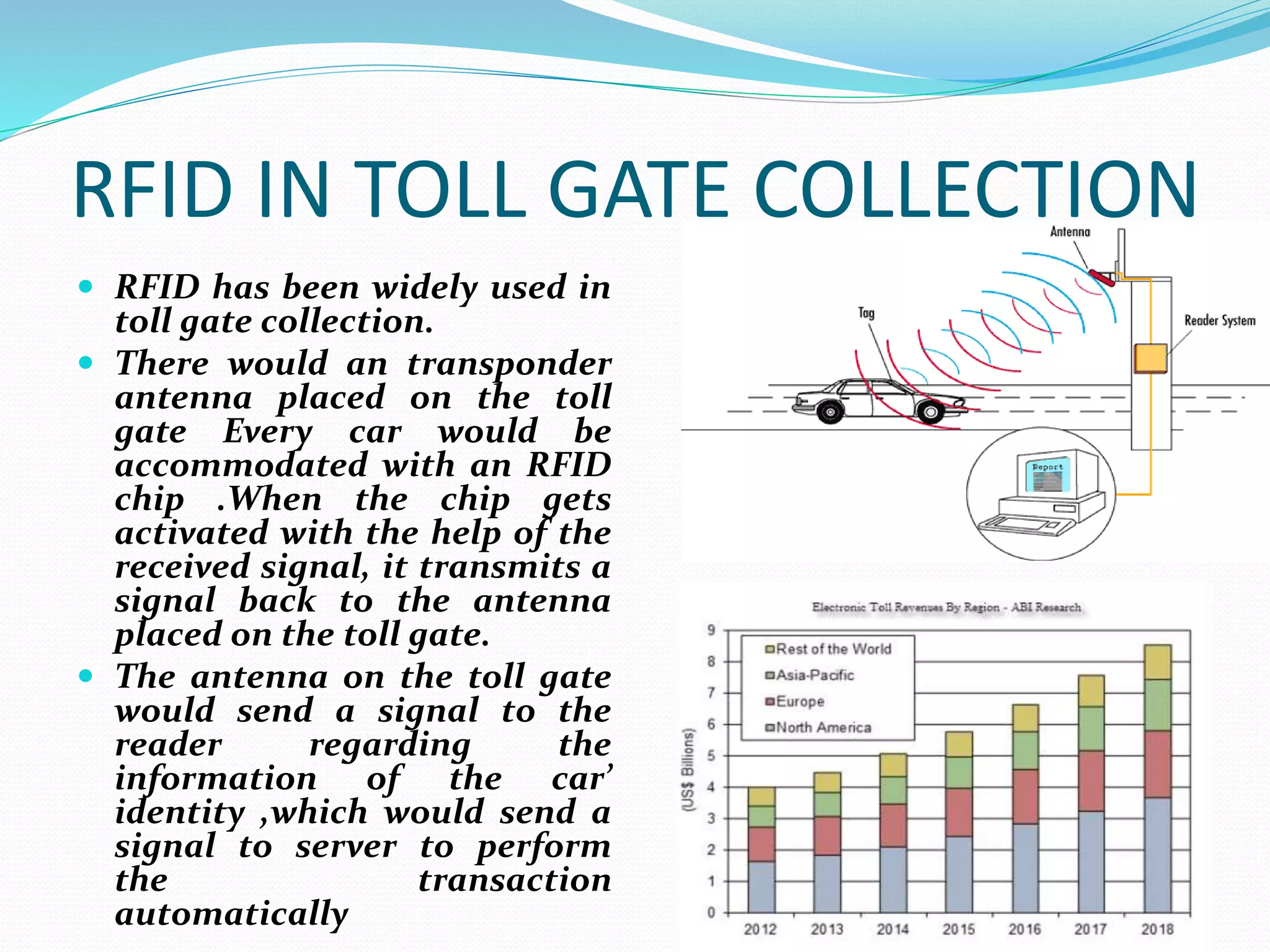
RFID IN TOLL GATE COLLECTION
 RFID has been widely used in
toll gate collection.
 There would an transponder
antenna placed on the toll
gate Every car would be
accommodated with an RFID
chip .When the chip gets
activated with the help of the
received signal, it transmits a
signal back to the antenna
placed on the toll gate.
 The antenna on the toll gate
would send a signal to the
reader regarding the
information of the car’
identity ,which would send a
signal to server to perform
the transaction
automatically
RFID IN BANKING
 The RFID chips would be embedded into the RFID
tags .
 By using the RFID technology, generally ATM
cards are swiped in the machine but by using this
technology one can just place the card near the
machine and process the transaction.
 The signal would be transmitted back from the
card to the server, the server would recognize who
the person is and would proceed further asking
the person to type the password and then amount
of transaction.
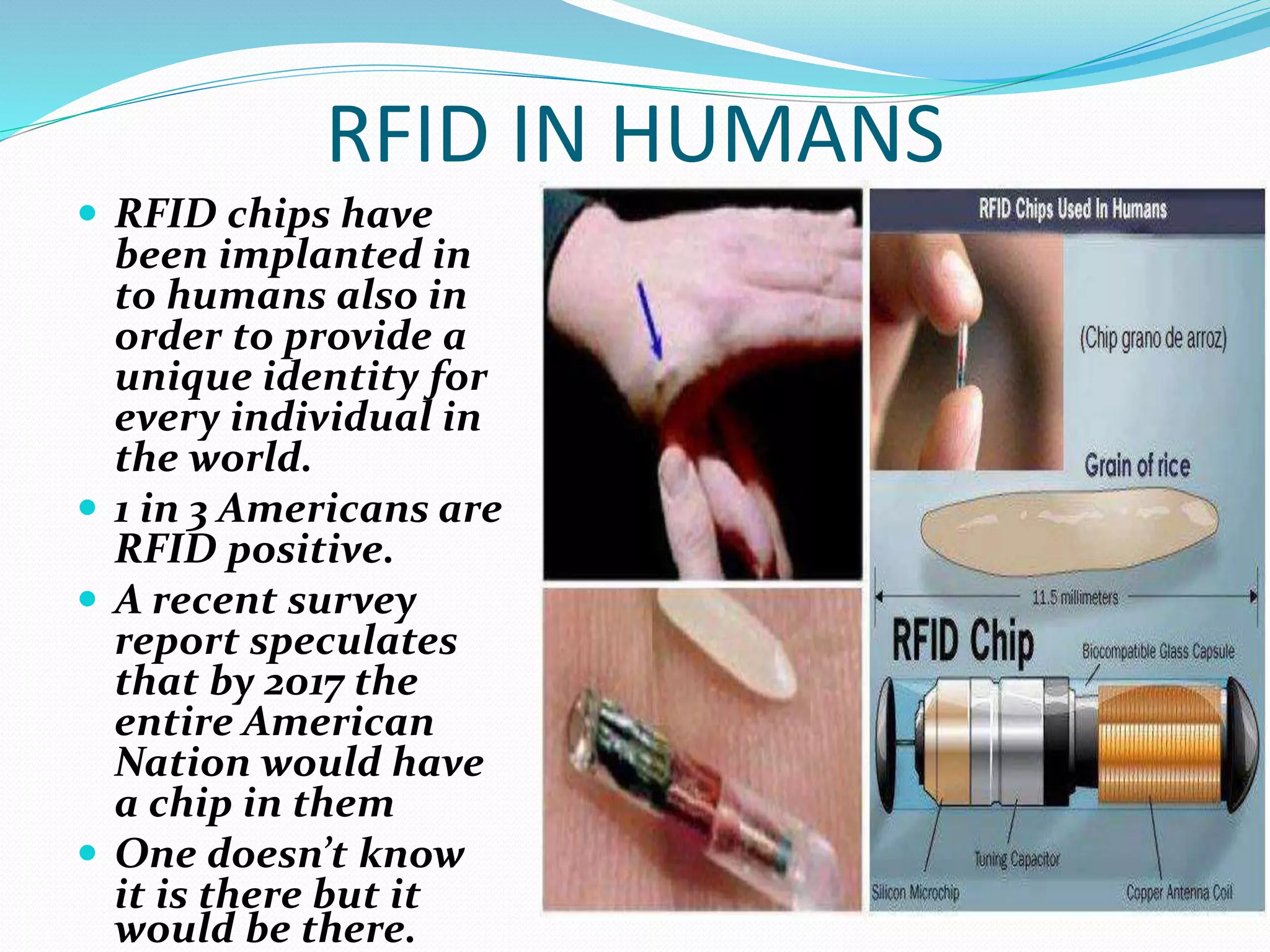
RFID IN HUMANS
 RFID chips have
been implanted in
to humans also in
order to provide a
unique identity for
every individual in
the world.
 1 in 3 Americans are
RFID positive.
 A recent survey
report speculates
that by 2017 the
entire American
Nation would have
a chip in them
 One doesn’t know
it is there but it
would be there.
COMPANIES EMPLOYING RFID
ADVANTAGES/DISADVANTAGES
Advantages Disadvantages
 Has the ability to pinpoint
location.
 Technology is versatile:
can be smaller than a
thumb tack or can be the
size of a tablet, depending
on its use
 The tag does not need to be
in line of sight with
the receiver to be read
(compare to a barcode and
its optical scanner) .
 RFID tags can store a lot of
information, and follow
instructions.
 Active RFID can be
expensive because of
batteries.
 There is a privacy concern
towards RFID devices, for
example some claim that
Wal-Mart is infringing on
natural rights by
overseeing what customers
buy.
 RFID may be easily
intercepted, even if it is
Encrypted.
 It takes a lengthy time to
program RFID devices.
RFID versus BARCODE
RFID BARCODE
 Radio Frequency-
Identification technology
(RFID) involves a tag affixed
to a product which identifies
and tracks the product via
radio waves.
 RFID tags carry large data
capabilities such as product
maintenance, shipping
histories and expiry dates;
which can all be programmed
to the tag.
 RFID tags can be read at a
faster rate than barcodes; as
approximately 40 RFID tags
can be read at the same time.
 RFID tags are more reusable
and rugged as they are
protected by a plastic cover.
 A barcode is a visual
representation of data that is
scanned and interpreted for
information.
 Barcodes have no read/write
capabilities; they do not
contain any added
information such as expiry
date etc. They only contain
the manufacturer and
product.
 They are very labor intensive;
as they must be scanned
individually.
 If a barcode is ripped or
damaged there is no way to
scan the product.
CONCLUSION The billion dollar industry that RFID has evolved into has done great good for
a lot of different fields.
 RFID has given doctors the ability for quick access to patients records, the
assurance of accounted merchandise for small business and large alike, and
the government the ability to conduct taxes for tolls in this technological day
and age.
 But with as many benefits as it has, Radio Frequency Identification's
overwhelming credibility is balanced out by the criticism against it.
 Though RFID allows for the allocation and distribution of sensitive
information, if that information is compromised, the effects could be
devastating.
 For there to be order in the realm of RFID, legislation and guidelines need to
be set up and enforced to ensure the integrity and confidence of the data being
communicated, which will in turn help Radio Frequency Identifications
emerge as more secure and advanced.
REFERENCES
 IEEE potentials September/October 2015
 RFID TECHNOLOGY-STEPHEN B MILES
 RFID ESSENTIALS-BILL GLOVER
 Obamacarefacts.com
 Wikipedia.org/RFID
 Electronics.how stuff works/RFID
 Mbaigrfidreport.blogspot.com
 Aalhysterfolkslifts.com
 Ijcee.org/papers/RFID
 Rfidarena.com
 Rfidjournal.com/article
Radio frequency    identification

Radio frequency identification

  • 1.
  • 2.
    CONTENTS  Evolution ofRFID  The RFID tag  The RFID system  RFID antenna’s  Applications of RFID  RFID in Transportation  RFID in hospitals  RFID in toll collection  Advantages/Disadvantages of RFID  Conclusion
  • 3.
    THE EVOLUTION  Theroots of RFID technology can be traced back to World War II . It was just during that time that RADAR evolved, but the problem was it was difficult to identify which planes belonged to enemy and which were a country’s pilots  The British developed the first active identify friend or foe system .They’ve installed a transmitter in each plane . They’ve had a base station that would transmit signals when the aircrafts would receive the signals they would broadcast a signal back that identified the system as friendly. RFID works on the same principle
  • 4.
    RFID-THE DEFINITION  RFIDis a remote/self powered asset tracking technology. It uses an antenna with a resonant field frequency that generates a charge to a microprocessor that send encrypted bits of data back to reader . The great thing is that uses radio frequency(FM waves).  The first experiment on these RFID systems was done in an antitheft system ,every object in the shop would have a tag , a radio wave transmitter would be used to determine whether an item has been paid or not, they have a 1 bit data tag .The bit is either ON or OFF in accordance to the payment.
  • 5.
    The RFID tag 1)Substrate(paper,plastic) – It is the surface on which the components of an RFID tag are placed. 2)Chip – It is a microprocessor chip which is used to identify the radio frequency and turn the circuit on 3)Antenna coil(aluminium)– It act’s like a transponder. A transponder is basically an antenna that acts as both transmitter and a receiver.
  • 6.
  • 7.
  • 8.
    RFID Antennas  Gateantennas  Patch antennas  Circular polarized antennas  Omni directional antennas  Stick antennas  Di-pole or multi-pole antennas  Linear polarized  Adaptive ,beam-forming or phased array element antennas
  • 9.
  • 10.
    RFID MIT IDCARD SYSTEM
  • 12.
    Applications of RFIDtags  It can be used in TRANSPORTATION  It can be used in SHOPPING MALLS  It can be used in BANK WITHDRAWALS  It can be used in RAIL ROADS  It can be used in HOSPITALS  It can be used in TOLL COLLECTION  It can be used in FIELD NAVIGATION FOR BLIND  It can be used in WASTE DISPOSAL  It can be used in CLOTHING
  • 13.
    RFID IN SHOPPINGMALLS  Easy Way  Self check out e-shopping cart  Displays  Information regarding the purchased items  Information, advertisements about the discounted items when near them  The price of items when placed in cart  Adjustable with a lot of storage
  • 14.
    RF TO DCCONVERTER  An exciting aspect of this old technology is the renewed interest in renewable energy.  As we know, an RFID tag gets its energy from radio waves, so why not take the unused energy from all of those peaky Wi-Fi hotspots and lurk in every creak and crevice of our modern lives.  From STARBUCKS to the hospital to the local elementary school ,Wi-Fi is everywhere. As Wi-Fi operates at 2.4 GHZ ,all we need are antennas have a cut off value 2.4 GHZ and RFID tags can reuse the extra radio waves and recharge devices like cell phones ,tablets and toys
  • 15.
    RFID IN TOLLGATE COLLECTION  RFID has been widely used in toll gate collection.  There would an transponder antenna placed on the toll gate Every car would be accommodated with an RFID chip .When the chip gets activated with the help of the received signal, it transmits a signal back to the antenna placed on the toll gate.  The antenna on the toll gate would send a signal to the reader regarding the information of the car’ identity ,which would send a signal to server to perform the transaction automatically
  • 16.
    RFID IN BANKING The RFID chips would be embedded into the RFID tags .  By using the RFID technology, generally ATM cards are swiped in the machine but by using this technology one can just place the card near the machine and process the transaction.  The signal would be transmitted back from the card to the server, the server would recognize who the person is and would proceed further asking the person to type the password and then amount of transaction.
  • 17.
    RFID IN HUMANS RFID chips have been implanted in to humans also in order to provide a unique identity for every individual in the world.  1 in 3 Americans are RFID positive.  A recent survey report speculates that by 2017 the entire American Nation would have a chip in them  One doesn’t know it is there but it would be there.
  • 18.
  • 19.
    ADVANTAGES/DISADVANTAGES Advantages Disadvantages  Hasthe ability to pinpoint location.  Technology is versatile: can be smaller than a thumb tack or can be the size of a tablet, depending on its use  The tag does not need to be in line of sight with the receiver to be read (compare to a barcode and its optical scanner) .  RFID tags can store a lot of information, and follow instructions.  Active RFID can be expensive because of batteries.  There is a privacy concern towards RFID devices, for example some claim that Wal-Mart is infringing on natural rights by overseeing what customers buy.  RFID may be easily intercepted, even if it is Encrypted.  It takes a lengthy time to program RFID devices.
  • 20.
    RFID versus BARCODE RFIDBARCODE  Radio Frequency- Identification technology (RFID) involves a tag affixed to a product which identifies and tracks the product via radio waves.  RFID tags carry large data capabilities such as product maintenance, shipping histories and expiry dates; which can all be programmed to the tag.  RFID tags can be read at a faster rate than barcodes; as approximately 40 RFID tags can be read at the same time.  RFID tags are more reusable and rugged as they are protected by a plastic cover.  A barcode is a visual representation of data that is scanned and interpreted for information.  Barcodes have no read/write capabilities; they do not contain any added information such as expiry date etc. They only contain the manufacturer and product.  They are very labor intensive; as they must be scanned individually.  If a barcode is ripped or damaged there is no way to scan the product.
  • 21.
    CONCLUSION The billiondollar industry that RFID has evolved into has done great good for a lot of different fields.  RFID has given doctors the ability for quick access to patients records, the assurance of accounted merchandise for small business and large alike, and the government the ability to conduct taxes for tolls in this technological day and age.  But with as many benefits as it has, Radio Frequency Identification's overwhelming credibility is balanced out by the criticism against it.  Though RFID allows for the allocation and distribution of sensitive information, if that information is compromised, the effects could be devastating.  For there to be order in the realm of RFID, legislation and guidelines need to be set up and enforced to ensure the integrity and confidence of the data being communicated, which will in turn help Radio Frequency Identifications emerge as more secure and advanced.
  • 22.
    REFERENCES  IEEE potentialsSeptember/October 2015  RFID TECHNOLOGY-STEPHEN B MILES  RFID ESSENTIALS-BILL GLOVER  Obamacarefacts.com  Wikipedia.org/RFID  Electronics.how stuff works/RFID  Mbaigrfidreport.blogspot.com  Aalhysterfolkslifts.com  Ijcee.org/papers/RFID  Rfidarena.com  Rfidjournal.com/article