1


RFID TECHNOLOGY

Kshitij Varma
Sec- A Roll No- 10
Dept. of Electrical & Electronics
Contents
2


       What is RFID?
       History
       Types of Tags
       Design & Working
       Applications
       Scope
       Conclusion
       References
What is RFID?
3


       Radio-frequency identification (R  FID) is the use
        of a wireless system that uses radio frequency
        electromagnetic fields to transfer data from a tag
        attached to an object, for the purposes of
        automatic identification and tracking.

       RFID is only one of the numerous technologies
        grouped under the term Automatic Identification
        (Auto ID), such as bar code, magnetic inks,
        optical character recognition, voice recognition,
        touch memory, smart cards, biometrics etc.

       The latest RFID market research from IDTechEx
        finds that in 2012 the value of the entire RFID
        market will be $7.67 billion, up from $6.51 billion
        in 2011.
History
4
       Radar is invented in 1935 by Scottish physicist Sir Robert Alexander Watson-
        Watt. Under him the British developed the first active identify friend or foe (IFF)
        system, during World War II.

       In October 1948, Harry Stockman, presented paper on Communication by Means
        of Reflected Power, Proceedings of the IRE, pp1196-1204.

       Mario W. Cardullo received the first U.S. patent for an active RFID tag with
        rewritable memory on January 23, 1973.

       Alfred Koelle, Steven Depp and Robert Freyman of Los Alamos Laboratory, USA
        presented work on Short-range radio-telemetry for electronic identification using
        modulated backscatter in 1975.

       In1999, the Uniform Code Council,  EAN International, Procter & Gamble and
        Gillette put up funding to establish the Auto-ID Center at the Massachusetts
        Institute of Technology.
Components of a RFID tag
5
    The IC is a small microprocessor, which has a
    logic unit that makes decisions and provides
    memory to store data.  The IC needs power to
    operate.

    The antenna is connected to the tag IC. It
    receives the signals from the interrogator and,
    depending on tag type, it either transmits or reflects
    the received signal back. The geometry of an
    antenna determines the frequency at which the tag
    operates.

    The substrate holds all other tag components                  IC
    together.  The tag antenna is deposited or printed
    on the substrate, and the IC is then attached to this    Antenna
    antenna.                                                           Substrate
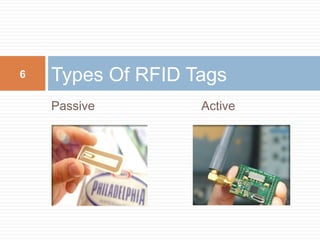
6   Types Of RFID Tags
    Passive        Active
Passive
7


       Passive RFID tags have no internal power supply.
       A small electric current is created in the antenna when
        an incoming signal reaches it.
       This current provides enough power to briefly activate
        the tag, usually just long enough to relay simple
        information, such as an ID number or product name.
       Because passive RFID tags do not contain a power
        supply, they can be very small in size, sometimes
        thinner than a piece of paper.
       These tags can be activated from a distance of ten
        millimetres to over 6 meters away.
Active
8

       Active RFID tags do contain an internal power source,
        which allows for a longer read-range and for a bigger
        memory on the tag itself.
       The power source also makes it possible to store
        information sent by the transceiver.
       Active RFID tags are larger than passive tags, usually
        slightly bigger than a coin.
       They can be read from many meters away, and
        generally have a battery life of about ten years.
       Advantages of active tags include accuracy, reliability,
        and superior performance in adverse environments,
        such as damp or metallic.
Types of RFID tags
9


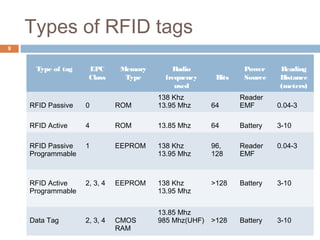
     Type of tag    EPC       Memory       R adio             Power    Reading
                    Class      Type      frequency    Bits    Source   Distance
                                            used                       (meters)
                                       138 Khz               Reader
    RFID Passive   0         ROM       13.95 Mhz     64      EMF       0.04-3

    RFID Active    4         ROM       13.85 Mhz     64      Battery   3-10

    RFID Passive   1         EEPROM    138 Khz       96,     Reader    0.04-3
    Programmable                       13.95 Mhz     128     EMF


    RFID Active    2, 3, 4   EEPROM    138 Khz       >128    Battery   3-10
    Programmable                       13.95 Mhz


                                       13.85 Mhz
    Data Tag       2, 3, 4   CMOS      985 Mhz(UHF) >128     Battery   3-10
                             RAM
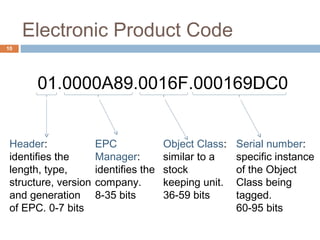
Electronic Product Code
10


       01.0000A89.0016F.000169DC0


 Header:              EPC              Object Class:   Serial number:
 identifies the       Manager:         similar to a    specific instance
 length, type,        identifies the   stock           of the Object
 structure, version   company.         keeping unit.   Class being
 and generation       8-35 bits        36-59 bits      tagged.
 of EPC. 0-7 bits                                      60-95 bits
11
12
RFID vs Barcode
13


     RFID                                            BARCODE

         Data capacity is more. Several               Data capacity is very less. Upto
          thousand characters.                          24 characters.
         Line of sight not required.                  Line of sight required.
         May last several years, depending            Paper labels are subject to wear
          upon the type of tag.                         and damage, hence less durable.
         Allows unattended identification.            Only a single barcode can be
          Several tags can be read                      scanned at a time.
          simultaneously.                              No memory storage possible.
         Some tags can store memory.
                      ..but RFID are not only for identification scope..
         But unlike Barcodes, RFID is not merely for identification purposes..
14


APPLICATIONS
Supply Chain Management and
15   RFID
      •Information about the contents to be loaded from a factory
      can be written onto the tag, e.g. quantity, weight, serial
      number, date, time etc.

      •This allows the information to be easily checked after transit,
      without having access to an on-line database. This can be
      very useful to check if items have gone "missing" during
      transit.

      •Using the tag on the shipment and RFID readers on each of
      the loading bays, it is possible to identify the shipment, as it
      is loaded.

      •The advantage is that the reading and verification is done
      completely   automatically, therefore manual labour is
16
Healthcare
17

    All patients admitted to the hospital are given
     an RFID-based wristband with a passive RFID
     chip in it.

    This chip stores a unique patient ID number
     and relevant medical information.

    The caregiver uses a handheld computer with
     an RFID interrogator to read the data encoded
     on the patients ID bracelets.

    Over a wireless LAN connection, the hospital
     staff can access the patient’s medical history
     as well as treatment record.
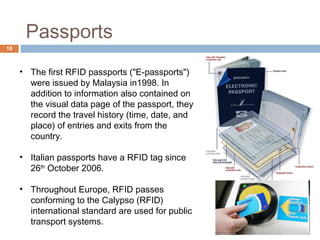
Passports
18


     • The first RFID passports ("E-passports")
       were issued by Malaysia in1998. In
       addition to information also contained on
       the visual data page of the passport, they
       record the travel history (time, date, and
       place) of entries and exits from the
       country.

     • Italian passports have a RFID tag since
       26th October 2006.

     • Throughout Europe, RFID passes
       conforming to the Calypso (RFID)
       international standard are used for public
       transport systems.
Objects become self
19
      discovering


     Each tag is augmented with a photo sensor to significantly extend the
     functionality and support radio frequency identity and geometry (RFIG)
     discovery
Livestock and Animal Tracking
20

        A tag is inserted through a Single Use
         Disposable syringe into the animal. It remains
         under the skin of the animal.
        The number of the RFID tag is unique and
         cannot be altered.
        When an animal is to be scanned, it is either
         brought near RFID reader or scanner or a
         hand-held reader is used.
        The reader is connected to a remote database
         which correlates the unique RFID tag number
         on the animal with other data on the animal.
        This helps in easily maintaining electronic
         records of vaccination and medication, health
         checkups, etc.
Other applications…
21

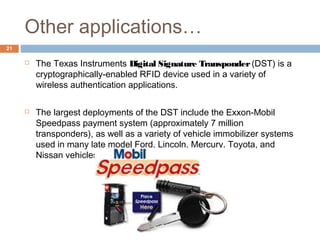
        The Texas Instruments Digital Signature Transponder (DST) is a
         cryptographically-enabled RFID device used in a variety of
         wireless authentication applications.

        The largest deployments of the DST include the Exxon-Mobil
         Speedpass payment system (approximately 7 million
         transponders), as well as a variety of vehicle immobilizer systems
         used in many late model Ford, Lincoln, Mercury, Toyota, and
         Nissan vehicles.
RFID reader integrated mobile phones
22


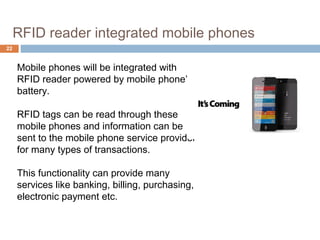
     Mobile phones will be integrated with
     RFID reader powered by mobile phone’s
     battery.

     RFID tags can be read through these
     mobile phones and information can be
     sent to the mobile phone service provider
     for many types of transactions.

     This functionality can provide many
     services like banking, billing, purchasing,
     electronic payment etc.
Initiatives in India on RFID
23

     W ipro Technologies: Member of the Electronic Product Code (EPC).
     Setting up a lab to study RFID. Working on pilot projects

     Infosys Technologies: RFID consulting on logistics player in the
     RFID space.

     TCS: Tied up with Hyderabad University to produce RFID tagged
     mark sheets & degrees to deter use of fake degree.

     Patni Computer Systems Lab:            Implemented Animal Tracking
     System.

     Intellicon:        Pilot project for BEL Bangalore, Tags installed on
     employee buses. Buses inside the BEL campus were tracked with the
     aim of gauging employee punctuality.

     Mumbai: The busiest Suburban Rail Transport in the world, which
Conclusion
24


     •The real value of RFID technology stems from the insight that
     stands to be gained from the identification, location and subsequent
     control of that item and applying that insight to business.

     •RFID is not industry specific—it’s business value specific. RFID is
     more than a locator beacon.

     •RFID is an enabling tool that is not only a source of powerful
     information, but a source of true business innovation.
References
25

        K Finkenzeller, RFI ha nd bo o k: fund a m e nta ls a nd a p p lic a tio ns in
                                      D
         c o nta c tle s s s m a rt c a rd s a nd id e ntific a tio n, 2nd ed., R. Waddington, Ed.
         West Sussex, England: John Wiley & Sons Ltd, 2003.
        Q. Z. Sheng, X. Li, and S. Zeadally, "Enabling next-generation RFID
         applications: Solutions and challenges," Co m p ute r, vol. 41, pp. 21-28, Sept.
         2008.
        A. Juels, RFID Security and Privacy: A Research Survey, Selected Areas in
         Communications, IEEE Journal. Publication Date:Feb. 2006 Volume: 24,
         Issue: 2 On page(s): 381- 394
        R. E. Sorace, V. S. Reinhardt, and S. A. Vaughn, “High-speed digital-to-RF
         converter,” U.S. Patent 5 668 842, Sept. 16, 1997
        ISO website. http://www.iso.orgl
        The EPCglobal website. http://www.epcglobalinc.orgl
        The RFID Journal website www.rfidjournal.com
        HowStuffWorks www.howstuffworks.com
      
THANK YOU

RFID Technology

  • 1.
    1 RFID TECHNOLOGY Kshitij Varma Sec-A Roll No- 10 Dept. of Electrical & Electronics
  • 2.
    Contents 2  What is RFID?  History  Types of Tags  Design & Working  Applications  Scope  Conclusion  References
  • 3.
    What is RFID? 3  Radio-frequency identification (R FID) is the use of a wireless system that uses radio frequency electromagnetic fields to transfer data from a tag attached to an object, for the purposes of automatic identification and tracking.  RFID is only one of the numerous technologies grouped under the term Automatic Identification (Auto ID), such as bar code, magnetic inks, optical character recognition, voice recognition, touch memory, smart cards, biometrics etc.  The latest RFID market research from IDTechEx finds that in 2012 the value of the entire RFID market will be $7.67 billion, up from $6.51 billion in 2011.
  • 4.
    History 4  Radar is invented in 1935 by Scottish physicist Sir Robert Alexander Watson- Watt. Under him the British developed the first active identify friend or foe (IFF) system, during World War II.  In October 1948, Harry Stockman, presented paper on Communication by Means of Reflected Power, Proceedings of the IRE, pp1196-1204.  Mario W. Cardullo received the first U.S. patent for an active RFID tag with rewritable memory on January 23, 1973.  Alfred Koelle, Steven Depp and Robert Freyman of Los Alamos Laboratory, USA presented work on Short-range radio-telemetry for electronic identification using modulated backscatter in 1975.  In1999, the Uniform Code Council,  EAN International, Procter & Gamble and Gillette put up funding to establish the Auto-ID Center at the Massachusetts Institute of Technology.
  • 5.
    Components of aRFID tag 5 The IC is a small microprocessor, which has a logic unit that makes decisions and provides memory to store data.  The IC needs power to operate. The antenna is connected to the tag IC. It receives the signals from the interrogator and, depending on tag type, it either transmits or reflects the received signal back. The geometry of an antenna determines the frequency at which the tag operates. The substrate holds all other tag components IC together.  The tag antenna is deposited or printed on the substrate, and the IC is then attached to this Antenna antenna. Substrate
  • 6.
    6 Types Of RFID Tags Passive Active
  • 7.
    Passive 7  Passive RFID tags have no internal power supply.  A small electric current is created in the antenna when an incoming signal reaches it.  This current provides enough power to briefly activate the tag, usually just long enough to relay simple information, such as an ID number or product name.  Because passive RFID tags do not contain a power supply, they can be very small in size, sometimes thinner than a piece of paper.  These tags can be activated from a distance of ten millimetres to over 6 meters away.
  • 8.
    Active 8  Active RFID tags do contain an internal power source, which allows for a longer read-range and for a bigger memory on the tag itself.  The power source also makes it possible to store information sent by the transceiver.  Active RFID tags are larger than passive tags, usually slightly bigger than a coin.  They can be read from many meters away, and generally have a battery life of about ten years.  Advantages of active tags include accuracy, reliability, and superior performance in adverse environments, such as damp or metallic.
  • 9.
    Types of RFIDtags 9 Type of tag EPC Memory R adio Power Reading Class Type frequency Bits Source Distance used (meters) 138 Khz Reader RFID Passive 0 ROM 13.95 Mhz 64 EMF 0.04-3 RFID Active 4 ROM 13.85 Mhz 64 Battery 3-10 RFID Passive 1 EEPROM 138 Khz 96, Reader 0.04-3 Programmable 13.95 Mhz 128 EMF RFID Active 2, 3, 4 EEPROM 138 Khz >128 Battery 3-10 Programmable 13.95 Mhz 13.85 Mhz Data Tag 2, 3, 4 CMOS 985 Mhz(UHF) >128 Battery 3-10 RAM
  • 10.
    Electronic Product Code 10 01.0000A89.0016F.000169DC0 Header: EPC Object Class: Serial number: identifies the Manager: similar to a specific instance length, type, identifies the stock of the Object structure, version company. keeping unit. Class being and generation 8-35 bits 36-59 bits tagged. of EPC. 0-7 bits 60-95 bits
  • 11.
  • 12.
  • 13.
    RFID vs Barcode 13 RFID BARCODE  Data capacity is more. Several  Data capacity is very less. Upto thousand characters. 24 characters.  Line of sight not required.  Line of sight required.  May last several years, depending  Paper labels are subject to wear upon the type of tag. and damage, hence less durable.  Allows unattended identification.  Only a single barcode can be Several tags can be read scanned at a time. simultaneously.  No memory storage possible.  Some tags can store memory. ..but RFID are not only for identification scope.. But unlike Barcodes, RFID is not merely for identification purposes..
  • 14.
  • 15.
    Supply Chain Managementand 15 RFID •Information about the contents to be loaded from a factory can be written onto the tag, e.g. quantity, weight, serial number, date, time etc. •This allows the information to be easily checked after transit, without having access to an on-line database. This can be very useful to check if items have gone "missing" during transit. •Using the tag on the shipment and RFID readers on each of the loading bays, it is possible to identify the shipment, as it is loaded. •The advantage is that the reading and verification is done completely automatically, therefore manual labour is
  • 16.
  • 17.
    Healthcare 17  All patients admitted to the hospital are given an RFID-based wristband with a passive RFID chip in it.  This chip stores a unique patient ID number and relevant medical information.  The caregiver uses a handheld computer with an RFID interrogator to read the data encoded on the patients ID bracelets.  Over a wireless LAN connection, the hospital staff can access the patient’s medical history as well as treatment record.
  • 18.
    Passports 18 • The first RFID passports ("E-passports") were issued by Malaysia in1998. In addition to information also contained on the visual data page of the passport, they record the travel history (time, date, and place) of entries and exits from the country. • Italian passports have a RFID tag since 26th October 2006. • Throughout Europe, RFID passes conforming to the Calypso (RFID) international standard are used for public transport systems.
  • 19.
    Objects become self 19 discovering Each tag is augmented with a photo sensor to significantly extend the functionality and support radio frequency identity and geometry (RFIG) discovery
  • 20.
    Livestock and AnimalTracking 20  A tag is inserted through a Single Use Disposable syringe into the animal. It remains under the skin of the animal.  The number of the RFID tag is unique and cannot be altered.  When an animal is to be scanned, it is either brought near RFID reader or scanner or a hand-held reader is used.  The reader is connected to a remote database which correlates the unique RFID tag number on the animal with other data on the animal.  This helps in easily maintaining electronic records of vaccination and medication, health checkups, etc.
  • 21.
    Other applications… 21  The Texas Instruments Digital Signature Transponder (DST) is a cryptographically-enabled RFID device used in a variety of wireless authentication applications.  The largest deployments of the DST include the Exxon-Mobil Speedpass payment system (approximately 7 million transponders), as well as a variety of vehicle immobilizer systems used in many late model Ford, Lincoln, Mercury, Toyota, and Nissan vehicles.
  • 22.
    RFID reader integratedmobile phones 22 Mobile phones will be integrated with RFID reader powered by mobile phone’s battery. RFID tags can be read through these mobile phones and information can be sent to the mobile phone service provider for many types of transactions. This functionality can provide many services like banking, billing, purchasing, electronic payment etc.
  • 23.
    Initiatives in Indiaon RFID 23 W ipro Technologies: Member of the Electronic Product Code (EPC). Setting up a lab to study RFID. Working on pilot projects Infosys Technologies: RFID consulting on logistics player in the RFID space. TCS: Tied up with Hyderabad University to produce RFID tagged mark sheets & degrees to deter use of fake degree. Patni Computer Systems Lab: Implemented Animal Tracking System. Intellicon: Pilot project for BEL Bangalore, Tags installed on employee buses. Buses inside the BEL campus were tracked with the aim of gauging employee punctuality. Mumbai: The busiest Suburban Rail Transport in the world, which
  • 24.
    Conclusion 24 •The real value of RFID technology stems from the insight that stands to be gained from the identification, location and subsequent control of that item and applying that insight to business. •RFID is not industry specific—it’s business value specific. RFID is more than a locator beacon. •RFID is an enabling tool that is not only a source of powerful information, but a source of true business innovation.
  • 25.
    References 25  K Finkenzeller, RFI ha nd bo o k: fund a m e nta ls a nd a p p lic a tio ns in D c o nta c tle s s s m a rt c a rd s a nd id e ntific a tio n, 2nd ed., R. Waddington, Ed. West Sussex, England: John Wiley & Sons Ltd, 2003.  Q. Z. Sheng, X. Li, and S. Zeadally, "Enabling next-generation RFID applications: Solutions and challenges," Co m p ute r, vol. 41, pp. 21-28, Sept. 2008.  A. Juels, RFID Security and Privacy: A Research Survey, Selected Areas in Communications, IEEE Journal. Publication Date:Feb. 2006 Volume: 24, Issue: 2 On page(s): 381- 394  R. E. Sorace, V. S. Reinhardt, and S. A. Vaughn, “High-speed digital-to-RF converter,” U.S. Patent 5 668 842, Sept. 16, 1997  ISO website. http://www.iso.orgl  The EPCglobal website. http://www.epcglobalinc.orgl  The RFID Journal website www.rfidjournal.com  HowStuffWorks www.howstuffworks.com  
  • 26.

Editor's Notes