RFID – An Introduction


Venkat Alagarsamy
             venkat.alagarsamy@gmail.com


                                              www.linkedin.com/in/VenkatAlagarsamy
                                                  www.scribd.com/VenkatAlagarsamy
                                     www.facebook.com/Venkatachalapathi.Alagarsamy
                                               www.slideshare.net/VenkatAlagarsamy
                                                       VenkatAlagarsamy.blogspot.in
Last Updated: 7th march 2007
Automatic Identification (Auto
             ID)
Capture of a data without any user
 intervention

Aim is to
  increase efficiency
  reduce data entry errors
  and free up staff to perform more value-added
   services
Common Auto IDs

   Bar Codes
   Smart Cards
   Voice Recognition
   Biometric Technologies
   Optical Character Recognition (OCR) and
   Radio Frequency Identification (RFID)
RFID -- Methodology

 Storing a unique data on a microchip that is
  attached to an antenna
 Chip and antenna called as RFID tag
 Antenna enables the chip to transmit the data to
  reader
 Reader converts the radio waves reflected back
  from RFID tag into digital data that can then be
  processed by computer.
Why RFID was/is not popular?
 Issue 1: “Standards”    Issue 3:
  • Standards              “Incompatibility”
     weren’t                • Existing RFID
     established until        systems use
     recently.
                              proprietary
                              technology
 Issue 2: “Cost”
  • RFID readers
     typically cost
     $1000 or more.
  • Need thousands
     of readers to
     cover all
Comparison with Bar Code
        Bar Code                        RFID
Line-of-sight model.         Line-of-sight not required
Scanner has to see the
code
Can not scan if label is     Can read with in a range
ripped or soiled
Can identify                 Tags use microchips
manufacturer, product        (2KB data)
and Unique item
Data combination is not Data combination is not
configurable                 limited and configurable
                    Reading RFID
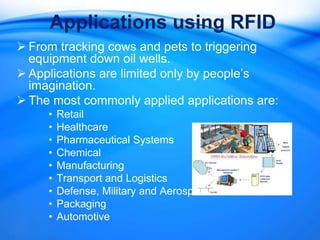
Applications using RFID
 From tracking cows and pets to triggering
  equipment down oil wells.
 Applications are limited only by people’s
  imagination.
 The most commonly applied applications are:
     •   Retail
     •   Healthcare
     •   Pharmaceutical Systems
     •   Chemical
     •   Manufacturing
     •   Transport and Logistics
     •   Defense, Military and Aerospace
     •   Packaging
     •   Automotive
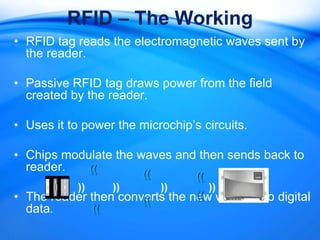
RFID – The Working
• RFID tag reads the electromagnetic waves sent by
  the reader.

• Passive RFID tag draws power from the field
  created by the reader.

• Uses it to power the microchip’s circuits.

• Chips modulate the waves and then sends back to
  reader.   ((          ((        ((
            ))    ))         ))        ))
• The reader then converts the new waves into digital
                      ((        ((
  data.       ((
RFID Operating Frequencies
RFID tags and readers have to be tuned to the same
  frequency to communicate
 Low-Frequency (around 125KHz)
   •   less power
   •   better able to penetrate non-metallic substances
   •   for scanning objects with high-water content, such as fruit.
   •   But the read range is limited to less than a foot (0.33 meter)
 High-Frequency (around 13.56 MHz)
   • better on objects made of metal
   • can work around goods with high water content
   • range of 1 meter.
 Ultra-High-Frequency (800-960 MHz)
   •   faster than LF and HF tags
   •   Use more power and are less likely to pass through materials
   •   require clear path between the tag and reader.
   •   better for scanning boxes of goods
   •   range up to 3 to 7 meters with active tags the reading range could
       be up to100 meters.
 Microwave (2.45 GHz).
Types of RFID Tags
 Three types depending on it’s R/W methods
  • Read Only (RO tags)
  • Write Once, Read Many (WORM tags)
  • Read-Write (RW tags)


 Classifying based on its power source
  • Active tags
     o transmits the data using its own power source (typically a battery)
  • Passive tags
     o have no battery, but draw power from the reader to transmit.
  • Semi-Passive tags
     o has power source to run the chip’s circuit
     o but communicate to reader by drawing power from the reader.
RFID Readers
It is a host device attached with the computer,
    which communicates with the RFID tags and
    receives data

 Active Reader
  • can read tags operating different frequencies
  • using different methods of communication between
    tags and readers.
 Intelligent Reader
  • can run different protocols
  • to filter data and to even run applications.
 Dump Reader
  • simple device that might read only one type of tag
  • uses one frequency and one protocol.
RFID Standards
 International standards have been adopted for
  some specific applications, such as
  • tracking animals
  • for smart cards, which require encryption to keep data
    secure.

 Many other standards initiatives are under way

 International Organization for Standardization
  (ISO)
  • for tracking goods in the supply chain using HF tags
    (ISO 18000-3) and UHF tags (ISO 18000-6)

 EPC global
  • set up to commercialize Electronic Product Code
    technologies
RFID – Implementation Cost
        (Approximate)
 RFID Tag Cost
  • Pricing is based
     o on volume
     o the amount of memory on the tag
     o and the packaging of the tag (plastic or embedded in a label,
       for instance)
  • Depending on the volume a 96-bit EPC, passive, RO
    tag cost from 20 to 40 cents.

 RFID Reader Cost
  • Cost from $1000 to $3000 depending on the features
    in the device
  • Standalone LF reader may cost $750
  • HF reader may cost $500
  • But cost could be reduced by 50% to 70% by buying a
    reader module alone and putting into another device.
Fully Functional RFID System
 Cost Depends on Cost
      •   on the application
      •   size of the installation
      •   type of system
      •   and many other factors

 not possible to give a ballpark figure

 Other costs
      • middleware to filter RFID data
      • need to hire a systems integrator
      • upgrade enterprise applications, such as warehouse
        management systems
      • upgrade networks within facilities

Introduction to RFID

  • 1.
    RFID – AnIntroduction Venkat Alagarsamy venkat.alagarsamy@gmail.com www.linkedin.com/in/VenkatAlagarsamy www.scribd.com/VenkatAlagarsamy www.facebook.com/Venkatachalapathi.Alagarsamy www.slideshare.net/VenkatAlagarsamy VenkatAlagarsamy.blogspot.in Last Updated: 7th march 2007
  • 2.
    Automatic Identification (Auto ID) Capture of a data without any user intervention Aim is to increase efficiency reduce data entry errors and free up staff to perform more value-added services
  • 3.
    Common Auto IDs  Bar Codes  Smart Cards  Voice Recognition  Biometric Technologies  Optical Character Recognition (OCR) and  Radio Frequency Identification (RFID)
  • 4.
    RFID -- Methodology Storing a unique data on a microchip that is attached to an antenna  Chip and antenna called as RFID tag  Antenna enables the chip to transmit the data to reader  Reader converts the radio waves reflected back from RFID tag into digital data that can then be processed by computer.
  • 5.
    Why RFID was/isnot popular?  Issue 1: “Standards”  Issue 3: • Standards “Incompatibility” weren’t • Existing RFID established until systems use recently. proprietary technology  Issue 2: “Cost” • RFID readers typically cost $1000 or more. • Need thousands of readers to cover all
  • 6.
    Comparison with BarCode Bar Code RFID Line-of-sight model. Line-of-sight not required Scanner has to see the code Can not scan if label is Can read with in a range ripped or soiled Can identify Tags use microchips manufacturer, product (2KB data) and Unique item Data combination is not Data combination is not configurable limited and configurable Reading RFID
  • 7.
    Applications using RFID From tracking cows and pets to triggering equipment down oil wells.  Applications are limited only by people’s imagination.  The most commonly applied applications are: • Retail • Healthcare • Pharmaceutical Systems • Chemical • Manufacturing • Transport and Logistics • Defense, Military and Aerospace • Packaging • Automotive
  • 8.
    RFID – TheWorking • RFID tag reads the electromagnetic waves sent by the reader. • Passive RFID tag draws power from the field created by the reader. • Uses it to power the microchip’s circuits. • Chips modulate the waves and then sends back to reader. (( (( (( )) )) )) )) • The reader then converts the new waves into digital (( (( data. ((
  • 9.
    RFID Operating Frequencies RFIDtags and readers have to be tuned to the same frequency to communicate  Low-Frequency (around 125KHz) • less power • better able to penetrate non-metallic substances • for scanning objects with high-water content, such as fruit. • But the read range is limited to less than a foot (0.33 meter)  High-Frequency (around 13.56 MHz) • better on objects made of metal • can work around goods with high water content • range of 1 meter.  Ultra-High-Frequency (800-960 MHz) • faster than LF and HF tags • Use more power and are less likely to pass through materials • require clear path between the tag and reader. • better for scanning boxes of goods • range up to 3 to 7 meters with active tags the reading range could be up to100 meters.  Microwave (2.45 GHz).
  • 10.
    Types of RFIDTags  Three types depending on it’s R/W methods • Read Only (RO tags) • Write Once, Read Many (WORM tags) • Read-Write (RW tags)  Classifying based on its power source • Active tags o transmits the data using its own power source (typically a battery) • Passive tags o have no battery, but draw power from the reader to transmit. • Semi-Passive tags o has power source to run the chip’s circuit o but communicate to reader by drawing power from the reader.
  • 11.
    RFID Readers It isa host device attached with the computer, which communicates with the RFID tags and receives data  Active Reader • can read tags operating different frequencies • using different methods of communication between tags and readers.  Intelligent Reader • can run different protocols • to filter data and to even run applications.  Dump Reader • simple device that might read only one type of tag • uses one frequency and one protocol.
  • 12.
    RFID Standards  Internationalstandards have been adopted for some specific applications, such as • tracking animals • for smart cards, which require encryption to keep data secure.  Many other standards initiatives are under way  International Organization for Standardization (ISO) • for tracking goods in the supply chain using HF tags (ISO 18000-3) and UHF tags (ISO 18000-6)  EPC global • set up to commercialize Electronic Product Code technologies
  • 13.
    RFID – ImplementationCost (Approximate)  RFID Tag Cost • Pricing is based o on volume o the amount of memory on the tag o and the packaging of the tag (plastic or embedded in a label, for instance) • Depending on the volume a 96-bit EPC, passive, RO tag cost from 20 to 40 cents.  RFID Reader Cost • Cost from $1000 to $3000 depending on the features in the device • Standalone LF reader may cost $750 • HF reader may cost $500 • But cost could be reduced by 50% to 70% by buying a reader module alone and putting into another device.
  • 14.
    Fully Functional RFIDSystem  Cost Depends on Cost • on the application • size of the installation • type of system • and many other factors  not possible to give a ballpark figure  Other costs • middleware to filter RFID data • need to hire a systems integrator • upgrade enterprise applications, such as warehouse management systems • upgrade networks within facilities