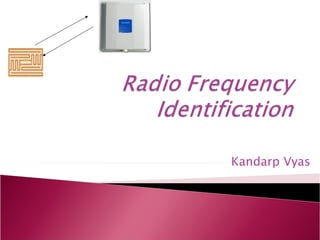
Kandarp Vyas
RFID or Radio Frequency Identification is a technology that
enables
   the tracking and/or identification of objects and living
things.

Unlike bar-code technology, RFID technology does not
require contact or line-of-sight for communication.
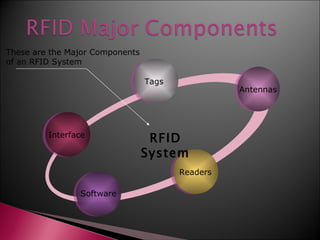
These are the Major Components
of an RFID System

                                 Tags
                                                  Antennas


         Interface
                                  RFID
                                 System
                                        Readers

                Software
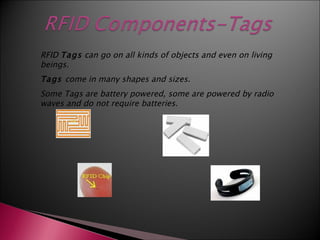
RFID Tags can go on all kinds of objects and even on living
beings.
Tags come in many shapes and sizes.
Some Tags are battery powered, some are powered by radio
waves and do not require batteries.
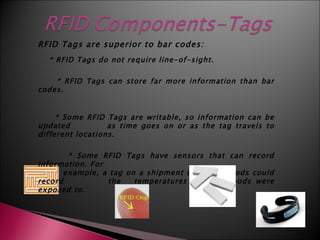
RFID Tags are superior to bar codes:
  * RFID Tags do not require line-of-sight.

    * RFID Tags can store far more information than bar
codes.


     * Some RFID Tags are writable, so information can be
updated           as time goes on or as the tag travels to
different locations.

        * Some RFID Tags have sensors that can record
information. For
       example, a tag on a shipment of frozen foods could
record           the    temperatures that the foods were
exposed to.
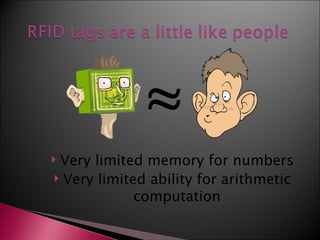
≈
Very limited memory for numbers
 Very limited ability for arithmetic

             computation
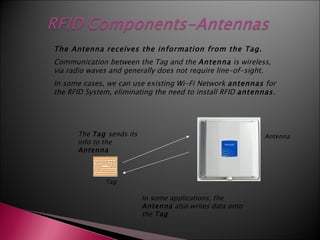
The Antenna receives the information from the Tag.
Communication between the Tag and the Antenna is wireless,
via radio waves and generally does not require line-of-sight.
In some cases, we can use existing Wi-Fi Network antennas for
the RFID System, eliminating the need to install RFID antennas.


      The Tag sends its                                    Antenna
      info to the
      Antenna


              Tag

                          In some applications, the
                          Antenna also writes data onto
                          the Tag
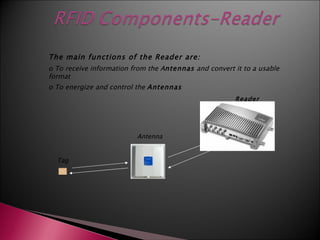
The main functions of the Reader are :
o To receive information from the Antennas and convert it to a usable
format
o To energize and control the Antennas
                                                       Reader


                          Antenna


  Tag
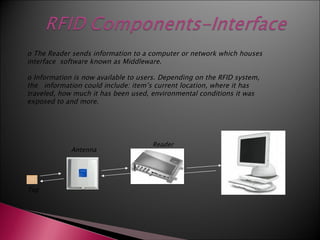
o The Reader sends information to a computer or network which houses
interface software known as Middleware.

o Information is now available to users. Depending on the RFID system,
the information could include: item’s current location, where it has
traveled, how much it has been used, environmental conditions it was
exposed to and more.


                                     Reader                     Reader
             Antenna


Tag
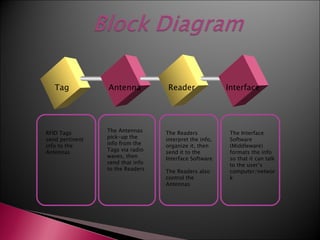
Tag           Antenna          Reader                Interface


RFID Tags        The Antennas     The Readers            The Interface
send pertinent   pick-up the      interpret the info,    Software
info to the      info from the    organize it, then      (Middleware)
Antennas         Tags via radio   send it to the         formats the info
                 waves, then      Interface Software     so that it can talk
                 send that info                          to the user’s
                 to the Readers   The Readers also       computer/networ
                                  control the            k
                                  Antennas
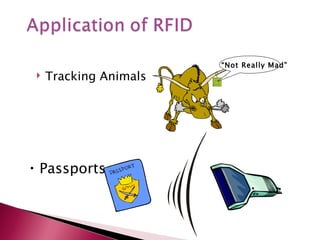
“Not Really Mad”
    Tracking Animals


• Passports
P
                                                   P


    P                        
P
           P        P               P        P
         P P P
        P P P
         P P P
                  P P
                 P P
                  P P
                        P
                         P
                         P
                                  P P P
                                 P P P
                                  P P P
                                           P P P
                                          P P P
                                           P P P
                                                   
        P P P    P P    P        P P P    P P P
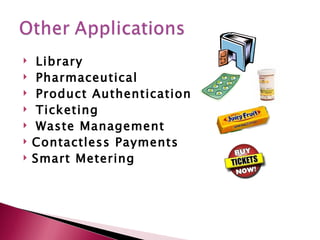
    Library
    Pharmaceutical
    Product Authentication
    Ticketing
    Waste Management
   Contactless Payments
   Smart Metering
Radio Frequency Identification (RFID)

Radio Frequency Identification (RFID)

  • 1.
  • 2.
    RFID or RadioFrequency Identification is a technology that enables the tracking and/or identification of objects and living things. Unlike bar-code technology, RFID technology does not require contact or line-of-sight for communication.
  • 3.
    These are theMajor Components of an RFID System Tags Antennas Interface RFID System Readers Software
  • 4.
    RFID Tags cango on all kinds of objects and even on living beings. Tags come in many shapes and sizes. Some Tags are battery powered, some are powered by radio waves and do not require batteries.
  • 5.
    RFID Tags aresuperior to bar codes: * RFID Tags do not require line-of-sight. * RFID Tags can store far more information than bar codes. * Some RFID Tags are writable, so information can be updated as time goes on or as the tag travels to different locations. * Some RFID Tags have sensors that can record information. For example, a tag on a shipment of frozen foods could record the temperatures that the foods were exposed to.
  • 6.
    ≈ Very limited memoryfor numbers  Very limited ability for arithmetic computation
  • 7.
    The Antenna receivesthe information from the Tag. Communication between the Tag and the Antenna is wireless, via radio waves and generally does not require line-of-sight. In some cases, we can use existing Wi-Fi Network antennas for the RFID System, eliminating the need to install RFID antennas. The Tag sends its Antenna info to the Antenna Tag In some applications, the Antenna also writes data onto the Tag
  • 8.
    The main functionsof the Reader are : o To receive information from the Antennas and convert it to a usable format o To energize and control the Antennas Reader Antenna Tag
  • 9.
    o The Readersends information to a computer or network which houses interface software known as Middleware. o Information is now available to users. Depending on the RFID system, the information could include: item’s current location, where it has traveled, how much it has been used, environmental conditions it was exposed to and more. Reader Reader Antenna Tag
  • 10.
    Tag Antenna Reader Interface RFID Tags The Antennas The Readers The Interface send pertinent pick-up the interpret the info, Software info to the info from the organize it, then (Middleware) Antennas Tags via radio send it to the formats the info waves, then Interface Software so that it can talk send that info to the user’s to the Readers The Readers also computer/networ control the k Antennas
  • 11.
    “Not Really Mad”  Tracking Animals • Passports
  • 12.
    P P P  P P P P P P P P P P P P P P P P P P P P P P P P P P P P P P P P P P P P P P P P P  P P P P P P P P P P P P
  • 13.
     Library   Pharmaceutical   Product Authentication   Ticketing   Waste Management  Contactless Payments  Smart Metering