Honors Physics Good Morning! Please… Take out your homework to be checked  Write down the objectives for today.  Work on the warm-up problem:  What is a vector quantity? What is a scalar quantity? Provide one example of each.
Housekeeping… Unit 1 measurement test is Friday See me today after school if you need help Homework solutions posted online Vocab binders will be checked that period Website has full vocab list of words that will be checked on Friday Bring your calculators for test! Quizzes Folders have FLM worksheets in them – check it
Test information for Friday Measurement Accuracy (no calculations of relative error) Precision (no calculations of standard deviation) Significant figures Unit prefixes, abbreviations, and their values (know giga through nano) See table 1-4 (pg. 11) for full metric prefixes Scientific notation Factor label method
The bottom line…. Motion is RELATIVE It depends completely on how you want to look at the moving object.  You establish a  frame of reference! Frame of reference can be thought of as your point of view.  We usually use the earth’s surface as our frame of reference.  Example: You are sitting in an airplane which is moving at a speed of 100 km/h and there is a fly sitting on your head. What is your speed relative to the ground? What is your speed relative to the seat you're sitting in? What is the speed of the fly relative to you? 100 km/hr 0 km/hr 0 km/hr
One Dimensional Motion Mechanics :  the study of the motion of objects under the reference of force and energy Two parts:  Kinematics :  the description of how objects move Dynamics :  how forces cause motion
Displacement Displacement (x or y)    "Change in position"   It is not necessarily the total distance traveled . In fact, displacement and distance are entirely different concepts.  Displacement is relative to an axis. "x" displacement  means you are  moving horizontally either right or left . "y" displacement  means you are  moving vertically either up or down . The word  change  is expressed using the Greek letter  DELTA ( Δ ) . To find the  change  you ALWAYS subtract your  FINAL - INITIAL  position It is therefore expressed as either    Δx = x f  - x i  o r  Δy = y f  – y i Displacement is a vector quantity: It has both magnitude and direction  (north, south, east, west, positive, negative, right, left, up, down, at an angle, etc.) Distance -  How far you travel regardless of direction. Distance is a  scalar quantity: it only has magnitude .
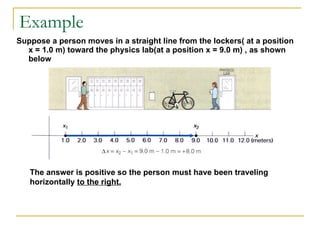
Example Suppose a person moves in a straight line from the lockers( at a position  x = 1.0 m) toward the physics lab(at a position x = 9.0 m) , as shown below The answer is positive so the person must have been traveling horizontally  to the right.
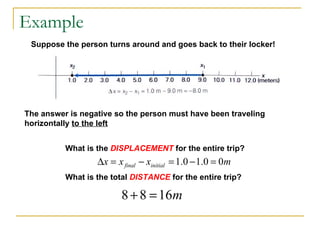
Example Suppose the person turns around and goes back to their locker! The answer is negative so the person must have been traveling horizontally  to the left What is the  DISPLACEMENT  for the entire trip? What is the total  DISTANCE  for the entire trip?
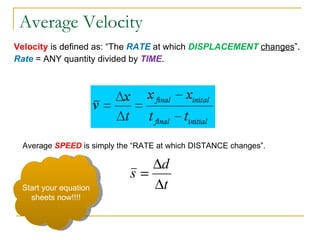
Average Velocity Velocity  is defined as:  “The  RATE  at which  DISPLACEMENT   changes ”.  Rate  = ANY quantity divided by  TIME .  Average  SPEED  is simply the  “RATE at which DISTANCE changes”. Start your equation sheets now!!!!
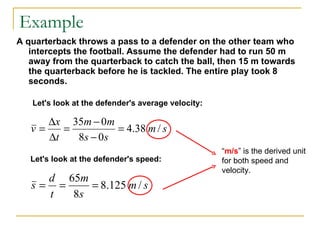
Example A quarterback throws a pass to a defender on the other team who intercepts the football. Assume the defender had to run 50 m away from the quarterback to catch the ball, then 15 m towards the quarterback before he is tackled. The entire play took 8 seconds.   Let's look at the defender's average velocity: Let's look at the defender's speed: “ m/s ” is the derived unit for both speed and velocity.
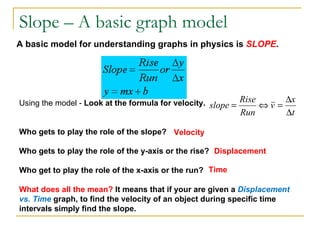
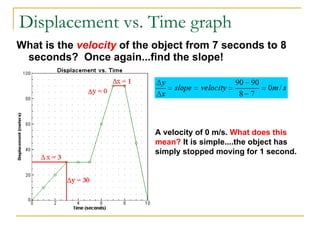
Slope – A basic graph model A basic model for understanding graphs in physics is  SLOPE .  Using the model -  Look at the formula for velocity. Who gets to play the role of the slope?  Who gets to play the role of the y-axis or the rise?  Who get to play the role of the x-axis or the run?  What does all the mean?  It means that if your are given a  Displacement vs. Time  graph, to find the velocity of an object during specific time intervals simply find the slope.   Velocity Displacement Time
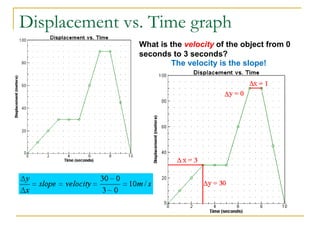
Displacement vs. Time graph What is the  velocity  of the object from 0 seconds to 3 seconds? The velocity is the slope!
Displacement vs. Time graph What is the  velocity  of the object from 7 seconds to 8 seconds?  Once again...find the slope!   A velocity of 0 m/s.  What does this mean?  It is simple....the object has simply stopped moving for 1 second.
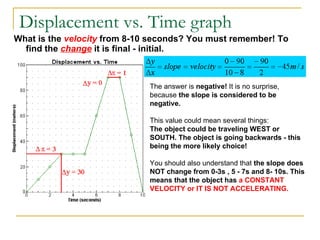
Displacement vs. Time graph What is the  velocity  from 8-10 seconds? You must remember! To find the  change  it is final - initial.   The answer is  negative!  It is no surprise, because  the slope is considered to be negative.  This value could mean several things:  The object could be traveling WEST or SOUTH.   The object is going backwards - this being the more likely choice! You should also understand that  the slope does NOT change from 0-3s , 5 - 7s and 8- 10s.   This means that the object has  a CONSTANT VELOCITY or IT IS NOT ACCELERATING.
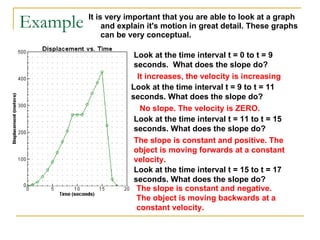
Example It is very important that you are able to look at a graph and explain it's motion in great detail. These graphs can be very conceptual. Look at the time interval t = 0 to t = 9 seconds.  What does the slope do?   It increases, the velocity is increasing Look at the time interval t = 9 to t = 11 seconds. What does the slope do?   No slope. The velocity is ZERO. Look at the time interval t = 11 to t = 15 seconds. What does the slope do?   The slope is constant and positive. The object is moving forwards at a constant velocity. Look at the time interval t = 15 to t = 17 seconds. What does the slope do?   The slope is constant and negative. The object is moving backwards at a constant velocity.
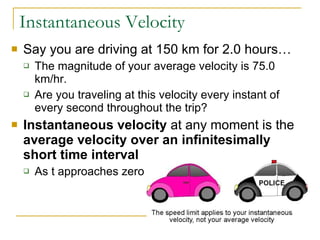
Instantaneous Velocity Say you are driving at 150 km for 2.0 hours…  The magnitude of your average velocity is 75.0 km/hr.  Are you traveling at this velocity every instant of every second throughout the trip? Instantaneous velocity  at any moment is the  average velocity over an infinitesimally short time interval As t approaches zero
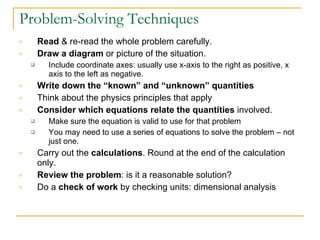
Problem-Solving Techniques Read  & re-read the whole problem carefully. Draw a diagram  or picture of the situation. Include coordinate axes: usually use x-axis to the right as positive, x axis to the left as negative.  Write down the “known” and “unknown” quantities Think about the physics principles that apply Consider which equations relate the quantities  involved.  Make sure the equation is valid to use for that problem You may need to use a series of equations to solve the problem – not just one.  Carry out the  calculations . Round at the end of the calculation only.  Review the problem : is it a reasonable solution?  Do a  check of work  by checking units: dimensional analysis
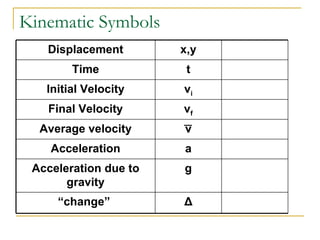
Kinematic Symbols Displacement x,y Time t Initial Velocity v i Final Velocity v f Average velocity v Acceleration a Acceleration due to gravity g “ change”  Δ
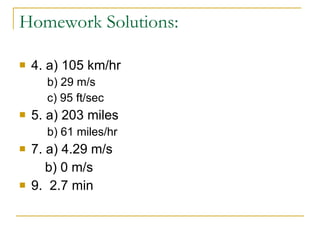
Homework Solutions: 4. a) 105 km/hr b) 29 m/s c) 95 ft/sec 5. a) 203 miles b) 61 miles/hr 7. a) 4.29 m/s b) 0 m/s 9.  2.7 min
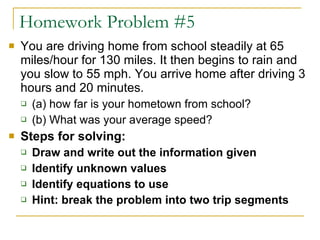
Homework Problem #5 You are driving home from school steadily at 65 miles/hour for 130 miles. It then begins to rain and you slow to 55 mph. You arrive home after driving 3 hours and 20 minutes. (a) how far is your hometown from school?  (b) What was your average speed? Steps for solving: Draw and write out the information given Identify unknown values Identify equations to use Hint: break the problem into two trip segments
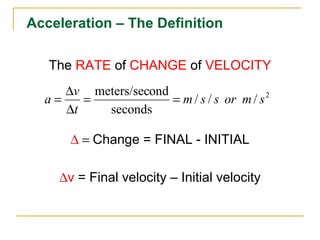
The  RATE  of  CHANGE  of  VELOCITY   Change = FINAL - INITIAL  v  = Final velocity – Initial velocity Acceleration – The Definition
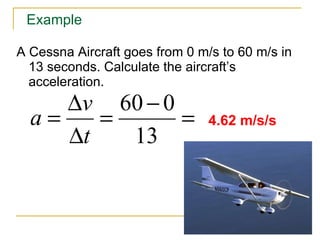
A Cessna Aircraft goes from 0 m/s to 60 m/s in 13 seconds. Calculate the aircraft ’s acceleration. 4.62 m/s/s Example
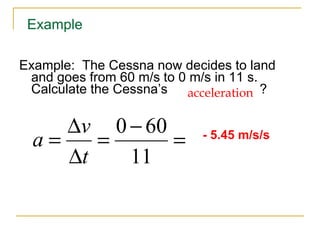
Example:  The Cessna now decides to land and goes from 60 m/s to 0 m/s in 11 s. Calculate the Cessna ’s  ? acceleration - 5.45 m/s/s Example
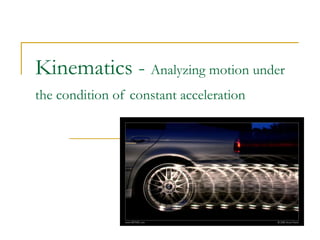
Kinematics -  Analyzing motion under the condition of constant acceleration

Honors methods of motion-day 7-per4

  • 1.
    Honors Physics GoodMorning! Please… Take out your homework to be checked Write down the objectives for today. Work on the warm-up problem: What is a vector quantity? What is a scalar quantity? Provide one example of each.
  • 2.
    Housekeeping… Unit 1measurement test is Friday See me today after school if you need help Homework solutions posted online Vocab binders will be checked that period Website has full vocab list of words that will be checked on Friday Bring your calculators for test! Quizzes Folders have FLM worksheets in them – check it
  • 3.
    Test information forFriday Measurement Accuracy (no calculations of relative error) Precision (no calculations of standard deviation) Significant figures Unit prefixes, abbreviations, and their values (know giga through nano) See table 1-4 (pg. 11) for full metric prefixes Scientific notation Factor label method
  • 4.
    The bottom line….Motion is RELATIVE It depends completely on how you want to look at the moving object. You establish a frame of reference! Frame of reference can be thought of as your point of view. We usually use the earth’s surface as our frame of reference. Example: You are sitting in an airplane which is moving at a speed of 100 km/h and there is a fly sitting on your head. What is your speed relative to the ground? What is your speed relative to the seat you're sitting in? What is the speed of the fly relative to you? 100 km/hr 0 km/hr 0 km/hr
  • 5.
    One Dimensional MotionMechanics : the study of the motion of objects under the reference of force and energy Two parts: Kinematics : the description of how objects move Dynamics : how forces cause motion
  • 6.
    Displacement Displacement (xor y)   "Change in position" It is not necessarily the total distance traveled . In fact, displacement and distance are entirely different concepts. Displacement is relative to an axis. "x" displacement means you are moving horizontally either right or left . "y" displacement means you are moving vertically either up or down . The word change is expressed using the Greek letter DELTA ( Δ ) . To find the change you ALWAYS subtract your FINAL - INITIAL position It is therefore expressed as either   Δx = x f - x i o r Δy = y f – y i Displacement is a vector quantity: It has both magnitude and direction (north, south, east, west, positive, negative, right, left, up, down, at an angle, etc.) Distance - How far you travel regardless of direction. Distance is a scalar quantity: it only has magnitude .
  • 7.
    Example Suppose aperson moves in a straight line from the lockers( at a position  x = 1.0 m) toward the physics lab(at a position x = 9.0 m) , as shown below The answer is positive so the person must have been traveling horizontally to the right.
  • 8.
    Example Suppose theperson turns around and goes back to their locker! The answer is negative so the person must have been traveling horizontally to the left What is the DISPLACEMENT for the entire trip? What is the total DISTANCE for the entire trip?
  • 9.
    Average Velocity Velocity is defined as: “The RATE at which DISPLACEMENT changes ”. Rate = ANY quantity divided by TIME . Average SPEED is simply the “RATE at which DISTANCE changes”. Start your equation sheets now!!!!
  • 10.
    Example A quarterbackthrows a pass to a defender on the other team who intercepts the football. Assume the defender had to run 50 m away from the quarterback to catch the ball, then 15 m towards the quarterback before he is tackled. The entire play took 8 seconds. Let's look at the defender's average velocity: Let's look at the defender's speed: “ m/s ” is the derived unit for both speed and velocity.
  • 11.
    Slope – Abasic graph model A basic model for understanding graphs in physics is SLOPE . Using the model - Look at the formula for velocity. Who gets to play the role of the slope? Who gets to play the role of the y-axis or the rise? Who get to play the role of the x-axis or the run?  What does all the mean? It means that if your are given a Displacement vs. Time graph, to find the velocity of an object during specific time intervals simply find the slope. Velocity Displacement Time
  • 12.
    Displacement vs. Timegraph What is the velocity of the object from 0 seconds to 3 seconds? The velocity is the slope!
  • 13.
    Displacement vs. Timegraph What is the velocity of the object from 7 seconds to 8 seconds?  Once again...find the slope! A velocity of 0 m/s. What does this mean? It is simple....the object has simply stopped moving for 1 second.
  • 14.
    Displacement vs. Timegraph What is the velocity from 8-10 seconds? You must remember! To find the change it is final - initial. The answer is negative! It is no surprise, because the slope is considered to be negative. This value could mean several things: The object could be traveling WEST or SOUTH. The object is going backwards - this being the more likely choice! You should also understand that the slope does NOT change from 0-3s , 5 - 7s and 8- 10s. This means that the object has a CONSTANT VELOCITY or IT IS NOT ACCELERATING.
  • 15.
    Example It isvery important that you are able to look at a graph and explain it's motion in great detail. These graphs can be very conceptual. Look at the time interval t = 0 to t = 9 seconds. What does the slope do? It increases, the velocity is increasing Look at the time interval t = 9 to t = 11 seconds. What does the slope do? No slope. The velocity is ZERO. Look at the time interval t = 11 to t = 15 seconds. What does the slope do? The slope is constant and positive. The object is moving forwards at a constant velocity. Look at the time interval t = 15 to t = 17 seconds. What does the slope do? The slope is constant and negative. The object is moving backwards at a constant velocity.
  • 16.
    Instantaneous Velocity Sayyou are driving at 150 km for 2.0 hours… The magnitude of your average velocity is 75.0 km/hr. Are you traveling at this velocity every instant of every second throughout the trip? Instantaneous velocity at any moment is the average velocity over an infinitesimally short time interval As t approaches zero
  • 17.
    Problem-Solving Techniques Read & re-read the whole problem carefully. Draw a diagram or picture of the situation. Include coordinate axes: usually use x-axis to the right as positive, x axis to the left as negative. Write down the “known” and “unknown” quantities Think about the physics principles that apply Consider which equations relate the quantities involved. Make sure the equation is valid to use for that problem You may need to use a series of equations to solve the problem – not just one. Carry out the calculations . Round at the end of the calculation only. Review the problem : is it a reasonable solution? Do a check of work by checking units: dimensional analysis
  • 18.
    Kinematic Symbols Displacementx,y Time t Initial Velocity v i Final Velocity v f Average velocity v Acceleration a Acceleration due to gravity g “ change” Δ
  • 19.
    Homework Solutions: 4.a) 105 km/hr b) 29 m/s c) 95 ft/sec 5. a) 203 miles b) 61 miles/hr 7. a) 4.29 m/s b) 0 m/s 9. 2.7 min
  • 20.
    Homework Problem #5You are driving home from school steadily at 65 miles/hour for 130 miles. It then begins to rain and you slow to 55 mph. You arrive home after driving 3 hours and 20 minutes. (a) how far is your hometown from school? (b) What was your average speed? Steps for solving: Draw and write out the information given Identify unknown values Identify equations to use Hint: break the problem into two trip segments
  • 21.
    The RATE of CHANGE of VELOCITY   Change = FINAL - INITIAL  v = Final velocity – Initial velocity Acceleration – The Definition
  • 22.
    A Cessna Aircraftgoes from 0 m/s to 60 m/s in 13 seconds. Calculate the aircraft ’s acceleration. 4.62 m/s/s Example
  • 23.
    Example: TheCessna now decides to land and goes from 60 m/s to 0 m/s in 11 s. Calculate the Cessna ’s ? acceleration - 5.45 m/s/s Example
  • 24.
    Kinematics - Analyzing motion under the condition of constant acceleration