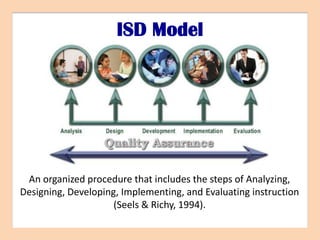
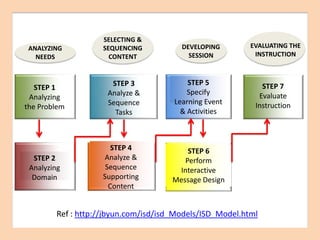
The ISD model is a 5-step instructional design process that includes analyzing, designing, developing, implementing, and evaluating instruction. It provides an organized procedure for developing instructional materials and activities.
ISD Model
Anorganized procedure that includes the steps of Analyzing,
Designing, Developing, Implementing, and Evaluating instruction
(Seels & Richy, 1994).
Rapid prototyping inFireworks
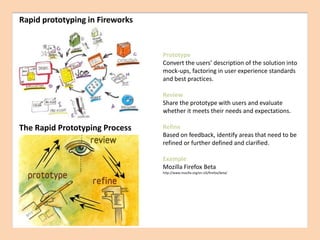
Prototype
Convert the users’ description of the solution into
mock-ups, factoring in user experience standards
and best practices.
Review
Share the prototype with users and evaluate
whether it meets their needs and expectations.
The Rapid Prototyping Process Refine
Based on feedback, identify areas that need to be
refined or further defined and clarified.
Example
Mozilla Firefox Beta
http://www.mozilla.org/en-US/firefox/beta/
4.
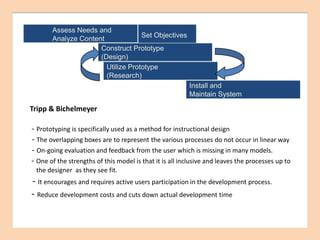
Assess Needs and
Analyze Content Set Objectives
Construct Prototype
(Design)
Utilize Prototype
(Research)
Install and
Maintain System
Tripp & Bichelmeyer
- Prototyping is specifically used as a method for instructional design
- The overlapping boxes are to represent the various processes do not occur in linear way
- On-going evaluation and feedback from the user which is missing in many models.
- One of the strengths of this model is that it is all inclusive and leaves the processes up to
the designer as they see fit.
- It encourages and requires active users participation in the development process.
- Reduce development costs and cuts down actual development time
5.
Leshin, Pollock, andReigeluth
(1992)
Instructional Design
Strategies and tactics for improving
learning and performance
Bergman & Moore
Itis applicable for technology, especially new
technologies, that are interactive, in addition to multi-
media and video, and focuses on guiding and managing
the products. The end result of instruction using this
model is a student-created multimedia product.
8.
Bergman and Mooreincluded six steps in their model:
analysis, design, develop, produce, author, and validate
1
2
3
4
5
6
9.
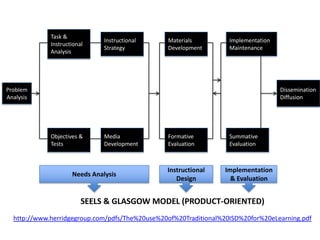
Task &
Instructional Materials Implementation
Instructional
Strategy Development Maintenance
Analysis
Problem Dissemination
Analysis Diffusion
Objectives & Media Formative Summative
Tests Development Evaluation Evaluation
Instructional Implementation
Needs Analysis
Design & Evaluation
SEELS & GLASGOW MODEL (PRODUCT-ORIENTED)
http://www.herridgegroup.com/pdfs/The%20use%20of%20Traditional%20ISD%20for%20eLearning.pdf
10.
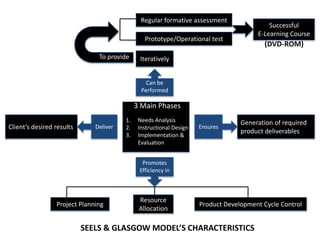
Regular formative assessment
Successful
E-Learning Course
Prototype/Operational test
(DVD-ROM)
To provide Iteratively
Can be
Performed
3 Main Phases
1. Needs Analysis Generation of required
Client’s desired results Deliver 2. Instructional Design Ensures
product deliverables
3. Implementation &
Evaluation
Promotes
Efficiency in
Resource
Project Planning Product Development Cycle Control
Allocation
SEELS & GLASGOW MODEL’S CHARACTERISTICS
11.
References :
• http://www.smashingmagazine.com/2010/06/16/design-better-faster-
with-rapid-prototyping/
• http://www.adobe.com/devnet/fireworks/articles/rapid_prototyping.html
• http://www.slideshare.net/rainbowprototype/rapid-prototypingrapid-
prototypesla-prototype
• http://web2.uwindsor.ca/courses/edfac/morton/instructional_design.htm
• http://uwf.edu/ddawson/d3net/research/rapid_prototype.htm
• Comparison of Alternative Instructional Design Models David Norman