Tutorial 2
Topic 2 : Instructional design
ADDIE model and ASSURE model
Prepared by
Izzati Masturah Madini
Shaliza Abdul Said
Wan Nor Hazwani Hazirah
Instructional Design
 Maximise the effectiveness, efficiency and appeal of
instruction and other learning experiences.
 The process consists of determining the current state and
needs of the learner, defining the end goal of instruction, and
creating some "intervention" to assist in the transition.
 Instructional design, also known as instructional systems design, is
the analysis of learning needs and systematic development of
instruction. Instructional designers often use Instructional technology
as a method for developing instruction.
 Instructional design models typically specify a method, that if followed
will facilitate the transfer of knowledge, skills and attitude to the
recipient or acquirer of the instruction."
ADDIE Model
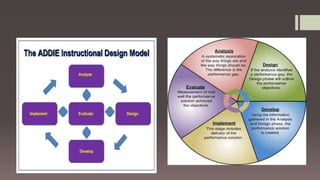
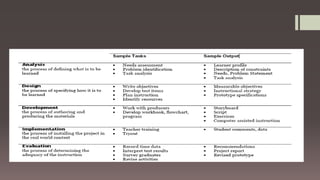
 The ADDIE model is used by instructional designers
and training developers. It is composed of five phases
 Analysis,
 Design,
 Development,
 Implementation, and
 Evaluation
 Which represent a dynamic, flexible guideline for
building effective training and performance support
tools. This model attempts to save time and money by
catching problems while they are still easy to fix.
ADDIE Model
ADDIE Model :
A = Analysis
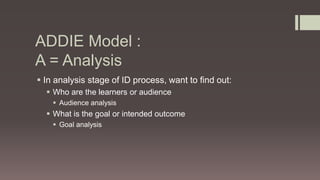
 In analysis stage of ID process, want to find out:
 Who are the learners or audience
 Audience analysis
 What is the goal or intended outcome
 Goal analysis
ADDIE Model :
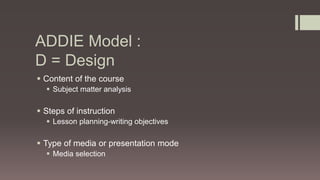
D = Design
 Content of the course
 Subject matter analysis
 Steps of instruction
 Lesson planning-writing objectives
 Type of media or presentation mode
 Media selection
ADDIE Model :
D = Development
 Development of instruction
 Generate lesson plans (different from lesson planning) and
lesson materials.
 Complete all media & materials for instruction, and supporting
documents.
 End result is a course or workshop ready for delivery.
ADDIE Model :
I = Implementation
 The delivery of the instruction.
 Purpose is effective & efficient delivery of instruction.
 Promote students’ understanding of material & objectives, and
ensure transfer of knowledge.
ADDIE Model :
E = Evaluation
 Two related evaluations going on simultaneously in most ID
situations.
 Formative Evaluation
 Summative Evaluation
ADDIE Model
The elusive origins of the ADDIE
Model
Remarkably it appears that the ADDIE model
wasn’t specifically developed by any single
author but rather to have evolved informally
through oral tradition.
The ADDIE Model is merely a colloquial term
used to describe a systematic approach to
instructional development.
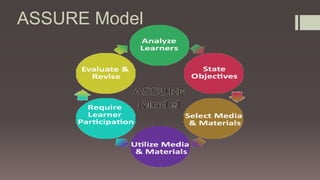
ASSURE Model
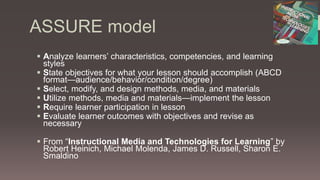
ASSURE model
 Analyze learners’ characteristics, competencies, and learning
styles
 State objectives for what your lesson should accomplish (ABCD
format—audience/behavior/condition/degree)
 Select, modify, and design methods, media, and materials
 Utilize methods, media and materials—implement the lesson
 Require learner participation in lesson
 Evaluate learner outcomes with objectives and revise as
necessary
 From “Instructional Media and Technologies for Learning” by
Robert Heinich, Michael Molenda, James D. Russell, Sharon E.
Smaldino
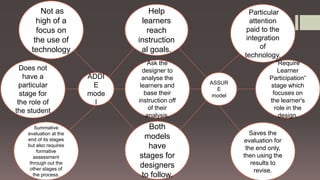
Help
learners
reach
instruction
al goals.
Ask the
designer to
analyse the
learners and
base their
instruction off
of their
analysis.
Both
models
have
stages for
designers
to follow.
Not as
high of a
focus on
the use of
technology
Does not
have a
particular
stage for
the role of
the student
Summative
evaluation at the
end of its stages
but also requires
formative
assessment
through out the
other stages of
the process.
Particular
attention
paid to the
integration
of
technology.
"Require
Learner
Participation“
stage which
focuses on
the learner's
role in the
design.
Saves the
evaluation for
the end only,
then using the
results to
revise.
ADDI
E
mode
l
ASSUR
E
model
How to connect the mentioned models
in the 21st century learning
 In the 21st century, Information and Communication Technology (ICT) is providing us
with new ways to access and process knowledge in every field. ICT is also transforming
pedagogy by providing new ways to engage learners.
 In ASSURE Model, we can utilize media and materials as it gives particular attention to
the integration of technology. For example, the flipped classroom, blended learning, lab
rotation model and station rotation model.
 It also focused on the learners (student-centred learning) which has the "Require
Learner Participation“ stage. Teachers will act as facilitators and guide the students
when needed. A lesson plan should include a description for how you will require your
learners to know, comprehend, apply, analyse, synthesize, and evaluate the information
included in the lesson. It is critical that your description states how you plan to get each
learner actively and individually involved in the learning process. The goal here is for
active learning to occur!
In ADDIE model, there are formative and summative evaluation
which can be used in the 21st century learning.
Formative – test/questionnaire/quizzes/
Summative – at the end of semester

EDUP3053 ADDIE VS ASSURE models

  • 1.
    Tutorial 2 Topic 2: Instructional design ADDIE model and ASSURE model Prepared by Izzati Masturah Madini Shaliza Abdul Said Wan Nor Hazwani Hazirah
  • 2.
    Instructional Design  Maximisethe effectiveness, efficiency and appeal of instruction and other learning experiences.  The process consists of determining the current state and needs of the learner, defining the end goal of instruction, and creating some "intervention" to assist in the transition.
  • 3.
     Instructional design,also known as instructional systems design, is the analysis of learning needs and systematic development of instruction. Instructional designers often use Instructional technology as a method for developing instruction.  Instructional design models typically specify a method, that if followed will facilitate the transfer of knowledge, skills and attitude to the recipient or acquirer of the instruction."
  • 4.
    ADDIE Model  TheADDIE model is used by instructional designers and training developers. It is composed of five phases  Analysis,  Design,  Development,  Implementation, and  Evaluation  Which represent a dynamic, flexible guideline for building effective training and performance support tools. This model attempts to save time and money by catching problems while they are still easy to fix.
  • 5.
  • 6.
    ADDIE Model : A= Analysis  In analysis stage of ID process, want to find out:  Who are the learners or audience  Audience analysis  What is the goal or intended outcome  Goal analysis
  • 7.
    ADDIE Model : D= Design  Content of the course  Subject matter analysis  Steps of instruction  Lesson planning-writing objectives  Type of media or presentation mode  Media selection
  • 8.
    ADDIE Model : D= Development  Development of instruction  Generate lesson plans (different from lesson planning) and lesson materials.  Complete all media & materials for instruction, and supporting documents.  End result is a course or workshop ready for delivery.
  • 9.
    ADDIE Model : I= Implementation  The delivery of the instruction.  Purpose is effective & efficient delivery of instruction.  Promote students’ understanding of material & objectives, and ensure transfer of knowledge.
  • 10.
    ADDIE Model : E= Evaluation  Two related evaluations going on simultaneously in most ID situations.  Formative Evaluation  Summative Evaluation
  • 11.
  • 12.
    The elusive originsof the ADDIE Model Remarkably it appears that the ADDIE model wasn’t specifically developed by any single author but rather to have evolved informally through oral tradition. The ADDIE Model is merely a colloquial term used to describe a systematic approach to instructional development.
  • 13.
  • 14.
    ASSURE model  Analyzelearners’ characteristics, competencies, and learning styles  State objectives for what your lesson should accomplish (ABCD format—audience/behavior/condition/degree)  Select, modify, and design methods, media, and materials  Utilize methods, media and materials—implement the lesson  Require learner participation in lesson  Evaluate learner outcomes with objectives and revise as necessary  From “Instructional Media and Technologies for Learning” by Robert Heinich, Michael Molenda, James D. Russell, Sharon E. Smaldino
  • 15.
    Help learners reach instruction al goals. Ask the designerto analyse the learners and base their instruction off of their analysis. Both models have stages for designers to follow. Not as high of a focus on the use of technology Does not have a particular stage for the role of the student Summative evaluation at the end of its stages but also requires formative assessment through out the other stages of the process. Particular attention paid to the integration of technology. "Require Learner Participation“ stage which focuses on the learner's role in the design. Saves the evaluation for the end only, then using the results to revise. ADDI E mode l ASSUR E model
  • 16.
    How to connectthe mentioned models in the 21st century learning  In the 21st century, Information and Communication Technology (ICT) is providing us with new ways to access and process knowledge in every field. ICT is also transforming pedagogy by providing new ways to engage learners.  In ASSURE Model, we can utilize media and materials as it gives particular attention to the integration of technology. For example, the flipped classroom, blended learning, lab rotation model and station rotation model.  It also focused on the learners (student-centred learning) which has the "Require Learner Participation“ stage. Teachers will act as facilitators and guide the students when needed. A lesson plan should include a description for how you will require your learners to know, comprehend, apply, analyse, synthesize, and evaluate the information included in the lesson. It is critical that your description states how you plan to get each learner actively and individually involved in the learning process. The goal here is for active learning to occur!
  • 17.
    In ADDIE model,there are formative and summative evaluation which can be used in the 21st century learning. Formative – test/questionnaire/quizzes/ Summative – at the end of semester