SPECIFIC HEAT
CAPACITY, c
HEAT | PHYSICS FORM 4
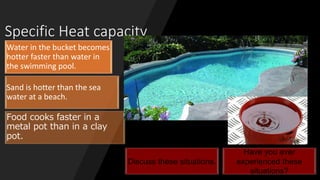
Specific Heat capacity
Water in the bucket becomes
hotter faster than water in
the swimming pool.
Sand is hotter than the sea
water at a beach.
Food cooks faster in a
metal pot than in a clay
pot.
Discuss these situations.
Have you ever
experienced these
situations?
Heat
capacity,
C
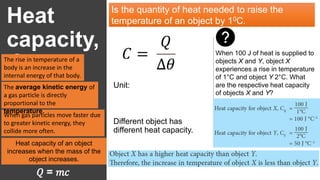
Is the quantity of heat needed to raise the
temperature of an object by 10C.
When 100 J of heat is supplied to
objects X and Y, object X
experiences a rise in temperature
of 1°C and object Y 2°C. What
are the respective heat capacity
of objects X and Y?
Unit:
Different object has
different heat capacity.
𝐶 =
𝑄
Δ𝜃
When gas particles move faster due
to greater kinetic energy, they
collide more often.
𝑄 = 𝑚𝑐
The rise in temperature of a
body is an increase in the
internal energy of that body.
The average kinetic energy of
a gas particle is directly
proportional to the
temperature.
Heat capacity of an object
increases when the mass of the
object increases.
A material engineer tries to choose a
suitable metal as building material. He
needs a material that does not heat
up easily. Since the heat capacity of a
material differs with its mass, he
needs to make his choice based on
specific heat capacity instead –
which means he has to choose the
material based on the heat capacity of
every 1 kg of each material.
Specific
heat
capacity,
c
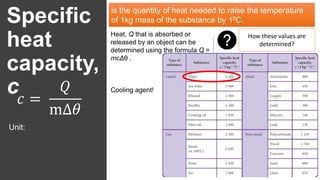
is the quantity of heat needed to raise the temperature
of 1kg mass of the substance by 10C.
Heat, Q that is absorbed or
released by an object can be
determined using the formula Q =
mcΔθ .
Cooling agent!
Unit:
𝑐 =
𝑄
mΔ𝜃
How these values are
determined?
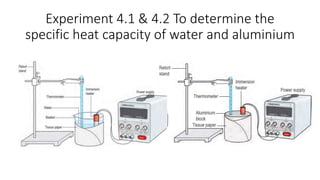
Experiment 4.1 & 4.2 To determine the
specific heat capacity of water and aluminium
Activity 4.4 Gallery Walk and Round Table
Aim: To search for information on applications of specific heat capacity
Instructions:
1. Gallery walk: gather information on applications of specific heat capacity related to:
(a) Daily life
(b) Material engineering
(c) Natural phenomena
2. Carry out a Round Table activity.
3. One group member writes the information on a piece of paper. The paper is then
passed clockwise so other group members can add their information.
5. Present your group findings in your class.
7
minutes!
(Watch
video/read):
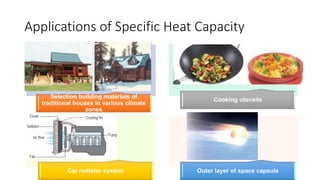
Applications of Specific Heat Capacity
Selection building materials of
traditional houses in various climate
zones
Cooking utensils
Car radiator system Outer layer of space capsule
Applications of Specific Heat Capacity
Production of latest materials in the
construction of green buildings
Cooking utensils
Sea Breeze Land Breeze
Examples of problems No. 1
A 0.5 kg metal block is heated by a 50 W electric heater for 90 s. The
temperature of the block rises from 20°C to 45°C. Calculate the specific
heat capacity of the metal.
Examples of problems No. 2
20 g of boiling water at 100°C is poured into a glass containing 200 g of water at 28°C.
Calculate the final temperature of the mixture of water.
Let y = final temperature of mixture
For boiling water:
Mass, m1 = 20 g = 0.02 kg
Temperature change, Δθ1 = (100 –
y)°C
For water at 28°C:
Mass, m2 = 200 g = 0.20 kg
Temperature change, Δθ2 = (y – 28)°C
water, c = 4 200 J kg–1 °C–1
Q1 = Q2
m1cΔθ1 = m2cΔθ2
0.02 (4 200)(100 – y) = 0.20 (4 200)(y
– 28)
8 400 – 84y = 840y – 23 520
924y = 31 920
y = 34.55°C
Therefore, the final temperature of the
Aim: To build a model of a cluster home which can
overcome the problem of extreme temperatures
1. Work in groups.
2. Read and understand the following information.
3. Based on the above information, analyse the situation by listing the facts and problems
related to the condition of extreme temperature in cluster homes.
4. Brainstorm several solutions to the problems. Sketch a model based on your solutions.
Project Based
Learning (PBL)
5. Build the model based on the sketch.
6. Display and present the model.
Quiz 1. What is the difference between heat capacity
and specific heat capacity?
2. How much heat energy is needed to increase
the temperature of a 0.2 kg mass of gold
by 10°C?
[Given the value of specific heat capacity of
gold is 300 J kg–1 °C–1]

2 specific heat cap

  • 1.
  • 2.
    Specific Heat capacity Waterin the bucket becomes hotter faster than water in the swimming pool. Sand is hotter than the sea water at a beach. Food cooks faster in a metal pot than in a clay pot. Discuss these situations. Have you ever experienced these situations?
  • 3.
    Heat capacity, C Is the quantityof heat needed to raise the temperature of an object by 10C. When 100 J of heat is supplied to objects X and Y, object X experiences a rise in temperature of 1°C and object Y 2°C. What are the respective heat capacity of objects X and Y? Unit: Different object has different heat capacity. 𝐶 = 𝑄 Δ𝜃 When gas particles move faster due to greater kinetic energy, they collide more often. 𝑄 = 𝑚𝑐 The rise in temperature of a body is an increase in the internal energy of that body. The average kinetic energy of a gas particle is directly proportional to the temperature. Heat capacity of an object increases when the mass of the object increases.
  • 5.
    A material engineertries to choose a suitable metal as building material. He needs a material that does not heat up easily. Since the heat capacity of a material differs with its mass, he needs to make his choice based on specific heat capacity instead – which means he has to choose the material based on the heat capacity of every 1 kg of each material.
  • 6.
    Specific heat capacity, c is the quantityof heat needed to raise the temperature of 1kg mass of the substance by 10C. Heat, Q that is absorbed or released by an object can be determined using the formula Q = mcΔθ . Cooling agent! Unit: 𝑐 = 𝑄 mΔ𝜃 How these values are determined?
  • 7.
    Experiment 4.1 &4.2 To determine the specific heat capacity of water and aluminium
  • 9.
    Activity 4.4 GalleryWalk and Round Table Aim: To search for information on applications of specific heat capacity Instructions: 1. Gallery walk: gather information on applications of specific heat capacity related to: (a) Daily life (b) Material engineering (c) Natural phenomena 2. Carry out a Round Table activity. 3. One group member writes the information on a piece of paper. The paper is then passed clockwise so other group members can add their information. 5. Present your group findings in your class. 7 minutes! (Watch video/read):
  • 10.
    Applications of SpecificHeat Capacity Selection building materials of traditional houses in various climate zones Cooking utensils Car radiator system Outer layer of space capsule
  • 11.
    Applications of SpecificHeat Capacity Production of latest materials in the construction of green buildings Cooking utensils Sea Breeze Land Breeze
  • 12.
    Examples of problemsNo. 1 A 0.5 kg metal block is heated by a 50 W electric heater for 90 s. The temperature of the block rises from 20°C to 45°C. Calculate the specific heat capacity of the metal.
  • 13.
    Examples of problemsNo. 2 20 g of boiling water at 100°C is poured into a glass containing 200 g of water at 28°C. Calculate the final temperature of the mixture of water. Let y = final temperature of mixture For boiling water: Mass, m1 = 20 g = 0.02 kg Temperature change, Δθ1 = (100 – y)°C For water at 28°C: Mass, m2 = 200 g = 0.20 kg Temperature change, Δθ2 = (y – 28)°C water, c = 4 200 J kg–1 °C–1 Q1 = Q2 m1cΔθ1 = m2cΔθ2 0.02 (4 200)(100 – y) = 0.20 (4 200)(y – 28) 8 400 – 84y = 840y – 23 520 924y = 31 920 y = 34.55°C Therefore, the final temperature of the
  • 14.
    Aim: To builda model of a cluster home which can overcome the problem of extreme temperatures 1. Work in groups. 2. Read and understand the following information. 3. Based on the above information, analyse the situation by listing the facts and problems related to the condition of extreme temperature in cluster homes. 4. Brainstorm several solutions to the problems. Sketch a model based on your solutions. Project Based Learning (PBL) 5. Build the model based on the sketch. 6. Display and present the model.
  • 16.
    Quiz 1. Whatis the difference between heat capacity and specific heat capacity? 2. How much heat energy is needed to increase the temperature of a 0.2 kg mass of gold by 10°C? [Given the value of specific heat capacity of gold is 300 J kg–1 °C–1]

Editor's Notes

  • #3 sand gets hot quickly and sea water gets hot slowly. Th is can be explained based on the concept of heat capacity. Diff erent objects have diff erent heat capacity. Sand has a low heat capacity and gets hot quickly while sea water has a high heat capacity and gets hot slowly.
  • #11 Wood has a high specific heat capacity and gets hot slowly. In warm weather regions, traditional houses are built from wood which functions as an insulator of heat from the scorching sun. In cold weather regions, traditional houses are also built from wood. Heat from fi res lit in the wooden houses cannot flow out because wood functions as a good heat insulator. Woks are made of metal with low specific heat capacity. As such, food can be fried at high temperature in a short time. Clay pots on the other hand are made of clay which has a high specific heat capacity. As such, food can stay hot for a long time. Burning of fuel in car engines produces large amounts of heat. Th is heat needs to be released to avoid overheating the engine. Water has a high specific heat capacity and is used as a cooling agent. A pump will pump water into the engine block. Water will flow through the engine block to absorb heat produced. Hot water flows to the radiator. Cold air is sucked in by fans so that heat in the hot water can be released quickly through cooling fins. Space capsule on its journey back to Earth encounters air resistance when entering the atmosphere. Th is friction increases the temperature and causes the space capsule to burn. Therefore, the outer layer of a space capsule is made from substance with a high specific heat capacity and melting point.
  • #12 The Diamond Building, Energy Commission is built with an insulating concrete roof, that is a roof fitted with insulators using Styrofoam boards. Styrofoam has a high specific heat capacity and can reduce the absorption of heat from the surroundings to reduce the temperature inside the building. Th e body of a pot is made of aluminium which has a low specific heat capacity. Th is enables the pot to heat up quickly. However, the handle of the pot is made from plastic which has a high specific heat capacity. Th is ensures that the handle of the pot gets hot slowly and is safe to handle. Land has a lower specific heat capacity than the sea. Therefore, temperature on land rises more quickly than temperature in the sea during daytime. Th e air on land becomes hot and rises upwards. Cold air from the sea moves towards land as sea breeze. Sea has a higher specifi c heat capacity than land. So, temperature in the sea drops more slowly than temperature on land at night. Hot air above the sea rises upwards. Cold air above the land moves towards the sea as land breeze.
  • #13 Answer 360 J/kg/oC