Heat
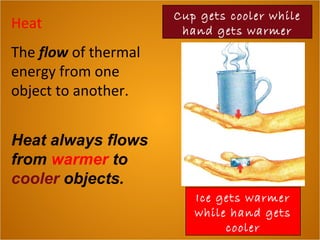
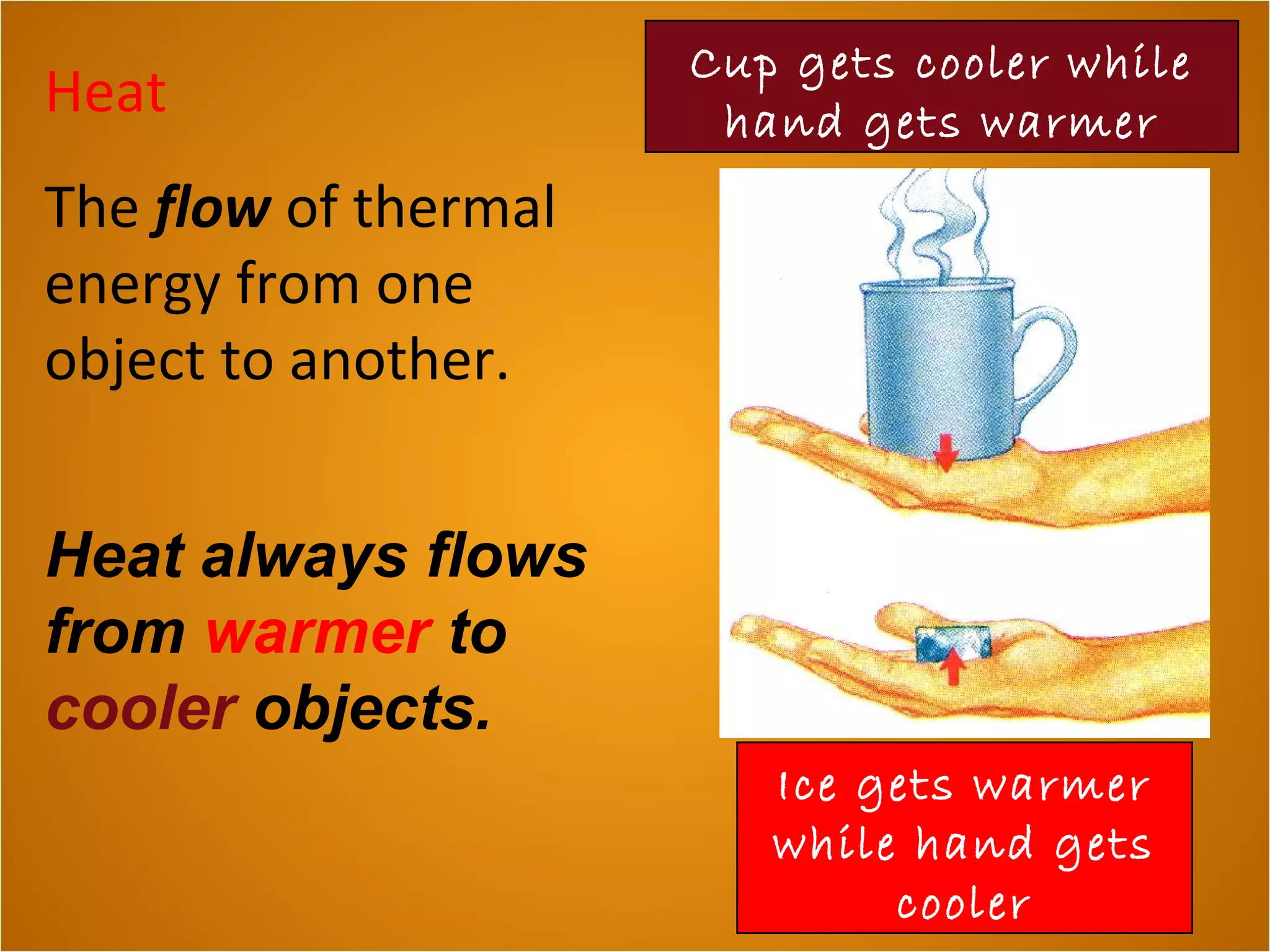
The flow of thermal
energy from one
object to another.
Heat always flows
from warmer to
cooler objects.
Ice gets warmer
while hand gets
cooler
Cup gets cooler while
hand gets warmer
Imagine…Imagine…
A hot day in your back yard is aA hot day in your back yard is a
Piece of SteelPiece of Steel and aand a wood Blockwood Block..
Would you want to stick your hand to theWould you want to stick your hand to the
wood or touch the steel?wood or touch the steel?
SteelSteelSteelSteel WoodWood
You would want to touch the wood becauseYou would want to touch the wood because
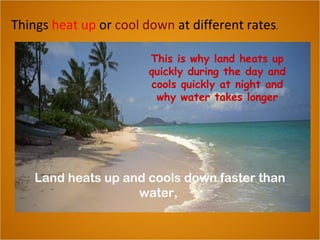
Things heat up or cool down at different rates.
Land heats up and cools down faster than
water,
This is why land heats up
quickly during the day and
cools quickly at night and
why water takes longer
Thermal (heat) capacity
What requires more
energy to heat up by
1o
C?
Different material heat up at different rate
Different material store different
amount of heat energy!!!
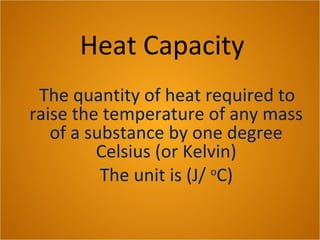
Heat Capacity
The quantity of heat required to
raise the temperature of any mass
of a substance by one degree
Celsius (or Kelvin)
The unit is (J/ o
C)
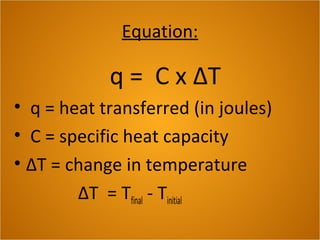
Equation:
q = C x ΔT
• q = heat transferred (in joules)
• C = specific heat capacity
• ΔT = change in temperature
ΔT = Tfinal - Tinitial
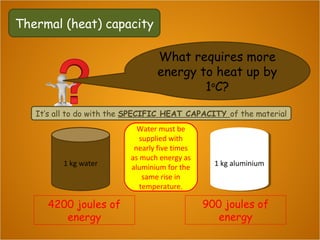
Thermal (heat) capacity
What requires more
energy to heat up by
1o
C?
1 kg water 1 kg aluminium1 kg aluminium
4200 joules of
energy
900 joules of
energy
Water must be
supplied with
nearly five times
as much energy as
aluminium for the
same rise in
temperature.
It’s all to do with the SPECIFIC HEAT CAPACITY of the material
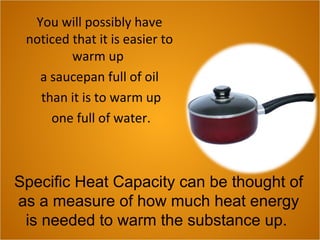
You will possibly have
noticed that it is easier to
warm up
a saucepan full of oil
than it is to warm up
one full of water.
Specific Heat Capacity can be thought of
as a measure of how much heat energy
is needed to warm the substance up.
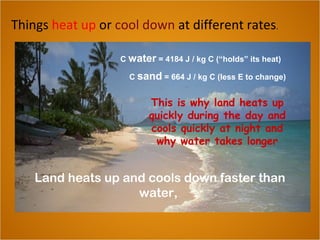
Things heat up or cool down at different rates.
Land heats up and cools down faster than
water,
C water = 4184 J / kg C (“holds” its heat)
C sand = 664 J / kg C (less E to change)
This is why land heats up
quickly during the day and
cools quickly at night and
why water takes longer
Specific Heat Capacity
The quantity of heat required to
raise the temperature of 1 kilo
gram of a substance by one
degree Celsius (or Kelvin)
The unit is (J/kg o
C)
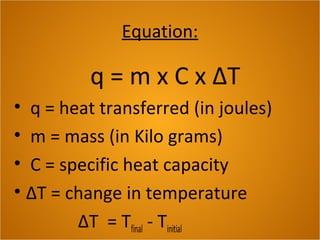
Equation:
q = m x C x ΔT
• q = heat transferred (in joules)
• m = mass (in Kilo grams)
• C = specific heat capacity
• ΔT = change in temperature
ΔT = Tfinal - Tinitial
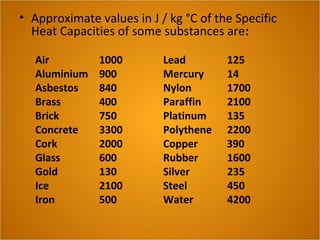
• The next table shows how much energy it
takes to heat up some different substances.
• The small values show that not a lot ofThe small values show that not a lot of
energy is needed to produce aenergy is needed to produce a
temperature change, whereas the largetemperature change, whereas the large
values indicate a lot more energy isvalues indicate a lot more energy is
needed.needed.
• Approximate values in J / kg °C of the Specific
Heat Capacities of some substances are:
Air 1000 Lead 125
Aluminium 900 Mercury 14
Asbestos 840 Nylon 1700
Brass 400 Paraffin 2100
Brick 750 Platinum 135
Concrete 3300 Polythene 2200
Cork 2000 Copper 390
Glass 600 Rubber 1600
Gold 130 Silver 235
Ice 2100 Steel 450
Iron 500 Water 4200
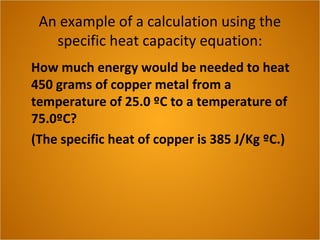
An example of a calculation using the
specific heat capacity equation:
How much energy would be needed to heat
450 grams of copper metal from a
temperature of 25.0 ºC to a temperature of
75.0ºC?
(The specific heat of copper is 385 J/Kg ºC.)
Heat Capacity Specific heat-capacity (1)

Heat Capacity Specific heat-capacity (1)

  • 1.
    Heat The flow ofthermal energy from one object to another. Heat always flows from warmer to cooler objects. Ice gets warmer while hand gets cooler Cup gets cooler while hand gets warmer
  • 2.
    Imagine…Imagine… A hot dayin your back yard is aA hot day in your back yard is a Piece of SteelPiece of Steel and aand a wood Blockwood Block.. Would you want to stick your hand to theWould you want to stick your hand to the wood or touch the steel?wood or touch the steel? SteelSteelSteelSteel WoodWood You would want to touch the wood becauseYou would want to touch the wood because
  • 3.
    Things heat upor cool down at different rates. Land heats up and cools down faster than water, This is why land heats up quickly during the day and cools quickly at night and why water takes longer
  • 4.
    Thermal (heat) capacity Whatrequires more energy to heat up by 1o C? Different material heat up at different rate Different material store different amount of heat energy!!!
  • 5.
    Heat Capacity The quantityof heat required to raise the temperature of any mass of a substance by one degree Celsius (or Kelvin) The unit is (J/ o C)
  • 6.
    Equation: q = Cx ΔT • q = heat transferred (in joules) • C = specific heat capacity • ΔT = change in temperature ΔT = Tfinal - Tinitial
  • 7.
    Thermal (heat) capacity Whatrequires more energy to heat up by 1o C? 1 kg water 1 kg aluminium1 kg aluminium 4200 joules of energy 900 joules of energy Water must be supplied with nearly five times as much energy as aluminium for the same rise in temperature. It’s all to do with the SPECIFIC HEAT CAPACITY of the material
  • 8.
    You will possiblyhave noticed that it is easier to warm up a saucepan full of oil than it is to warm up one full of water. Specific Heat Capacity can be thought of as a measure of how much heat energy is needed to warm the substance up.
  • 9.
    Things heat upor cool down at different rates. Land heats up and cools down faster than water, C water = 4184 J / kg C (“holds” its heat) C sand = 664 J / kg C (less E to change) This is why land heats up quickly during the day and cools quickly at night and why water takes longer
  • 10.
    Specific Heat Capacity Thequantity of heat required to raise the temperature of 1 kilo gram of a substance by one degree Celsius (or Kelvin) The unit is (J/kg o C)
  • 11.
    Equation: q = mx C x ΔT • q = heat transferred (in joules) • m = mass (in Kilo grams) • C = specific heat capacity • ΔT = change in temperature ΔT = Tfinal - Tinitial
  • 12.
    • The nexttable shows how much energy it takes to heat up some different substances. • The small values show that not a lot ofThe small values show that not a lot of energy is needed to produce aenergy is needed to produce a temperature change, whereas the largetemperature change, whereas the large values indicate a lot more energy isvalues indicate a lot more energy is needed.needed.
  • 13.
    • Approximate valuesin J / kg °C of the Specific Heat Capacities of some substances are: Air 1000 Lead 125 Aluminium 900 Mercury 14 Asbestos 840 Nylon 1700 Brass 400 Paraffin 2100 Brick 750 Platinum 135 Concrete 3300 Polythene 2200 Cork 2000 Copper 390 Glass 600 Rubber 1600 Gold 130 Silver 235 Ice 2100 Steel 450 Iron 500 Water 4200
  • 14.
    An example ofa calculation using the specific heat capacity equation: How much energy would be needed to heat 450 grams of copper metal from a temperature of 25.0 ºC to a temperature of 75.0ºC? (The specific heat of copper is 385 J/Kg ºC.)