Heat and Heat Capacity
Dr. K. Shahzad Baig
Memorial University of Newfoundland
(MUN)
Canada
Petrucci, et al. 2011. General Chemistry: Principles and Modern Applications. Pearson Canada Inc., Toronto, Ontario.
Tro, N.J. 2010. Principles of Chemistry. : A molecular approach. Pearson Education, Inc.
Some Terminology
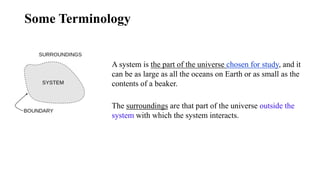
A system is the part of the universe chosen for study, and it
can be as large as all the oceans on Earth or as small as the
contents of a beaker.
The surroundings are that part of the universe outside the
system with which the system interacts.
Energy is the capacity to do work.
Work is done when a force acts through a distance.
The energy of a moving object is called kinetic energy
Potential energy is energy resulting from position, condition, or composition; it is an
energy associated with forces of attraction or repulsion between objects
This kinetic energy associated with random molecular motion is called thermal energy
In general, thermal energy is proportional to the temperature of a system, as suggested
by the kinetic theory of gases.
The more vigorous the motion of the molecules in the system, the hotter the sample and
the greater is its thermal energy.
However, the thermal energy of a system also depends on the number of particles present,
so that a small sample at a high temperature (for example, a cup of coffee at 75 OC) may
have less thermal energy than a larger sample at a lower temperature (for example, a
swimming pool at, temperature 30 °C)
Heat is energy transferred between a system and its surroundings as a result of a
temperature difference.
The quantity of heat required to change the temperature of one gram of water by one
degree Celsius has been called the calorie (cal).
1 cal = 4.184 J
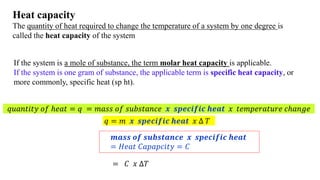
Heat capacity
The quantity of heat required to change the temperature of a system by one degree is
called the heat capacity of the system
If the system is a mole of substance, the term molar heat capacity is applicable.
If the system is one gram of substance, the applicable term is specific heat capacity, or
more commonly, specific heat (sp ht).
𝑞𝑢𝑎𝑛𝑡𝑖𝑡𝑦 𝑜𝑓 ℎ𝑒𝑎𝑡 = 𝑞 = 𝑚𝑎𝑠𝑠 𝑜𝑓 𝑠𝑢𝑏𝑠𝑡𝑎𝑛𝑐𝑒 𝒙 𝒔𝒑𝒆𝒄𝒊𝒇𝒊𝒄 𝒉𝒆𝒂𝒕 𝑥 𝑡𝑒𝑚𝑝𝑒𝑟𝑎𝑡𝑢𝑟𝑒 𝑐ℎ𝑎𝑛𝑔𝑒
𝒎𝒂𝒔𝒔 𝒐𝒇 𝒔𝒖𝒃𝒔𝒕𝒂𝒏𝒄𝒆 𝒙 𝒔𝒑𝒆𝒄𝒊𝒇𝒊𝒄 𝒉𝒆𝒂𝒕
= 𝐻𝑒𝑎𝑡 𝐶𝑎𝑝𝑎𝑝𝑐𝑖𝑡𝑦 = 𝐶
𝑞 = 𝑚 𝒙 𝒔𝒑𝒆𝒄𝒊𝒇𝒊𝒄 𝒉𝒆𝒂𝒕 𝑥 ∆ 𝑇
= 𝐶 𝑥 ∆𝑇
the Specific heat of 𝐶 𝑤𝑎𝑡𝑒𝑟 = 4.18
𝐽
𝑂 𝐶 𝑔 − 𝑤𝑎𝑡𝑒𝑟
a substance's specific heat tells you how much heat is needed in order to increase the
temperature of 1 g of that substance by 1OC.
Now let's say that you wanted to cause a
1∘C increase in a 2-g sample of water
a 1∘C increase in the temperature of
m grams of water,
To increase the temperature of m g of water by [ n OC ], you'd need to supply it with
𝐻𝑒𝑎𝑡 𝑟𝑒𝑞𝑢𝑖𝑟𝑒𝑑 = 𝑚 𝑥 𝑛 𝑥 𝑠𝑝𝑒𝑐𝑖𝑓𝑖𝑐 ℎ𝑒𝑎𝑡
= 𝑚 𝑥 𝑠𝑝𝑒𝑐𝑖𝑓𝑖𝑐 ℎ𝑒𝑎𝑡 𝑥 𝑛
𝐻𝑒𝑎𝑡 𝑟𝑒𝑞𝑢𝑖𝑟𝑒𝑑 = 𝑚 𝑥 𝑆𝑝𝑒𝑐𝑖𝑓𝑖𝑐 ℎ𝑒𝑎𝑡 𝑥 ∆ 𝑇
𝒒 = 𝒎 𝒙 𝒄 𝒙 ∆𝑻
𝒒 = 𝒎 𝒙 𝒄 𝒙 ∆𝑻
q = quantity of heat = heat absorbed
m = the mass of the sample
c = the Specific heat of the substance
ΔT = the change in temperature
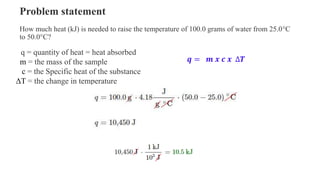
Problem statement
How much heat (kJ) is needed to raise the temperature of 100.0 grams of water from 25.0°C
to 50.0°C?
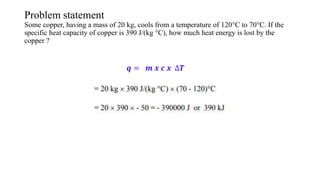
Problem statement
Some copper, having a mass of 20 kg, cools from a temperature of 120°C to 70°C. If the
specific heat capacity of copper is 390 J/(kg °C), how much heat energy is lost by the
copper ?
𝒒 = 𝒎 𝒙 𝒄 𝒙 ∆𝑻
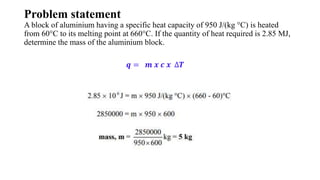
Problem statement
A block of aluminium having a specific heat capacity of 950 J/(kg °C) is heated
from 60°C to its melting point at 660°C. If the quantity of heat required is 2.85 MJ,
determine the mass of the aluminium block.
𝒒 = 𝒎 𝒙 𝒄 𝒙 ∆𝑻
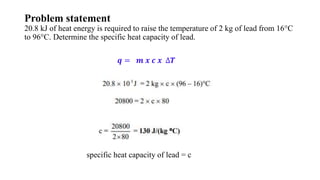
Problem statement
20.8 kJ of heat energy is required to raise the temperature of 2 kg of lead from 16°C
to 96°C. Determine the specific heat capacity of lead.
𝒒 = 𝒎 𝒙 𝒄 𝒙 ∆𝑻
specific heat capacity of lead = c
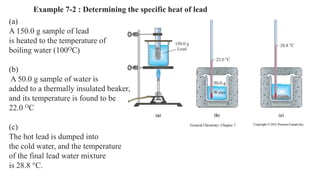
(a)
A 150.0 g sample of lead
is heated to the temperature of
boiling water (100OC)
(b)
A 50.0 g sample of water is
added to a thermally insulated beaker,
and its temperature is found to be
22.0 OC
(c)
The hot lead is dumped into
the cold water, and the temperature
of the final lead water mixture
is 28.8 °C.
Example 7-2 : Determining the specific heat of lead
Solution
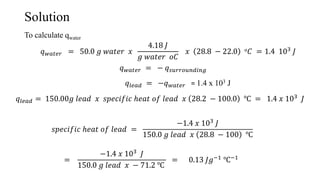
To calculate qwater
𝑞 𝑤𝑎𝑡𝑒𝑟 = 50.0 𝑔 𝑤𝑎𝑡𝑒𝑟 𝑥
4.18 𝐽
𝑔 𝑤𝑎𝑡𝑒𝑟 𝑜𝐶
𝑥 28.8 − 22.0 𝑜 𝐶 = 1.4 103 𝐽
𝑞 𝑤𝑎𝑡𝑒𝑟 = − 𝑞 𝑠𝑢𝑟𝑟𝑜𝑢𝑛𝑑𝑖𝑛𝑔
𝑞𝑙𝑒𝑎𝑑 = −𝑞 𝑤𝑎𝑡𝑒𝑟 = 1.4 x 10³ J
𝑞𝑙𝑒𝑎𝑑 = 150.00𝑔 𝑙𝑒𝑎𝑑 𝑥 𝑠𝑝𝑒𝑐𝑖𝑓𝑖𝑐 ℎ𝑒𝑎𝑡 𝑜𝑓 𝑙𝑒𝑎𝑑 𝑥 28.2 − 100.0 ℃ = 1.4 𝑥 103 𝐽
𝑠𝑝𝑒𝑐𝑖𝑓𝑖𝑐 ℎ𝑒𝑎𝑡 𝑜𝑓 𝑙𝑒𝑎𝑑 =
−1.4 𝑥 103 𝐽
150.0 𝑔 𝑙𝑒𝑎𝑑 𝑥 28.8 − 100 ℃
=
−1.4 𝑥 103
𝐽
150.0 𝑔 𝑙𝑒𝑎𝑑 𝑥 − 71.2 ℃
= 0.13 𝐽𝑔−1 ℃−1

Heat and heat capacity

  • 1.
    Heat and HeatCapacity Dr. K. Shahzad Baig Memorial University of Newfoundland (MUN) Canada Petrucci, et al. 2011. General Chemistry: Principles and Modern Applications. Pearson Canada Inc., Toronto, Ontario. Tro, N.J. 2010. Principles of Chemistry. : A molecular approach. Pearson Education, Inc.
  • 2.
    Some Terminology A systemis the part of the universe chosen for study, and it can be as large as all the oceans on Earth or as small as the contents of a beaker. The surroundings are that part of the universe outside the system with which the system interacts.
  • 4.
    Energy is thecapacity to do work. Work is done when a force acts through a distance. The energy of a moving object is called kinetic energy Potential energy is energy resulting from position, condition, or composition; it is an energy associated with forces of attraction or repulsion between objects This kinetic energy associated with random molecular motion is called thermal energy In general, thermal energy is proportional to the temperature of a system, as suggested by the kinetic theory of gases.
  • 5.
    The more vigorousthe motion of the molecules in the system, the hotter the sample and the greater is its thermal energy. However, the thermal energy of a system also depends on the number of particles present, so that a small sample at a high temperature (for example, a cup of coffee at 75 OC) may have less thermal energy than a larger sample at a lower temperature (for example, a swimming pool at, temperature 30 °C) Heat is energy transferred between a system and its surroundings as a result of a temperature difference. The quantity of heat required to change the temperature of one gram of water by one degree Celsius has been called the calorie (cal). 1 cal = 4.184 J
  • 6.
    Heat capacity The quantityof heat required to change the temperature of a system by one degree is called the heat capacity of the system If the system is a mole of substance, the term molar heat capacity is applicable. If the system is one gram of substance, the applicable term is specific heat capacity, or more commonly, specific heat (sp ht). 𝑞𝑢𝑎𝑛𝑡𝑖𝑡𝑦 𝑜𝑓 ℎ𝑒𝑎𝑡 = 𝑞 = 𝑚𝑎𝑠𝑠 𝑜𝑓 𝑠𝑢𝑏𝑠𝑡𝑎𝑛𝑐𝑒 𝒙 𝒔𝒑𝒆𝒄𝒊𝒇𝒊𝒄 𝒉𝒆𝒂𝒕 𝑥 𝑡𝑒𝑚𝑝𝑒𝑟𝑎𝑡𝑢𝑟𝑒 𝑐ℎ𝑎𝑛𝑔𝑒 𝒎𝒂𝒔𝒔 𝒐𝒇 𝒔𝒖𝒃𝒔𝒕𝒂𝒏𝒄𝒆 𝒙 𝒔𝒑𝒆𝒄𝒊𝒇𝒊𝒄 𝒉𝒆𝒂𝒕 = 𝐻𝑒𝑎𝑡 𝐶𝑎𝑝𝑎𝑝𝑐𝑖𝑡𝑦 = 𝐶 𝑞 = 𝑚 𝒙 𝒔𝒑𝒆𝒄𝒊𝒇𝒊𝒄 𝒉𝒆𝒂𝒕 𝑥 ∆ 𝑇 = 𝐶 𝑥 ∆𝑇
  • 7.
    the Specific heatof 𝐶 𝑤𝑎𝑡𝑒𝑟 = 4.18 𝐽 𝑂 𝐶 𝑔 − 𝑤𝑎𝑡𝑒𝑟 a substance's specific heat tells you how much heat is needed in order to increase the temperature of 1 g of that substance by 1OC. Now let's say that you wanted to cause a 1∘C increase in a 2-g sample of water a 1∘C increase in the temperature of m grams of water, To increase the temperature of m g of water by [ n OC ], you'd need to supply it with 𝐻𝑒𝑎𝑡 𝑟𝑒𝑞𝑢𝑖𝑟𝑒𝑑 = 𝑚 𝑥 𝑛 𝑥 𝑠𝑝𝑒𝑐𝑖𝑓𝑖𝑐 ℎ𝑒𝑎𝑡 = 𝑚 𝑥 𝑠𝑝𝑒𝑐𝑖𝑓𝑖𝑐 ℎ𝑒𝑎𝑡 𝑥 𝑛 𝐻𝑒𝑎𝑡 𝑟𝑒𝑞𝑢𝑖𝑟𝑒𝑑 = 𝑚 𝑥 𝑆𝑝𝑒𝑐𝑖𝑓𝑖𝑐 ℎ𝑒𝑎𝑡 𝑥 ∆ 𝑇 𝒒 = 𝒎 𝒙 𝒄 𝒙 ∆𝑻
  • 8.
    𝒒 = 𝒎𝒙 𝒄 𝒙 ∆𝑻 q = quantity of heat = heat absorbed m = the mass of the sample c = the Specific heat of the substance ΔT = the change in temperature Problem statement How much heat (kJ) is needed to raise the temperature of 100.0 grams of water from 25.0°C to 50.0°C?
  • 9.
    Problem statement Some copper,having a mass of 20 kg, cools from a temperature of 120°C to 70°C. If the specific heat capacity of copper is 390 J/(kg °C), how much heat energy is lost by the copper ? 𝒒 = 𝒎 𝒙 𝒄 𝒙 ∆𝑻
  • 10.
    Problem statement A blockof aluminium having a specific heat capacity of 950 J/(kg °C) is heated from 60°C to its melting point at 660°C. If the quantity of heat required is 2.85 MJ, determine the mass of the aluminium block. 𝒒 = 𝒎 𝒙 𝒄 𝒙 ∆𝑻
  • 11.
    Problem statement 20.8 kJof heat energy is required to raise the temperature of 2 kg of lead from 16°C to 96°C. Determine the specific heat capacity of lead. 𝒒 = 𝒎 𝒙 𝒄 𝒙 ∆𝑻 specific heat capacity of lead = c
  • 12.
    (a) A 150.0 gsample of lead is heated to the temperature of boiling water (100OC) (b) A 50.0 g sample of water is added to a thermally insulated beaker, and its temperature is found to be 22.0 OC (c) The hot lead is dumped into the cold water, and the temperature of the final lead water mixture is 28.8 °C. Example 7-2 : Determining the specific heat of lead
  • 13.
    Solution To calculate qwater 𝑞𝑤𝑎𝑡𝑒𝑟 = 50.0 𝑔 𝑤𝑎𝑡𝑒𝑟 𝑥 4.18 𝐽 𝑔 𝑤𝑎𝑡𝑒𝑟 𝑜𝐶 𝑥 28.8 − 22.0 𝑜 𝐶 = 1.4 103 𝐽 𝑞 𝑤𝑎𝑡𝑒𝑟 = − 𝑞 𝑠𝑢𝑟𝑟𝑜𝑢𝑛𝑑𝑖𝑛𝑔 𝑞𝑙𝑒𝑎𝑑 = −𝑞 𝑤𝑎𝑡𝑒𝑟 = 1.4 x 10³ J 𝑞𝑙𝑒𝑎𝑑 = 150.00𝑔 𝑙𝑒𝑎𝑑 𝑥 𝑠𝑝𝑒𝑐𝑖𝑓𝑖𝑐 ℎ𝑒𝑎𝑡 𝑜𝑓 𝑙𝑒𝑎𝑑 𝑥 28.2 − 100.0 ℃ = 1.4 𝑥 103 𝐽 𝑠𝑝𝑒𝑐𝑖𝑓𝑖𝑐 ℎ𝑒𝑎𝑡 𝑜𝑓 𝑙𝑒𝑎𝑑 = −1.4 𝑥 103 𝐽 150.0 𝑔 𝑙𝑒𝑎𝑑 𝑥 28.8 − 100 ℃ = −1.4 𝑥 103 𝐽 150.0 𝑔 𝑙𝑒𝑎𝑑 𝑥 − 71.2 ℃ = 0.13 𝐽𝑔−1 ℃−1

Editor's Notes

  • #3 the combustion of a hydrocarbon, such as CH4 , yields carbon dioxide and water as products. More important, however, is another product of this reaction, which we have not previously mentioned: heat. T
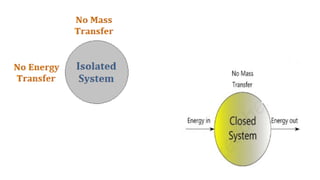
  • #4 An open system freely exchanges energy and matter with its surroundings
  • #5 An open system freely exchanges energy and matter with its surroundings
  • #6 The "calorie" we refer to in food is actually kilocalorie. One (1) kilocalorie is the same as one (1) Calorie (upper case C). A kilocalorie is the amount of heat required to raise the temperature of 1 kilogram of water one degree Celsius.
  • #7 Substance = system The original meaning of specific heat was that of a ratio: the quantity of heat required to change the temperature of a mass of substance divided by the quantity of heat required to produce the same temperature change in the same mass of water this definition would make specific heat dimensionless
  • #14 The key concept to recognize is that energy, in the form of heat, flowed from the lead, which is our system, to the water, which is part of the surroundings.