specific heat Capacity
What is specific heat
specific heat Capacity
If the same amount
of heat is given to
the same mass of
different
substances, what
will happen to their
temperatures?
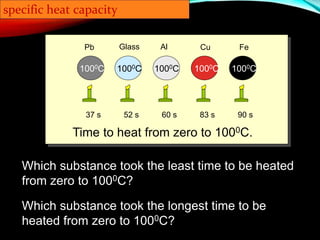
Pb Glass Al Cu Fe
Time to heat from zero to 1000C.
37 s 52 s 60 s 83 s 90 s
1000C 1000C 1000C 1000C 1000C
specific heat capacity
Which substance took the least time to be heated
from zero to 1000C?
Which substance took the longest time to be
heated from zero to 1000C?
The specific heat capacity (c) of a
substance is the amount of heat that
must be added or removed from a unit
mass of a substance to change its
temperature by 10.
specific heat capacity
Specific heat capacity is also the thermal
inertia of a substance.
Iron and copper balls melt all the way through; others have lesser
heat capacities.
A high specific heat
capacity means a
relatively small change
in temperature for a
given change in internal
energy content.
specific heat capacity
SPECIFIC HEAT
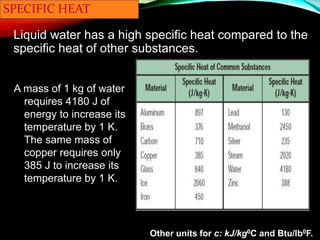
Liquid water has a high specific heat compared to the
specific heat of other substances.
A mass of 1 kg of water
requires 4180 J of
energy to increase its
temperature by 1 K.
The same mass of
copper requires only
385 J to increase its
temperature by 1 K.
Other units for c: kJ/kg0C and Btu/lb0F.
SPECIFIC HEAT
• Some objects are easier to heat than
others.
• When heat flows into an object, its thermal
energy and temperature increase.
• The amount of the increase in temperature
depends on the size of the object, and on
the material from which the object is made.
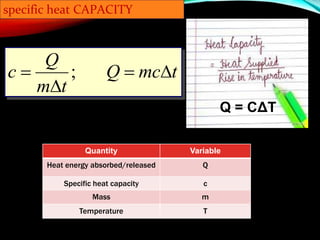
;
Q
c Q mc t
m t
  

specific heat CAPACITY
Quantity Variable
Heat energy absorbed/released Q
Specific heat capacity c
Mass m
Temperature T
Q = CΔT
450 g
specific heat example
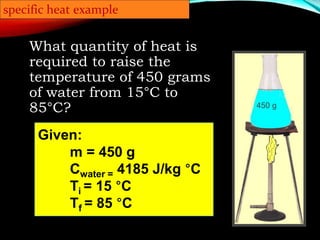
What quantity of heat is
required to raise the
temperature of 450 grams
of water from 15°C to
85°C?
Given:
m = 450 g
Cwater = 4185 J/kg °C
Ti = 15 °C
Tf = 85 °C
specific heat example
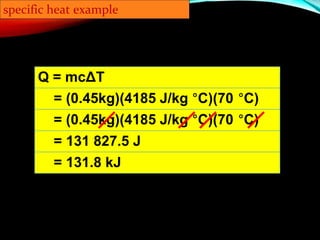
Q = mcΔT
= (0.45kg)(4185 J/kg °C)(70 °C)
= 131 827.5 J
= 131.8 kJ
specific heat example
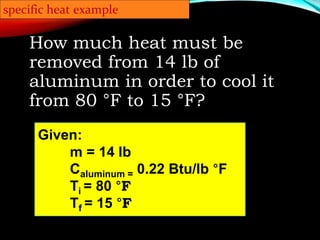
How much heat must be
removed from 14 lb of
aluminum in order to cool it
from 80 °F to 15 °F?
Given:
m = 14 lb
Caluminum = 0.22 Btu/lb °F
Ti = 80 °F
Tf = 15 °F
= (14 lb)(0.22 Btu/lb °F)(-65 °F)
specific heat example
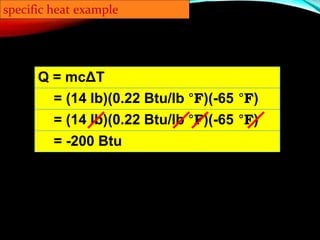
Q = mcΔT
= (14 lb)(0.22 Btu/lb °F)(-65 °F)
= -200 Btu
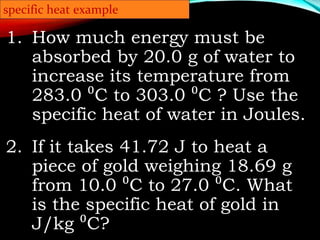
1. How much energy must be
absorbed by 20.0 g of water to
increase its temperature from
283.0 ⁰C to 303.0 ⁰C ? Use the
specific heat of water in Joules.
2. If it takes 41.72 J to heat a
piece of gold weighing 18.69 g
from 10.0 ⁰C to 27.0 ⁰C. What
is the specific heat of gold in
J/kg ⁰C?
specific heat example
CLOSING TASK
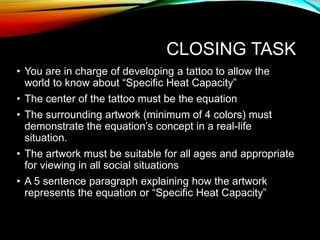
• You are in charge of developing a tattoo to allow the
world to know about “Specific Heat Capacity”
• The center of the tattoo must be the equation
• The surrounding artwork (minimum of 4 colors) must
demonstrate the equation’s concept in a real-life
situation.
• The artwork must be suitable for all ages and appropriate
for viewing in all social situations
• A 5 sentence paragraph explaining how the artwork
represents the equation or “Specific Heat Capacity”

Specific heat capacity

  • 1.
  • 2.
    specific heat Capacity Ifthe same amount of heat is given to the same mass of different substances, what will happen to their temperatures?
  • 3.
    Pb Glass AlCu Fe Time to heat from zero to 1000C. 37 s 52 s 60 s 83 s 90 s 1000C 1000C 1000C 1000C 1000C specific heat capacity Which substance took the least time to be heated from zero to 1000C? Which substance took the longest time to be heated from zero to 1000C?
  • 4.
    The specific heatcapacity (c) of a substance is the amount of heat that must be added or removed from a unit mass of a substance to change its temperature by 10. specific heat capacity Specific heat capacity is also the thermal inertia of a substance.
  • 5.
    Iron and copperballs melt all the way through; others have lesser heat capacities. A high specific heat capacity means a relatively small change in temperature for a given change in internal energy content. specific heat capacity
  • 6.
    SPECIFIC HEAT Liquid waterhas a high specific heat compared to the specific heat of other substances. A mass of 1 kg of water requires 4180 J of energy to increase its temperature by 1 K. The same mass of copper requires only 385 J to increase its temperature by 1 K. Other units for c: kJ/kg0C and Btu/lb0F.
  • 7.
    SPECIFIC HEAT • Someobjects are easier to heat than others. • When heat flows into an object, its thermal energy and temperature increase. • The amount of the increase in temperature depends on the size of the object, and on the material from which the object is made.
  • 8.
    ; Q c Q mct m t     specific heat CAPACITY Quantity Variable Heat energy absorbed/released Q Specific heat capacity c Mass m Temperature T Q = CΔT
  • 9.
    450 g specific heatexample What quantity of heat is required to raise the temperature of 450 grams of water from 15°C to 85°C? Given: m = 450 g Cwater = 4185 J/kg °C Ti = 15 °C Tf = 85 °C
  • 10.
    specific heat example Q= mcΔT = (0.45kg)(4185 J/kg °C)(70 °C) = (0.45kg)(4185 J/kg °C)(70 °C) = 131 827.5 J = 131.8 kJ
  • 11.
    specific heat example Howmuch heat must be removed from 14 lb of aluminum in order to cool it from 80 °F to 15 °F? Given: m = 14 lb Caluminum = 0.22 Btu/lb °F Ti = 80 °F Tf = 15 °F
  • 12.
    = (14 lb)(0.22Btu/lb °F)(-65 °F) specific heat example Q = mcΔT = (14 lb)(0.22 Btu/lb °F)(-65 °F) = -200 Btu
  • 13.
    1. How muchenergy must be absorbed by 20.0 g of water to increase its temperature from 283.0 ⁰C to 303.0 ⁰C ? Use the specific heat of water in Joules. 2. If it takes 41.72 J to heat a piece of gold weighing 18.69 g from 10.0 ⁰C to 27.0 ⁰C. What is the specific heat of gold in J/kg ⁰C? specific heat example
  • 14.
    CLOSING TASK • Youare in charge of developing a tattoo to allow the world to know about “Specific Heat Capacity” • The center of the tattoo must be the equation • The surrounding artwork (minimum of 4 colors) must demonstrate the equation’s concept in a real-life situation. • The artwork must be suitable for all ages and appropriate for viewing in all social situations • A 5 sentence paragraph explaining how the artwork represents the equation or “Specific Heat Capacity”