CHAPTER 6: HEAT
The energy that is being transferred between two bodies as a result of
temperature difference is called heat.
Heat is a form of energy which causes the
sensation of hotness/Coldness.
Measurement of Heat
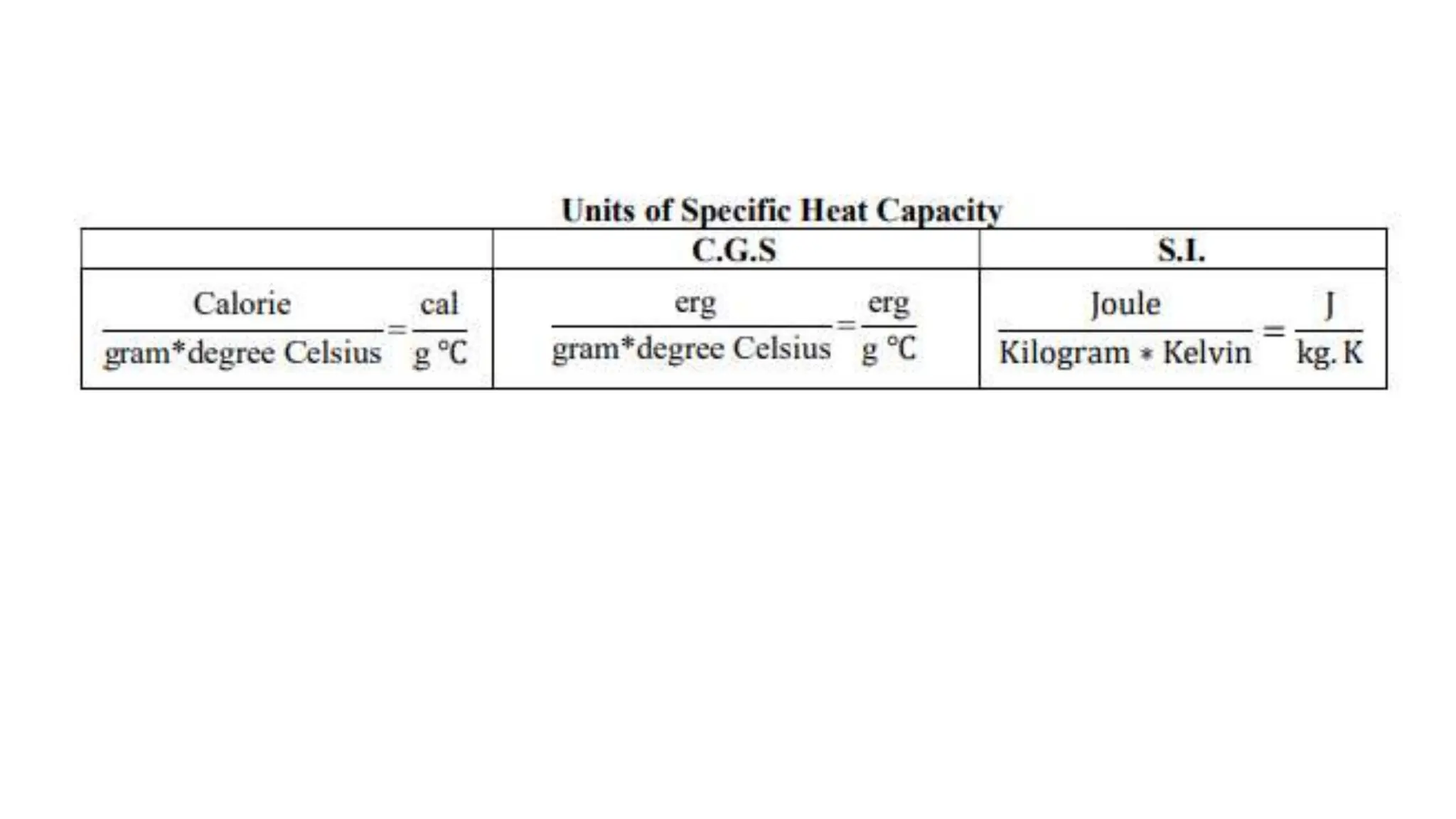
1) C.G.S unit: erg
2) Calorie : 1 calorie is defined as the amount of heat required for raising the
temperature of 1g of water through 1 degree Celsius from 14.5oC to 15.5oC.
3) S.I. unit: joule (J) The units calorie and joule are related as: 1 cal = 4.186 J (or
nearly 4.2 J) 1 J = 0.24 cal 1 J = 107 erg
Temperature
Heat always flow from a body at higher temperature to the body at lower temperature.
At molecular level, when temperature increases (means body is gaining heat), kinetic
energy of molecule increases, thus internal energy of that body increases.
Ice point: The temperature at which pure water and ice are in equilibrium in a mixture
at 1 atmospheric pressure, represented by 0°C (32°F)
Steam point: The temperature at which water vapor condenses at a pressure of one
atmosphere, represented by 100°C (212°F)
Measurement of Temperature
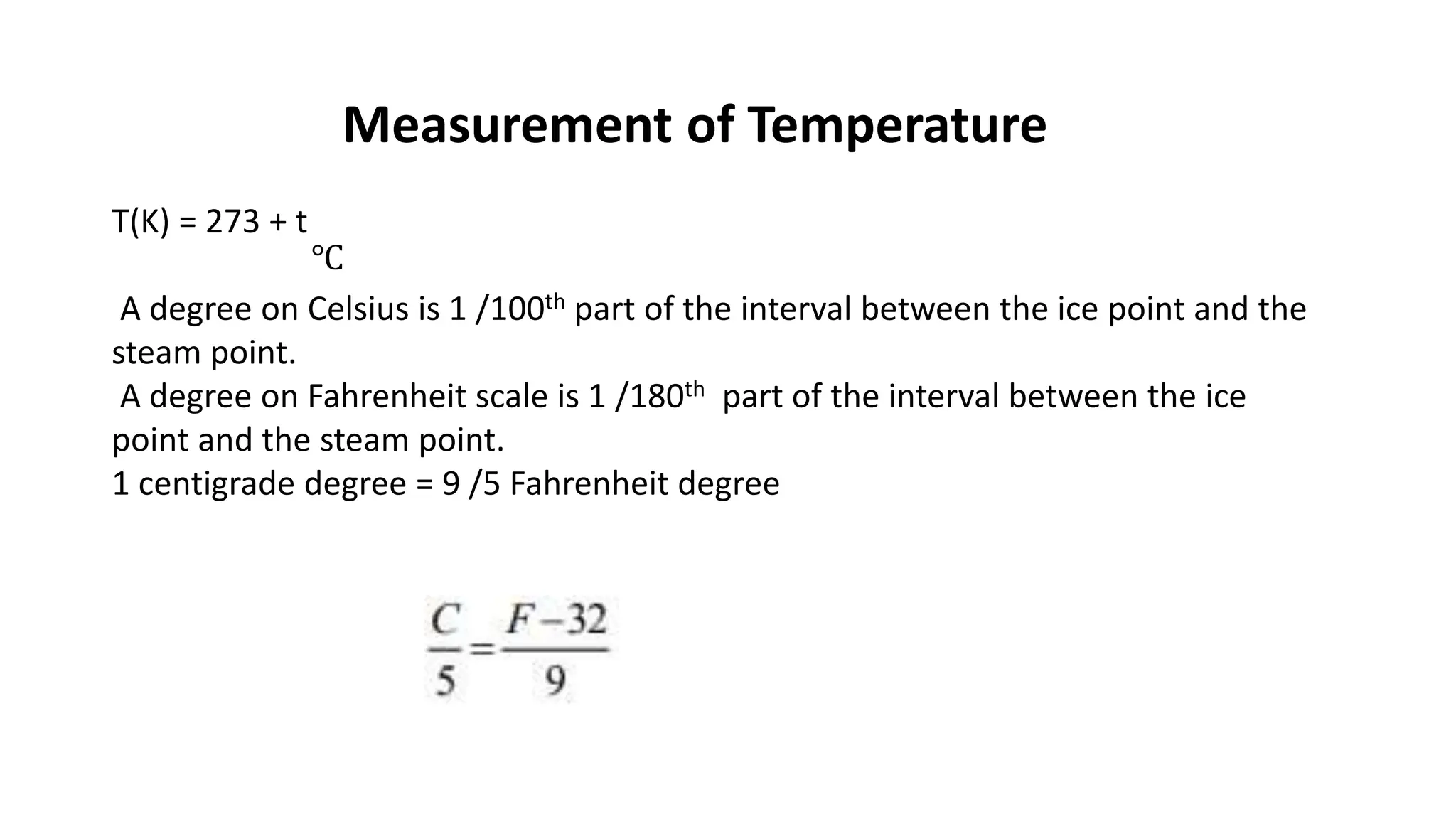
T(K) = 273 + t
A degree on Celsius is 1 /100th part of the interval between the ice point and the
steam point.
A degree on Fahrenheit scale is 1 /180th part of the interval between the ice
point and the steam point.
1 centigrade degree = 9 /5 Fahrenheit degree
℃
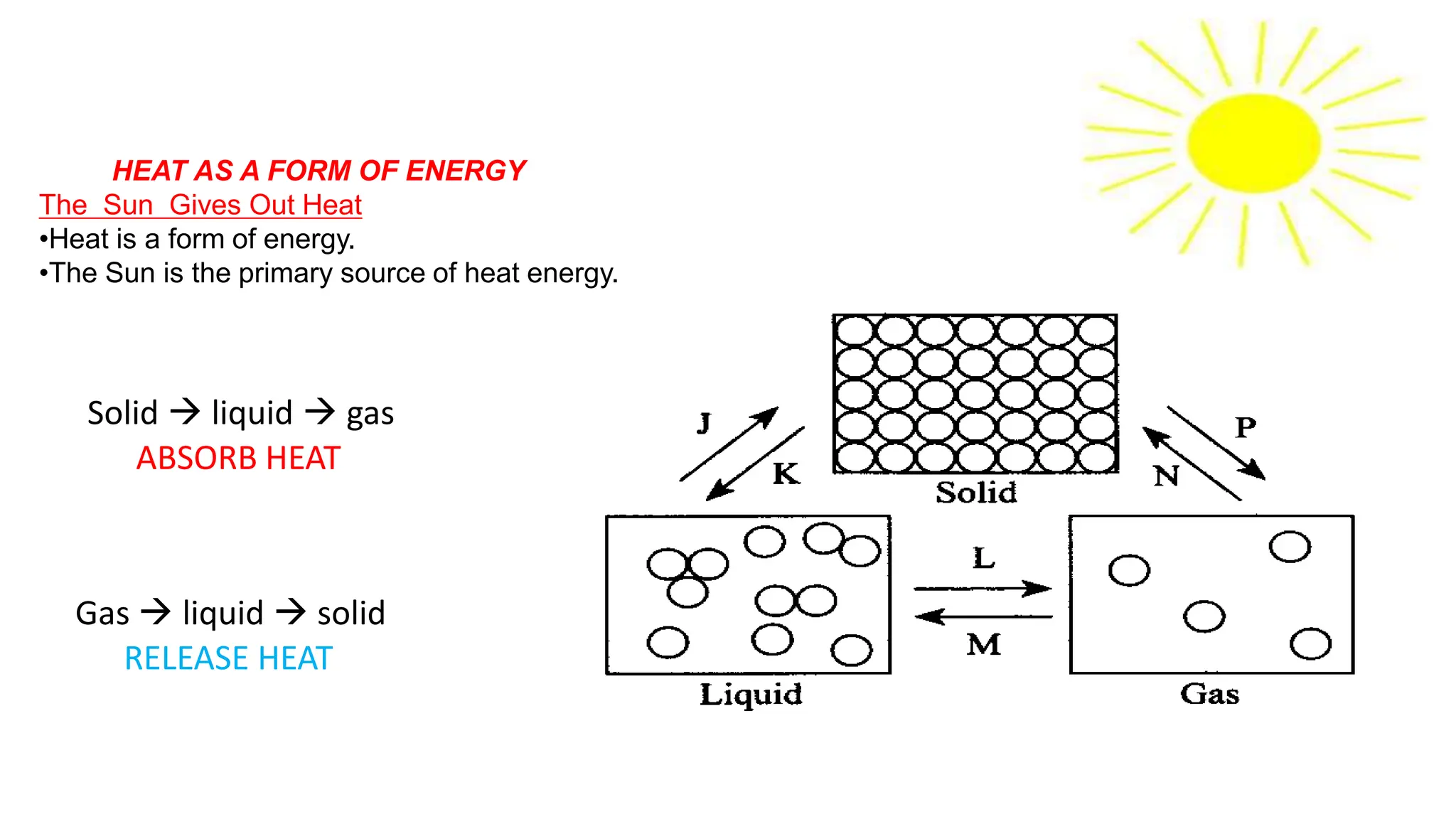
HEAT AS A FORM OF ENERGY
The Sun Gives Out Heat
•Heat is a form of energy.
•The Sun is the primary source of heat energy.
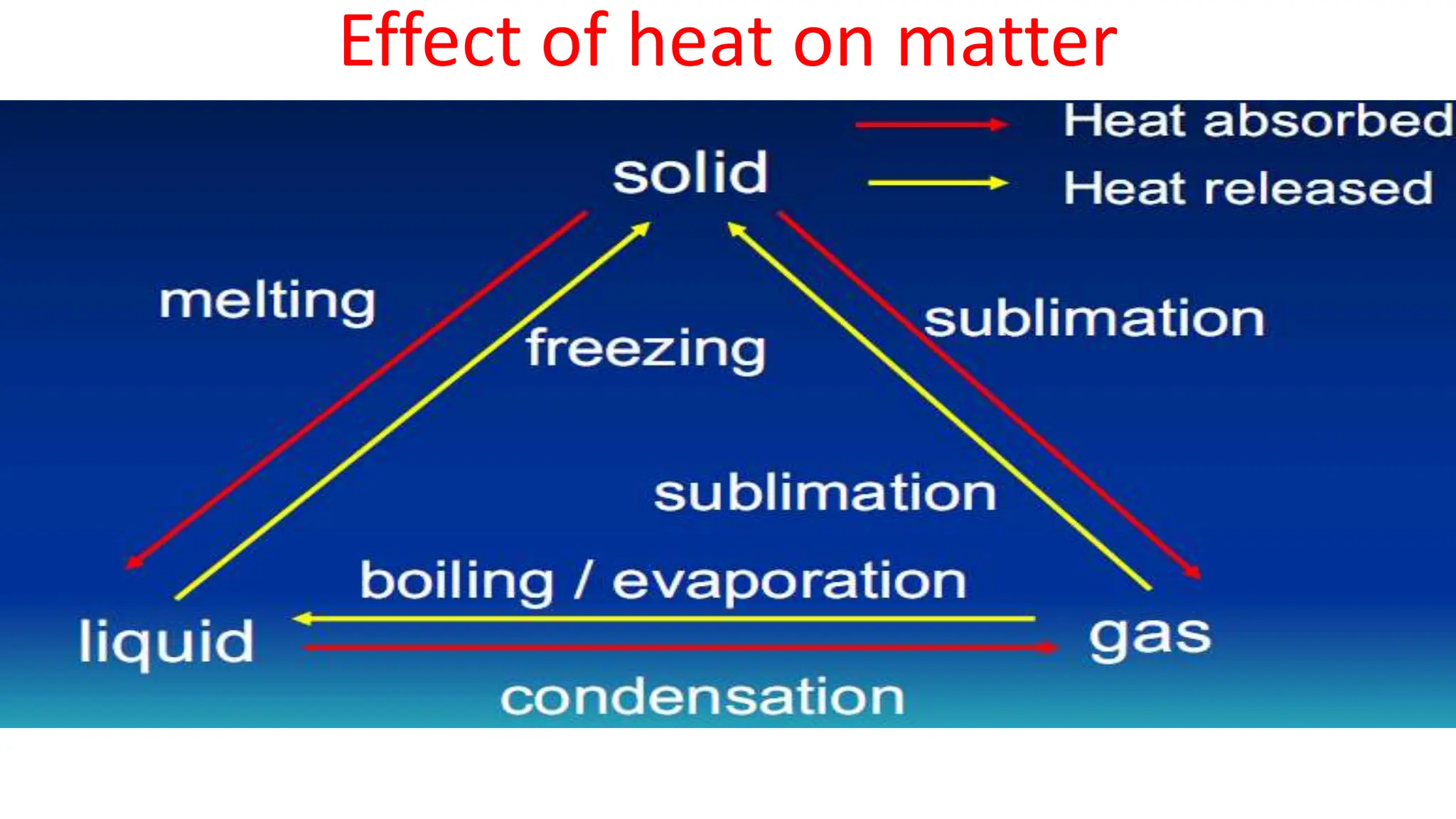
Solid  liquid  gas
Gas  liquid  solid
ABSORB HEAT
RELEASE HEAT
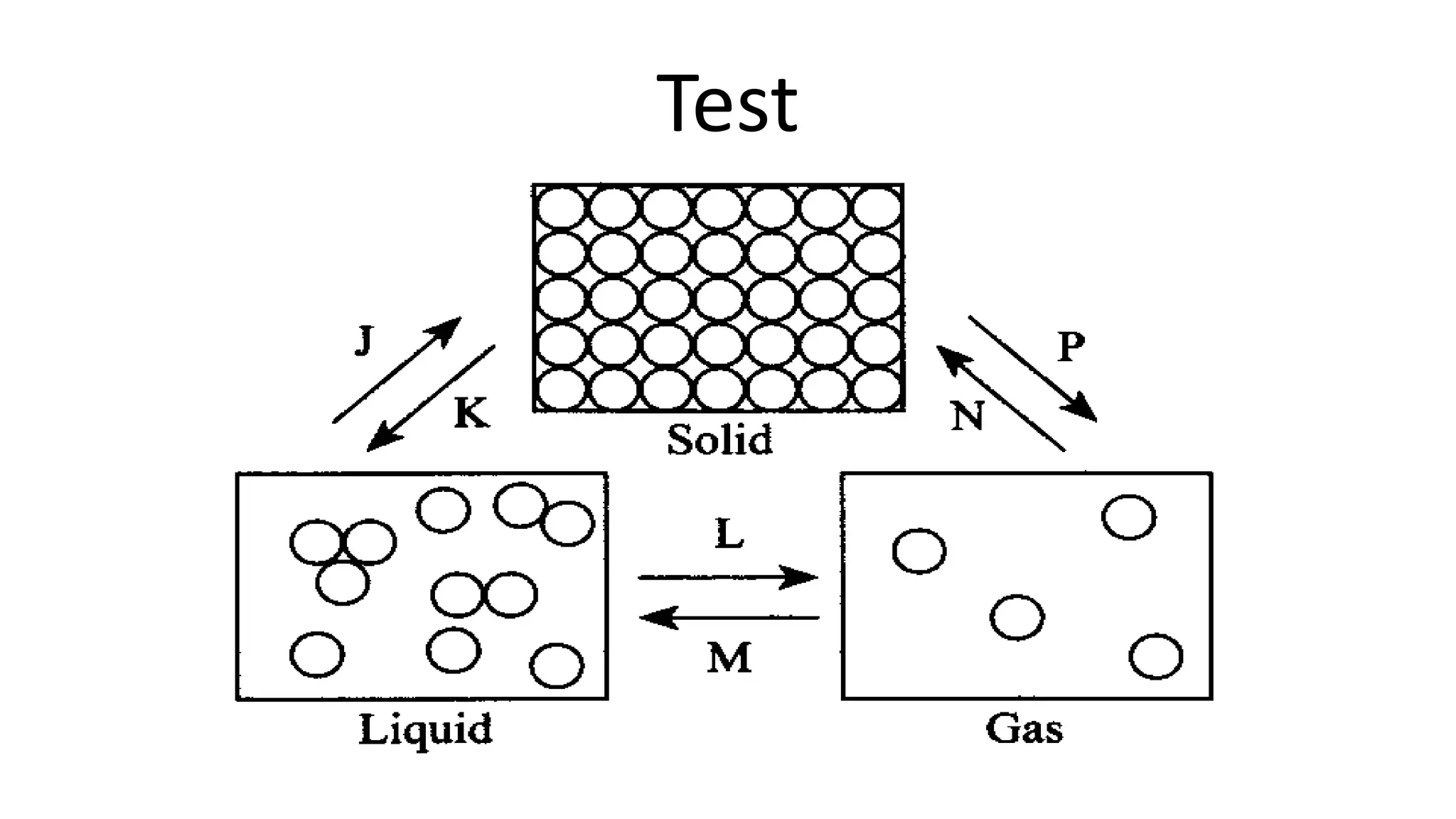
Test
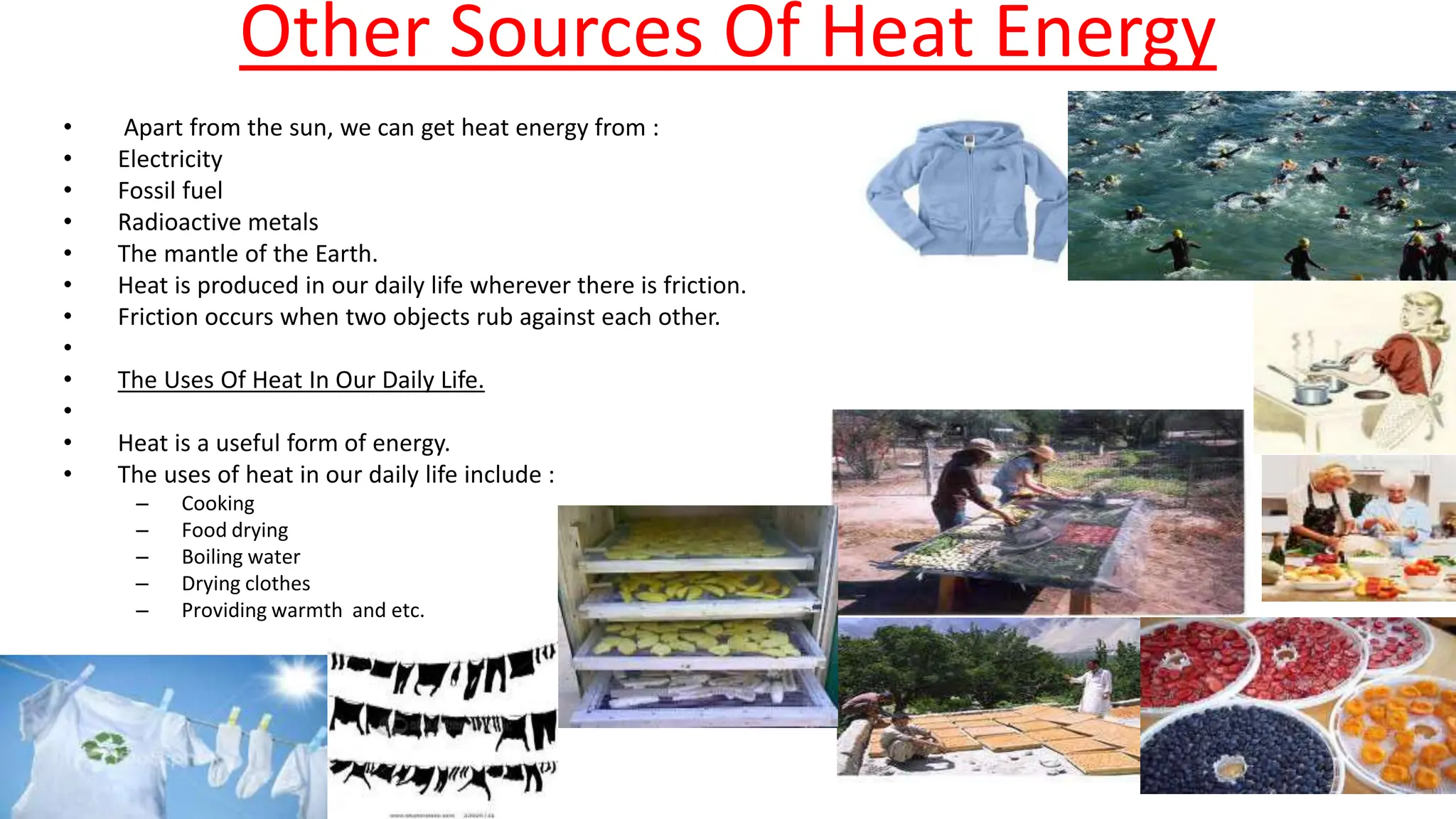
Other Sources Of Heat Energy
• Apart from the sun, we can get heat energy from :
• Electricity
• Fossil fuel
• Radioactive metals
• The mantle of the Earth.
• Heat is produced in our daily life wherever there is friction.
• Friction occurs when two objects rub against each other.
•
• The Uses Of Heat In Our Daily Life.
•
• Heat is a useful form of energy.
• The uses of heat in our daily life include :
– Cooking
– Food drying
– Boiling water
– Drying clothes
– Providing warmth and etc.
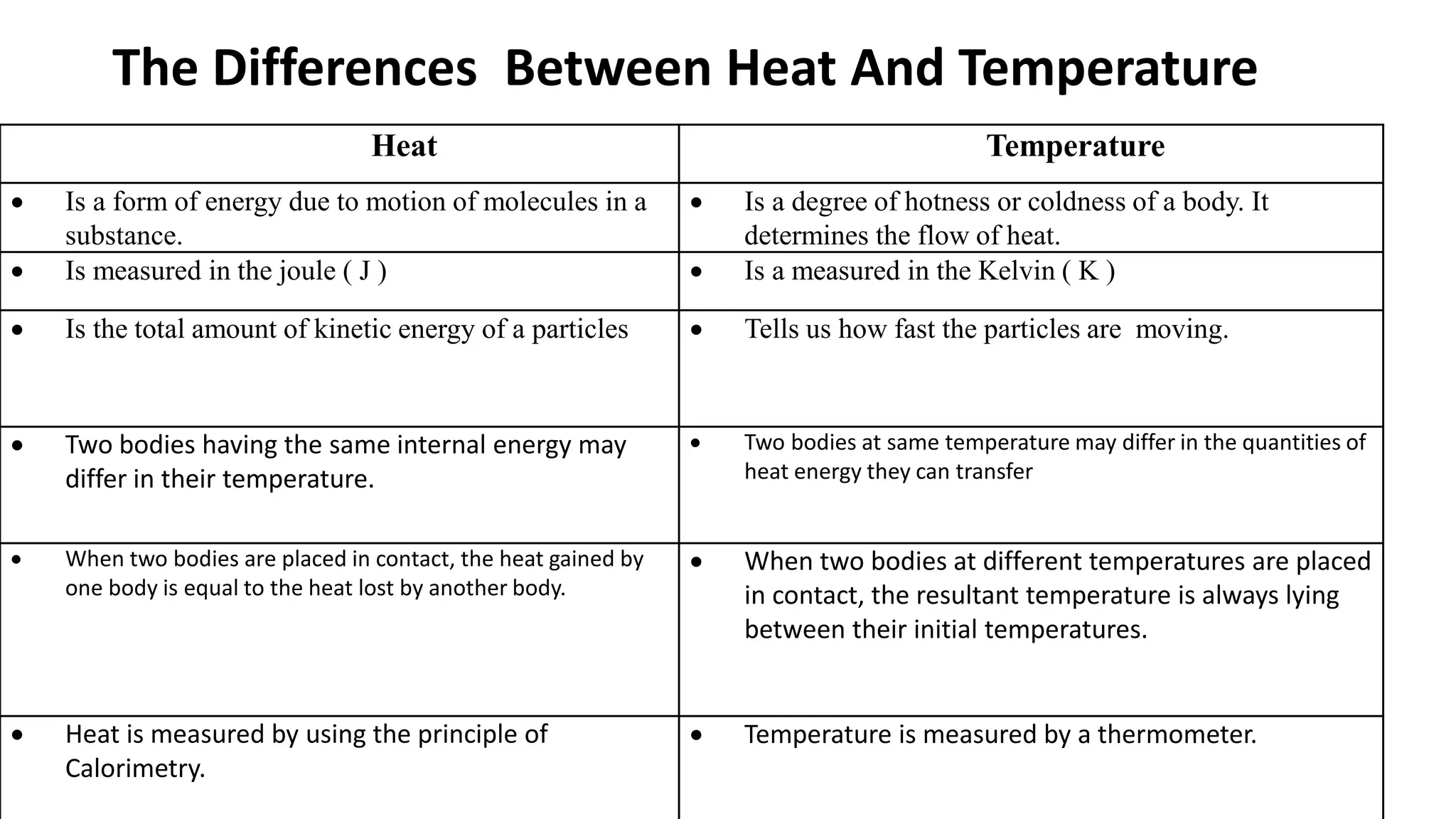
The Differences Between Heat And Temperature
Heat Temperature
 Is a form of energy due to motion of molecules in a
substance.
 Is a degree of hotness or coldness of a body. It
determines the flow of heat.
 Is measured in the joule ( J )  Is a measured in the Kelvin ( K )
 Is the total amount of kinetic energy of a particles  Tells us how fast the particles are moving.
 Two bodies having the same internal energy may
differ in their temperature.
 Two bodies at same temperature may differ in the quantities of
heat energy they can transfer
 When two bodies are placed in contact, the heat gained by
one body is equal to the heat lost by another body.
 When two bodies at different temperatures are placed
in contact, the resultant temperature is always lying
between their initial temperatures.
 Heat is measured by using the principle of
Calorimetry.
 Temperature is measured by a thermometer.
Effect of heat on matter
Thermometry
Types of thermometer: (a) Mercury
thermometer (b) Alcohol thermometer
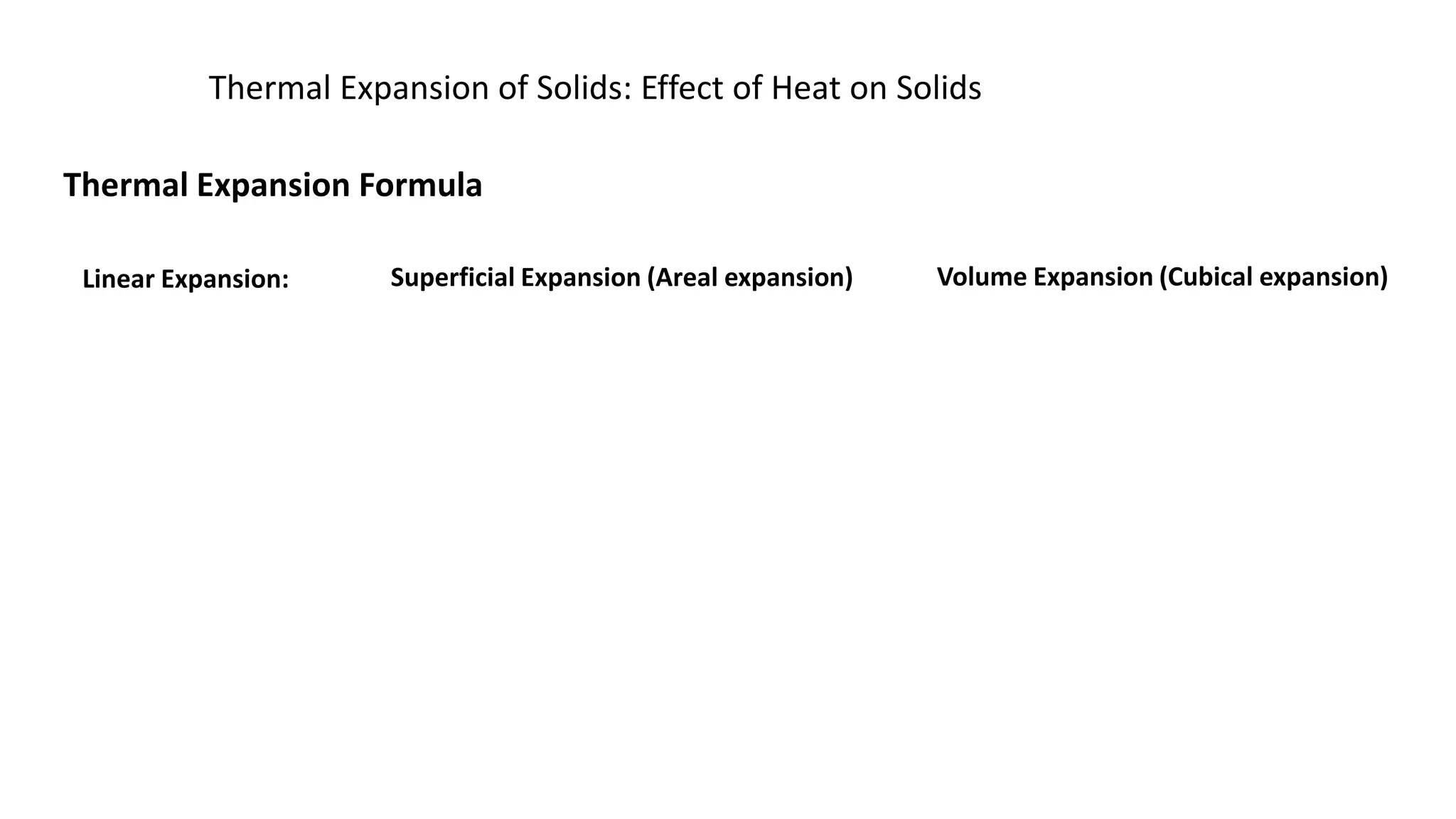
Thermal Expansion of Solids: Effect of Heat on Solids
Thermal Expansion Formula
Linear Expansion: Volume Expansion (Cubical expansion)
Superficial Expansion (Areal expansion)
Four rods, each of same initial length but made of copper, glass, iron and aluminium
are heated to the same rise in temperature. Which rod will expand more?
Specific heat of Copper is 0.385J/goC
Specific heat of glass is 0.84J/goC
Specific heat of iron is 0.450J/goC
Specific heat of Aluminium is 0.902J/goC
Relation between Three Coefficients of Expansion
Apparent Expansion of Liquid and Real expansion of liquid
Anomalous Expansion of Water
Thermal Equilibrium
Heat flows from a body at a higher temperature to a body at lower temperature till their
temperatures become equal. Two bodies are said to be in thermal equilibrium, if they are
at the same temperature.
SPECIFIC HEAT CAPACITY
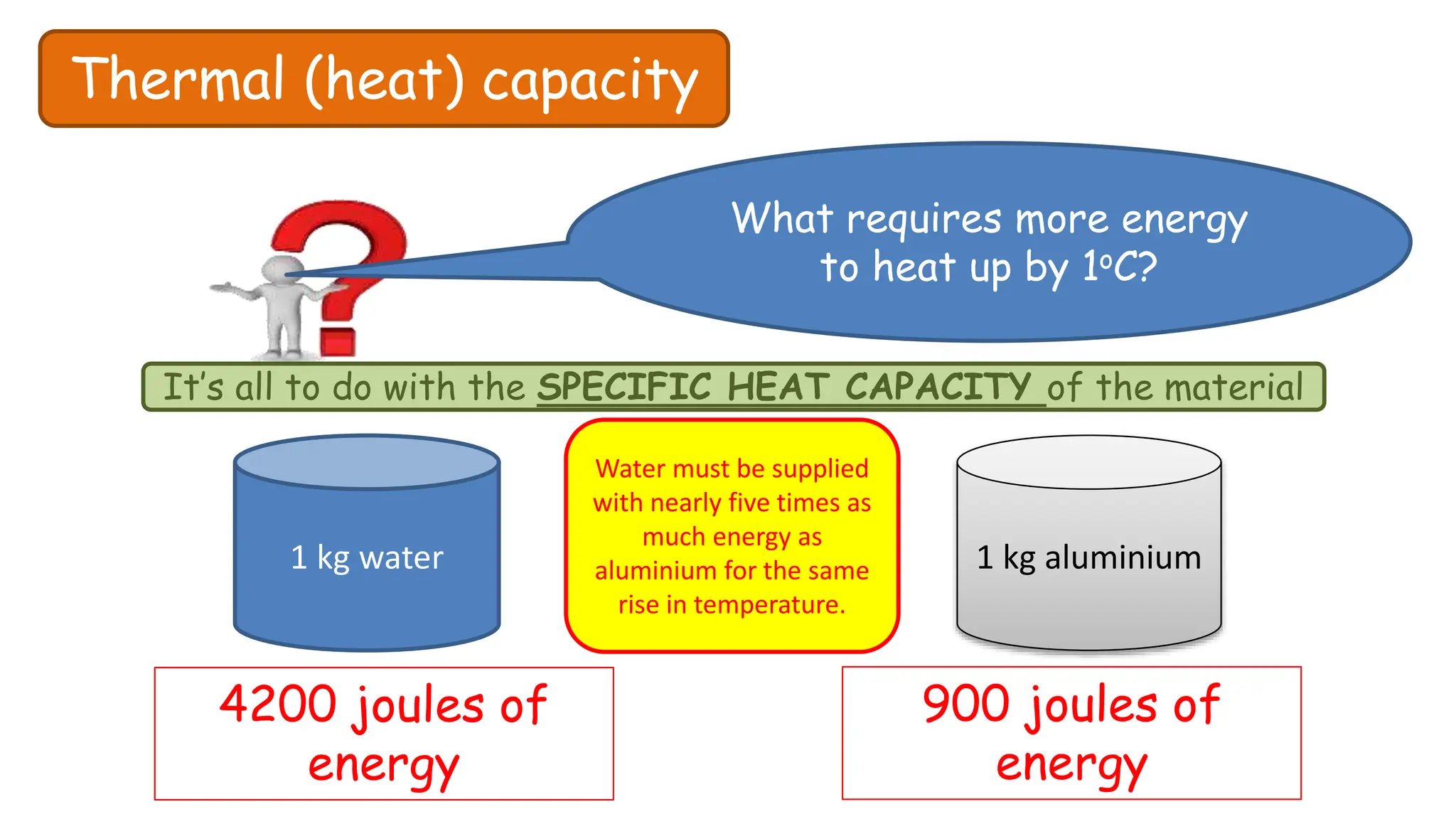
Thermal (heat) capacity
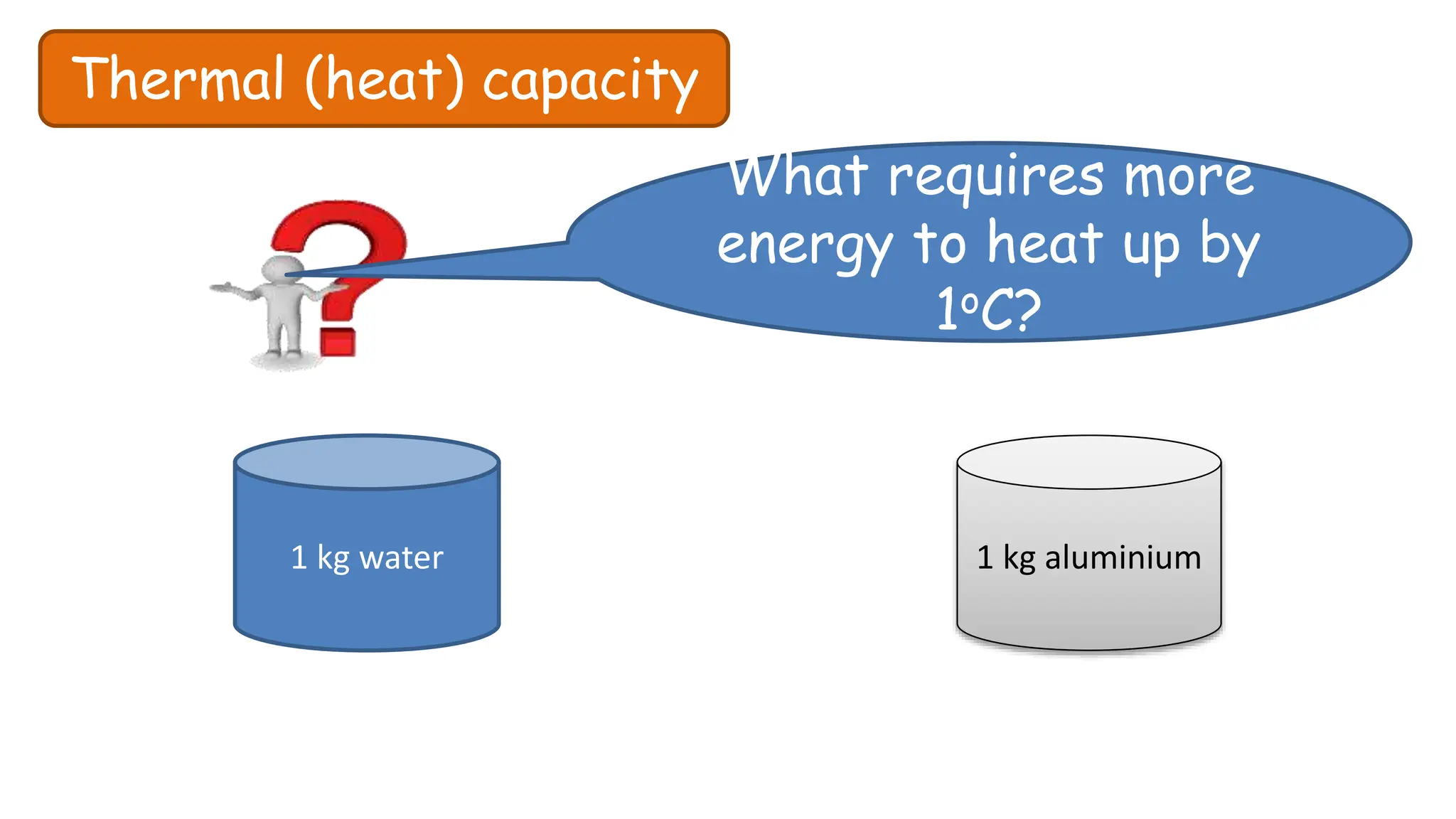
What requires more
energy to heat up by
1oC?
Thermal (heat) capacity
What requires more
energy to heat up by
1oC?
1 kg water
Thermal (heat) capacity
What requires more
energy to heat up by
1oC?
1 kg water 1 kg aluminium
Thermal (heat) capacity
What requires more
energy to heat up by
1oC?
1 kg water 1 kg aluminium
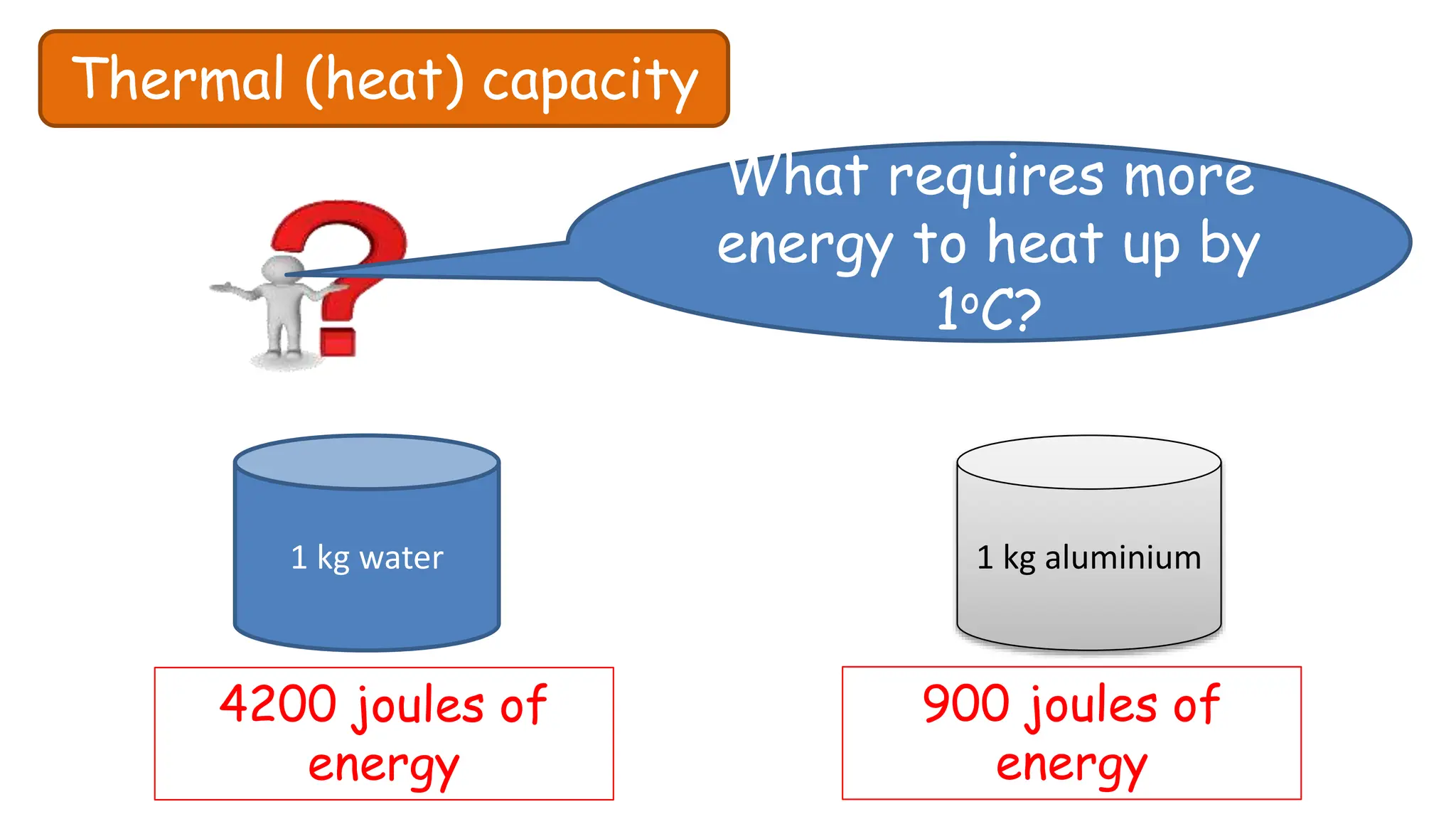
4200 joules of
energy
900 joules of
energy
Thermal (heat) capacity
What requires more energy
to heat up by 1oC?
1 kg water 1 kg aluminium
4200 joules of
energy
900 joules of
energy
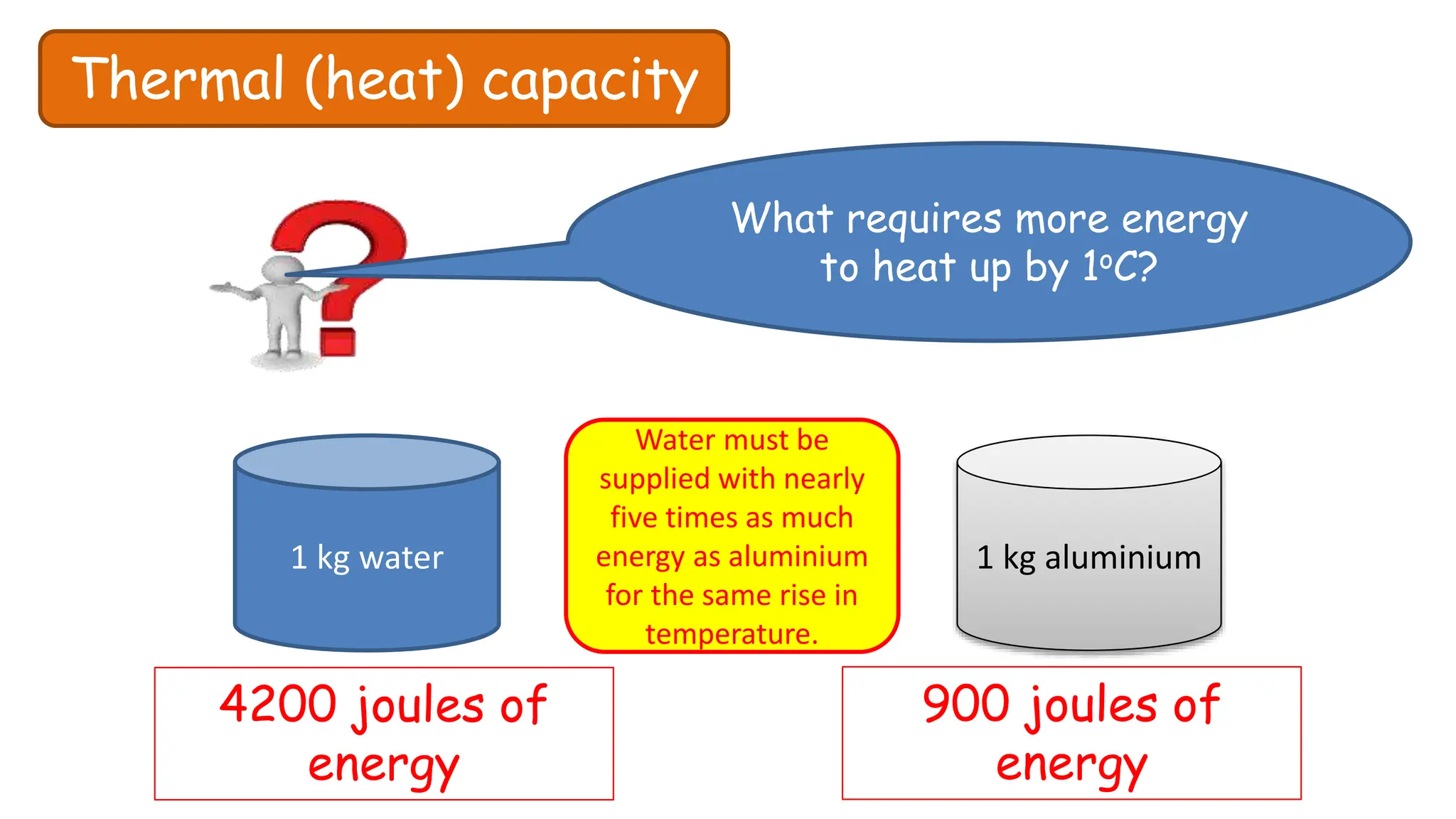
Water must be
supplied with nearly
five times as much
energy as aluminium
for the same rise in
temperature.
Thermal (heat) capacity
What requires more energy
to heat up by 1oC?
1 kg water 1 kg aluminium
4200 joules of
energy
900 joules of
energy
Water must be supplied
with nearly five times as
much energy as
aluminium for the same
rise in temperature.
It’s all to do with the SPECIFIC HEAT CAPACITY of the material
SPECIFIC HEAT CAPACITY
Amount of heat (Q) absorbed or given out by a body depends upon the following
factors:
(a) Mass of the body (m).
(b) The rise or fall in temperature of the body
(c) The nature of the material which the body is made of
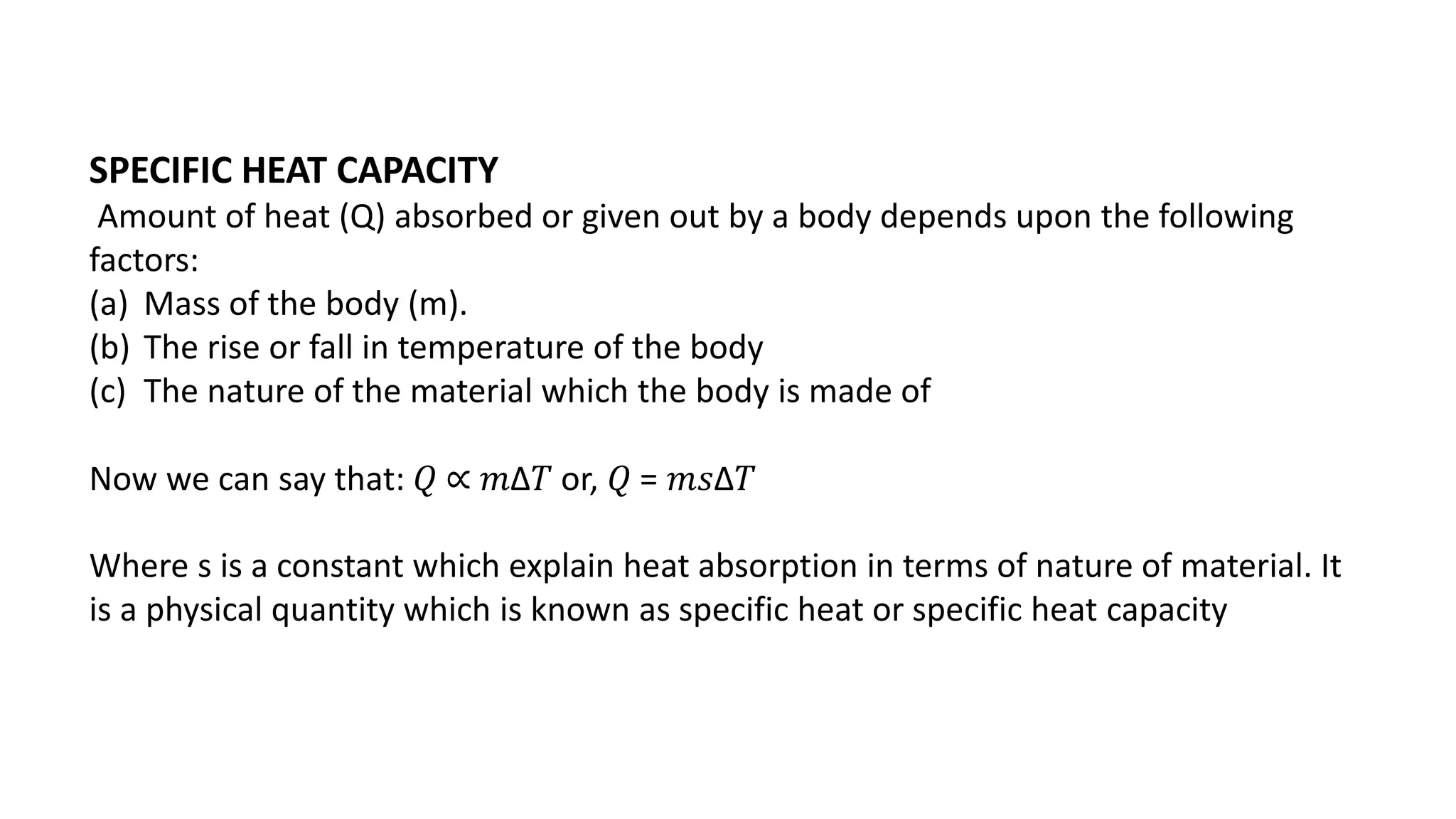
Now we can say that: 𝑄 ∝ 𝑚∆𝑇 or, 𝑄 = 𝑚𝑠∆𝑇
Where s is a constant which explain heat absorption in terms of nature of material. It
is a physical quantity which is known as specific heat or specific heat capacity
Thermal (heat) capacity
The specific heat capacity of
a substance is the amount of
energy needed to change the
temperature of 1kg of the
substance by 1oC.
Thermal (heat) capacity
The specific heat capacity of
a substance is the amount of
energy needed to change the
temperature of 1kg of the
substance by 1oC.
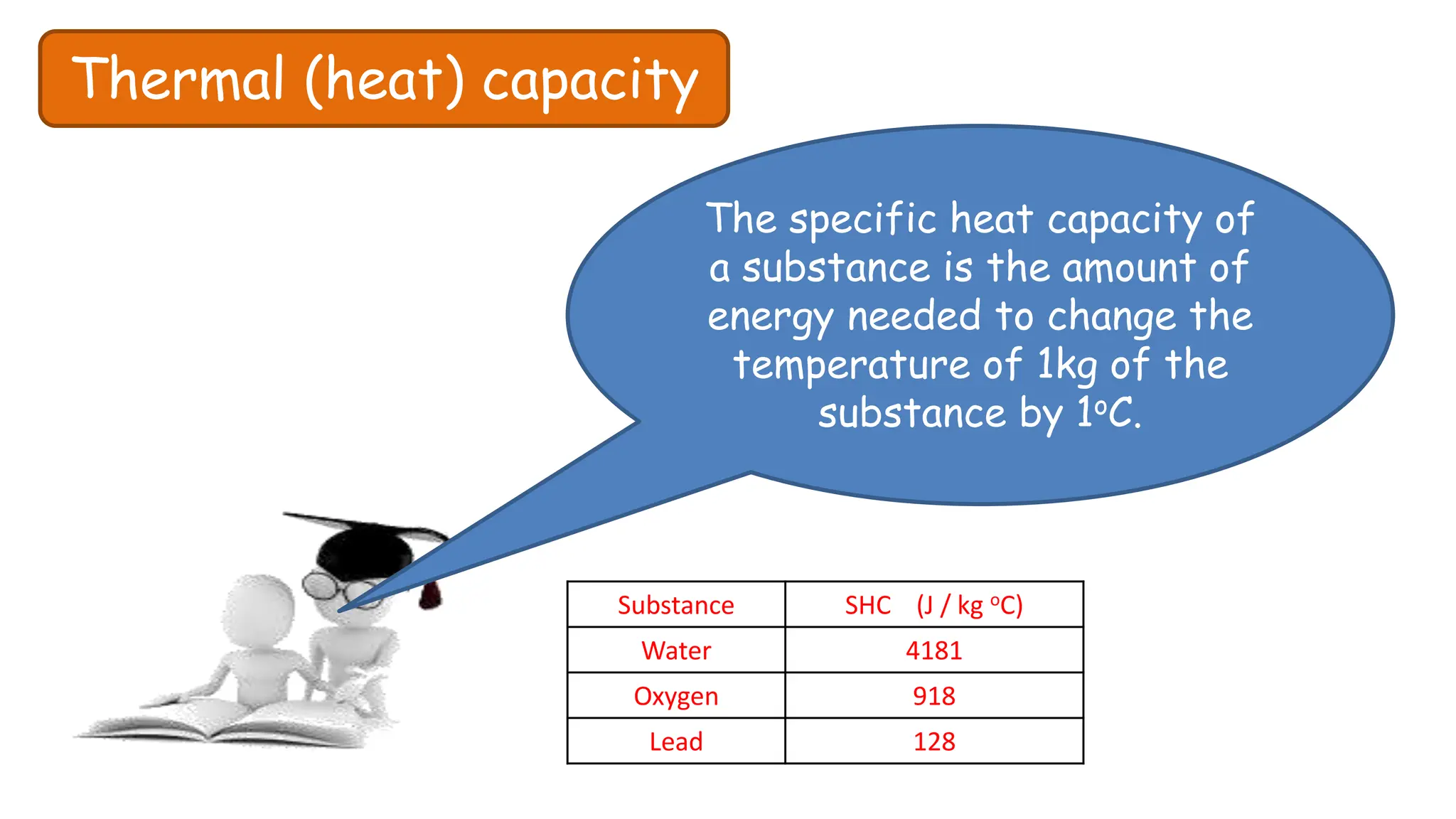
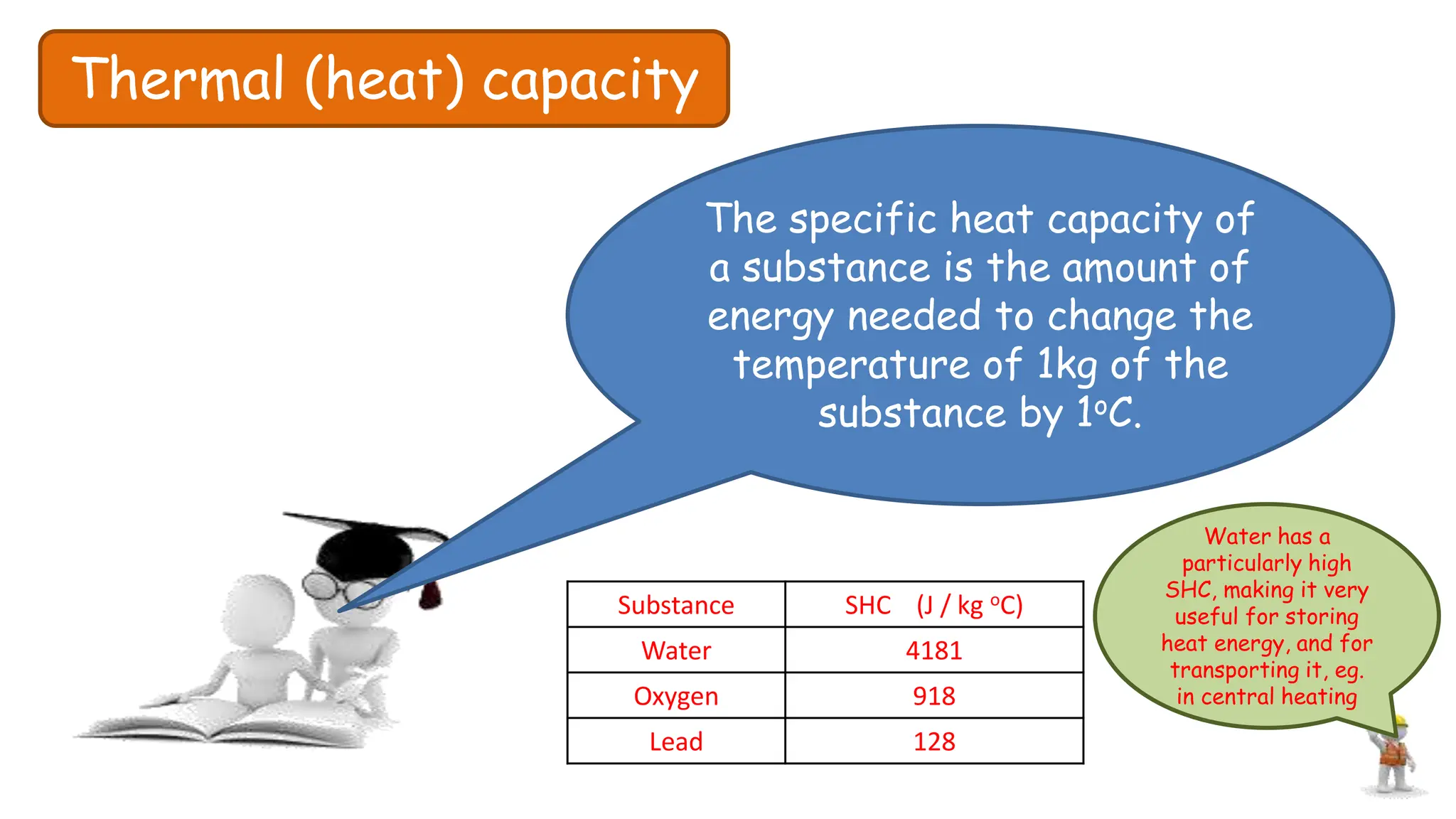
Substance SHC (J / kg oC)
Water 4181
Oxygen 918
Lead 128
Thermal (heat) capacity
The specific heat capacity of
a substance is the amount of
energy needed to change the
temperature of 1kg of the
substance by 1oC.
Substance SHC (J / kg oC)
Water 4181
Oxygen 918
Lead 128
Water has a
particularly high
SHC, making it very
useful for storing
heat energy, and for
transporting it, eg.
in central heating
Thermal (heat) capacity
The equation (just what you wanted!)
Thermal (heat) capacity
The equation (just what you wanted!)
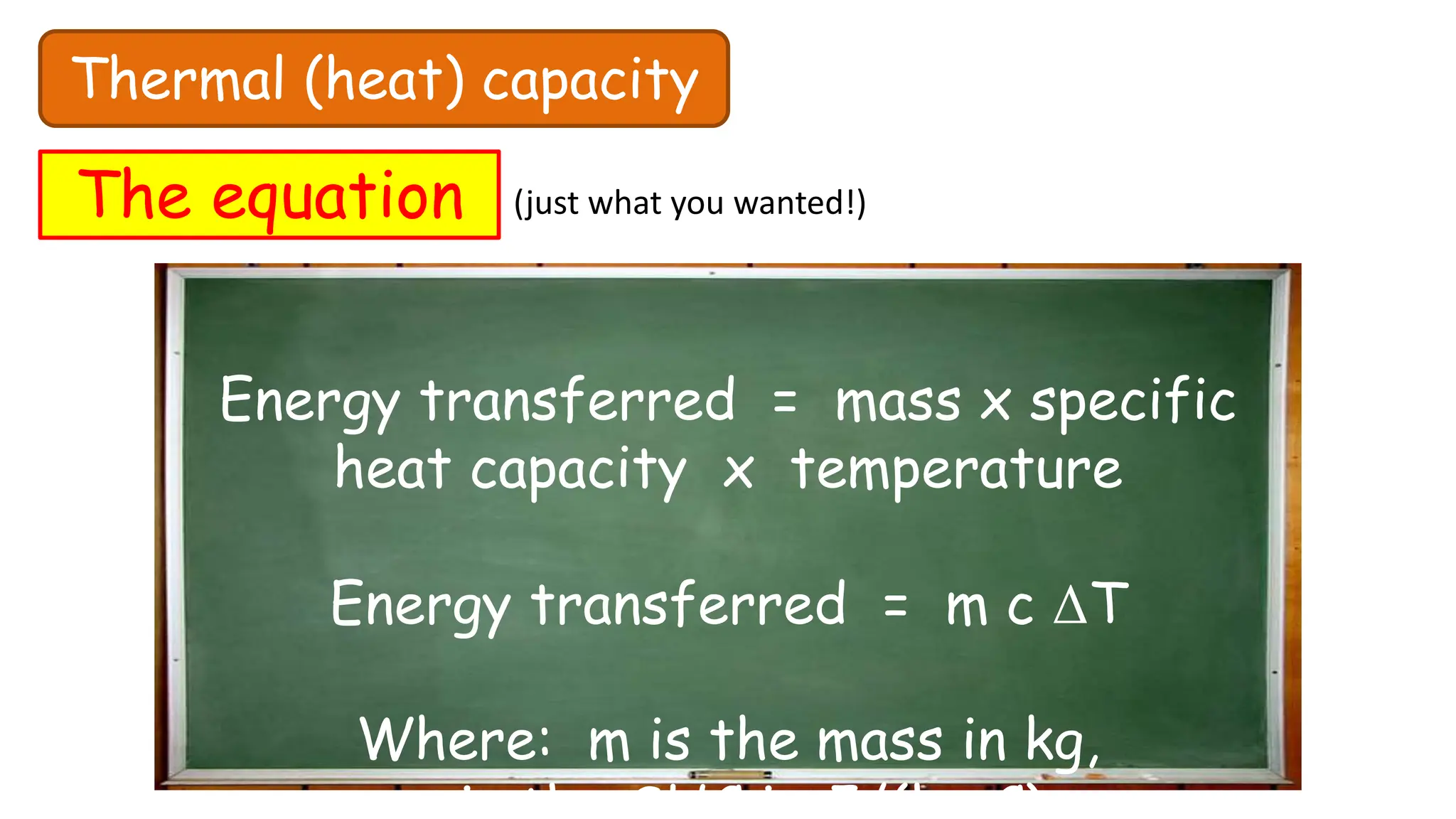
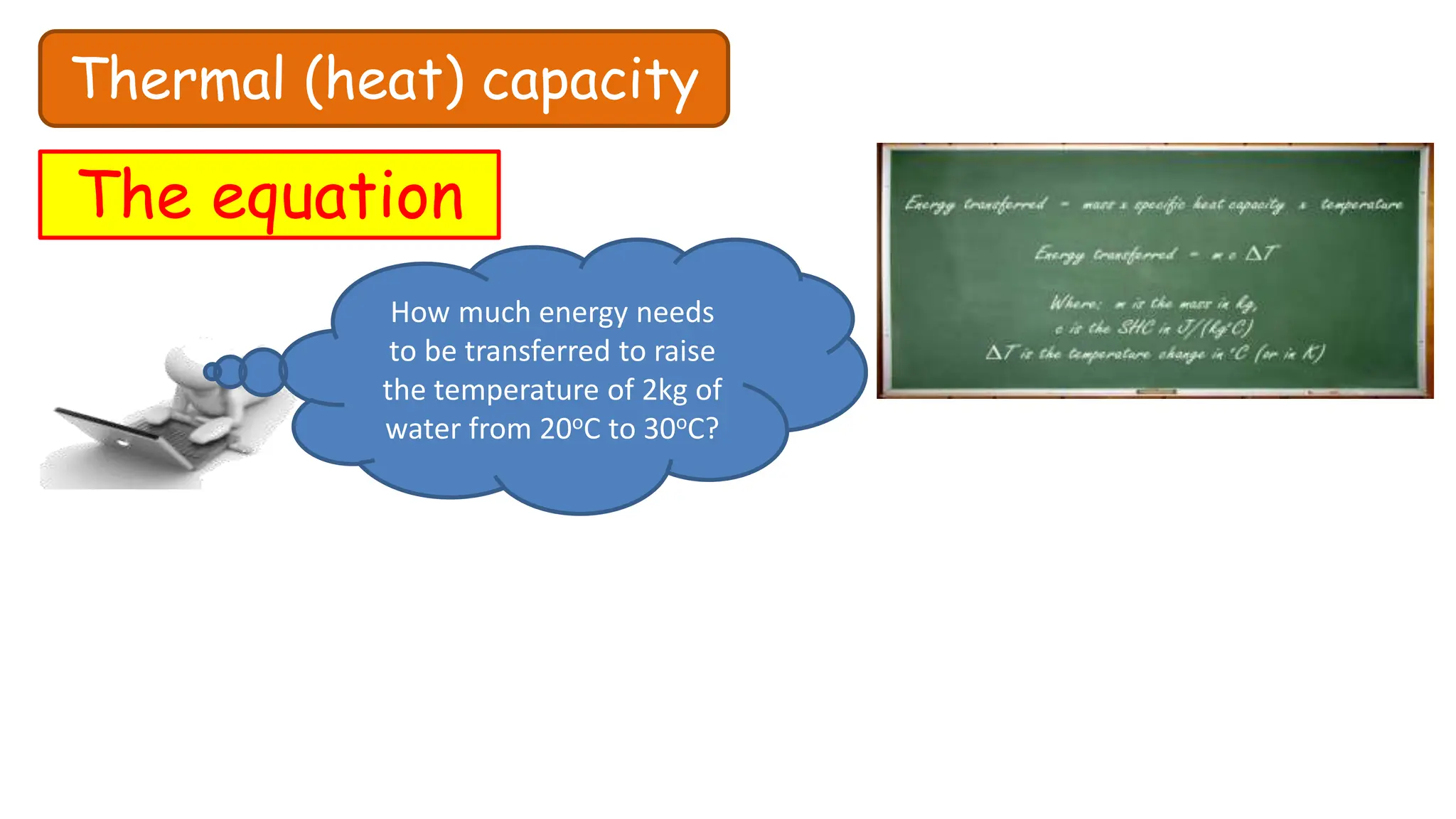
Energy transferred = mass x specific
heat capacity x temperature
Energy transferred = m c ΔT
Where: m is the mass in kg,
o
Thermal (heat) capacity
The equation
How much energy needs
to be transferred to raise
the temperature of 2kg of
water from 20oC to 30oC?
Thermal (heat) capacity
The equation
How much energy needs
to be transferred to raise
the temperature of 2kg of
water from 20oC to 30oC?
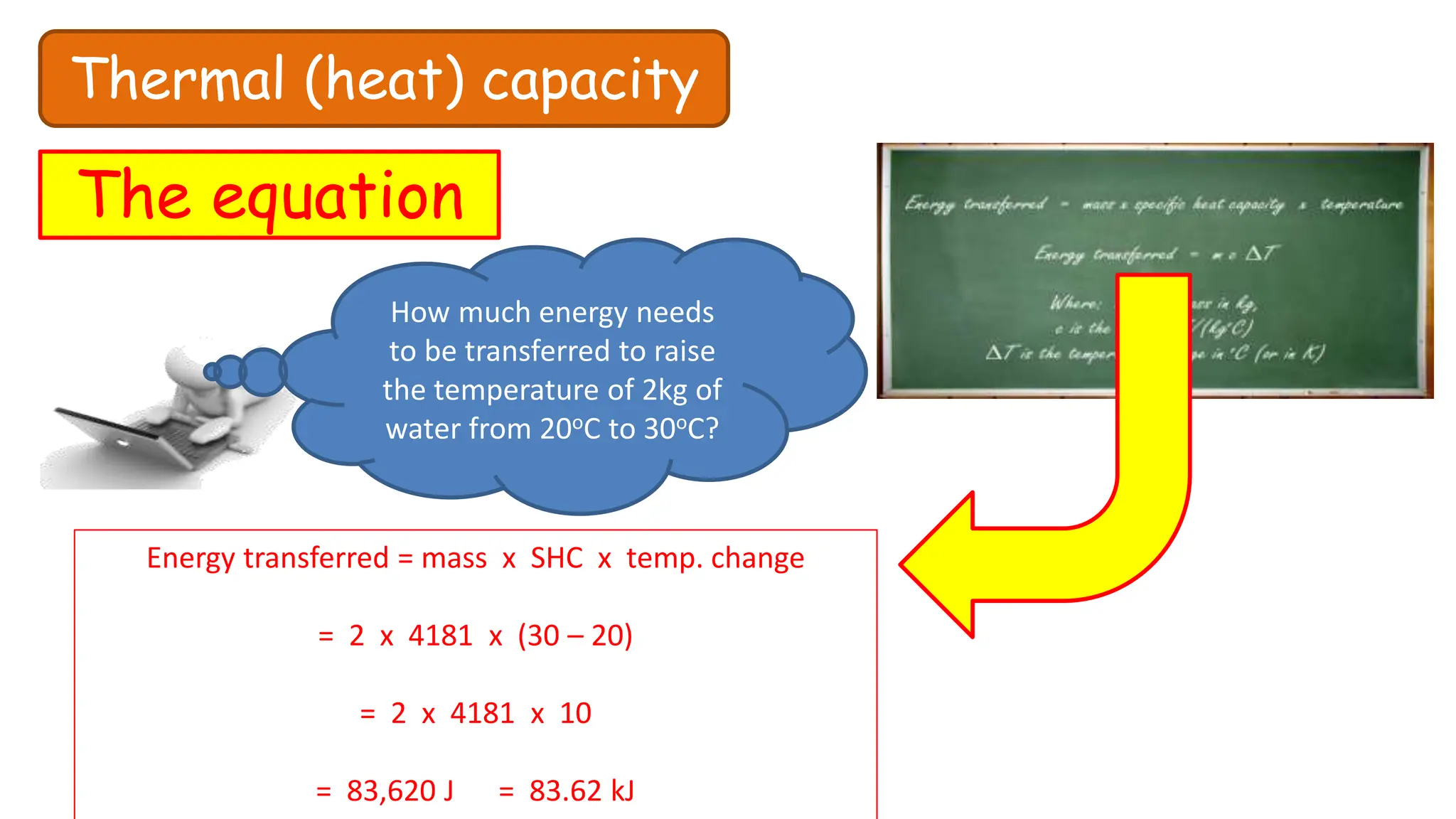
Energy transferred = mass x SHC x temp. change
= 2 x 4181 x (30 – 20)
= 2 x 4181 x 10
= 83,620 J = 83.62 kJ
Thermal (heat) capacity
So what’s this
‘thermal capacity’
bit?
Thermal (heat) capacity
So what’s this
‘thermal capacity’
bit?
Thermal capacity = mass x SHC
Thermal (heat) capacity
So what’s this
‘thermal capacity’
bit?
Thermal capacity = mass x SHC
eg. If there is 3kg of water in a
kettle:
Thermal capacity = 3 x 4181
= 12,543 J/oC
Thermal (heat) capacity
So what’s this
‘thermal capacity’
bit?
Thermal capacity = mass x SHC
eg. If there is 3kg of water in a
kettle:
Thermal capacity = 3 x 4181
= 12,543 J/oC
This means that for
every 1oC rise in
temperature of the
water in the kettle,
12,543 J of energy
need to be supplied.
Measuring specific heat capacity
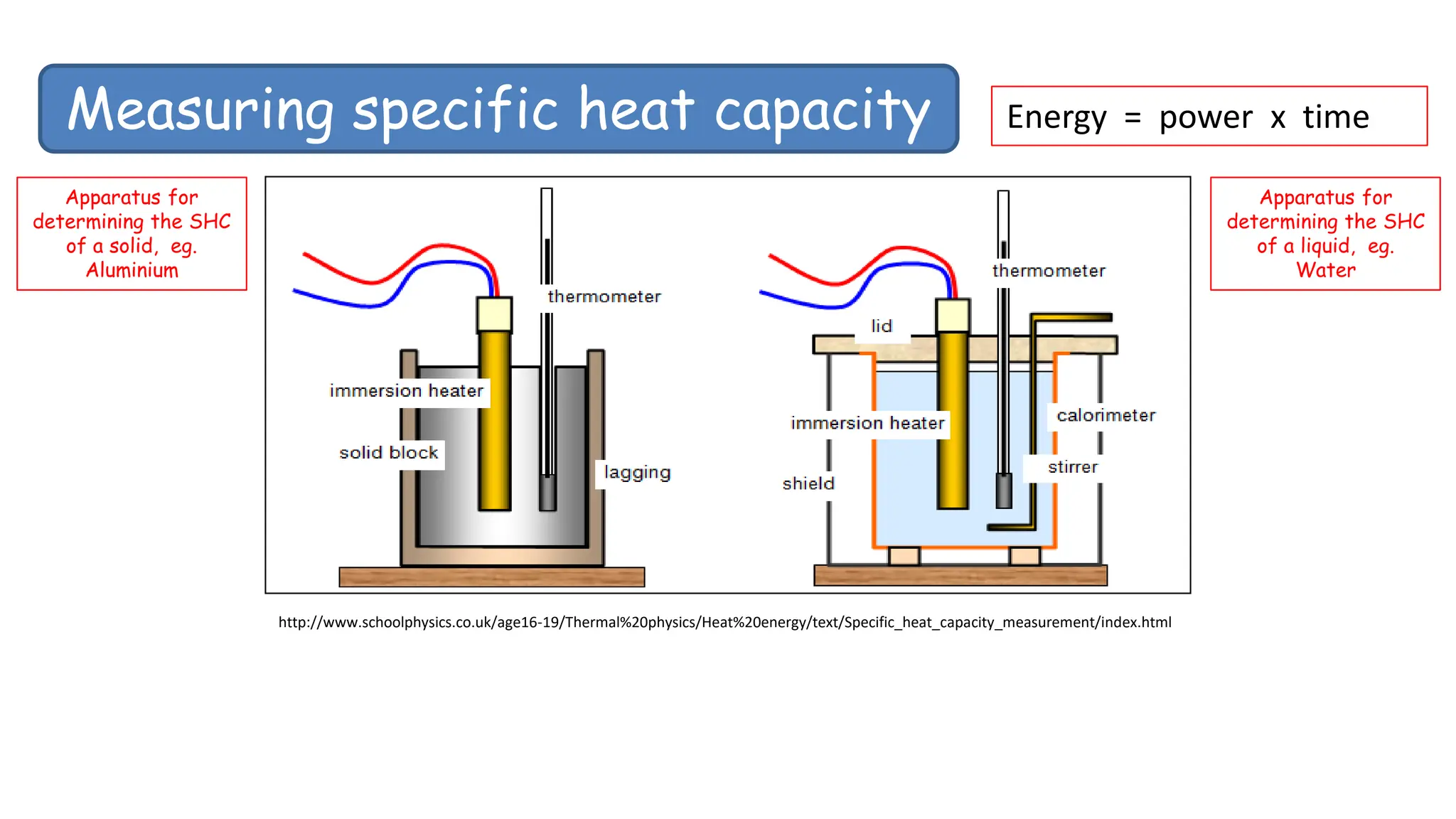
http://www.schoolphysics.co.uk/age16-19/Thermal%20physics/Heat%20energy/text/Specific_heat_capacity_measurement/index.html
Energy = power x time
Apparatus for
determining the SHC
of a solid, eg.
Aluminium
Apparatus for
determining the SHC
of a liquid, eg.
Water
Measuring specific heat capacity
http://www.schoolphysics.co.uk/age16-
19/Thermal%20physics/Heat%20energy/text/Specific_heat_capa
city_measurement/index.html
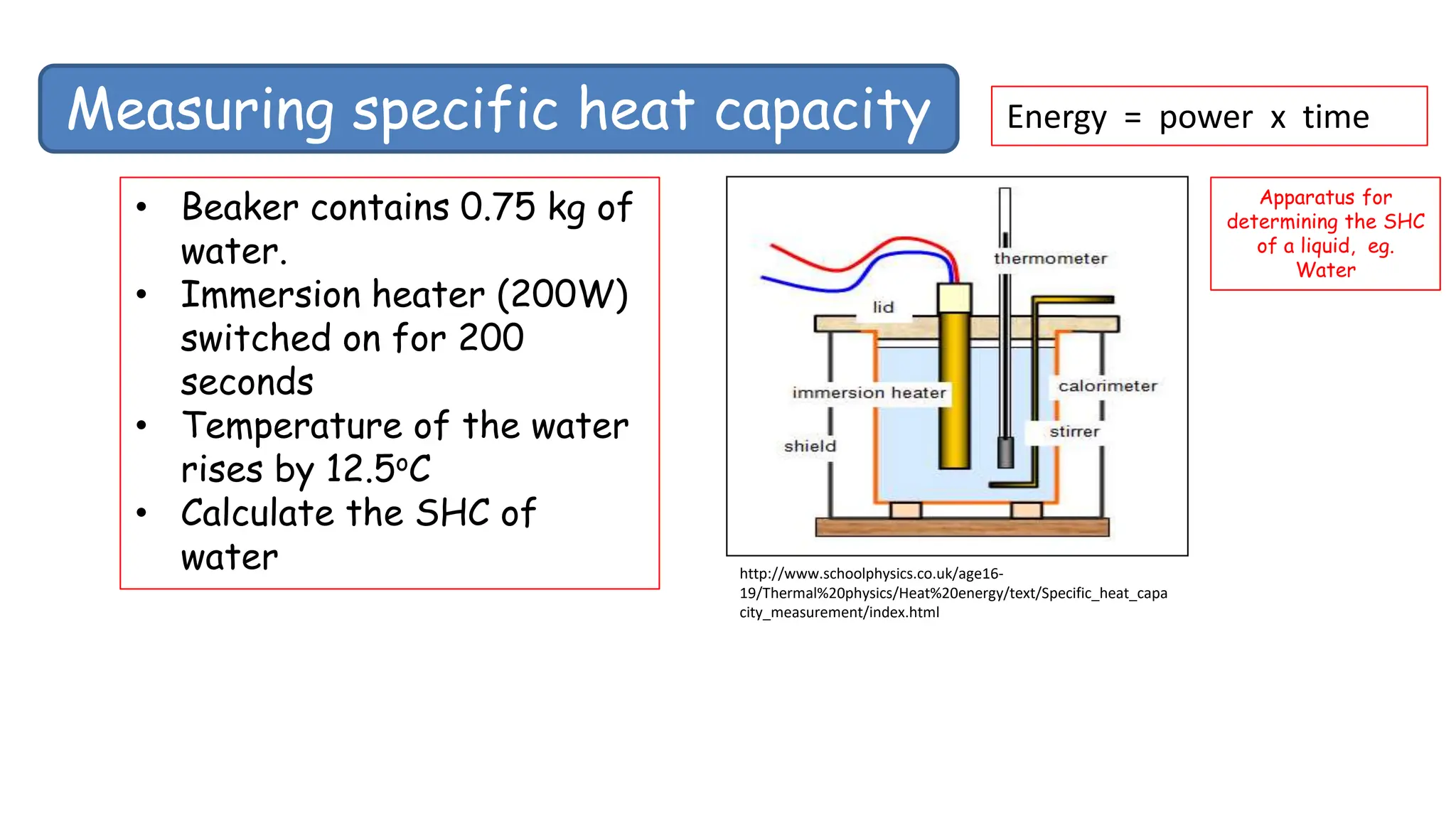
Energy = power x time
Apparatus for
determining the SHC
of a liquid, eg.
Water
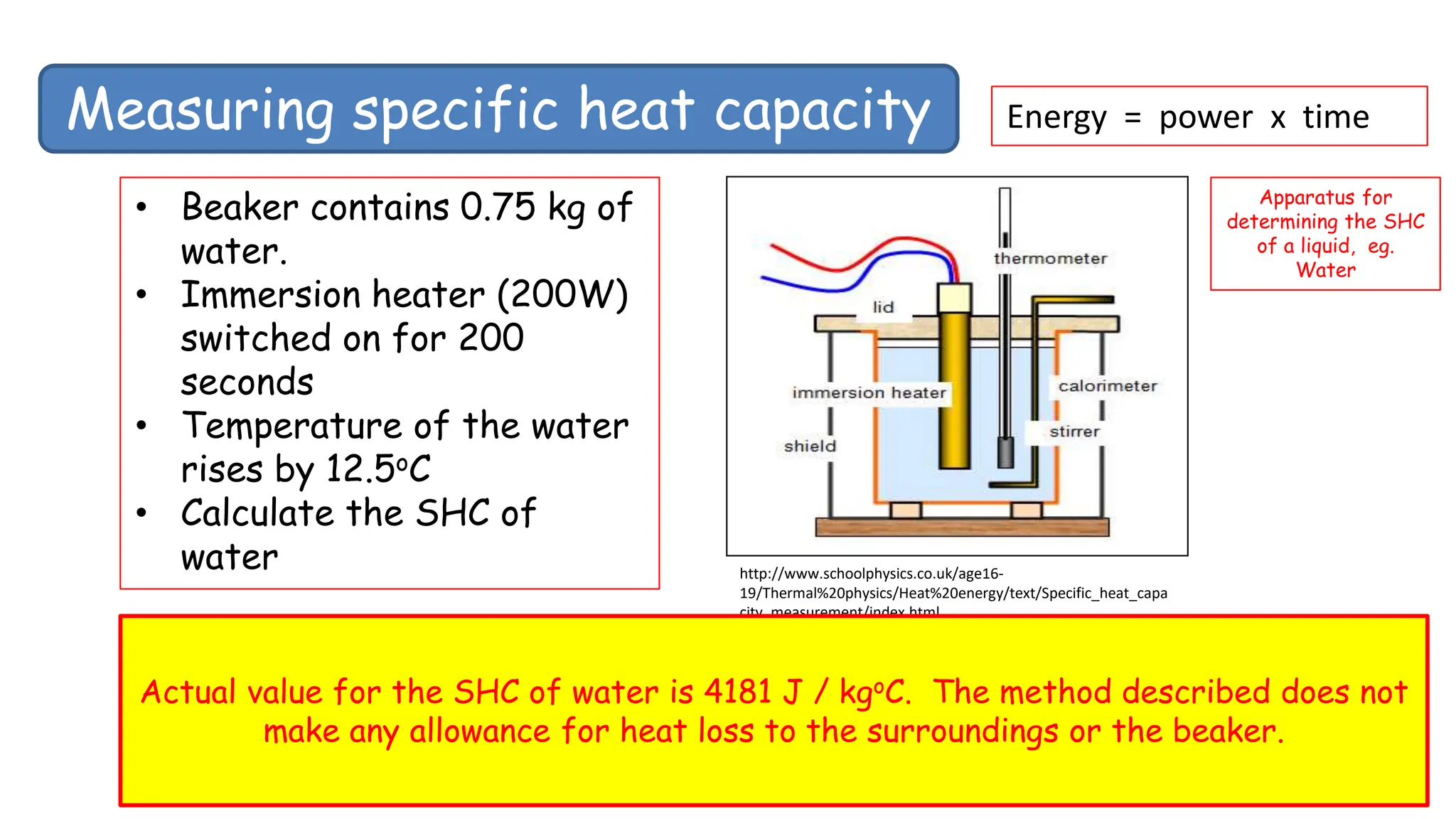
• Beaker contains 0.75 kg of
water.
• Immersion heater (200W)
switched on for 200
seconds
• Temperature of the water
rises by 12.5oC
• Calculate the SHC of
water
Measuring specific heat capacity
http://www.schoolphysics.co.uk/age16-
19/Thermal%20physics/Heat%20energy/text/Specific_heat_capa
city_measurement/index.html
Energy = power x time
Apparatus for
determining the SHC
of a liquid, eg.
Water
• Beaker contains 0.75 kg of
water.
• Immersion heater (200W)
switched on for 200
seconds
• Temperature of the water
rises by 12.5oC
• Calculate the SHC of
water
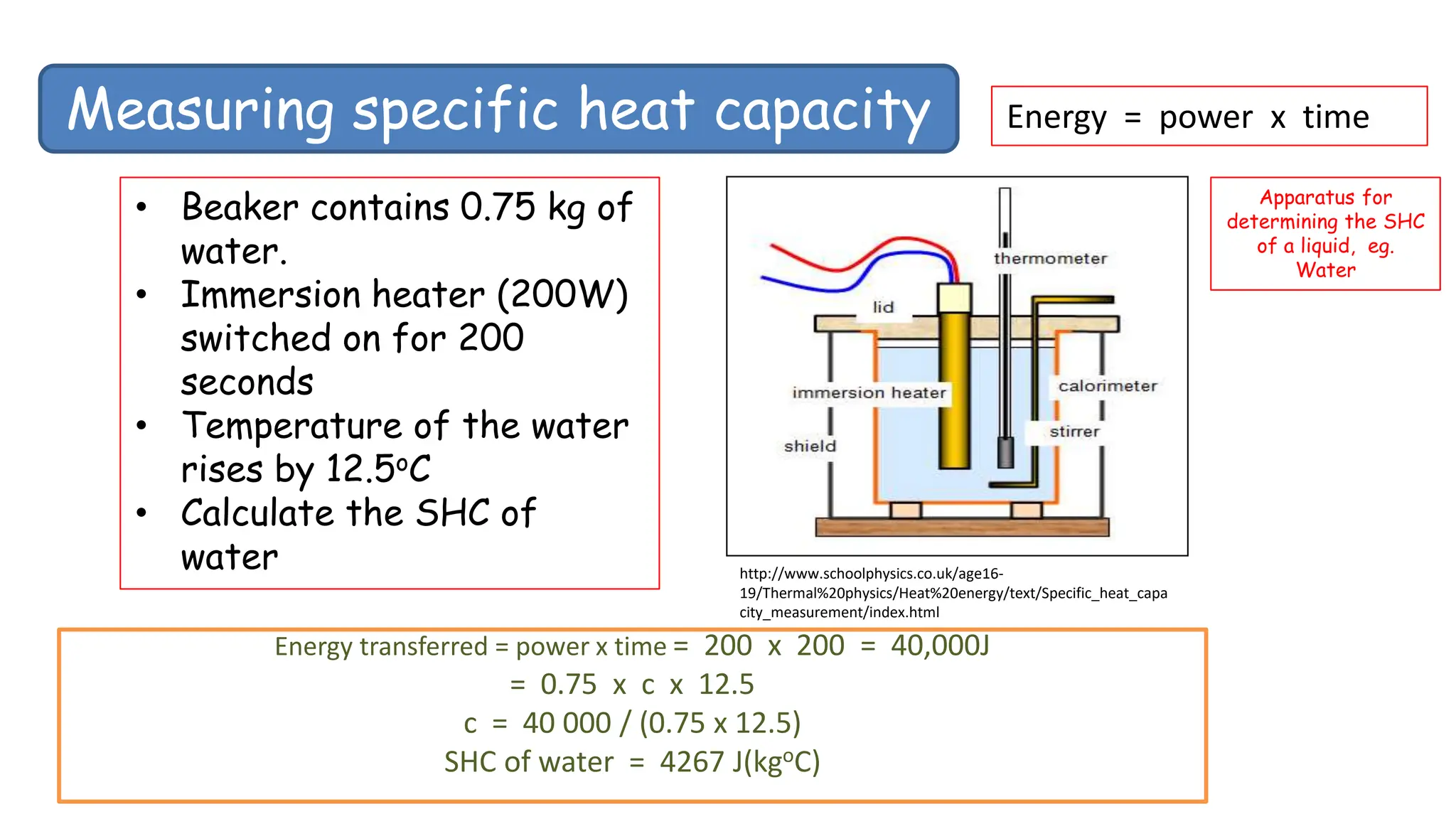
Energy transferred = power x time = 200 x 200 = 40,000J
= 0.75 x c x 12.5
c = 40 000 / (0.75 x 12.5)
SHC of water = 4267 J(kgoC)
Measuring specific heat capacity
http://www.schoolphysics.co.uk/age16-
19/Thermal%20physics/Heat%20energy/text/Specific_heat_capa
city_measurement/index.html
Energy = power x time
Apparatus for
determining the SHC
of a liquid, eg.
Water
• Beaker contains 0.75 kg of
water.
• Immersion heater (200W)
switched on for 200
seconds
• Temperature of the water
rises by 12.5oC
• Calculate the SHC of
water
Actual value for the SHC of water is 4181 J / kgoC. The method described does not
make any allowance for heat loss to the surroundings or the beaker.
Thermal (heat) capacity
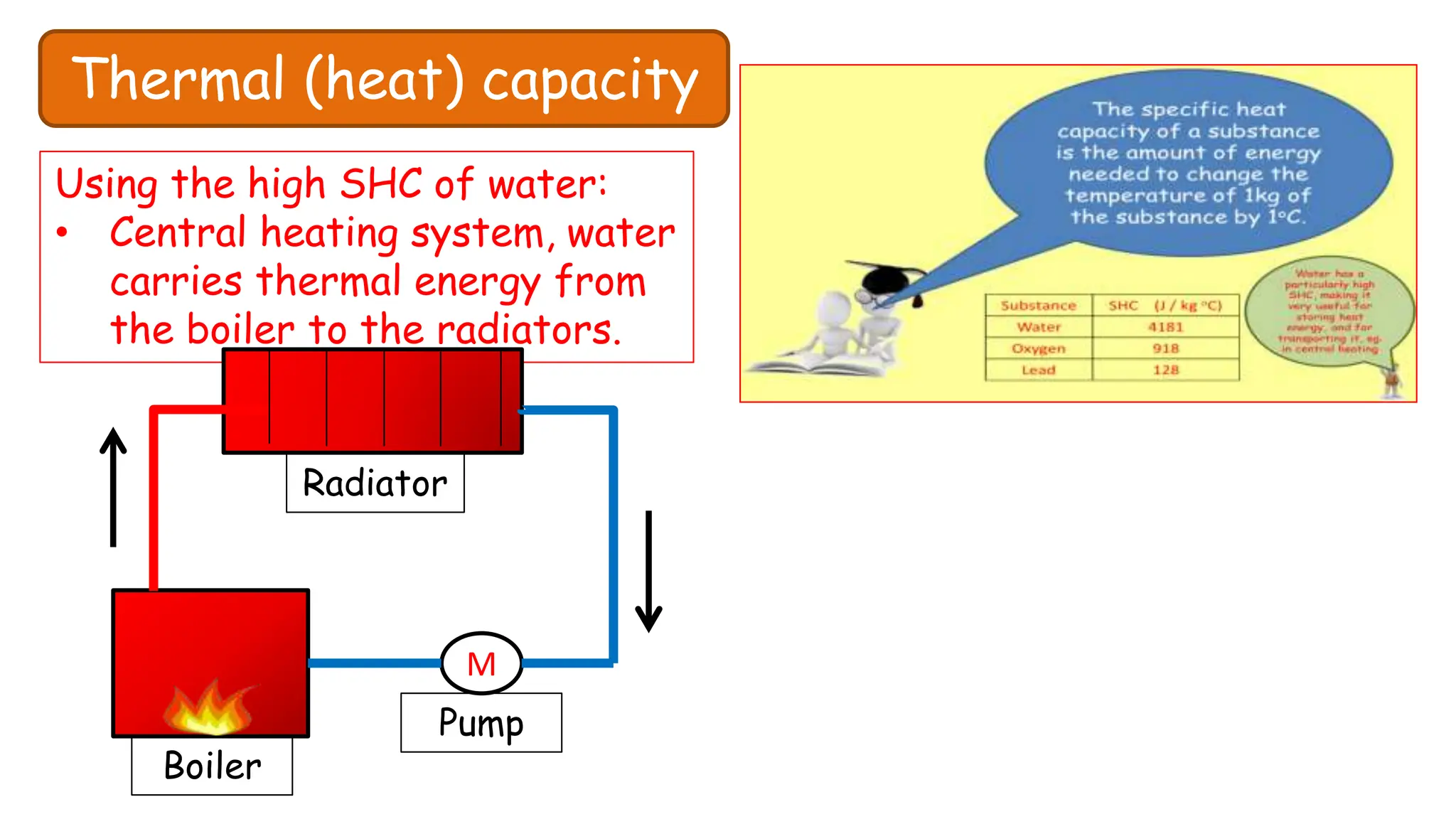
Using the high SHC of water:
• Central heating system, water
carries thermal energy from
the boiler to the radiators.
M
Boiler
Radiator
Pump
Thermal (heat) capacity
Using the high SHC of water:
• Central heating system, water
carries thermal energy from
the boiler to the radiators.
M
Boiler
Radiator
Pump
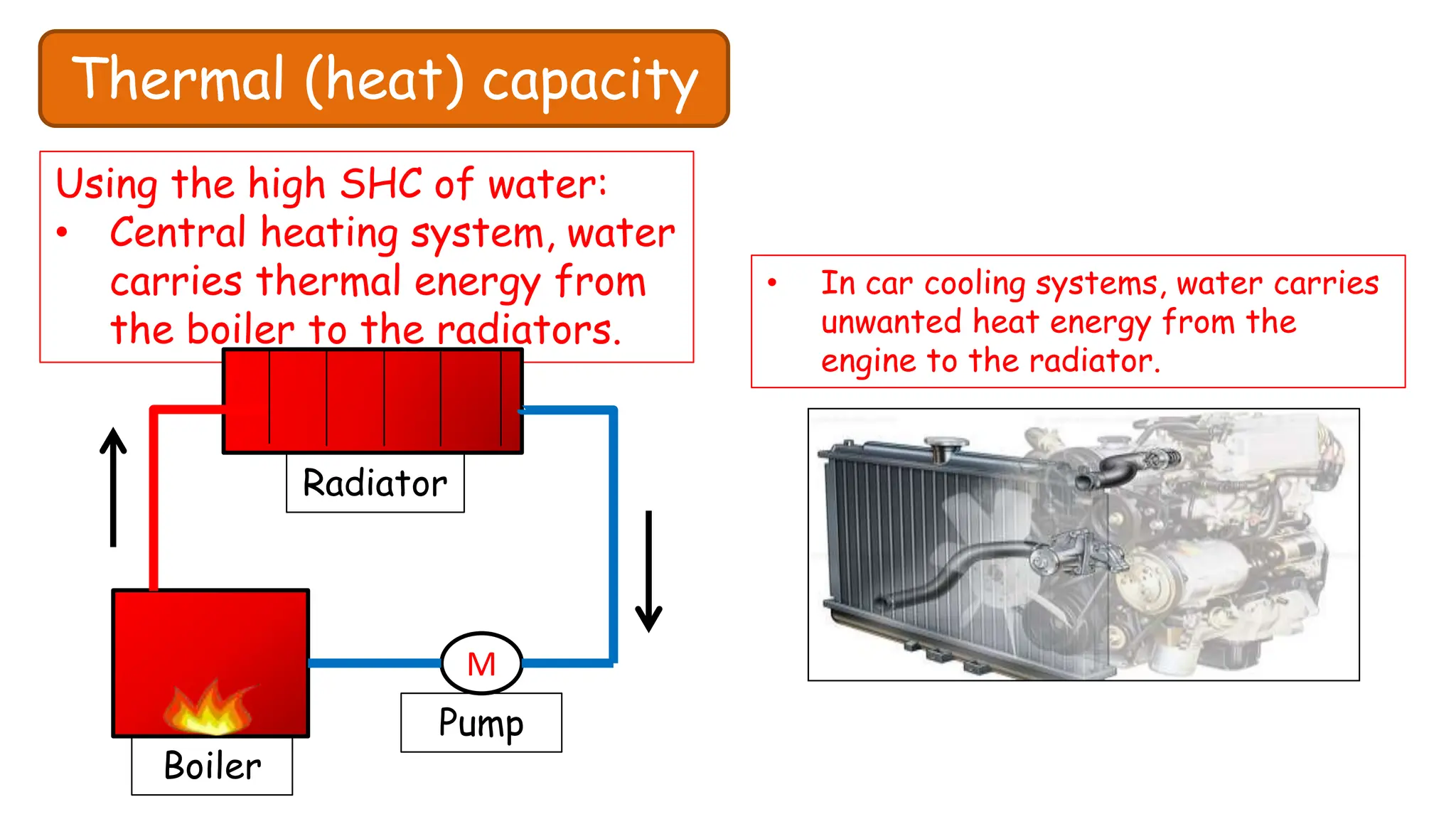
• In car cooling systems, water carries
unwanted heat energy from the
engine to the radiator.
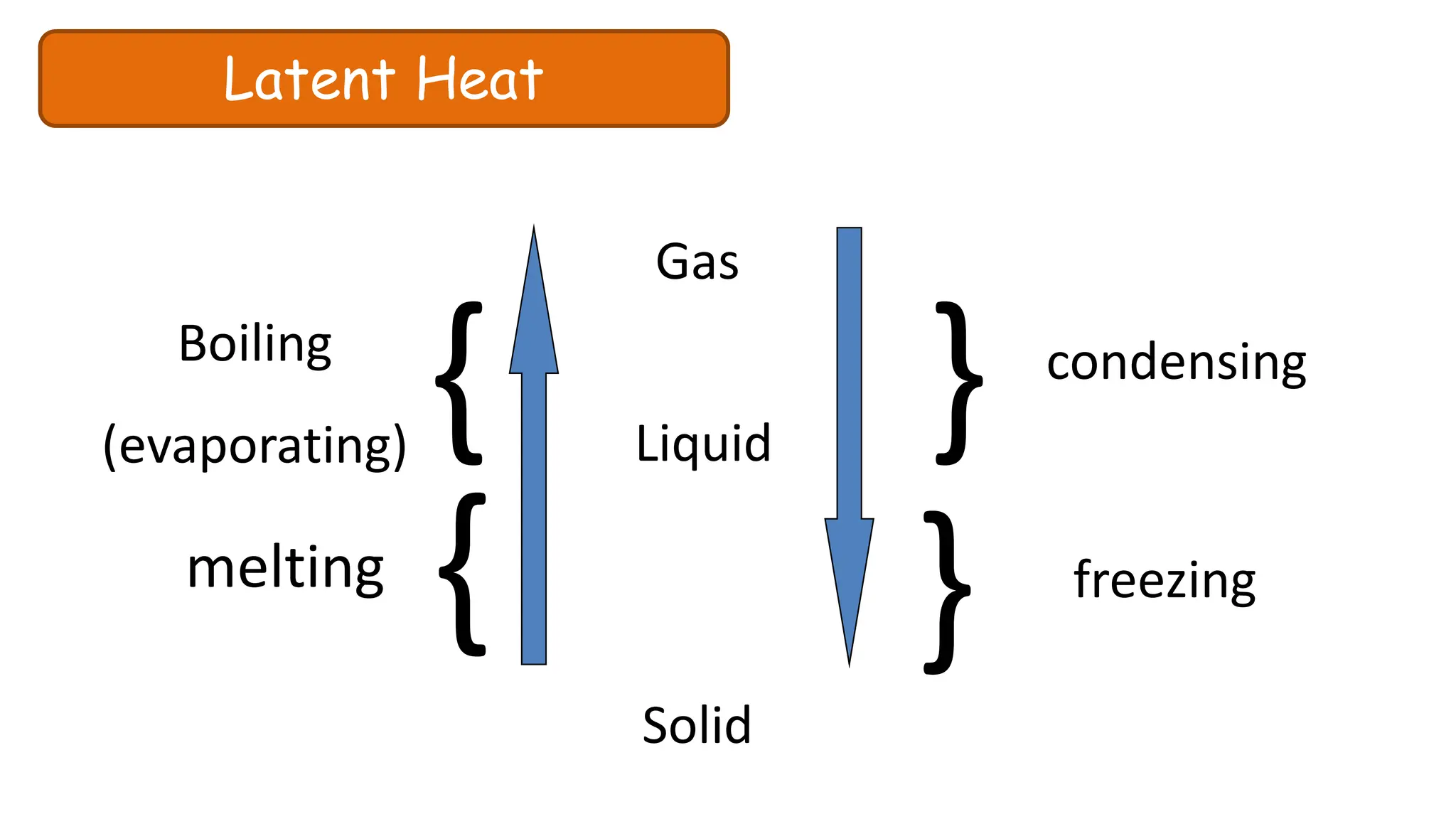
Latent Heat
Solid
Liquid
Gas
{
melting
{
Boiling
(evaporating) } condensing
} freezing
Latent Heat
Solid
Liquid
Gas
{
melting
{
Boiling
(evaporating) } condensing
} freezing
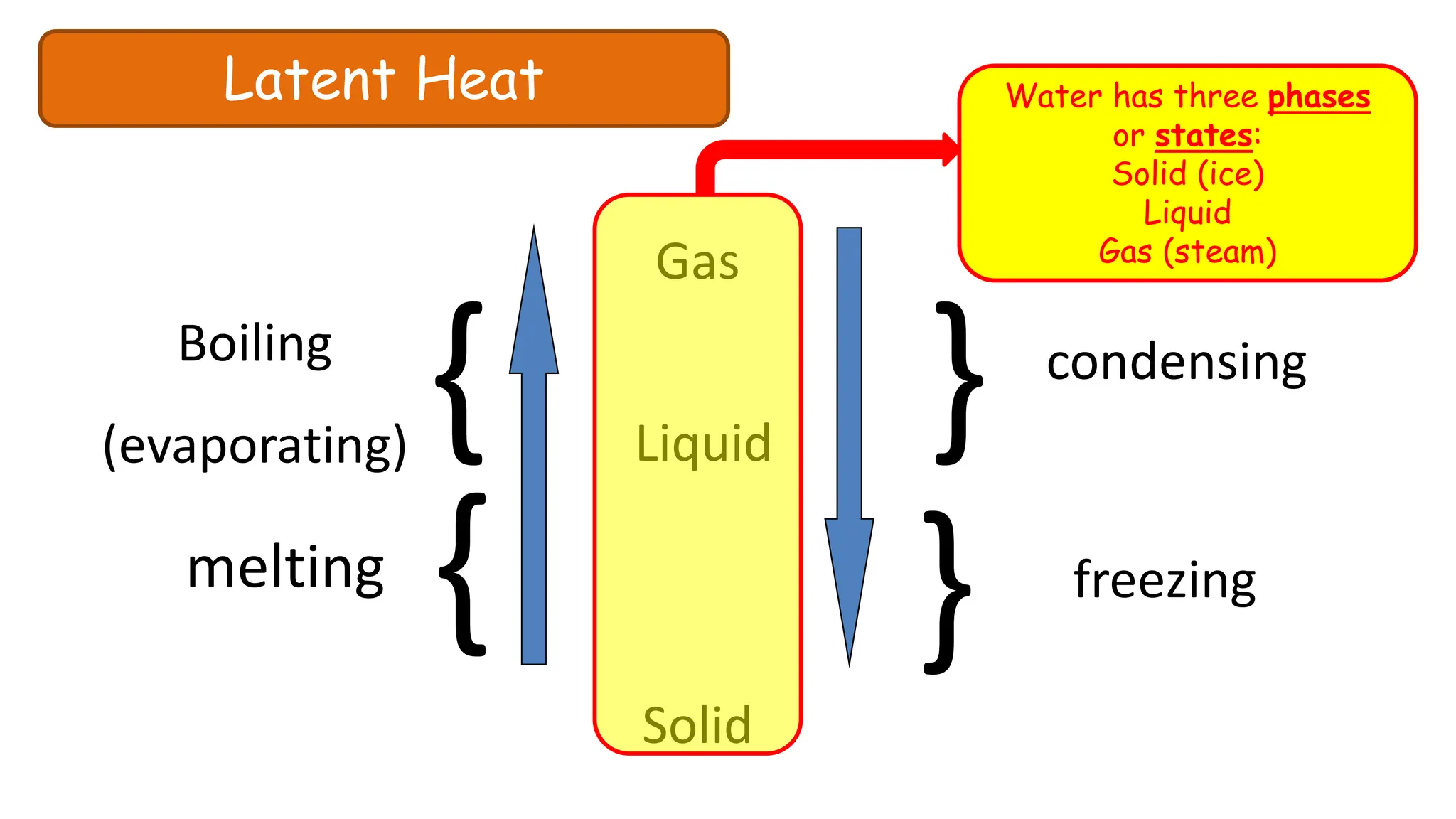
Latent Heat Water has three phases
or states:
Solid (ice)
Liquid
Gas (steam)
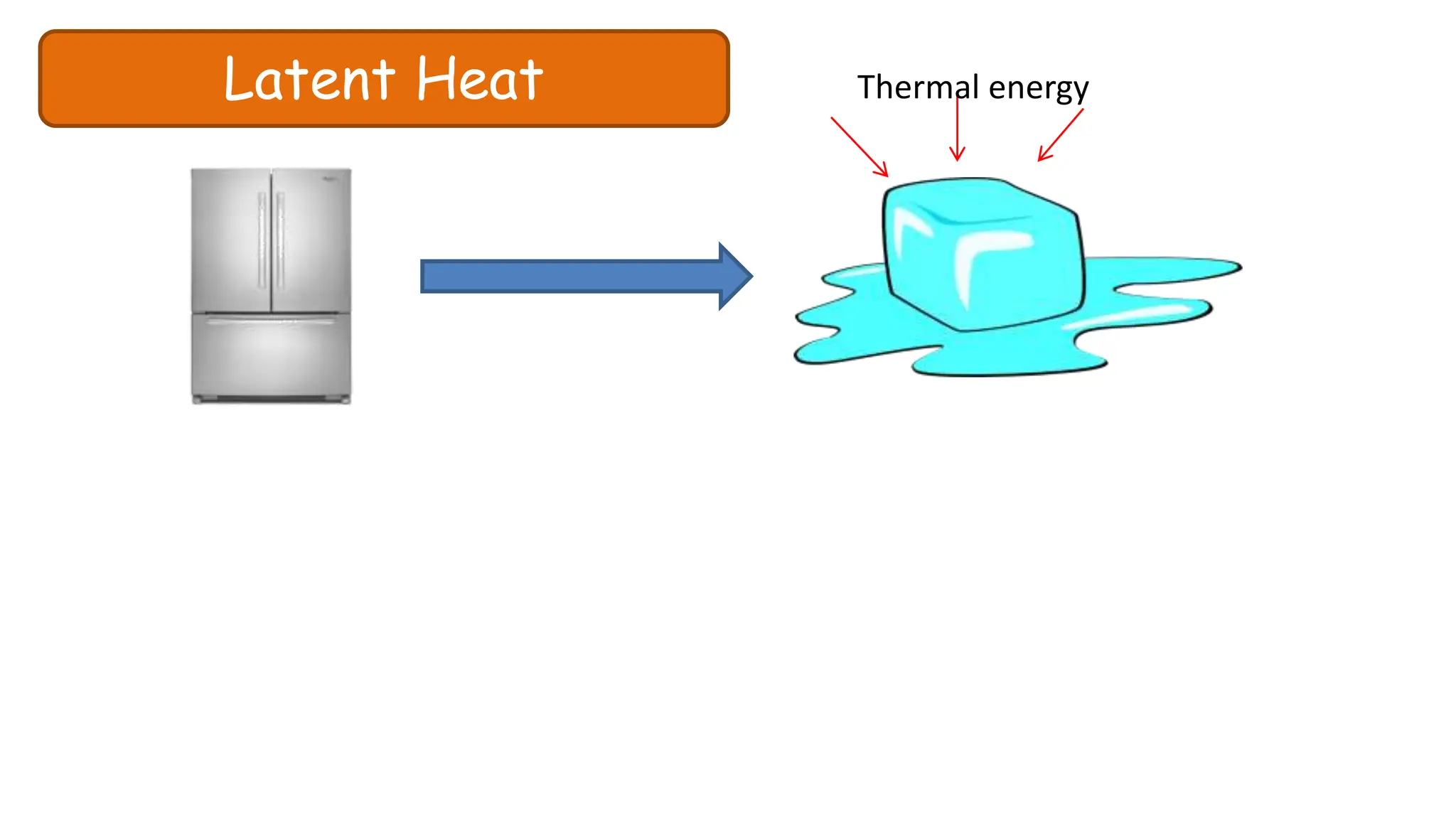
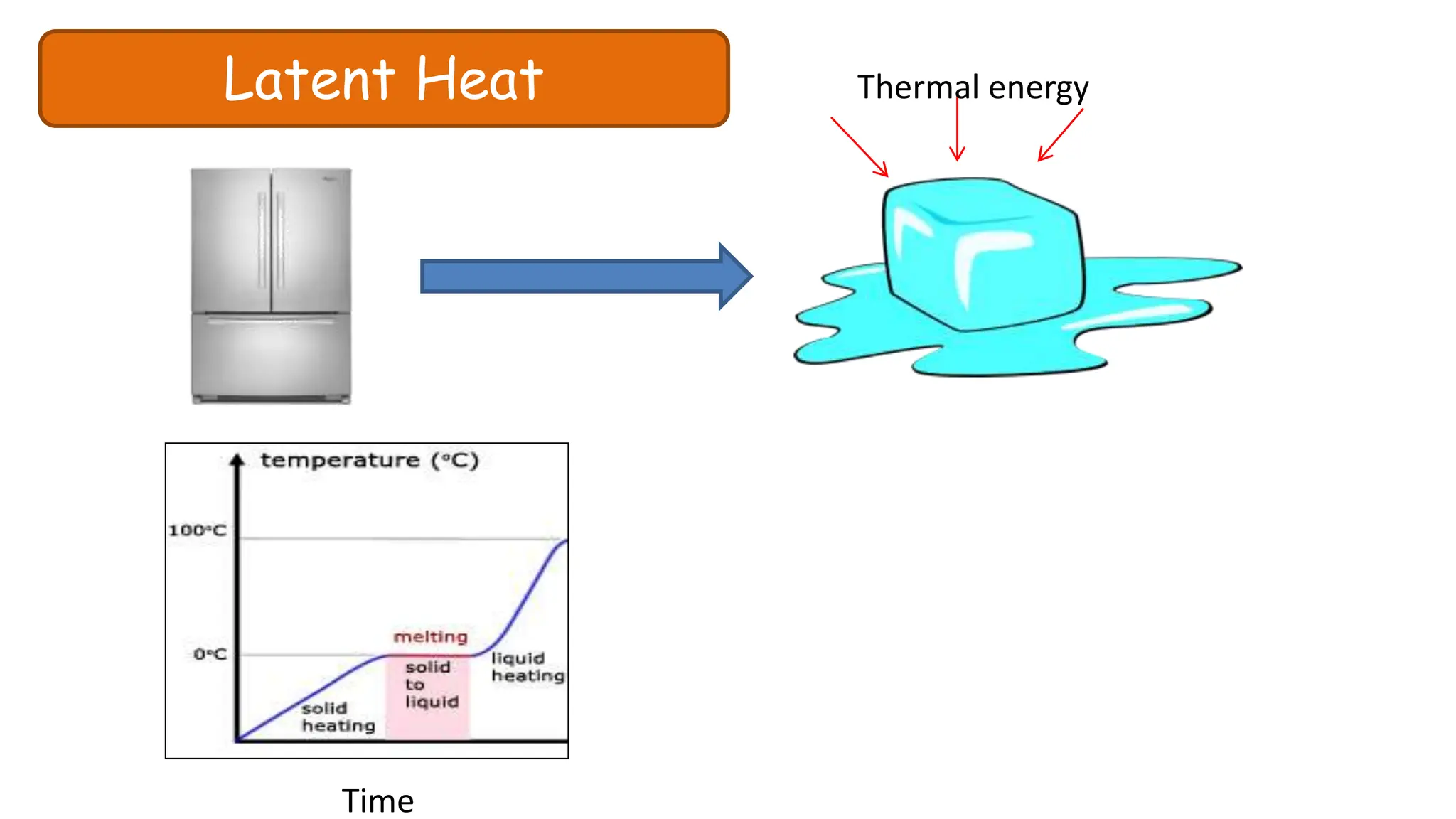
Latent Heat Thermal energy
Time
Latent Heat Thermal energy
Time
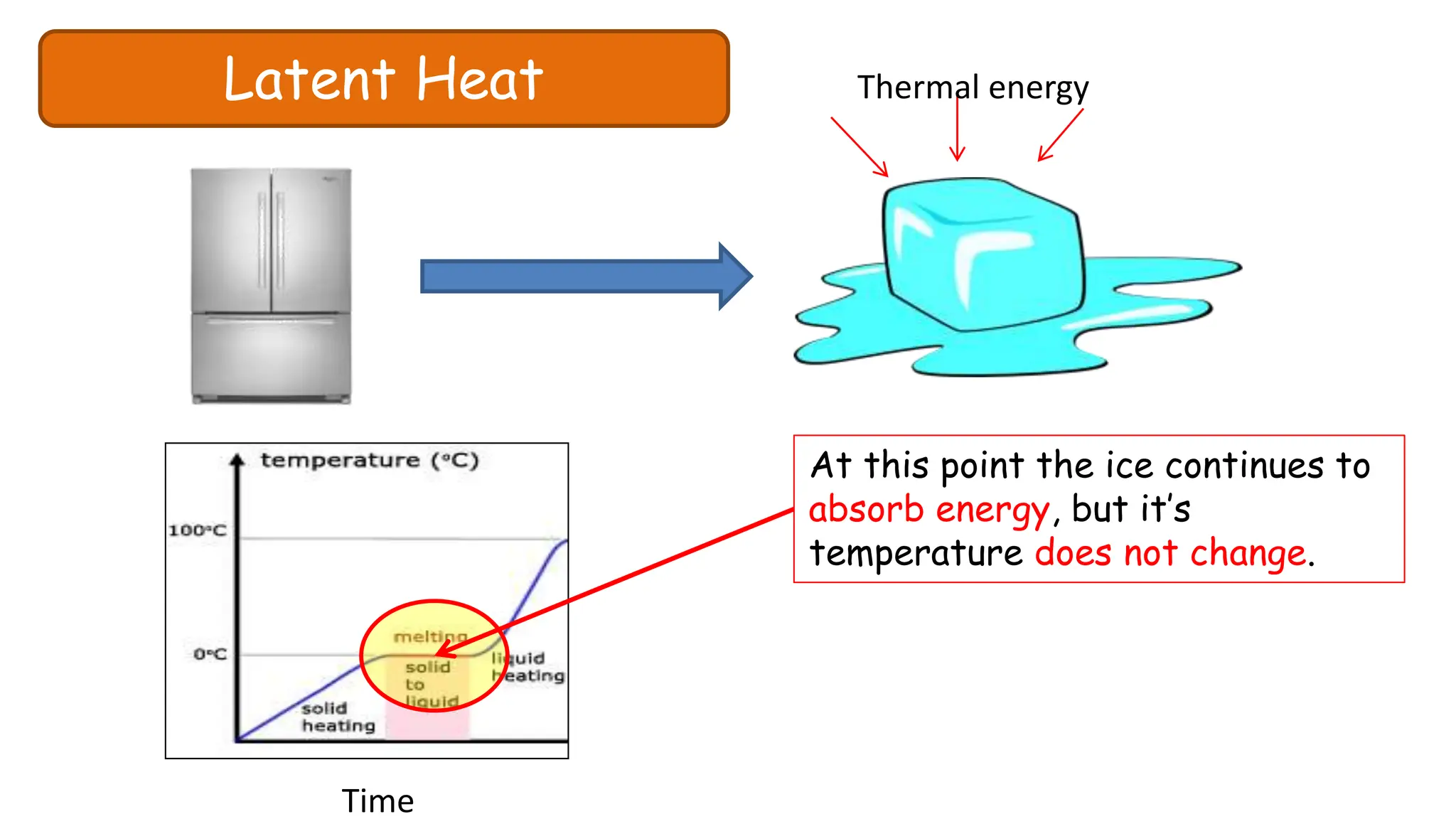
At this point the ice continues to
absorb energy, but it’s
temperature does not change.
Latent Heat Thermal energy
Time
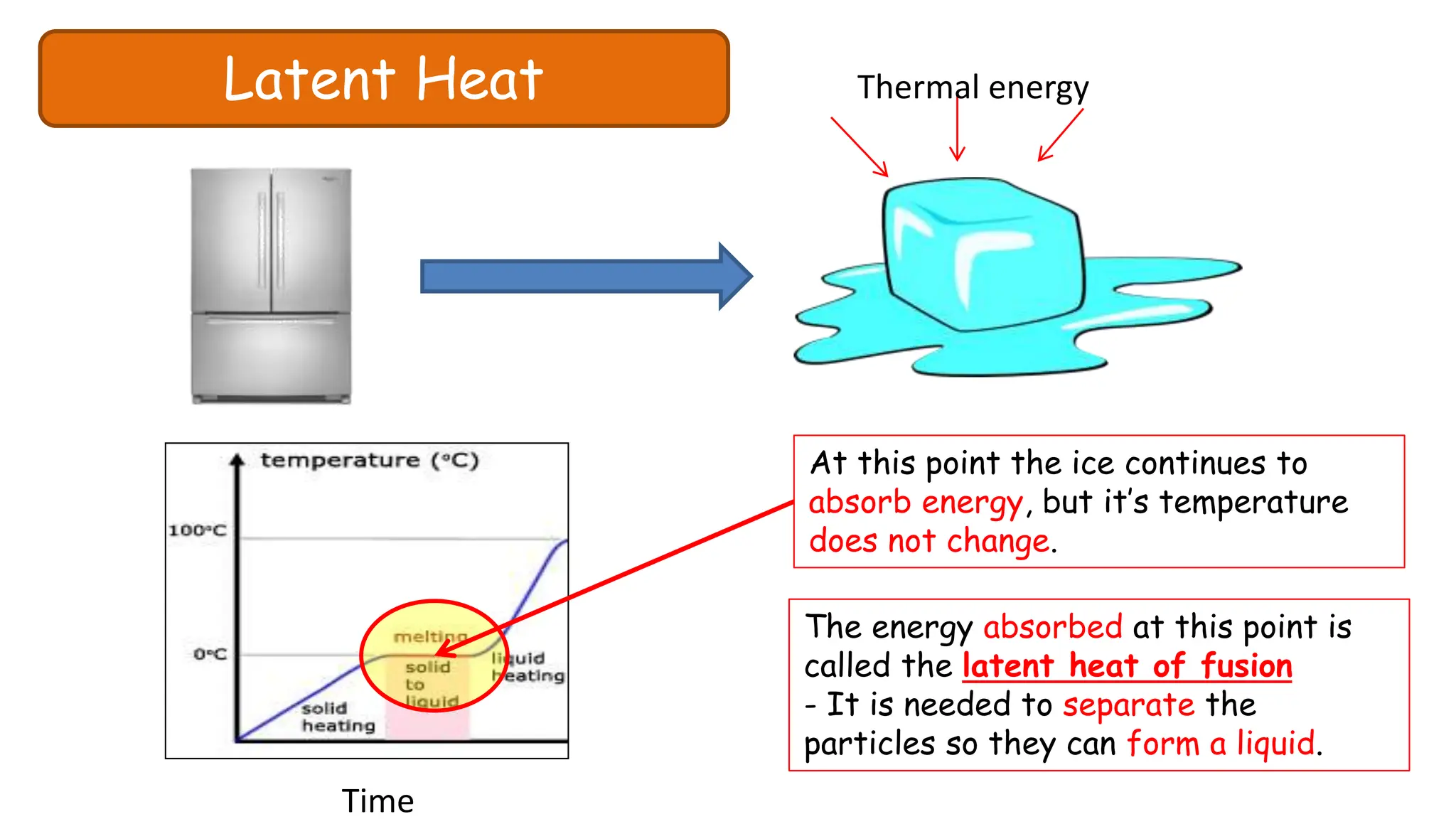
At this point the ice continues to
absorb energy, but it’s temperature
does not change.
The energy absorbed at this point is
called the latent heat of fusion
- It is needed to separate the
particles so they can form a liquid.
Latent Heat Thermal energy
Time
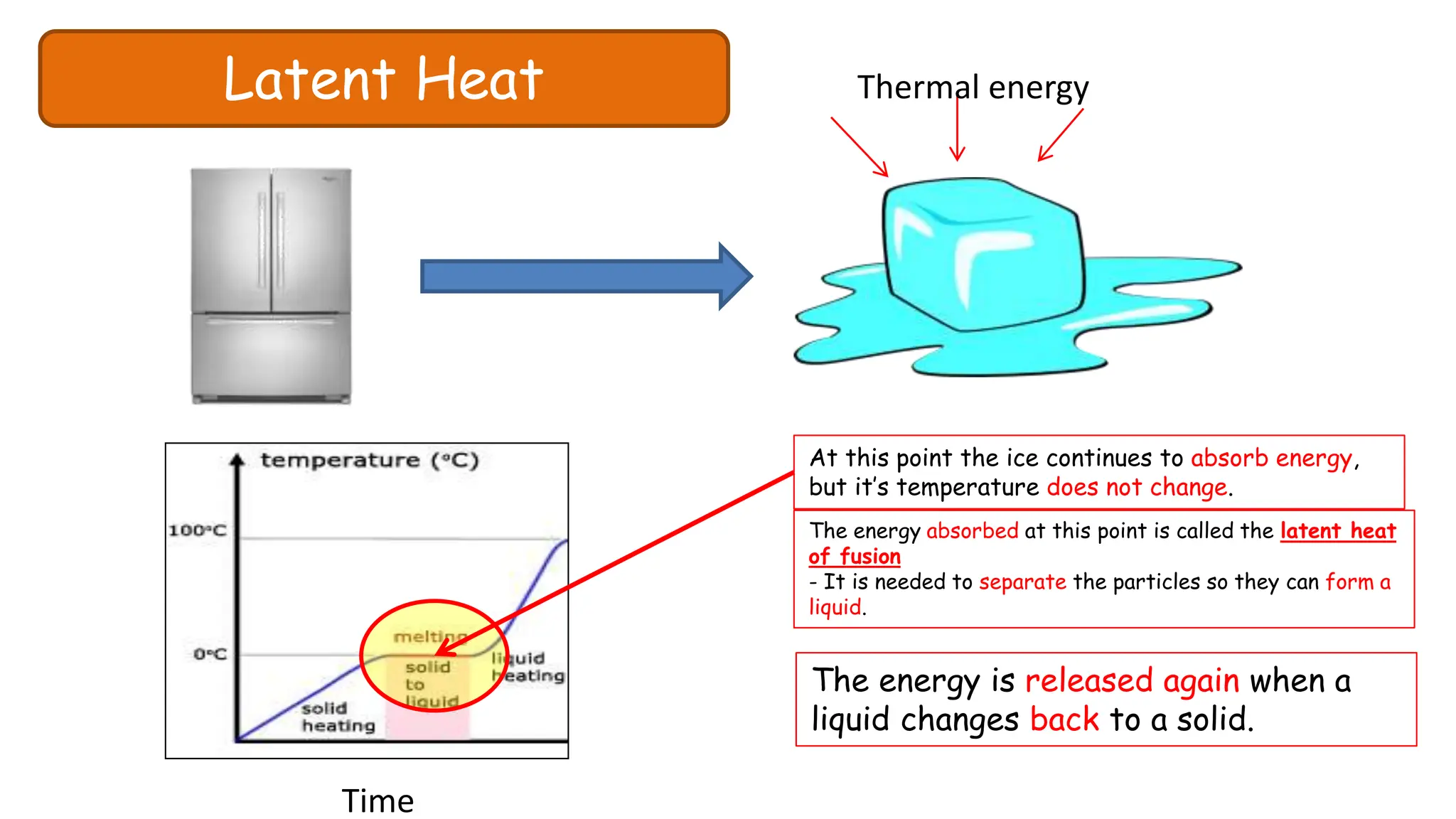
At this point the ice continues to absorb energy,
but it’s temperature does not change.
The energy absorbed at this point is called the latent heat
of fusion
- It is needed to separate the particles so they can form a
liquid.
The energy is released again when a
liquid changes back to a solid.
Latent Heat
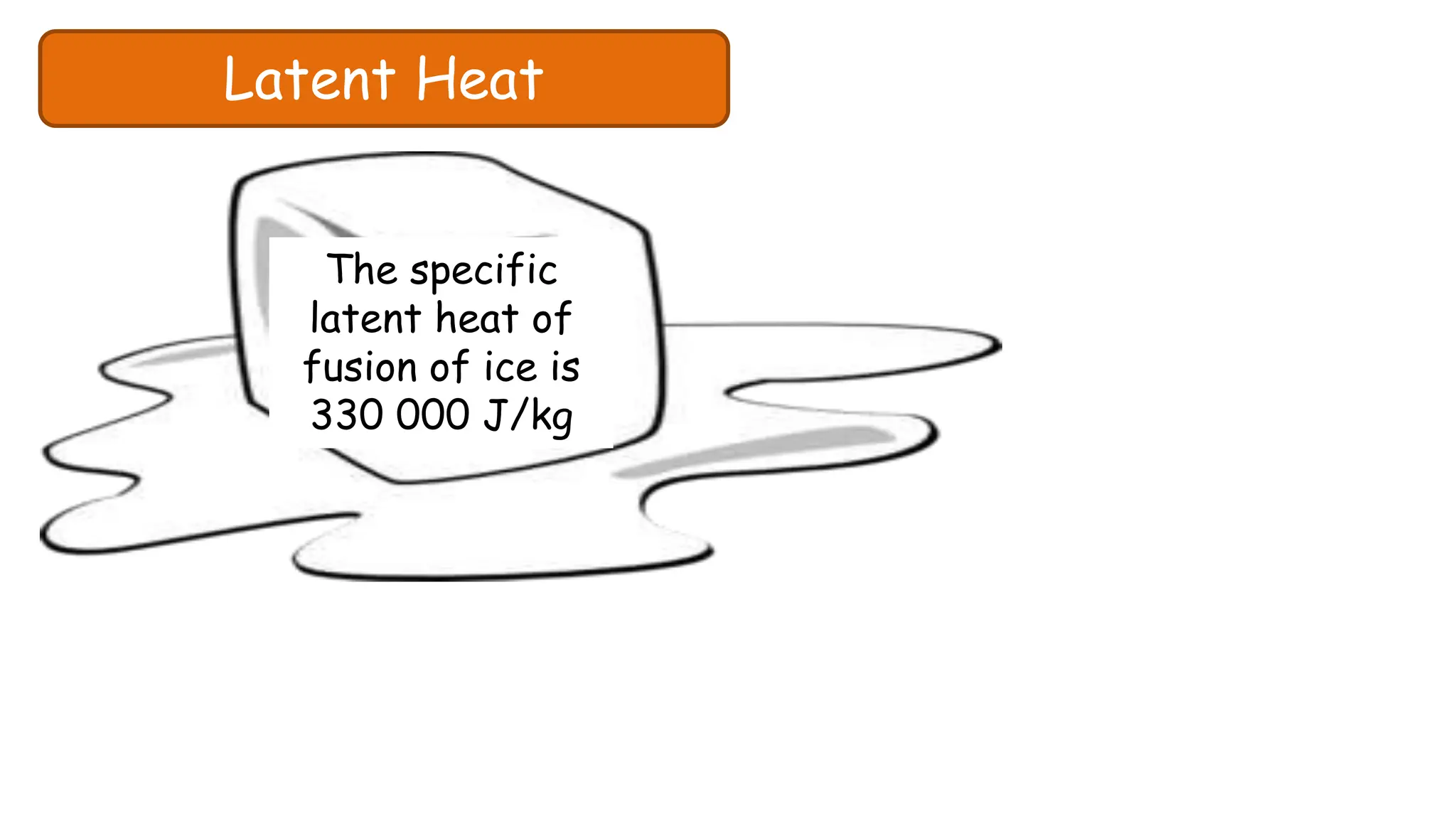
The specific
latent heat of
fusion of ice is
330 000 J/kg
Latent Heat
The specific
latent heat of
fusion of ice is
330 000 J/kg
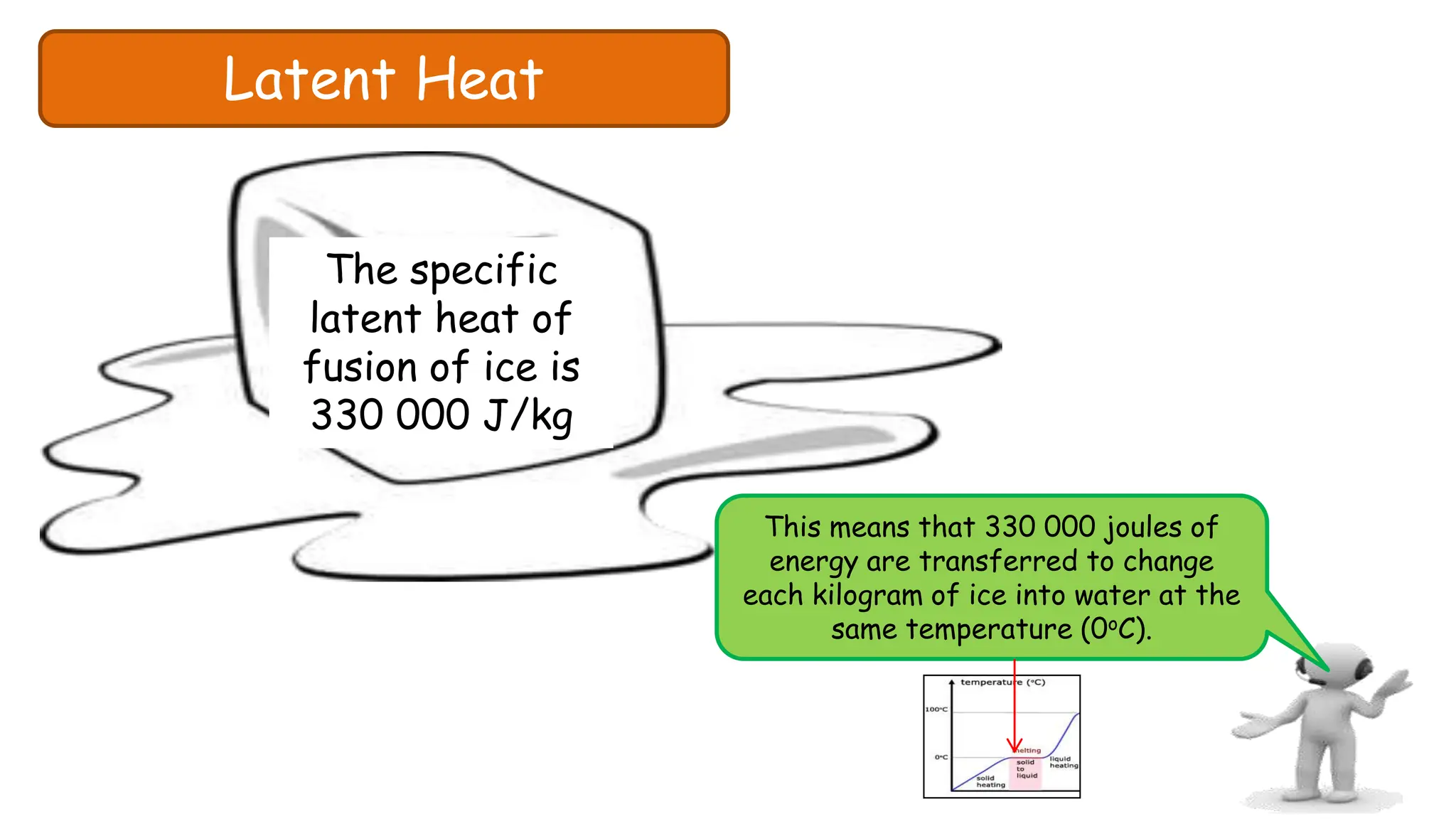
This means that 330 000 joules of
energy are transferred to change
each kilogram of ice into water at the
same temperature (0oC).
Latent Heat
The specific
latent heat of
fusion of ice is
330 000 J/kg
This means that 330 000 joules of
energy are transferred to change
each kilogram of ice into water at the
same temperature (0oC).
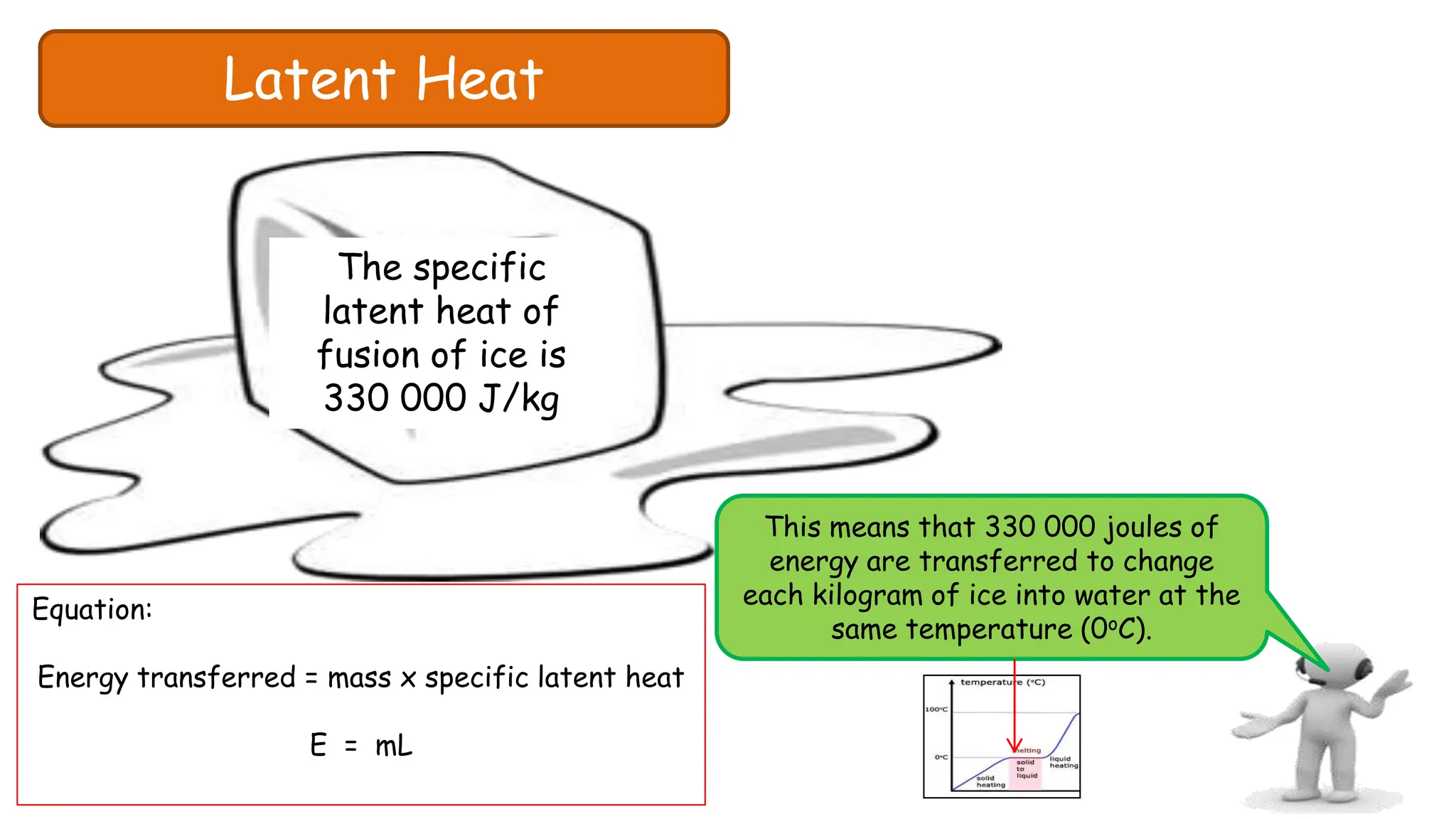
Equation:
Energy transferred = mass x specific latent heat
E = mL
Latent Heat
The specific
latent heat of
fusion of ice is
330 000 J/kg
This means that 330 000 joules of
energy are transferred to change
each kilogram of ice into water at the
same temperature (0oC).
Equation:
Energy transferred = mass x specific latent heat
E = mL
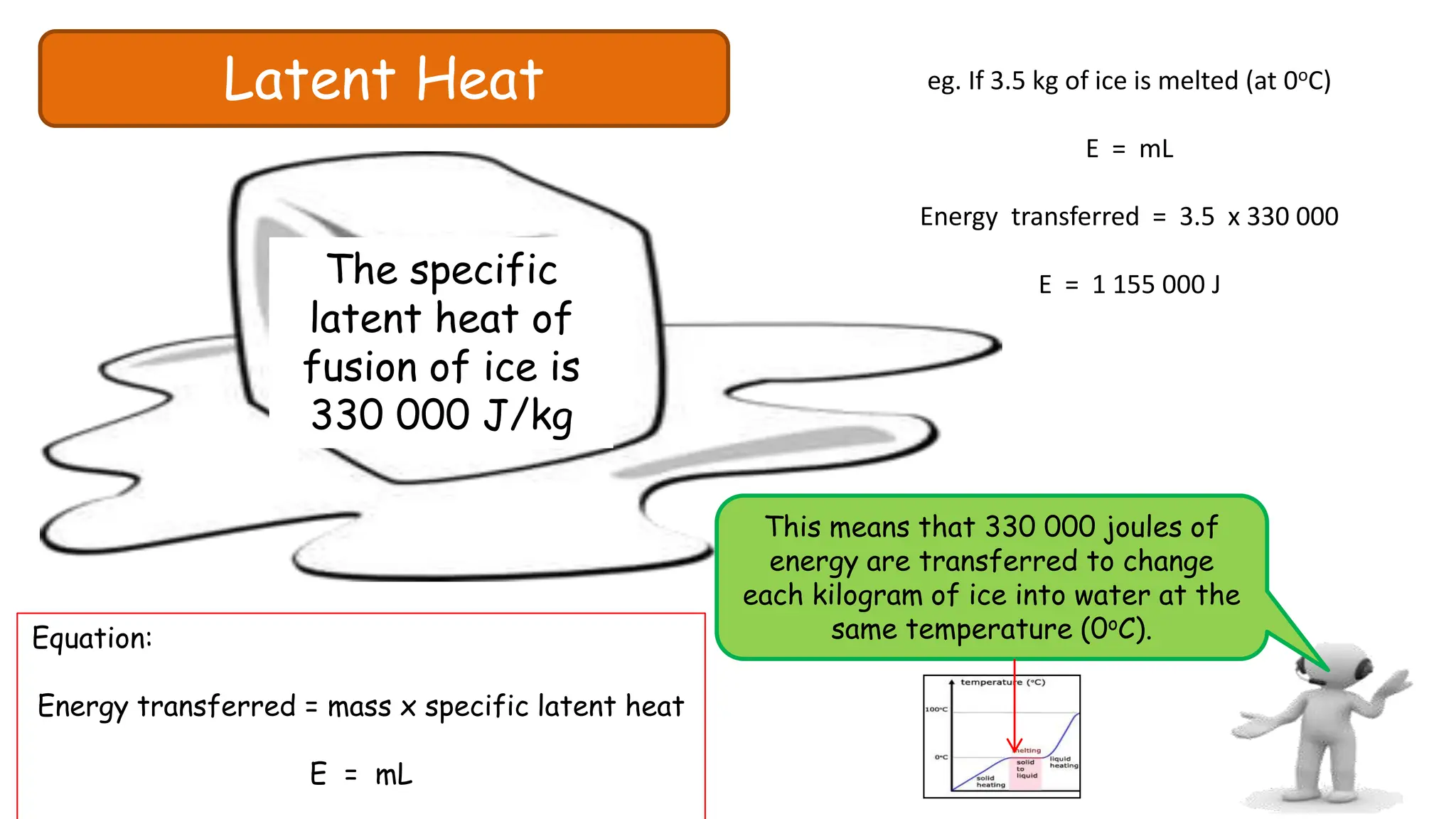
eg. If 3.5 kg of ice is melted (at 0oC)
E = mL
Energy transferred = 3.5 x 330 000
E = 1 155 000 J
Latent Heat
Measuring the
specific latent
heat of fusion
of ice.
Latent Heat
Measuring the
specific latent
heat of fusion
of ice.
Latent Heat
Measuring the
specific
latent heat of
fusion of ice.
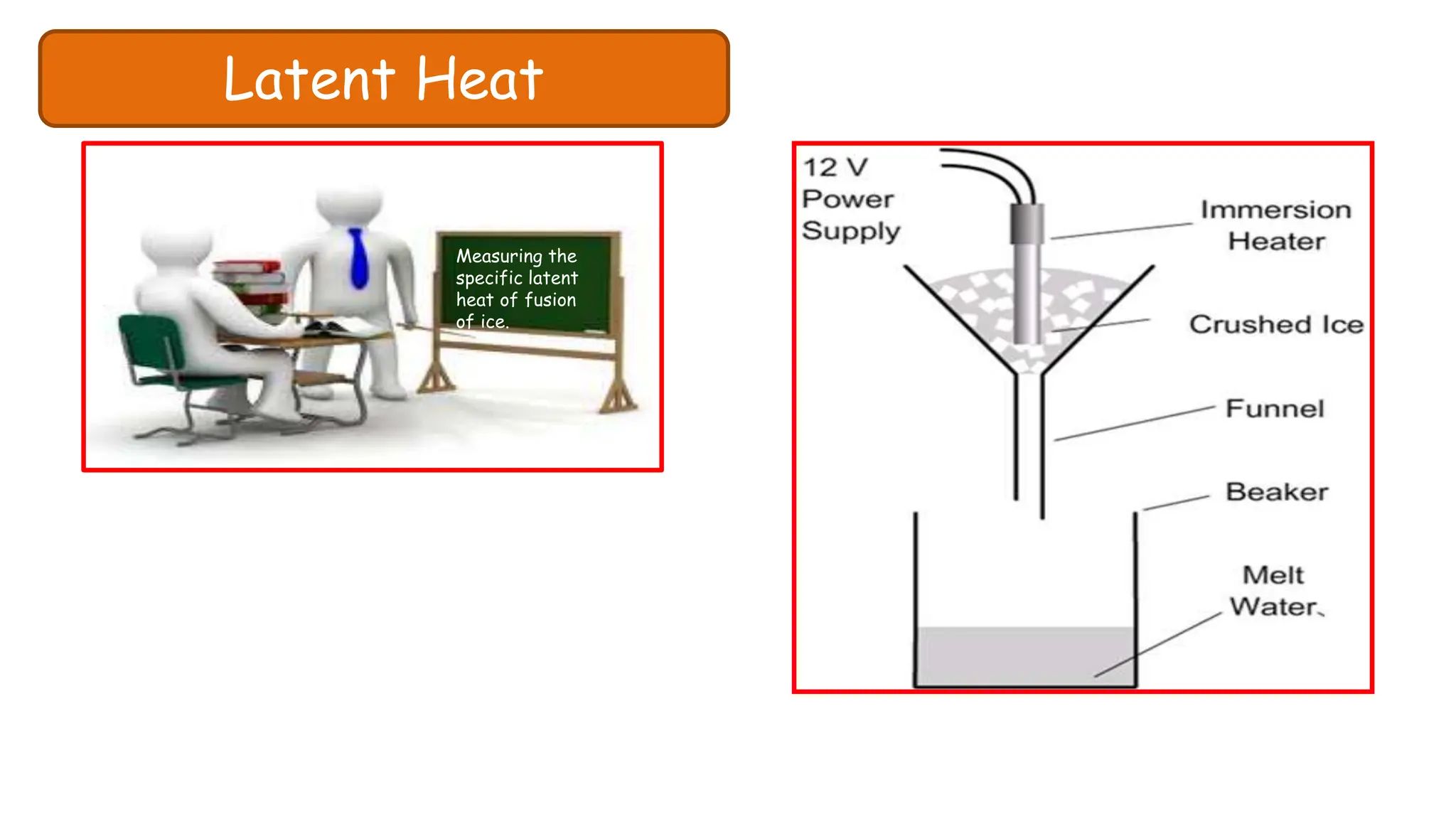
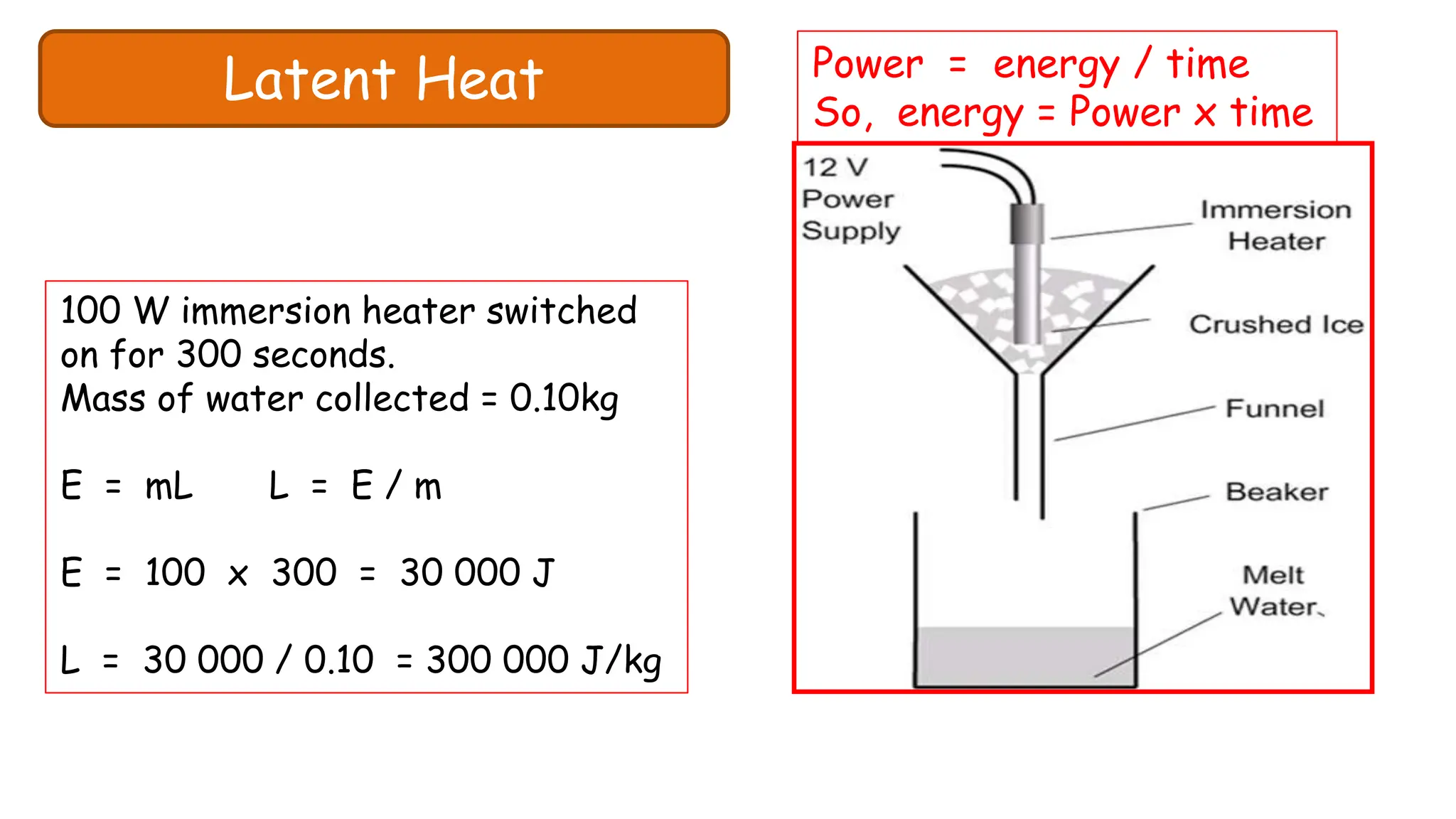
100 W immersion heater switched
on for 300 seconds.
Mass of water collected = 0.10kg
E = mL L = E / m
E = 100 x 300 = 30 000 J
L = 30 000 / 0.10 = 300 000 J/kg
Power = energy / time
So, energy = Power x time
Latent Heat
Measuring the
specific
latent heat of
fusion of ice.
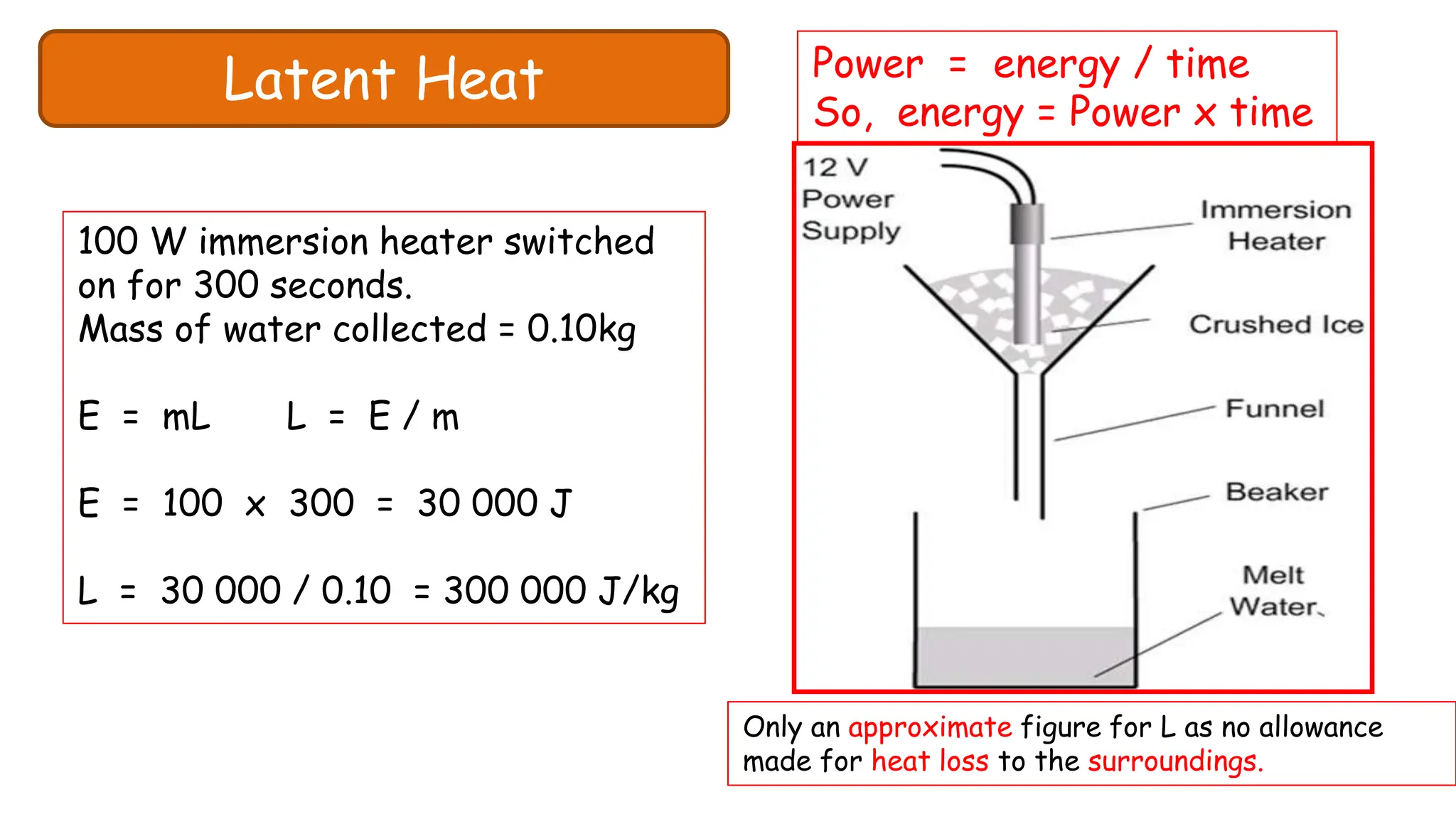
100 W immersion heater switched
on for 300 seconds.
Mass of water collected = 0.10kg
E = mL L = E / m
E = 100 x 300 = 30 000 J
L = 30 000 / 0.10 = 300 000 J/kg
Power = energy / time
So, energy = Power x time
Only an approximate figure for L as no allowance
made for heat loss to the surroundings.
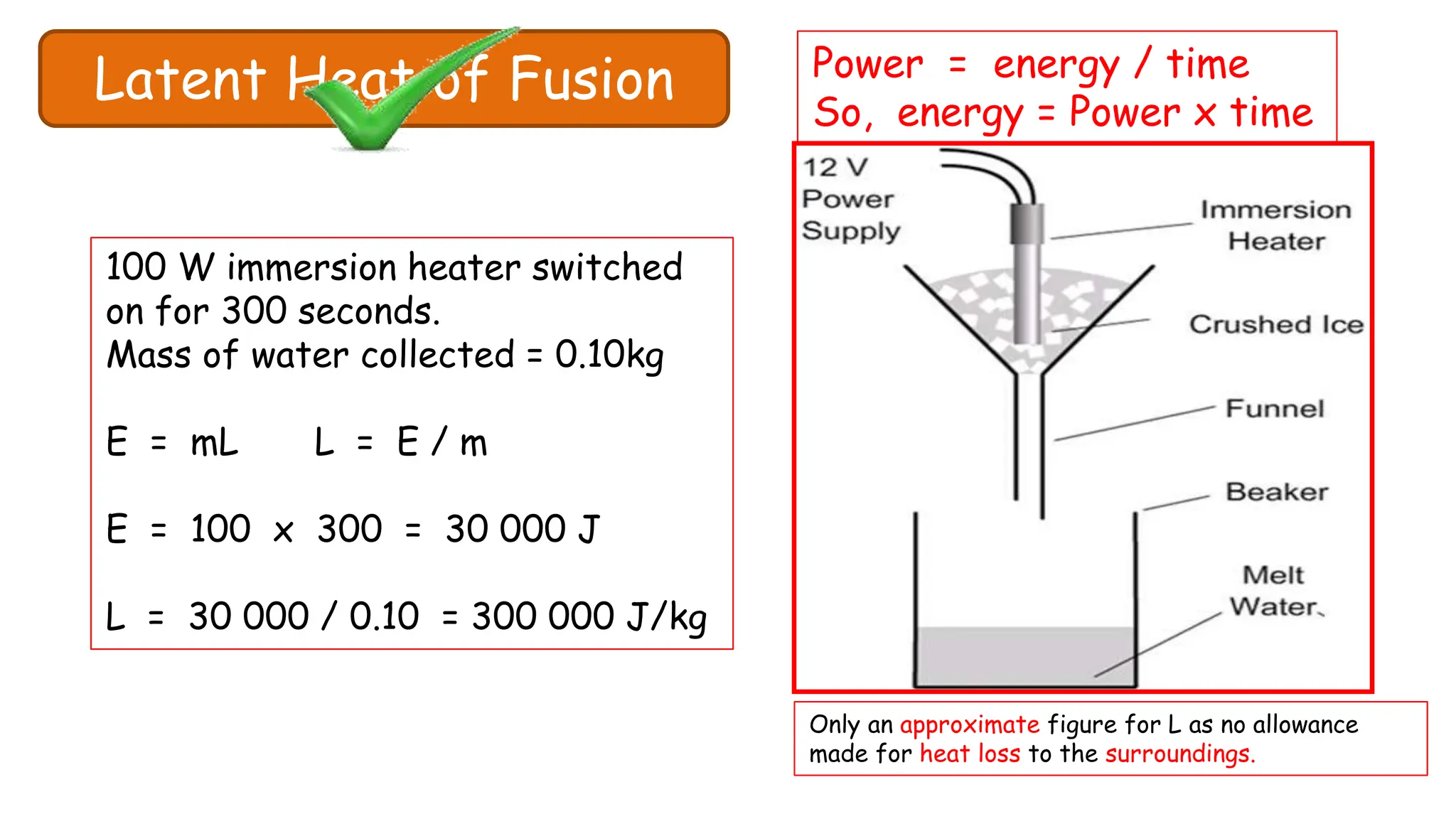
Latent Heat of Fusion
Measuring the
specific
latent heat of
fusion of ice.
100 W immersion heater switched
on for 300 seconds.
Mass of water collected = 0.10kg
E = mL L = E / m
E = 100 x 300 = 30 000 J
L = 30 000 / 0.10 = 300 000 J/kg
Power = energy / time
So, energy = Power x time
Only an approximate figure for L as no allowance
made for heat loss to the surroundings.
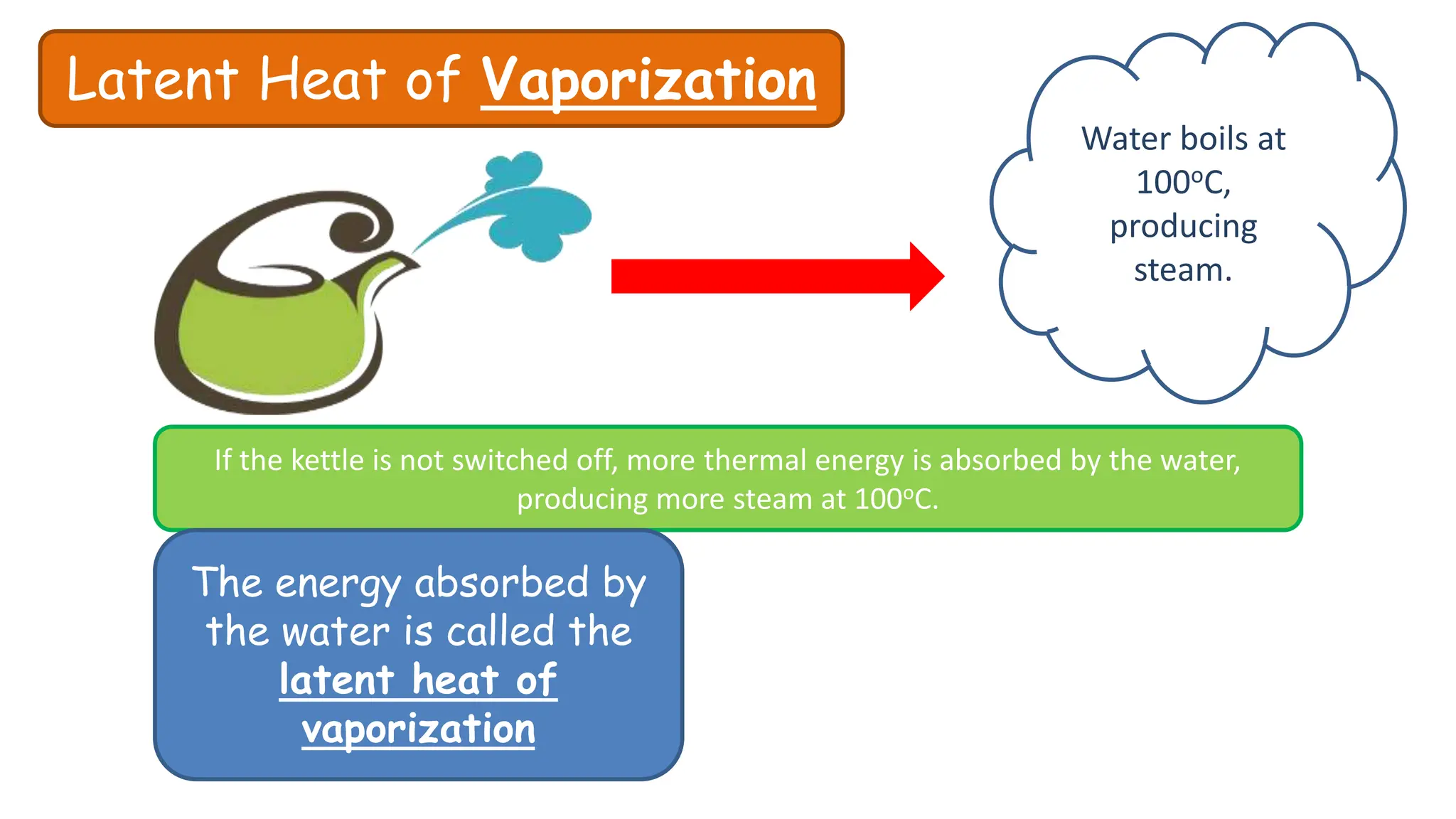
Latent Heat of Vaporization
Water boils at
100oC,
producing
steam.
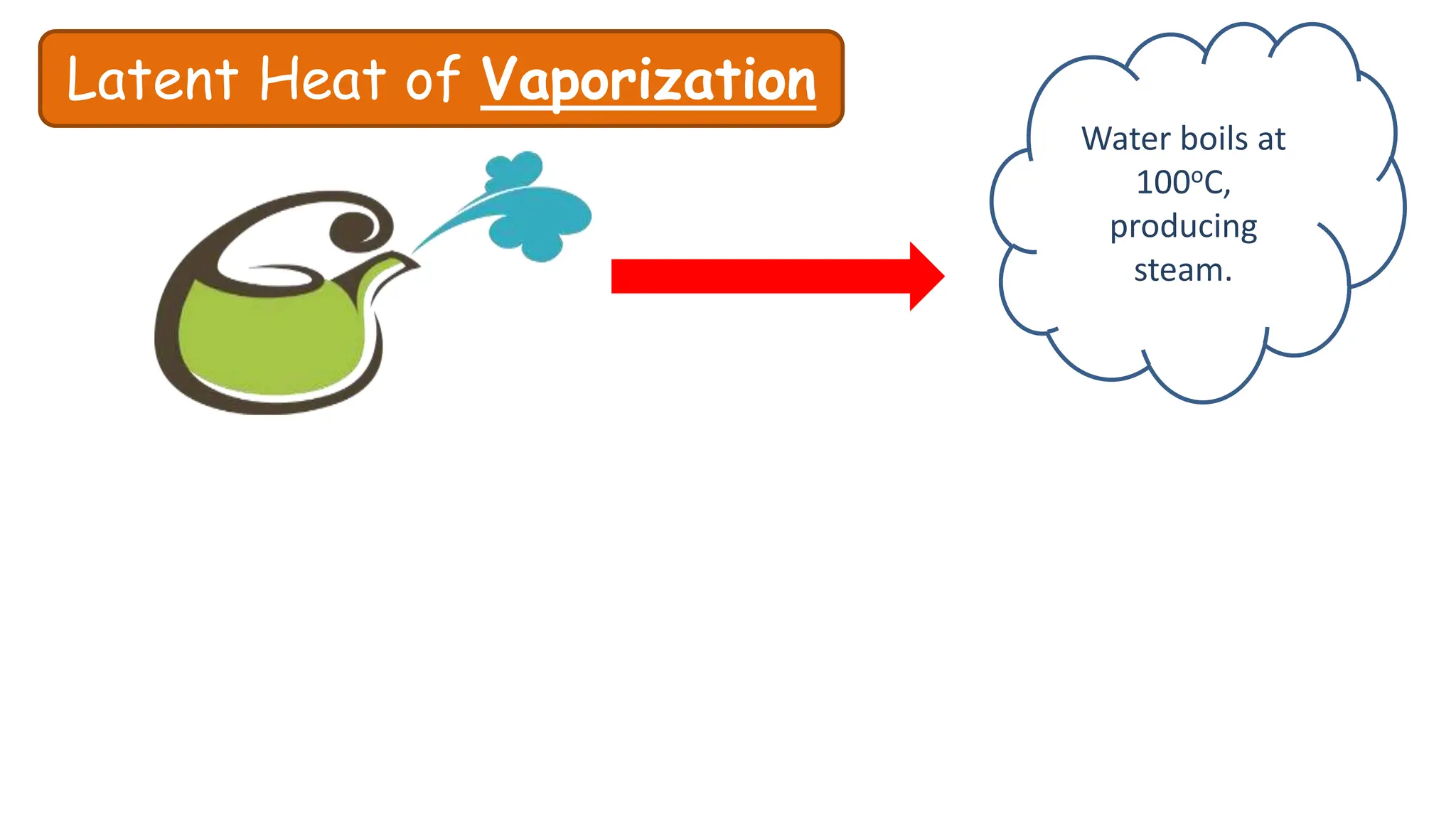
Latent Heat of Vaporization
Water boils at
100oC,
producing
steam.
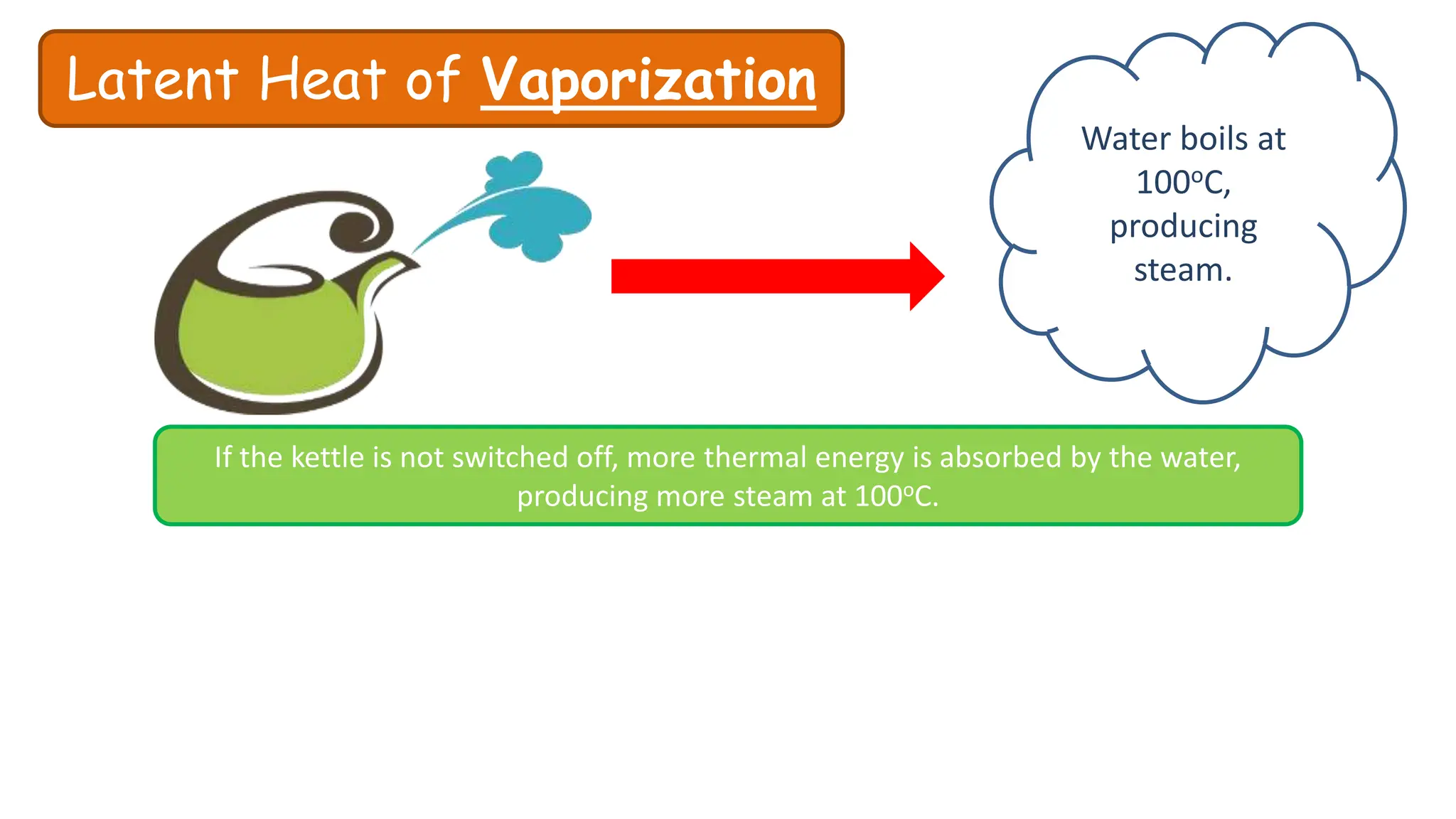
If the kettle is not switched off, more thermal energy is absorbed by the water,
producing more steam at 100oC.
Latent Heat of Vaporization
Water boils at
100oC,
producing
steam.
If the kettle is not switched off, more thermal energy is absorbed by the water,
producing more steam at 100oC.
The energy absorbed by
the water is called the
latent heat of
vaporization
Latent Heat of Vaporization
Water boils at
100oC,
producing
steam.
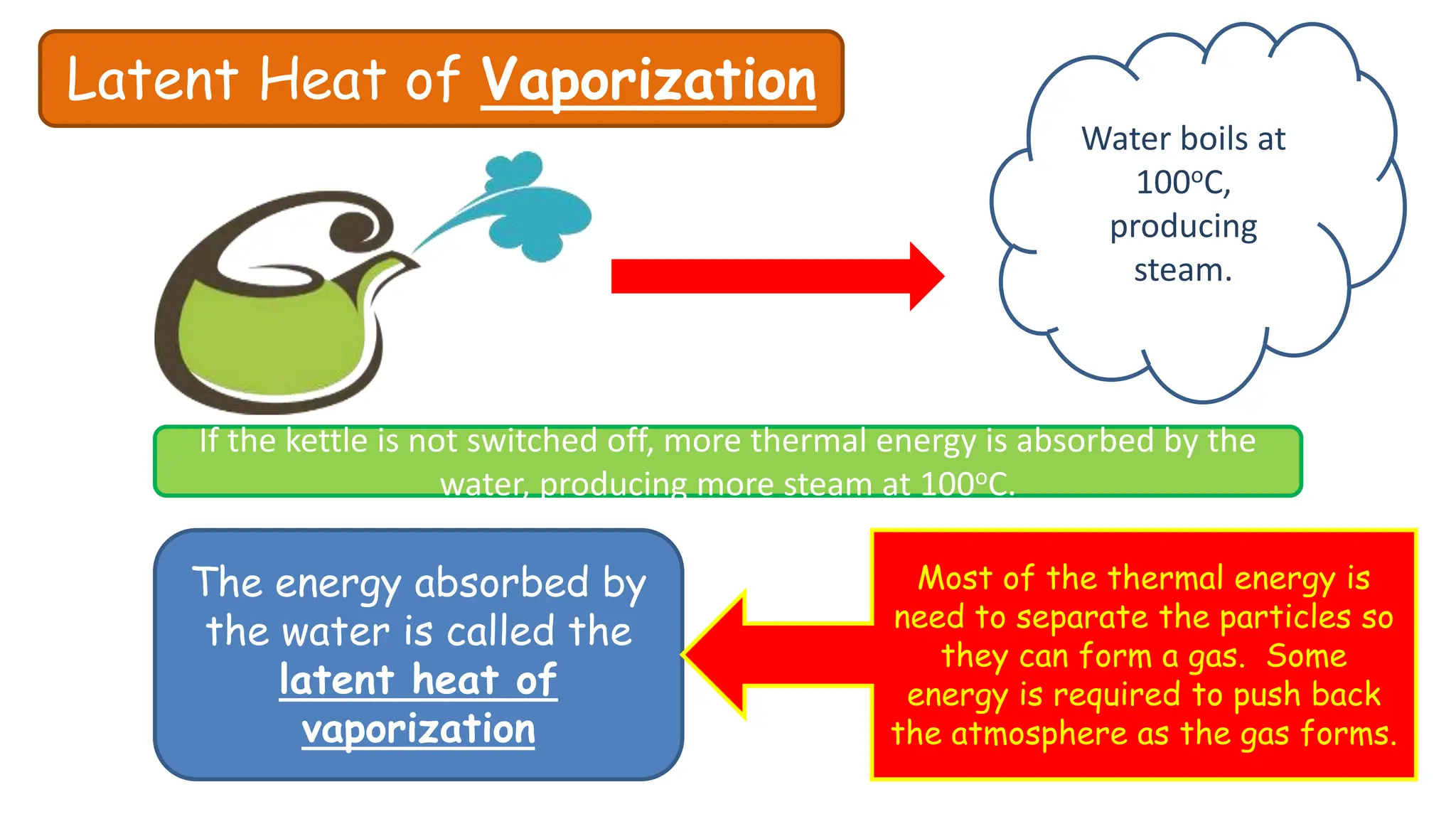
If the kettle is not switched off, more thermal energy is absorbed by the
water, producing more steam at 100oC.
The energy absorbed by
the water is called the
latent heat of
vaporization
Most of the thermal energy is
need to separate the particles so
they can form a gas. Some
energy is required to push back
the atmosphere as the gas forms.
Latent Heat of Vaporization
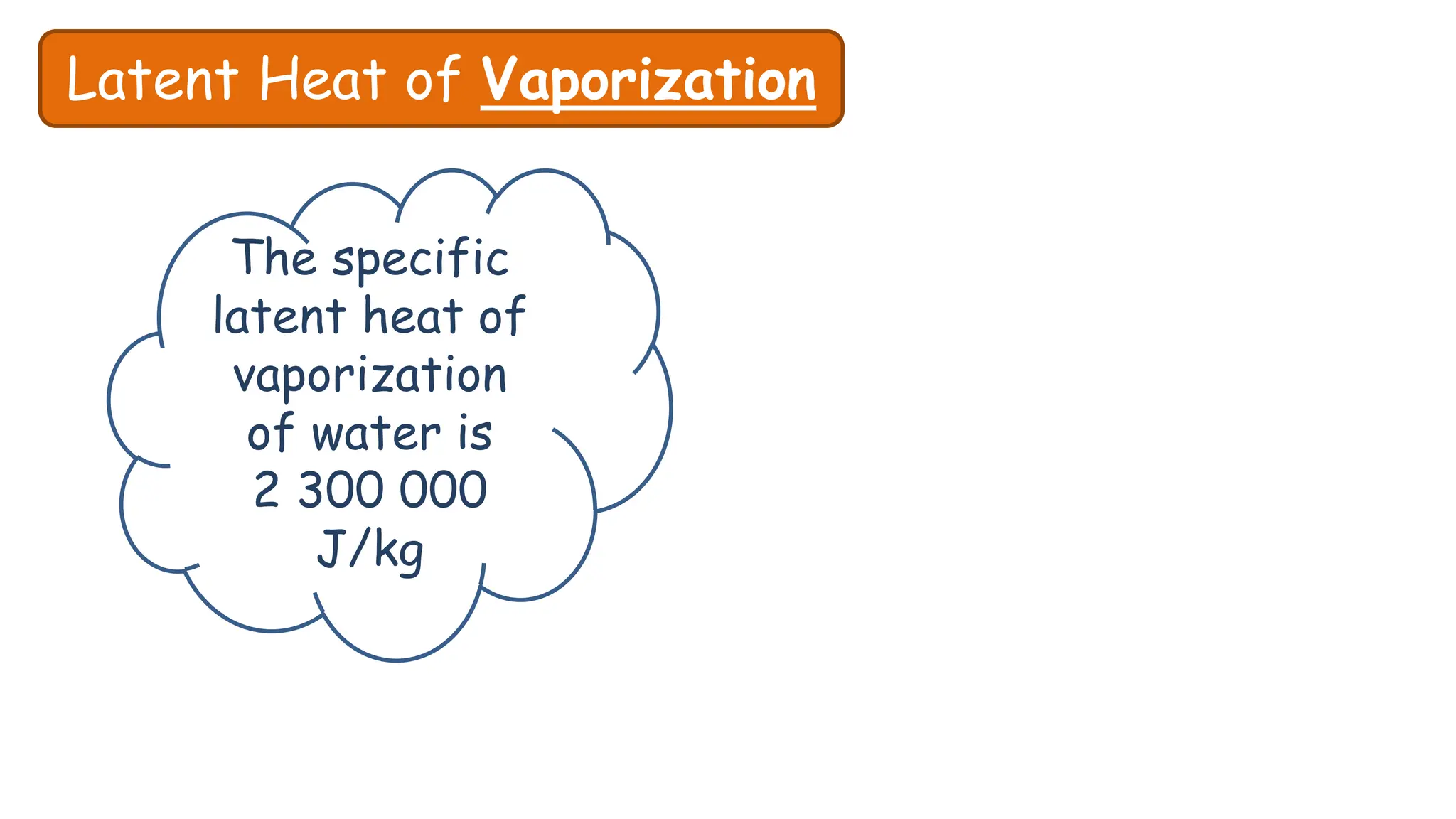
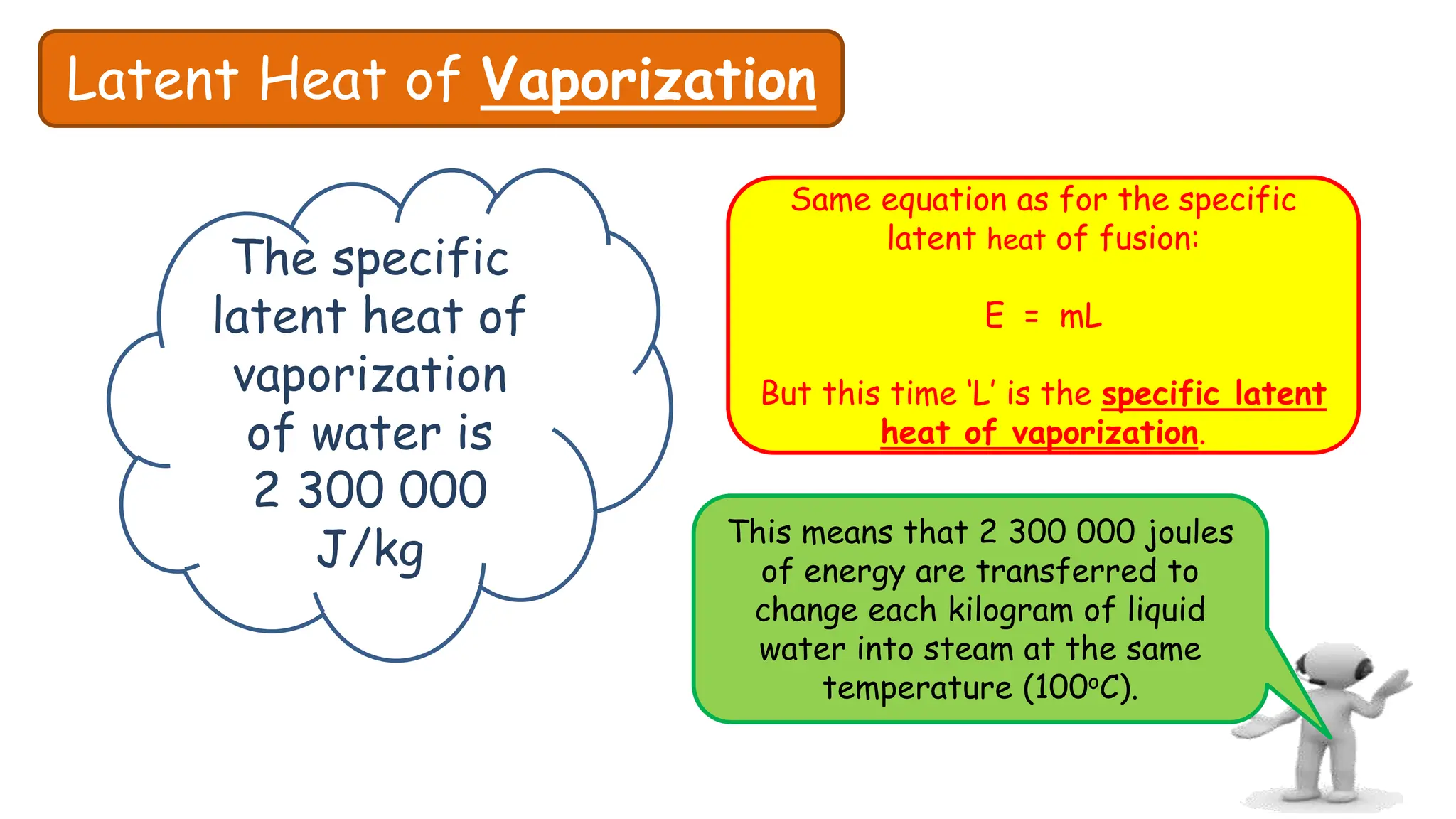
The specific
latent heat of
vaporization
of water is
2 300 000
J/kg
Latent Heat of Vaporization
The specific
latent heat of
vaporization
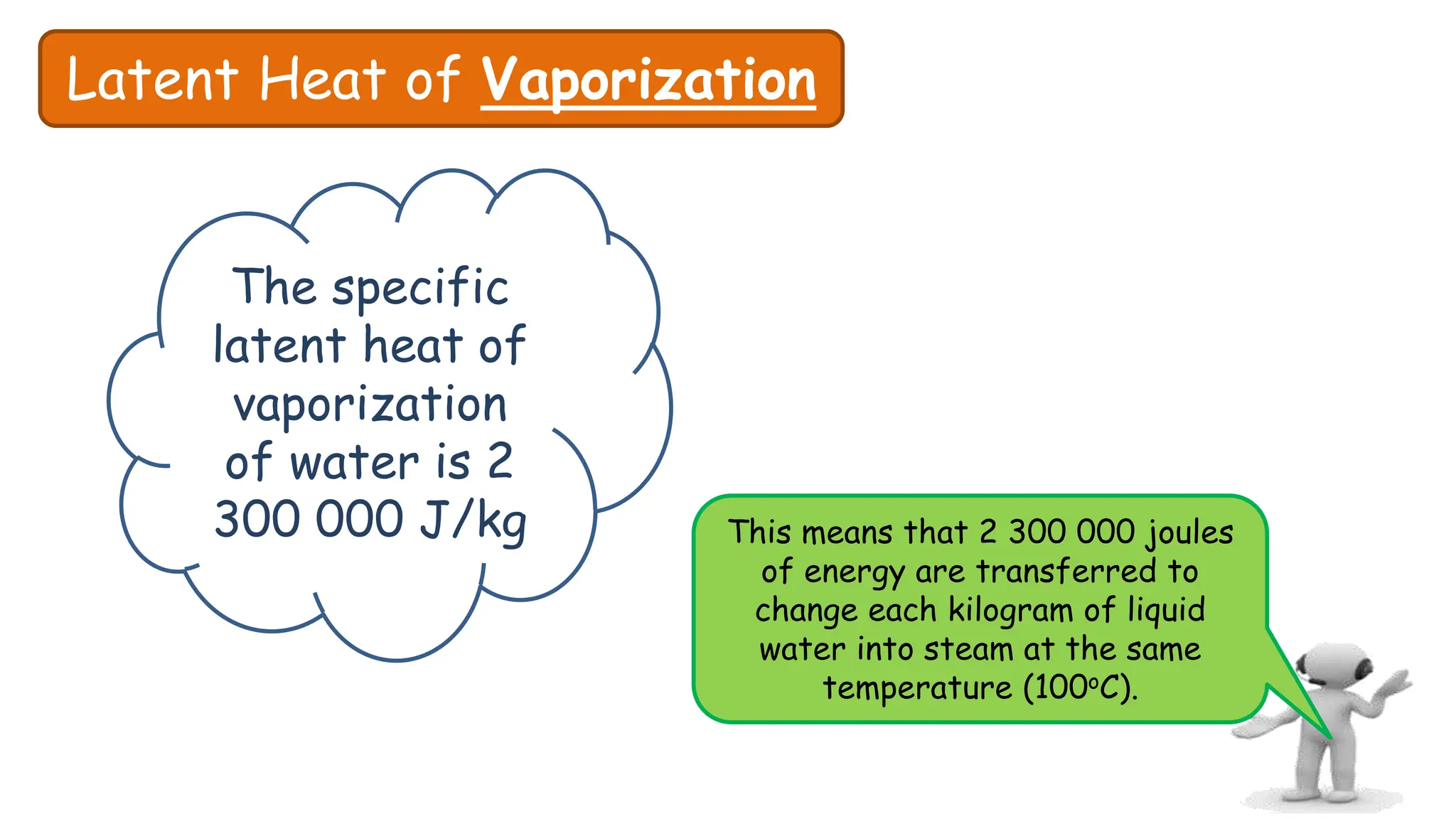
of water is 2
300 000 J/kg This means that 2 300 000 joules
of energy are transferred to
change each kilogram of liquid
water into steam at the same
temperature (100oC).
Latent Heat of Vaporization
The specific
latent heat of
vaporization
of water is
2 300 000
J/kg This means that 2 300 000 joules
of energy are transferred to
change each kilogram of liquid
water into steam at the same
temperature (100oC).
Same equation as for the specific
latent heat of fusion:
E = mL
But this time ‘L’ is the specific latent
heat of vaporization.
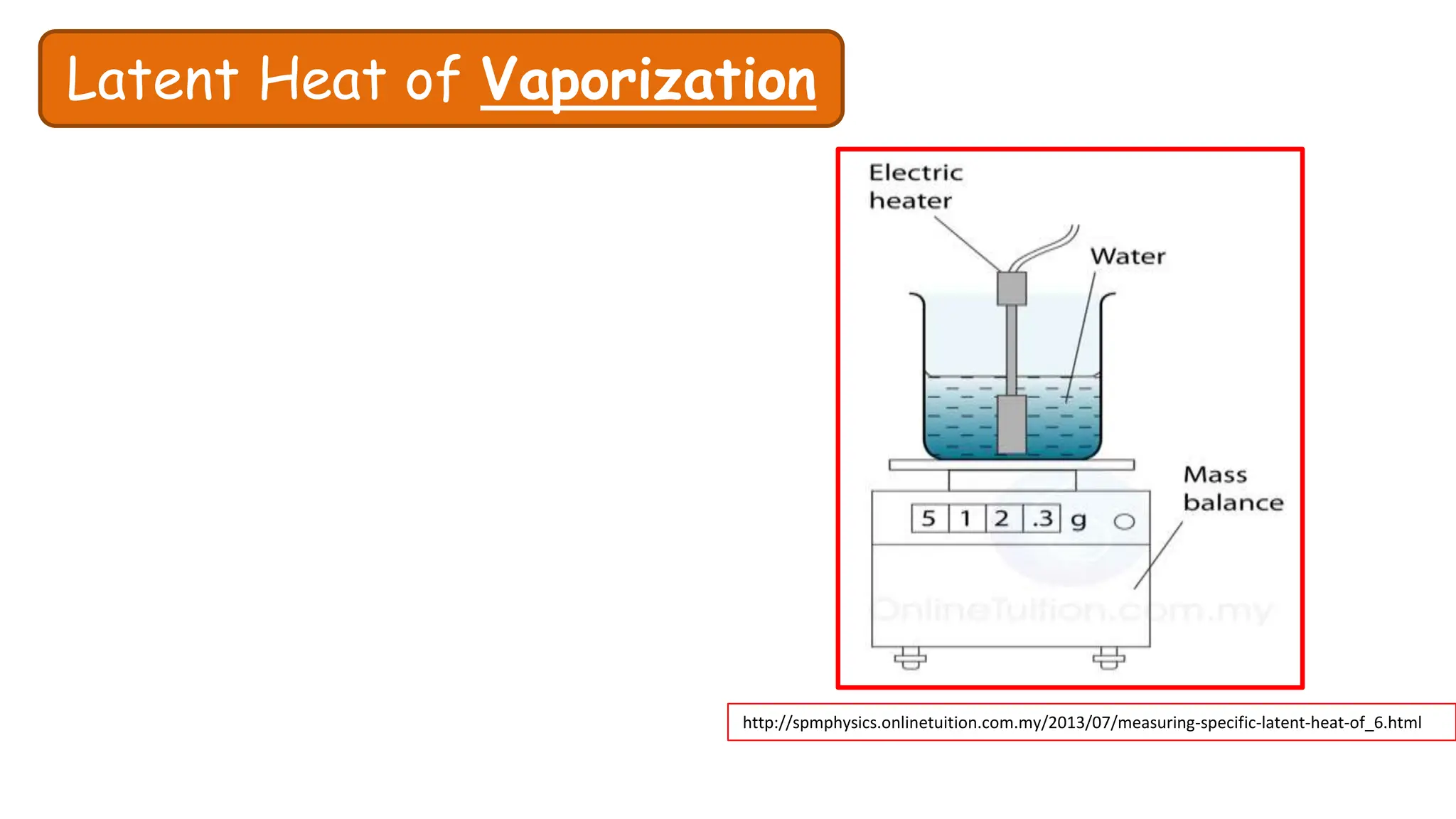
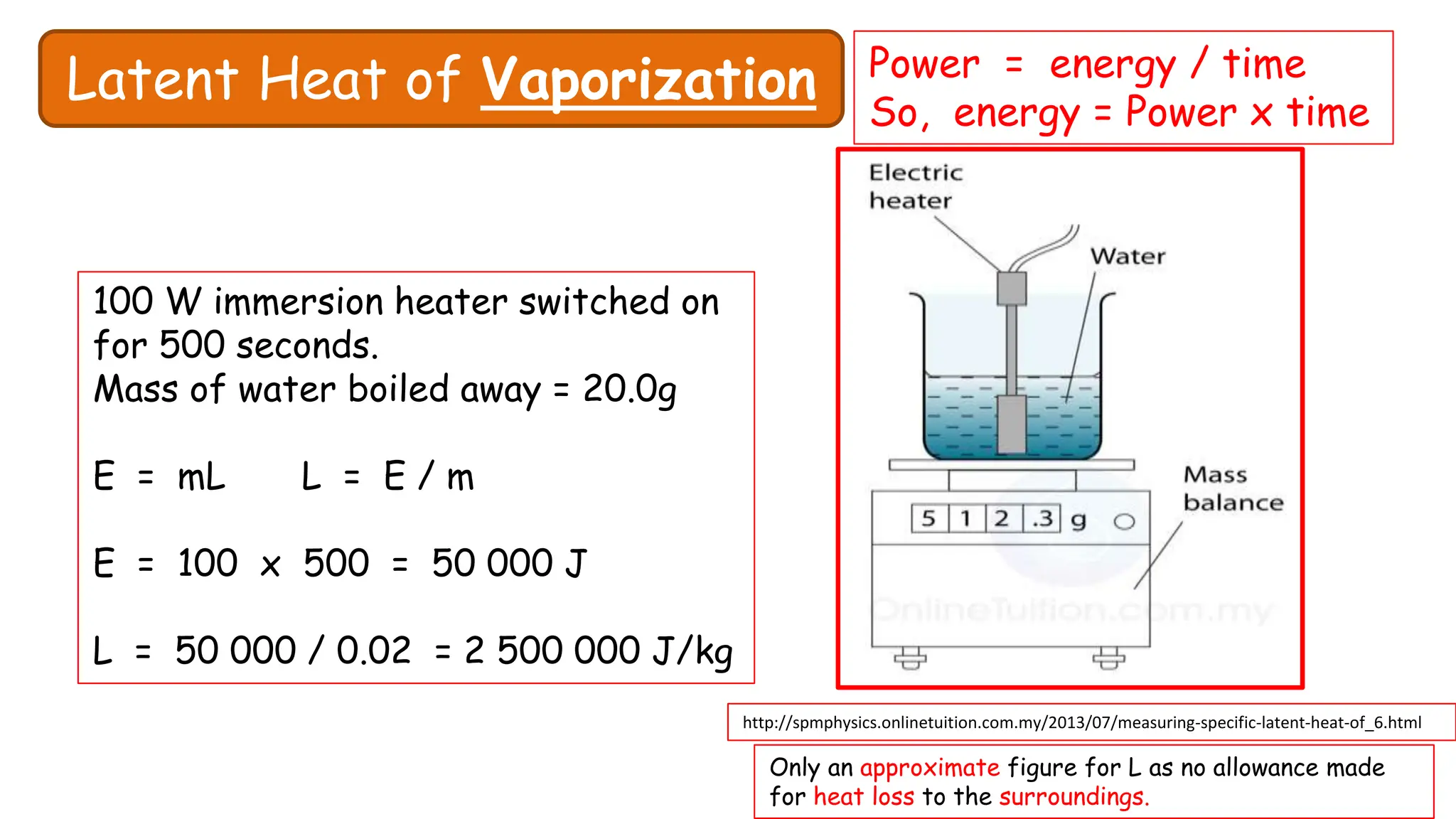
Measuring the
specific latent
heat of
vaporization of
water.
Latent Heat of Vaporization
Measuring the
specific latent
heat of
vaporization of
water.
Latent Heat of Vaporization
http://spmphysics.onlinetuition.com.my/2013/07/measuring-specific-latent-heat-of_6.html
Measuring the
specific latent
heat of
vaporization of
water.
Latent Heat of Vaporization
http://spmphysics.onlinetuition.com.my/2013/07/measuring-specific-latent-heat-of_6.html
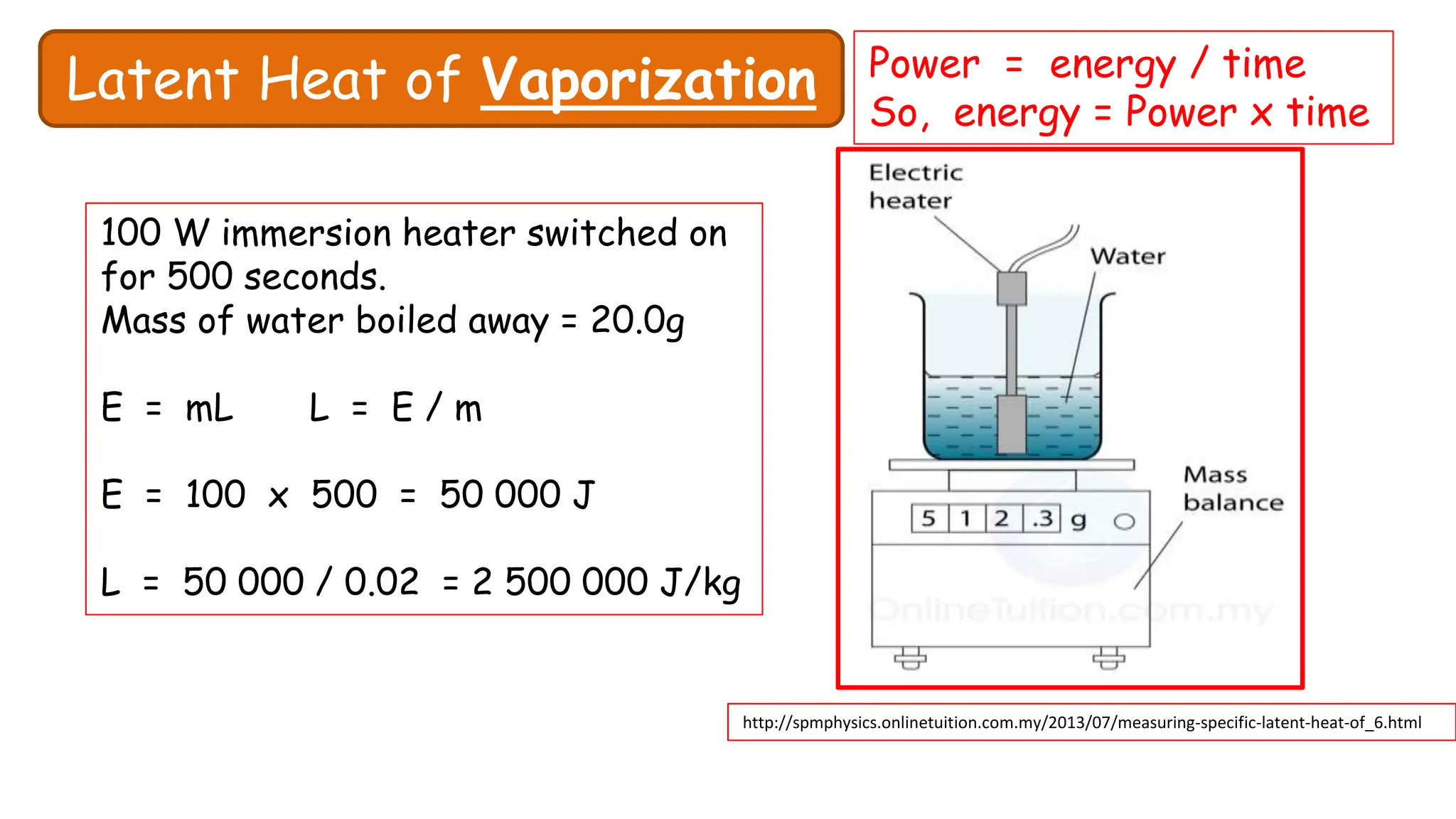
Power = energy / time
So, energy = Power x time
100 W immersion heater switched on
for 500 seconds.
Mass of water boiled away = 20.0g
E = mL L = E / m
E = 100 x 500 = 50 000 J
L = 50 000 / 0.02 = 2 500 000 J/kg
Measuring the
specific latent
heat of
vaporization of
water.
Latent Heat of Vaporization
http://spmphysics.onlinetuition.com.my/2013/07/measuring-specific-latent-heat-of_6.html
Power = energy / time
So, energy = Power x time
100 W immersion heater switched on
for 500 seconds.
Mass of water boiled away = 20.0g
E = mL L = E / m
E = 100 x 500 = 50 000 J
L = 50 000 / 0.02 = 2 500 000 J/kg
Only an approximate figure for L as no allowance made
for heat loss to the surroundings.
Physics 2.4 - Thermal properties and temperature - 2.pptx

Physics 2.4 - Thermal properties and temperature - 2.pptx

  • 1.
  • 2.
    The energy thatis being transferred between two bodies as a result of temperature difference is called heat. Heat is a form of energy which causes the sensation of hotness/Coldness.
  • 3.
    Measurement of Heat 1)C.G.S unit: erg 2) Calorie : 1 calorie is defined as the amount of heat required for raising the temperature of 1g of water through 1 degree Celsius from 14.5oC to 15.5oC. 3) S.I. unit: joule (J) The units calorie and joule are related as: 1 cal = 4.186 J (or nearly 4.2 J) 1 J = 0.24 cal 1 J = 107 erg
  • 4.
    Temperature Heat always flowfrom a body at higher temperature to the body at lower temperature. At molecular level, when temperature increases (means body is gaining heat), kinetic energy of molecule increases, thus internal energy of that body increases. Ice point: The temperature at which pure water and ice are in equilibrium in a mixture at 1 atmospheric pressure, represented by 0°C (32°F) Steam point: The temperature at which water vapor condenses at a pressure of one atmosphere, represented by 100°C (212°F)
  • 5.
    Measurement of Temperature T(K)= 273 + t A degree on Celsius is 1 /100th part of the interval between the ice point and the steam point. A degree on Fahrenheit scale is 1 /180th part of the interval between the ice point and the steam point. 1 centigrade degree = 9 /5 Fahrenheit degree ℃
  • 6.
    HEAT AS AFORM OF ENERGY The Sun Gives Out Heat •Heat is a form of energy. •The Sun is the primary source of heat energy. Solid  liquid  gas Gas  liquid  solid ABSORB HEAT RELEASE HEAT
  • 7.
  • 8.
    Other Sources OfHeat Energy • Apart from the sun, we can get heat energy from : • Electricity • Fossil fuel • Radioactive metals • The mantle of the Earth. • Heat is produced in our daily life wherever there is friction. • Friction occurs when two objects rub against each other. • • The Uses Of Heat In Our Daily Life. • • Heat is a useful form of energy. • The uses of heat in our daily life include : – Cooking – Food drying – Boiling water – Drying clothes – Providing warmth and etc.
  • 9.
    The Differences BetweenHeat And Temperature Heat Temperature  Is a form of energy due to motion of molecules in a substance.  Is a degree of hotness or coldness of a body. It determines the flow of heat.  Is measured in the joule ( J )  Is a measured in the Kelvin ( K )  Is the total amount of kinetic energy of a particles  Tells us how fast the particles are moving.  Two bodies having the same internal energy may differ in their temperature.  Two bodies at same temperature may differ in the quantities of heat energy they can transfer  When two bodies are placed in contact, the heat gained by one body is equal to the heat lost by another body.  When two bodies at different temperatures are placed in contact, the resultant temperature is always lying between their initial temperatures.  Heat is measured by using the principle of Calorimetry.  Temperature is measured by a thermometer.
  • 10.
    Effect of heaton matter
  • 11.
    Thermometry Types of thermometer:(a) Mercury thermometer (b) Alcohol thermometer
  • 12.
    Thermal Expansion ofSolids: Effect of Heat on Solids Thermal Expansion Formula Linear Expansion: Volume Expansion (Cubical expansion) Superficial Expansion (Areal expansion)
  • 13.
    Four rods, eachof same initial length but made of copper, glass, iron and aluminium are heated to the same rise in temperature. Which rod will expand more? Specific heat of Copper is 0.385J/goC Specific heat of glass is 0.84J/goC Specific heat of iron is 0.450J/goC Specific heat of Aluminium is 0.902J/goC
  • 14.
    Relation between ThreeCoefficients of Expansion
  • 15.
    Apparent Expansion ofLiquid and Real expansion of liquid
  • 16.
  • 17.
    Thermal Equilibrium Heat flowsfrom a body at a higher temperature to a body at lower temperature till their temperatures become equal. Two bodies are said to be in thermal equilibrium, if they are at the same temperature.
  • 18.
  • 19.
    Thermal (heat) capacity Whatrequires more energy to heat up by 1oC?
  • 20.
    Thermal (heat) capacity Whatrequires more energy to heat up by 1oC? 1 kg water
  • 21.
    Thermal (heat) capacity Whatrequires more energy to heat up by 1oC? 1 kg water 1 kg aluminium
  • 22.
    Thermal (heat) capacity Whatrequires more energy to heat up by 1oC? 1 kg water 1 kg aluminium 4200 joules of energy 900 joules of energy
  • 23.
    Thermal (heat) capacity Whatrequires more energy to heat up by 1oC? 1 kg water 1 kg aluminium 4200 joules of energy 900 joules of energy Water must be supplied with nearly five times as much energy as aluminium for the same rise in temperature.
  • 24.
    Thermal (heat) capacity Whatrequires more energy to heat up by 1oC? 1 kg water 1 kg aluminium 4200 joules of energy 900 joules of energy Water must be supplied with nearly five times as much energy as aluminium for the same rise in temperature. It’s all to do with the SPECIFIC HEAT CAPACITY of the material
  • 25.
    SPECIFIC HEAT CAPACITY Amountof heat (Q) absorbed or given out by a body depends upon the following factors: (a) Mass of the body (m). (b) The rise or fall in temperature of the body (c) The nature of the material which the body is made of Now we can say that: 𝑄 ∝ 𝑚∆𝑇 or, 𝑄 = 𝑚𝑠∆𝑇 Where s is a constant which explain heat absorption in terms of nature of material. It is a physical quantity which is known as specific heat or specific heat capacity
  • 26.
    Thermal (heat) capacity Thespecific heat capacity of a substance is the amount of energy needed to change the temperature of 1kg of the substance by 1oC.
  • 27.
    Thermal (heat) capacity Thespecific heat capacity of a substance is the amount of energy needed to change the temperature of 1kg of the substance by 1oC. Substance SHC (J / kg oC) Water 4181 Oxygen 918 Lead 128
  • 28.
    Thermal (heat) capacity Thespecific heat capacity of a substance is the amount of energy needed to change the temperature of 1kg of the substance by 1oC. Substance SHC (J / kg oC) Water 4181 Oxygen 918 Lead 128 Water has a particularly high SHC, making it very useful for storing heat energy, and for transporting it, eg. in central heating
  • 29.
    Thermal (heat) capacity Theequation (just what you wanted!)
  • 30.
    Thermal (heat) capacity Theequation (just what you wanted!) Energy transferred = mass x specific heat capacity x temperature Energy transferred = m c ΔT Where: m is the mass in kg, o
  • 31.
    Thermal (heat) capacity Theequation How much energy needs to be transferred to raise the temperature of 2kg of water from 20oC to 30oC?
  • 32.
    Thermal (heat) capacity Theequation How much energy needs to be transferred to raise the temperature of 2kg of water from 20oC to 30oC? Energy transferred = mass x SHC x temp. change = 2 x 4181 x (30 – 20) = 2 x 4181 x 10 = 83,620 J = 83.62 kJ
  • 33.
    Thermal (heat) capacity Sowhat’s this ‘thermal capacity’ bit?
  • 34.
    Thermal (heat) capacity Sowhat’s this ‘thermal capacity’ bit? Thermal capacity = mass x SHC
  • 35.
    Thermal (heat) capacity Sowhat’s this ‘thermal capacity’ bit? Thermal capacity = mass x SHC eg. If there is 3kg of water in a kettle: Thermal capacity = 3 x 4181 = 12,543 J/oC
  • 36.
    Thermal (heat) capacity Sowhat’s this ‘thermal capacity’ bit? Thermal capacity = mass x SHC eg. If there is 3kg of water in a kettle: Thermal capacity = 3 x 4181 = 12,543 J/oC This means that for every 1oC rise in temperature of the water in the kettle, 12,543 J of energy need to be supplied.
  • 37.
  • 38.
    Measuring specific heatcapacity http://www.schoolphysics.co.uk/age16-19/Thermal%20physics/Heat%20energy/text/Specific_heat_capacity_measurement/index.html Energy = power x time Apparatus for determining the SHC of a solid, eg. Aluminium Apparatus for determining the SHC of a liquid, eg. Water
  • 39.
    Measuring specific heatcapacity http://www.schoolphysics.co.uk/age16- 19/Thermal%20physics/Heat%20energy/text/Specific_heat_capa city_measurement/index.html Energy = power x time Apparatus for determining the SHC of a liquid, eg. Water • Beaker contains 0.75 kg of water. • Immersion heater (200W) switched on for 200 seconds • Temperature of the water rises by 12.5oC • Calculate the SHC of water
  • 40.
    Measuring specific heatcapacity http://www.schoolphysics.co.uk/age16- 19/Thermal%20physics/Heat%20energy/text/Specific_heat_capa city_measurement/index.html Energy = power x time Apparatus for determining the SHC of a liquid, eg. Water • Beaker contains 0.75 kg of water. • Immersion heater (200W) switched on for 200 seconds • Temperature of the water rises by 12.5oC • Calculate the SHC of water Energy transferred = power x time = 200 x 200 = 40,000J = 0.75 x c x 12.5 c = 40 000 / (0.75 x 12.5) SHC of water = 4267 J(kgoC)
  • 41.
    Measuring specific heatcapacity http://www.schoolphysics.co.uk/age16- 19/Thermal%20physics/Heat%20energy/text/Specific_heat_capa city_measurement/index.html Energy = power x time Apparatus for determining the SHC of a liquid, eg. Water • Beaker contains 0.75 kg of water. • Immersion heater (200W) switched on for 200 seconds • Temperature of the water rises by 12.5oC • Calculate the SHC of water Actual value for the SHC of water is 4181 J / kgoC. The method described does not make any allowance for heat loss to the surroundings or the beaker.
  • 43.
    Thermal (heat) capacity Usingthe high SHC of water: • Central heating system, water carries thermal energy from the boiler to the radiators. M Boiler Radiator Pump
  • 44.
    Thermal (heat) capacity Usingthe high SHC of water: • Central heating system, water carries thermal energy from the boiler to the radiators. M Boiler Radiator Pump • In car cooling systems, water carries unwanted heat energy from the engine to the radiator.
  • 45.
  • 46.
  • 47.
    Solid Liquid Gas { melting { Boiling (evaporating) } condensing }freezing Latent Heat Water has three phases or states: Solid (ice) Liquid Gas (steam)
  • 48.
  • 49.
  • 50.
    Latent Heat Thermalenergy Time At this point the ice continues to absorb energy, but it’s temperature does not change.
  • 51.
    Latent Heat Thermalenergy Time At this point the ice continues to absorb energy, but it’s temperature does not change. The energy absorbed at this point is called the latent heat of fusion - It is needed to separate the particles so they can form a liquid.
  • 52.
    Latent Heat Thermalenergy Time At this point the ice continues to absorb energy, but it’s temperature does not change. The energy absorbed at this point is called the latent heat of fusion - It is needed to separate the particles so they can form a liquid. The energy is released again when a liquid changes back to a solid.
  • 53.
    Latent Heat The specific latentheat of fusion of ice is 330 000 J/kg
  • 54.
    Latent Heat The specific latentheat of fusion of ice is 330 000 J/kg This means that 330 000 joules of energy are transferred to change each kilogram of ice into water at the same temperature (0oC).
  • 55.
    Latent Heat The specific latentheat of fusion of ice is 330 000 J/kg This means that 330 000 joules of energy are transferred to change each kilogram of ice into water at the same temperature (0oC). Equation: Energy transferred = mass x specific latent heat E = mL
  • 56.
    Latent Heat The specific latentheat of fusion of ice is 330 000 J/kg This means that 330 000 joules of energy are transferred to change each kilogram of ice into water at the same temperature (0oC). Equation: Energy transferred = mass x specific latent heat E = mL eg. If 3.5 kg of ice is melted (at 0oC) E = mL Energy transferred = 3.5 x 330 000 E = 1 155 000 J
  • 57.
    Latent Heat Measuring the specificlatent heat of fusion of ice.
  • 58.
    Latent Heat Measuring the specificlatent heat of fusion of ice.
  • 59.
    Latent Heat Measuring the specific latentheat of fusion of ice. 100 W immersion heater switched on for 300 seconds. Mass of water collected = 0.10kg E = mL L = E / m E = 100 x 300 = 30 000 J L = 30 000 / 0.10 = 300 000 J/kg Power = energy / time So, energy = Power x time
  • 60.
    Latent Heat Measuring the specific latentheat of fusion of ice. 100 W immersion heater switched on for 300 seconds. Mass of water collected = 0.10kg E = mL L = E / m E = 100 x 300 = 30 000 J L = 30 000 / 0.10 = 300 000 J/kg Power = energy / time So, energy = Power x time Only an approximate figure for L as no allowance made for heat loss to the surroundings.
  • 61.
    Latent Heat ofFusion Measuring the specific latent heat of fusion of ice. 100 W immersion heater switched on for 300 seconds. Mass of water collected = 0.10kg E = mL L = E / m E = 100 x 300 = 30 000 J L = 30 000 / 0.10 = 300 000 J/kg Power = energy / time So, energy = Power x time Only an approximate figure for L as no allowance made for heat loss to the surroundings.
  • 62.
    Latent Heat ofVaporization
  • 63.
    Latent Heat ofVaporization Water boils at 100oC, producing steam.
  • 64.
    Latent Heat ofVaporization Water boils at 100oC, producing steam. If the kettle is not switched off, more thermal energy is absorbed by the water, producing more steam at 100oC.
  • 65.
    Latent Heat ofVaporization Water boils at 100oC, producing steam. If the kettle is not switched off, more thermal energy is absorbed by the water, producing more steam at 100oC. The energy absorbed by the water is called the latent heat of vaporization
  • 66.
    Latent Heat ofVaporization Water boils at 100oC, producing steam. If the kettle is not switched off, more thermal energy is absorbed by the water, producing more steam at 100oC. The energy absorbed by the water is called the latent heat of vaporization Most of the thermal energy is need to separate the particles so they can form a gas. Some energy is required to push back the atmosphere as the gas forms.
  • 67.
    Latent Heat ofVaporization The specific latent heat of vaporization of water is 2 300 000 J/kg
  • 68.
    Latent Heat ofVaporization The specific latent heat of vaporization of water is 2 300 000 J/kg This means that 2 300 000 joules of energy are transferred to change each kilogram of liquid water into steam at the same temperature (100oC).
  • 69.
    Latent Heat ofVaporization The specific latent heat of vaporization of water is 2 300 000 J/kg This means that 2 300 000 joules of energy are transferred to change each kilogram of liquid water into steam at the same temperature (100oC). Same equation as for the specific latent heat of fusion: E = mL But this time ‘L’ is the specific latent heat of vaporization.
  • 70.
    Measuring the specific latent heatof vaporization of water. Latent Heat of Vaporization
  • 71.
    Measuring the specific latent heatof vaporization of water. Latent Heat of Vaporization http://spmphysics.onlinetuition.com.my/2013/07/measuring-specific-latent-heat-of_6.html
  • 72.
    Measuring the specific latent heatof vaporization of water. Latent Heat of Vaporization http://spmphysics.onlinetuition.com.my/2013/07/measuring-specific-latent-heat-of_6.html Power = energy / time So, energy = Power x time 100 W immersion heater switched on for 500 seconds. Mass of water boiled away = 20.0g E = mL L = E / m E = 100 x 500 = 50 000 J L = 50 000 / 0.02 = 2 500 000 J/kg
  • 73.
    Measuring the specific latent heatof vaporization of water. Latent Heat of Vaporization http://spmphysics.onlinetuition.com.my/2013/07/measuring-specific-latent-heat-of_6.html Power = energy / time So, energy = Power x time 100 W immersion heater switched on for 500 seconds. Mass of water boiled away = 20.0g E = mL L = E / m E = 100 x 500 = 50 000 J L = 50 000 / 0.02 = 2 500 000 J/kg Only an approximate figure for L as no allowance made for heat loss to the surroundings.