Generations of Computed Tomography
Muhammad Arif Afridi
Lecturer in Medical Imaging
Medical Imaging Technologist (MIT) - Radiology
Master in Public Health (MPH)
Email: RFafridi@hotmail.com
Muhammad Arif Afridi
Lecturer in Medical Imaging | RFafridi@hotmail.com
1
Generations Of Computed Tomography
There are four Generations Of Computed Tomography.
1. First-generation imaging system: translate and rotate, pencil beam,
single detector, 5-minute imaging time.
2. Second-generation imaging system: translate and rotate, fan beam,
detector array, 30-second imaging time.
3. Third-generation imaging system: rotate and rotate, fan beam,
detector array, subsecond imaging time.
4. Fourth-generation CT imaging system: rotate and stationary, fan
beam, detector array, subsecond imaging time.
Muhammad Arif Afridi
Lecturer in Medical Imaging | RFafridi@hotmail.com
2
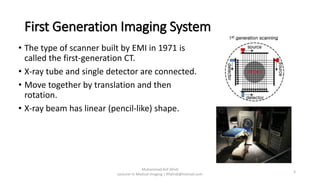
First Generation Imaging System
• The type of scanner built by EMI in 1971 is
called the first-generation CT.
• X-ray tube and single detector are connected.
• Move together by translation and then
rotation.
• X-ray beam has linear (pencil-like) shape.
Muhammad Arif Afridi
Lecturer in Medical Imaging | RFafridi@hotmail.com
3
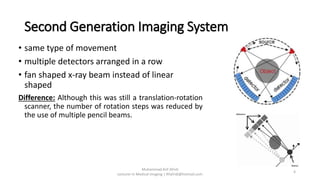
Second Generation Imaging System
• same type of movement
• multiple detectors arranged in a row
• fan shaped x-ray beam instead of linear
shaped
Difference: Although this was still a translation-rotation
scanner, the number of rotation steps was reduced by
the use of multiple pencil beams.
Muhammad Arif Afridi
Lecturer in Medical Imaging | RFafridi@hotmail.com
4
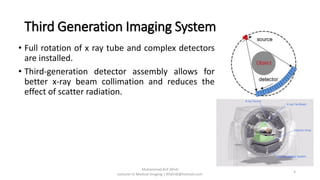
Third Generation Imaging System
• Full rotation of x ray tube and complex detectors
are installed.
• Third-generation detector assembly allows for
better x-ray beam collimation and reduces the
effect of scatter radiation.
Muhammad Arif Afridi
Lecturer in Medical Imaging | RFafridi@hotmail.com
5
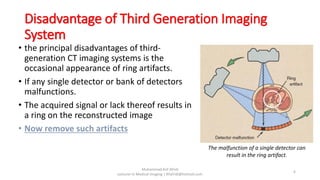
Disadvantage of Third Generation Imaging
System
• the principal disadvantages of third-
generation CT imaging systems is the
occasional appearance of ring artifacts.
• If any single detector or bank of detectors
malfunctions.
• The acquired signal or lack thereof results in
a ring on the reconstructed image
• Now remove such artifacts
Muhammad Arif Afridi
Lecturer in Medical Imaging | RFafridi@hotmail.com
6
The malfunction of a single detector can
result in the ring artifact.
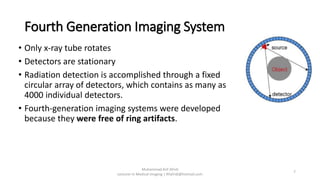
Fourth Generation Imaging System
• Only x-ray tube rotates
• Detectors are stationary
• Radiation detection is accomplished through a fixed
circular array of detectors, which contains as many as
4000 individual detectors.
• Fourth-generation imaging systems were developed
because they were free of ring artifacts.
Muhammad Arif Afridi
Lecturer in Medical Imaging | RFafridi@hotmail.com
7
Today
• Today essentially all CT imaging systems are third-generation and
have evolved into helical and multi slice imaging.
Muhammad Arif Afridi
Lecturer in Medical Imaging | RFafridi@hotmail.com
8
Thank you
Muhammad Arif Afridi
Lecturer in Medical Imaging | RFafridi@hotmail.com
9

2. generations of computed tomography

  • 1.
    Generations of ComputedTomography Muhammad Arif Afridi Lecturer in Medical Imaging Medical Imaging Technologist (MIT) - Radiology Master in Public Health (MPH) Email: RFafridi@hotmail.com Muhammad Arif Afridi Lecturer in Medical Imaging | RFafridi@hotmail.com 1
  • 2.
    Generations Of ComputedTomography There are four Generations Of Computed Tomography. 1. First-generation imaging system: translate and rotate, pencil beam, single detector, 5-minute imaging time. 2. Second-generation imaging system: translate and rotate, fan beam, detector array, 30-second imaging time. 3. Third-generation imaging system: rotate and rotate, fan beam, detector array, subsecond imaging time. 4. Fourth-generation CT imaging system: rotate and stationary, fan beam, detector array, subsecond imaging time. Muhammad Arif Afridi Lecturer in Medical Imaging | RFafridi@hotmail.com 2
  • 3.
    First Generation ImagingSystem • The type of scanner built by EMI in 1971 is called the first-generation CT. • X-ray tube and single detector are connected. • Move together by translation and then rotation. • X-ray beam has linear (pencil-like) shape. Muhammad Arif Afridi Lecturer in Medical Imaging | RFafridi@hotmail.com 3
  • 4.
    Second Generation ImagingSystem • same type of movement • multiple detectors arranged in a row • fan shaped x-ray beam instead of linear shaped Difference: Although this was still a translation-rotation scanner, the number of rotation steps was reduced by the use of multiple pencil beams. Muhammad Arif Afridi Lecturer in Medical Imaging | RFafridi@hotmail.com 4
  • 5.
    Third Generation ImagingSystem • Full rotation of x ray tube and complex detectors are installed. • Third-generation detector assembly allows for better x-ray beam collimation and reduces the effect of scatter radiation. Muhammad Arif Afridi Lecturer in Medical Imaging | RFafridi@hotmail.com 5
  • 6.
    Disadvantage of ThirdGeneration Imaging System • the principal disadvantages of third- generation CT imaging systems is the occasional appearance of ring artifacts. • If any single detector or bank of detectors malfunctions. • The acquired signal or lack thereof results in a ring on the reconstructed image • Now remove such artifacts Muhammad Arif Afridi Lecturer in Medical Imaging | RFafridi@hotmail.com 6 The malfunction of a single detector can result in the ring artifact.
  • 7.
    Fourth Generation ImagingSystem • Only x-ray tube rotates • Detectors are stationary • Radiation detection is accomplished through a fixed circular array of detectors, which contains as many as 4000 individual detectors. • Fourth-generation imaging systems were developed because they were free of ring artifacts. Muhammad Arif Afridi Lecturer in Medical Imaging | RFafridi@hotmail.com 7
  • 8.
    Today • Today essentiallyall CT imaging systems are third-generation and have evolved into helical and multi slice imaging. Muhammad Arif Afridi Lecturer in Medical Imaging | RFafridi@hotmail.com 8
  • 9.
    Thank you Muhammad ArifAfridi Lecturer in Medical Imaging | RFafridi@hotmail.com 9