Maulik R. Shah
B. E. (Inst & Control Engg.)
M. S. (Biomed Engg., USA)
PGDHA (Apollo Hospital)
Consultant Biomedical Engineer
Medical Equipment Planner
Hospital Project Consultant
Mobile : 9824019971
Email : mailtomaulik@gmail.com
www.atozforhospital.com
Basic & Conceptual
Information
about
Computed Tomography.
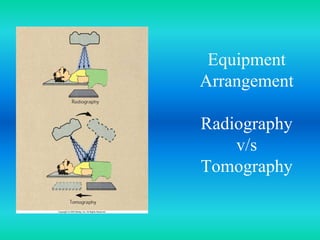
Equipment
Arrangement
Radiography
v/s
Tomography
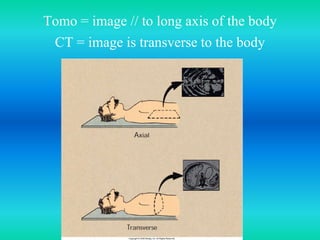
Tomo = image // to long axis of the body
CT = image is transverse to the body
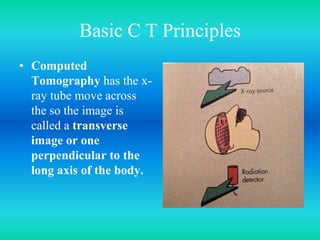
Basic C T Principles
• Computed
Tomography has the x-
ray tube move across
the so the image is
called a transverse
image or one
perpendicular to the
long axis of the body.
Computed Tomography
Development
• Computed tomography has gone through five
major design advancements since 1970
• Each development improved both scan time
and resolution or image quality.
• Scan time have been reduced from 5 minutes
to 50 ms.
• First scanner used a very tightly collimated
pencil beam.
Generations
• First Generation Scanners
– Translation/Rotation
– Tube produced a finely collimated beam or pencil
beam
– 1 to 3 detectors were placed opposite the tube for
radiation detection
– 4.5 minutes to gather enough information for one
slice
– Tube was only able to rotate 180 degrees
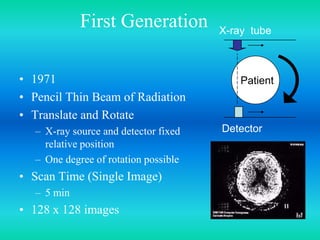
First Generation
• 1971
• Pencil Thin Beam of Radiation
• Translate and Rotate
– X-ray source and detector fixed
relative position
– One degree of rotation possible
• Scan Time (Single Image)
– 5 min
• 128 x 128 images
Patient
X-ray tube
Detector
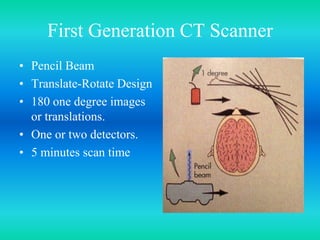
First Generation CT Scanner
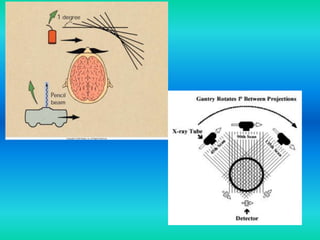
• Pencil Beam
• Translate-Rotate Design
• 180 one degree images
or translations.
• One or two detectors.
• 5 minutes scan time
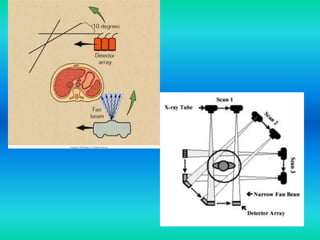
Second Generation
• Fan-shaped x-ray beam
• 30 or more detectors
• 20 seconds per slice or 10 minutes for a 40
slice exam
• 180 degree rotation
• Long data reconstruction time
Second Generation
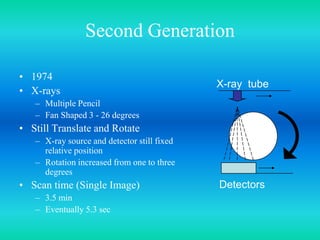
• 1974
• X-rays
– Multiple Pencil
– Fan Shaped 3 - 26 degrees
• Still Translate and Rotate
– X-ray source and detector still fixed
relative position
– Rotation increased from one to three
degrees
• Scan time (Single Image)
– 3.5 min
– Eventually 5.3 sec
X-ray tube
Detectors
Second Generation CT Scanner
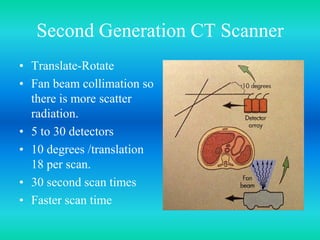
• Translate-Rotate
• Fan beam collimation so
there is more scatter
radiation.
• 5 to 30 detectors
• 10 degrees /translation
18 per scan.
• 30 second scan times
• Faster scan time
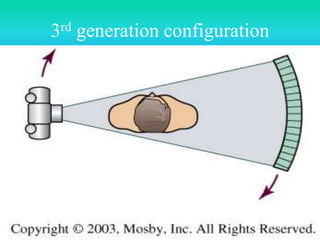
Third Generation
• Fan-shaped x-ray beam
• 960 detectors opposite the x-ray tube
• Complete 360 degree rotation Rotate/Rotate
movement
• One rotation = one slice
• Second data acquisition could be made as the
tube and detectors move in the opposite
direction.
• Time reduced to 1 sec per slice
3rd generation configuration
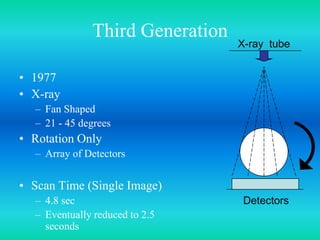
Third Generation
• 1977
• X-ray
– Fan Shaped
– 21 - 45 degrees
• Rotation Only
– Array of Detectors
• Scan Time (Single Image)
– 4.8 sec
– Eventually reduced to 2.5
seconds
Detectors
X-ray tube
Third Generation CT Scanner
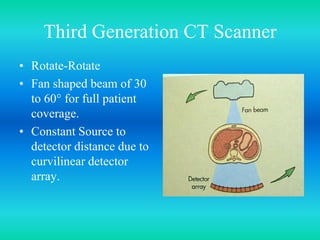
• Rotate-Rotate
• Fan shaped beam of 30
to 60° for full patient
coverage.
• Constant Source to
detector distance due to
curvilinear detector
array.
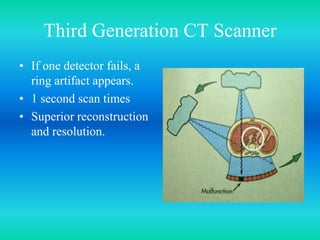
Third Generation CT Scanner
• If one detector fails, a
ring artifact appears.
• 1 second scan times
• Superior reconstruction
and resolution.
Fourth Generation
• Developed in 1980’s
• Fixed ring of as many as 4800
detectors, completely surrounding the
patient, Rotate only movement
• Rotating x-ray tube provides short bursts of
radiation
• Detectors collect the remnant radiation to
reconstruct into an image
• 1 minute for multiple slices
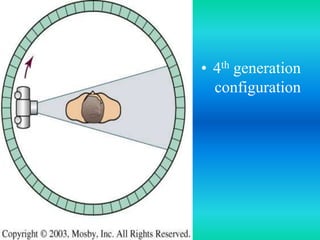
• 4th generation
configuration
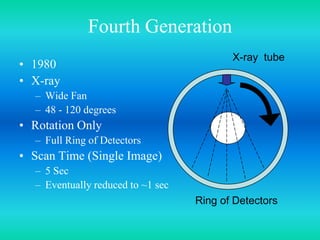
Fourth Generation
• 1980
• X-ray
– Wide Fan
– 48 - 120 degrees
• Rotation Only
– Full Ring of Detectors
• Scan Time (Single Image)
– 5 Sec
– Eventually reduced to ~1 sec
X-ray tube
Ring of Detectors
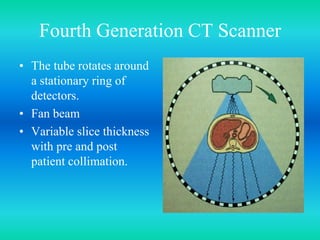
Fourth Generation CT Scanner
• The tube rotates around
a stationary ring of
detectors.
• Fan beam
• Variable slice thickness
with pre and post
patient collimation.
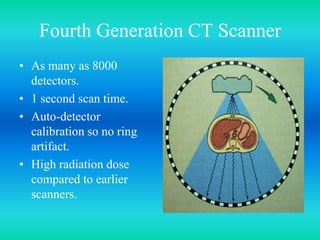
Fourth Generation CT Scanner
• As many as 8000
detectors.
• 1 second scan time.
• Auto-detector
calibration so no ring
artifact.
• High radiation dose
compared to earlier
scanners.
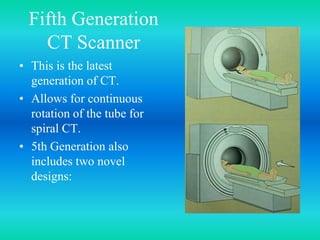
Fifth Generation
CT Scanner
• This is the latest
generation of CT.
• Allows for continuous
rotation of the tube for
spiral CT.
• 5th Generation also
includes two novel
designs:

Computed tomography basics

  • 1.
    Maulik R. Shah B.E. (Inst & Control Engg.) M. S. (Biomed Engg., USA) PGDHA (Apollo Hospital) Consultant Biomedical Engineer Medical Equipment Planner Hospital Project Consultant Mobile : 9824019971 Email : mailtomaulik@gmail.com www.atozforhospital.com
  • 2.
  • 3.
  • 4.
    Tomo = image// to long axis of the body CT = image is transverse to the body
  • 5.
    Basic C TPrinciples • Computed Tomography has the x- ray tube move across the so the image is called a transverse image or one perpendicular to the long axis of the body.
  • 6.
    Computed Tomography Development • Computedtomography has gone through five major design advancements since 1970 • Each development improved both scan time and resolution or image quality. • Scan time have been reduced from 5 minutes to 50 ms. • First scanner used a very tightly collimated pencil beam.
  • 7.
    Generations • First GenerationScanners – Translation/Rotation – Tube produced a finely collimated beam or pencil beam – 1 to 3 detectors were placed opposite the tube for radiation detection – 4.5 minutes to gather enough information for one slice – Tube was only able to rotate 180 degrees
  • 8.
    First Generation • 1971 •Pencil Thin Beam of Radiation • Translate and Rotate – X-ray source and detector fixed relative position – One degree of rotation possible • Scan Time (Single Image) – 5 min • 128 x 128 images Patient X-ray tube Detector
  • 9.
    First Generation CTScanner • Pencil Beam • Translate-Rotate Design • 180 one degree images or translations. • One or two detectors. • 5 minutes scan time
  • 11.
    Second Generation • Fan-shapedx-ray beam • 30 or more detectors • 20 seconds per slice or 10 minutes for a 40 slice exam • 180 degree rotation • Long data reconstruction time
  • 12.
    Second Generation • 1974 •X-rays – Multiple Pencil – Fan Shaped 3 - 26 degrees • Still Translate and Rotate – X-ray source and detector still fixed relative position – Rotation increased from one to three degrees • Scan time (Single Image) – 3.5 min – Eventually 5.3 sec X-ray tube Detectors
  • 13.
    Second Generation CTScanner • Translate-Rotate • Fan beam collimation so there is more scatter radiation. • 5 to 30 detectors • 10 degrees /translation 18 per scan. • 30 second scan times • Faster scan time
  • 15.
    Third Generation • Fan-shapedx-ray beam • 960 detectors opposite the x-ray tube • Complete 360 degree rotation Rotate/Rotate movement • One rotation = one slice • Second data acquisition could be made as the tube and detectors move in the opposite direction. • Time reduced to 1 sec per slice
  • 16.
  • 17.
    Third Generation • 1977 •X-ray – Fan Shaped – 21 - 45 degrees • Rotation Only – Array of Detectors • Scan Time (Single Image) – 4.8 sec – Eventually reduced to 2.5 seconds Detectors X-ray tube
  • 18.
    Third Generation CTScanner • Rotate-Rotate • Fan shaped beam of 30 to 60° for full patient coverage. • Constant Source to detector distance due to curvilinear detector array.
  • 19.
    Third Generation CTScanner • If one detector fails, a ring artifact appears. • 1 second scan times • Superior reconstruction and resolution.
  • 20.
    Fourth Generation • Developedin 1980’s • Fixed ring of as many as 4800 detectors, completely surrounding the patient, Rotate only movement • Rotating x-ray tube provides short bursts of radiation • Detectors collect the remnant radiation to reconstruct into an image • 1 minute for multiple slices
  • 21.
  • 22.
    Fourth Generation • 1980 •X-ray – Wide Fan – 48 - 120 degrees • Rotation Only – Full Ring of Detectors • Scan Time (Single Image) – 5 Sec – Eventually reduced to ~1 sec X-ray tube Ring of Detectors
  • 23.
    Fourth Generation CTScanner • The tube rotates around a stationary ring of detectors. • Fan beam • Variable slice thickness with pre and post patient collimation.
  • 24.
    Fourth Generation CTScanner • As many as 8000 detectors. • 1 second scan time. • Auto-detector calibration so no ring artifact. • High radiation dose compared to earlier scanners.
  • 25.
    Fifth Generation CT Scanner •This is the latest generation of CT. • Allows for continuous rotation of the tube for spiral CT. • 5th Generation also includes two novel designs: