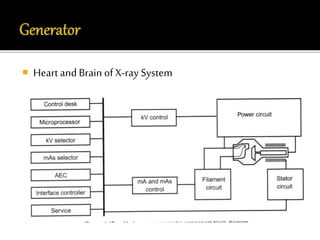
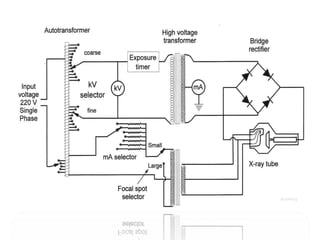
 Heart and Brain of X-ray System
 Needs DC (is in fact a vacuum tube diode) 
 Can only conduct in one direction: 
 cathode negative with respect to anode 
 Because of thermionic emission 
 Therefore need rectifiers; convert AC to DC 
 Need high voltage for X-ray production 
 ½ mv2 into h  
 110 Volts vs 110 thousand volts 
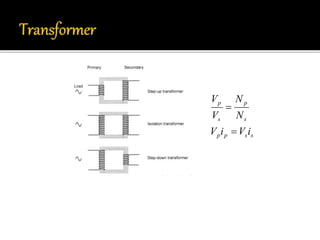
 Therefore need transformers (changes voltage)
p 
s 
p 
s 
N 
N 
V 
V 
 
V i  
V i 
p p s s
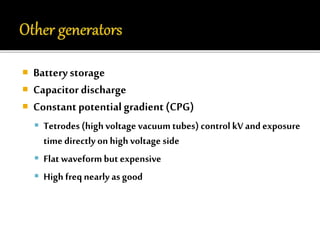
 Battery storage 
 Capacitor discharge 
 Constant potential gradient (CPG) 
 Tetrodes (high voltage vacuum tubes) control kV and exposure 
time directly on high voltage side 
 Flat waveform but expensive 
 High freq nearly as good
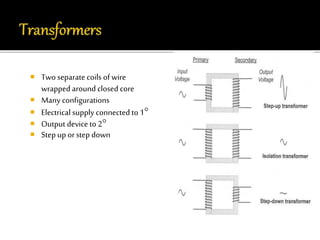
 Two separate coils of wire 
wrapped around closed core 
 Many configurations 
 Electrical supply connected to 1 
 Output device to 2 
 Step up or step down
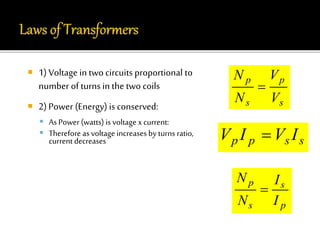
 1) Voltage in two circuits proportional to 
number of turns in the two coils 
 2) Power (Energy) is conserved: 
p 
s 
p 
s 
V 
V 
N 
N 
 
 As Power (watts) is voltage x current: 
 Therefore as voltage increases by turns ratio, 
current decreases p p s s V I  V I 
s 
p 
p 
s 
I 
I 
N 
N 

Bushberg
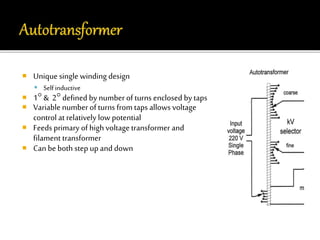
 Unique single winding design 
 Self inductive 
 1 & 2 defined by number of turns enclosed by taps 
 Variable number of turns from taps allows voltage 
control at relatively low potential 
 Feeds primary of high voltage transformer and 
filament transformer 
 Can be both step up and down
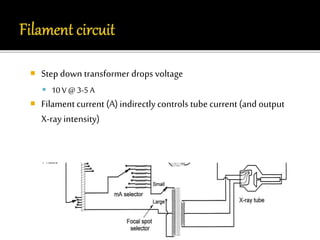
 Step down transformer drops voltage 
 10 V @ 3-5 A 
 Filament current (A) indirectly controls tube current (and output 
X-ray intensity)
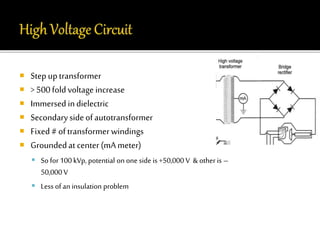
 Step up transformer 
 > 500 fold voltage increase 
 Immersed in dielectric 
 Secondary side of autotransformer 
 Fixed # of transformer windings 
 Grounded at center (mA meter) 
 So for 100 kVp, potential on one side is +50,000 V & other is – 
50,000 V 
 Less of an insulation problem
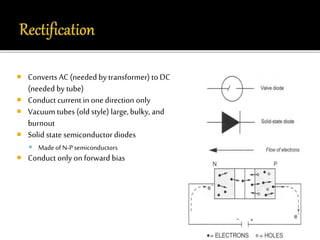
 Converts AC (needed by transformer) to DC 
(needed by tube) 
 Conduct current in one direction only 
 Vacuum tubes (old style) large, bulky, and 
burnout 
 Solid state semiconductor diodes 
 Made of N-P semiconductors 
 Conduct only on forward bias
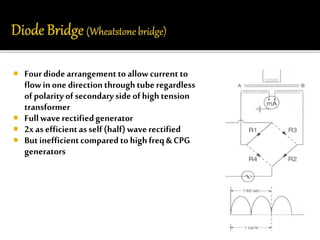
 Four diode arrangement to allow current to 
flow in one direction through tube regardless 
of polarity of secondary side of high tension 
transformer 
 Full wave rectified generator 
 2x as efficient as self (half) wave rectified 
 But inefficient compared to high freq & CPG 
generators
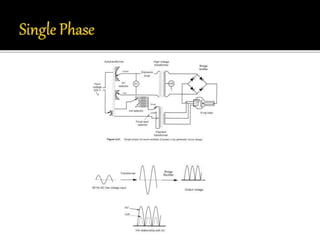
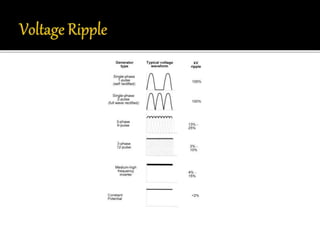
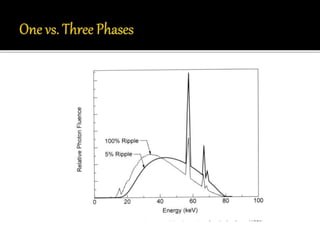
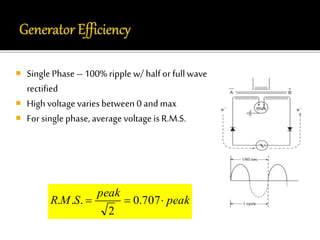
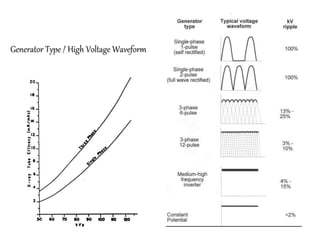
 Single Phase – 100% ripple w/ half or full wave 
rectified 
 High voltage varies between 0 and max 
 For single phase, average voltage is R.M.S. 
peak 
peak 
RM S   0.707 
2 
. . .
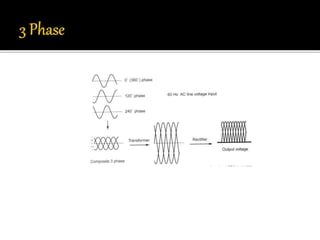
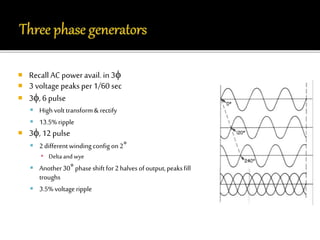
 Recall AC power avail. in 3 
 3 voltage peaks per 1/60 sec 
 3, 6 pulse 
 High volt transform & rectify 
 13.5% ripple 
 3, 12 pulse 
 2 different winding config on 2° 
▪ Delta and wye 
 Another 30° phase shift for 2 halves of output, peaks fill 
troughs 
 3.5% voltage ripple
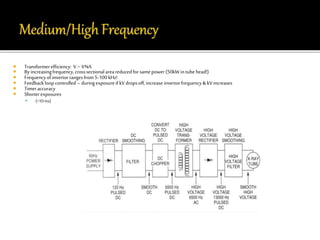
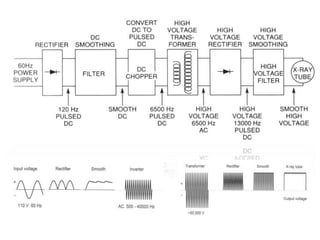
 Transformer efficiency: V ~ NA 
 By increasing frequency, cross sectional area reduced for same power (50kW in tube head!) 
 Frequency of invertor ranges from 5-100 kHz! 
 Feedback loop controlled – during exposure if kV drops off, increase invertor frequency & kV increases 
 Timer accuracy 
 Shorter exposures 
 (<10 ms)
Generator Type / High Voltage Waveform
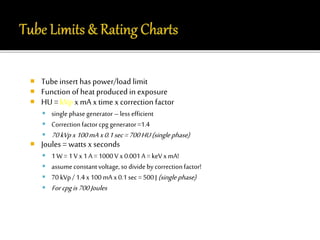
 Tube insert has power/load limit 
 Function of heat produced in exposure 
 HU = kVp x mA x time x correction factor 
 single phase generator – less efficient 
 Correction factor cpg generator =1.4 
 70 kVp x 100 mA x 0.1 sec = 700 HU (single phase) 
 Joules = watts x seconds 
 1 W = 1 V x 1 A = 1000 V x 0.001 A = keV x mA! 
 assume constant voltage, so divide by correction factor! 
 70 kVp / 1.4 x 100 mA x 0.1 sec = 500 J (single phase) 
 For cpg is 700 Joules
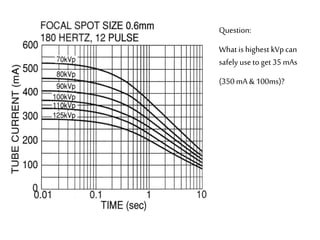
Question: 
What is highest kVp can 
safely use to get 35 mAs 
(350 mA & 100ms)?
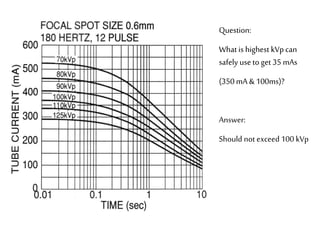
Question: 
What is highest kVp can 
safely use to get 35 mAs 
(350 mA & 100ms)? 
Answer: 
Should not exceed 100 kVp
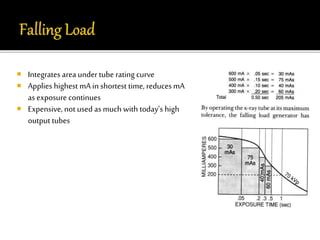
 Integrates area under tube rating curve 
 Applies highest mA in shortest time, reduces mA 
as exposure continues 
 Expensive, not used as much with today’s high 
output tubes
 Single phase seldom at peak voltage, so set higher kVp 
 Three phase higher average kVp 
 Less ripple means more mR/mAs (shorter exposure time) 
 5 mR/mAs single vs. 10 mR/mAs three phase 
 Ripple based on some multiple of 60 Hz 
 High frequency more common now, smaller and cheaper than CPG
 Tube power handling should match generator output 
 Rated in kilowatts under load (kVp x mA) @ 100 kVp 
 80 kW generator can produce 800 mA at 100 kVp (simultaneously) 
 Polydoros 80s, Medio CP80 
 Small clinic may have 20kW, 200 mA at most 
 Angio/Cardio generators 100 kW and greater 
 CT not necessarily high instantaneous, but tube and generator sustain for long 
periods

x-ray generator

  • 2.
     Heart andBrain of X-ray System
  • 3.
     Needs DC(is in fact a vacuum tube diode)  Can only conduct in one direction:  cathode negative with respect to anode  Because of thermionic emission  Therefore need rectifiers; convert AC to DC  Need high voltage for X-ray production  ½ mv2 into h   110 Volts vs 110 thousand volts  Therefore need transformers (changes voltage)
  • 4.
    p s p s N N V V  V i  V i p p s s
  • 10.
     Battery storage  Capacitor discharge  Constant potential gradient (CPG)  Tetrodes (high voltage vacuum tubes) control kV and exposure time directly on high voltage side  Flat waveform but expensive  High freq nearly as good
  • 11.
     Two separatecoils of wire wrapped around closed core  Many configurations  Electrical supply connected to 1  Output device to 2  Step up or step down
  • 12.
     1) Voltagein two circuits proportional to number of turns in the two coils  2) Power (Energy) is conserved: p s p s V V N N   As Power (watts) is voltage x current:  Therefore as voltage increases by turns ratio, current decreases p p s s V I  V I s p p s I I N N 
  • 13.
  • 14.
     Unique singlewinding design  Self inductive  1 & 2 defined by number of turns enclosed by taps  Variable number of turns from taps allows voltage control at relatively low potential  Feeds primary of high voltage transformer and filament transformer  Can be both step up and down
  • 15.
     Step downtransformer drops voltage  10 V @ 3-5 A  Filament current (A) indirectly controls tube current (and output X-ray intensity)
  • 16.
     Step uptransformer  > 500 fold voltage increase  Immersed in dielectric  Secondary side of autotransformer  Fixed # of transformer windings  Grounded at center (mA meter)  So for 100 kVp, potential on one side is +50,000 V & other is – 50,000 V  Less of an insulation problem
  • 17.
     Converts AC(needed by transformer) to DC (needed by tube)  Conduct current in one direction only  Vacuum tubes (old style) large, bulky, and burnout  Solid state semiconductor diodes  Made of N-P semiconductors  Conduct only on forward bias
  • 18.
     Four diodearrangement to allow current to flow in one direction through tube regardless of polarity of secondary side of high tension transformer  Full wave rectified generator  2x as efficient as self (half) wave rectified  But inefficient compared to high freq & CPG generators
  • 19.
     Single Phase– 100% ripple w/ half or full wave rectified  High voltage varies between 0 and max  For single phase, average voltage is R.M.S. peak peak RM S   0.707 2 . . .
  • 20.
     Recall ACpower avail. in 3  3 voltage peaks per 1/60 sec  3, 6 pulse  High volt transform & rectify  13.5% ripple  3, 12 pulse  2 different winding config on 2° ▪ Delta and wye  Another 30° phase shift for 2 halves of output, peaks fill troughs  3.5% voltage ripple
  • 21.
     Transformer efficiency:V ~ NA  By increasing frequency, cross sectional area reduced for same power (50kW in tube head!)  Frequency of invertor ranges from 5-100 kHz!  Feedback loop controlled – during exposure if kV drops off, increase invertor frequency & kV increases  Timer accuracy  Shorter exposures  (<10 ms)
  • 23.
    Generator Type /High Voltage Waveform
  • 24.
     Tube inserthas power/load limit  Function of heat produced in exposure  HU = kVp x mA x time x correction factor  single phase generator – less efficient  Correction factor cpg generator =1.4  70 kVp x 100 mA x 0.1 sec = 700 HU (single phase)  Joules = watts x seconds  1 W = 1 V x 1 A = 1000 V x 0.001 A = keV x mA!  assume constant voltage, so divide by correction factor!  70 kVp / 1.4 x 100 mA x 0.1 sec = 500 J (single phase)  For cpg is 700 Joules
  • 25.
    Question: What ishighest kVp can safely use to get 35 mAs (350 mA & 100ms)?
  • 26.
    Question: What ishighest kVp can safely use to get 35 mAs (350 mA & 100ms)? Answer: Should not exceed 100 kVp
  • 27.
     Integrates areaunder tube rating curve  Applies highest mA in shortest time, reduces mA as exposure continues  Expensive, not used as much with today’s high output tubes
  • 28.
     Single phaseseldom at peak voltage, so set higher kVp  Three phase higher average kVp  Less ripple means more mR/mAs (shorter exposure time)  5 mR/mAs single vs. 10 mR/mAs three phase  Ripple based on some multiple of 60 Hz  High frequency more common now, smaller and cheaper than CPG
  • 29.
     Tube powerhandling should match generator output  Rated in kilowatts under load (kVp x mA) @ 100 kVp  80 kW generator can produce 800 mA at 100 kVp (simultaneously)  Polydoros 80s, Medio CP80  Small clinic may have 20kW, 200 mA at most  Angio/Cardio generators 100 kW and greater  CT not necessarily high instantaneous, but tube and generator sustain for long periods