System Components
Muhammad Arif Afridi
Lecturer in Medical Imaging | RFafridi@hotmail.com
1
Muhammad Arif Afridi
Lecturer in Medical Imaging
Medical Imaging Technologist (MIT) - Radiology
Master in Public Health (MPH)
Email: RFafridi@hotmail.com
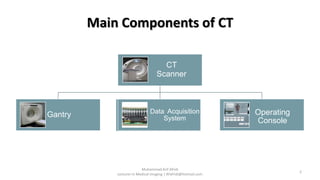
Main Components of CT
Muhammad Arif Afridi
Lecturer in Medical Imaging | RFafridi@hotmail.com
2
CT
Scanner
Gantry Data Acquisition
System
Operating
Console
System Components
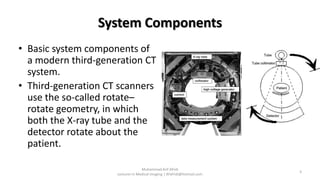
• Basic system components of
a modern third-generation CT
system.
• Third-generation CT scanners
use the so-called rotate–
rotate geometry, in which
both the X-ray tube and the
detector rotate about the
patient.
Muhammad Arif Afridi
Lecturer in Medical Imaging | RFafridi@hotmail.com
3
System Components
• The overall performance of a CT system depends on several key
components.
• These components include the X-ray source, a high-powered
generator, detector, data transmission systems, and the
computer system for image reconstruction and manipulation.
Muhammad Arif Afridi
Lecturer in Medical Imaging | RFafridi@hotmail.com
4
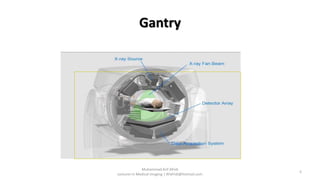
Gantry
5
Muhammad Arif Afridi
Lecturer in Medical Imaging | RFafridi@hotmail.com
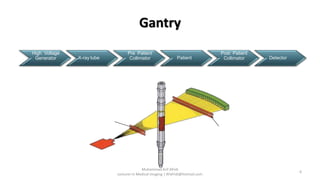
High Voltage
Generator X-ray tube
Pre Patient
Collimator Patient
Post Patient
Collimator Detector
X ray source
Pre Patient Collimation
Post Patient
Collimation
X-ray Detector
Gantry
6
Muhammad Arif Afridi
Lecturer in Medical Imaging | RFafridi@hotmail.com
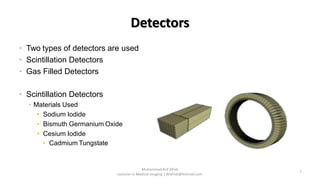
• Two types of detectors are used
• Scintillation Detectors
• Gas Filled Detectors
• Scintillation Detectors
• Materials Used
• Sodium Iodide
• Bismuth Germanium Oxide
• Cesium Iodide
• Cadmium Tungstate Scintillator
Crystal
Photo Multiplier
Detector
Rings
Detectors
7
Muhammad Arif Afridi
Lecturer in Medical Imaging | RFafridi@hotmail.com
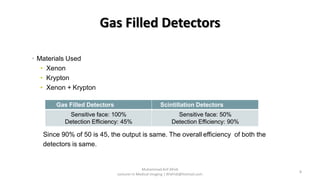
Gas Filled Detectors
• Materials Used
• Xenon
• Krypton
• Xenon + Krypton
Since 90% of 50 is 45, the output is same. The overall efficiency of both the
detectors is same.
Gas Filled Detectors Scintillation Detectors
Sensitive face: 100%
Detection Efficiency: 45%
Sensitive face: 50%
Detection Efficiency: 90%
8
Muhammad Arif Afridi
Lecturer in Medical Imaging | RFafridi@hotmail.com
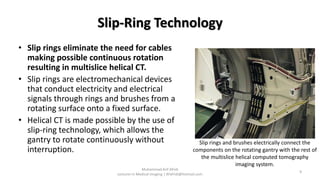
Slip-Ring Technology
• Slip rings eliminate the need for cables
making possible continuous rotation
resulting in multislice helical CT.
• Slip rings are electromechanical devices
that conduct electricity and electrical
signals through rings and brushes from a
rotating surface onto a fixed surface.
• Helical CT is made possible by the use of
slip-ring technology, which allows the
gantry to rotate continuously without
interruption.
Muhammad Arif Afridi
Lecturer in Medical Imaging | RFafridi@hotmail.com
9
Slip rings and brushes electrically connect the
components on the rotating gantry with the rest of
the multislice helical computed tomography
imaging system.
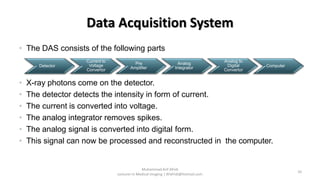
• The DAS consists of the following parts
• X-ray photons come on the detector.
• The detector detects the intensity in form of current.
• The current is converted into voltage.
• The analog integrator removes spikes.
• The analog signal is converted into digital form.
• This signal can now be processed and reconstructed in the computer.
Detector
Current to
Voltage
Convertor
Pre
Amplifier
Analog
Integrator
Analog to
Digital
Convertor
Computer
Data Acquisition System
10
Muhammad Arif Afridi
Lecturer in Medical Imaging | RFafridi@hotmail.com
Image Reconstruction
• After enough transmission measurements (detector)
• Sent to the computer for processing
• A software called Fourier Slice Transform is used.
• More than 250,000 reconstruction algorithms are used
(example: algebraic reconstruction technique) to compute the
image.
11
Muhammad Arif Afridi
Lecturer in Medical Imaging | RFafridi@hotmail.com
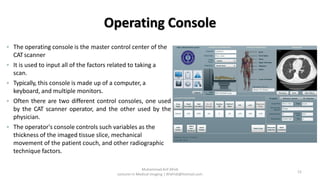
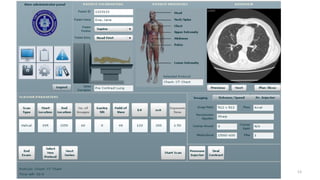
• The operating console is the master control center of the
CATscanner
• It is used to input all of the factors related to taking a
scan.
• Typically, this console is made up of a computer, a
keyboard, and multiple monitors.
• Often there are two different control consoles, one used
by the CAT scanner operator, and the other used by the
physician.
• The operator's console controls such variables as the
thickness of the imaged tissue slice, mechanical
movement of the patient couch, and other radiographic
technique factors.
Operating Console
12
Muhammad Arif Afridi
Lecturer in Medical Imaging | RFafridi@hotmail.com
Muhammad Arif Afridi
Lecturer in Medical Imaging | RFafridi@hotmail.com
13
• End of the lecture
• Thank you!
Muhammad Arif Afridi
Lecturer in Medical Imaging | RFafridi@hotmail.com
14

4. system components

  • 1.
    System Components Muhammad ArifAfridi Lecturer in Medical Imaging | RFafridi@hotmail.com 1 Muhammad Arif Afridi Lecturer in Medical Imaging Medical Imaging Technologist (MIT) - Radiology Master in Public Health (MPH) Email: RFafridi@hotmail.com
  • 2.
    Main Components ofCT Muhammad Arif Afridi Lecturer in Medical Imaging | RFafridi@hotmail.com 2 CT Scanner Gantry Data Acquisition System Operating Console
  • 3.
    System Components • Basicsystem components of a modern third-generation CT system. • Third-generation CT scanners use the so-called rotate– rotate geometry, in which both the X-ray tube and the detector rotate about the patient. Muhammad Arif Afridi Lecturer in Medical Imaging | RFafridi@hotmail.com 3
  • 4.
    System Components • Theoverall performance of a CT system depends on several key components. • These components include the X-ray source, a high-powered generator, detector, data transmission systems, and the computer system for image reconstruction and manipulation. Muhammad Arif Afridi Lecturer in Medical Imaging | RFafridi@hotmail.com 4
  • 5.
    Gantry 5 Muhammad Arif Afridi Lecturerin Medical Imaging | RFafridi@hotmail.com
  • 6.
    High Voltage Generator X-raytube Pre Patient Collimator Patient Post Patient Collimator Detector X ray source Pre Patient Collimation Post Patient Collimation X-ray Detector Gantry 6 Muhammad Arif Afridi Lecturer in Medical Imaging | RFafridi@hotmail.com
  • 7.
    • Two typesof detectors are used • Scintillation Detectors • Gas Filled Detectors • Scintillation Detectors • Materials Used • Sodium Iodide • Bismuth Germanium Oxide • Cesium Iodide • Cadmium Tungstate Scintillator Crystal Photo Multiplier Detector Rings Detectors 7 Muhammad Arif Afridi Lecturer in Medical Imaging | RFafridi@hotmail.com
  • 8.
    Gas Filled Detectors •Materials Used • Xenon • Krypton • Xenon + Krypton Since 90% of 50 is 45, the output is same. The overall efficiency of both the detectors is same. Gas Filled Detectors Scintillation Detectors Sensitive face: 100% Detection Efficiency: 45% Sensitive face: 50% Detection Efficiency: 90% 8 Muhammad Arif Afridi Lecturer in Medical Imaging | RFafridi@hotmail.com
  • 9.
    Slip-Ring Technology • Sliprings eliminate the need for cables making possible continuous rotation resulting in multislice helical CT. • Slip rings are electromechanical devices that conduct electricity and electrical signals through rings and brushes from a rotating surface onto a fixed surface. • Helical CT is made possible by the use of slip-ring technology, which allows the gantry to rotate continuously without interruption. Muhammad Arif Afridi Lecturer in Medical Imaging | RFafridi@hotmail.com 9 Slip rings and brushes electrically connect the components on the rotating gantry with the rest of the multislice helical computed tomography imaging system.
  • 10.
    • The DASconsists of the following parts • X-ray photons come on the detector. • The detector detects the intensity in form of current. • The current is converted into voltage. • The analog integrator removes spikes. • The analog signal is converted into digital form. • This signal can now be processed and reconstructed in the computer. Detector Current to Voltage Convertor Pre Amplifier Analog Integrator Analog to Digital Convertor Computer Data Acquisition System 10 Muhammad Arif Afridi Lecturer in Medical Imaging | RFafridi@hotmail.com
  • 11.
    Image Reconstruction • Afterenough transmission measurements (detector) • Sent to the computer for processing • A software called Fourier Slice Transform is used. • More than 250,000 reconstruction algorithms are used (example: algebraic reconstruction technique) to compute the image. 11 Muhammad Arif Afridi Lecturer in Medical Imaging | RFafridi@hotmail.com
  • 12.
    • The operatingconsole is the master control center of the CATscanner • It is used to input all of the factors related to taking a scan. • Typically, this console is made up of a computer, a keyboard, and multiple monitors. • Often there are two different control consoles, one used by the CAT scanner operator, and the other used by the physician. • The operator's console controls such variables as the thickness of the imaged tissue slice, mechanical movement of the patient couch, and other radiographic technique factors. Operating Console 12 Muhammad Arif Afridi Lecturer in Medical Imaging | RFafridi@hotmail.com
  • 13.
    Muhammad Arif Afridi Lecturerin Medical Imaging | RFafridi@hotmail.com 13
  • 14.
    • End ofthe lecture • Thank you! Muhammad Arif Afridi Lecturer in Medical Imaging | RFafridi@hotmail.com 14