GENERATIONS OF CT
Presented by :Prativa Khanal
BSc.MIT 2nd year
NMCTH
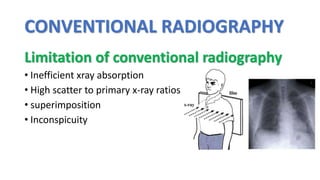
CONVENTIONAL RADIOGRAPHY
Limitation of conventional radiography
• Inefficient xray absorption
• High scatter to primary x-ray ratios
• superimposition
• Inconspicuity
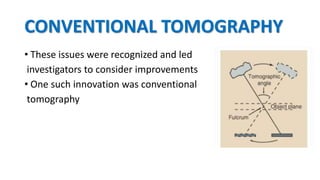
CONVENTIONAL TOMOGRAPHY
• These issues were recognized and led
investigators to consider improvements
• One such innovation was conventional
tomography
COMPUTED TOMOGRAPHY
• In the last 30 years of X-ray Computed Tomography
development produced a great change in the role of
diagnostic imaging in medicine
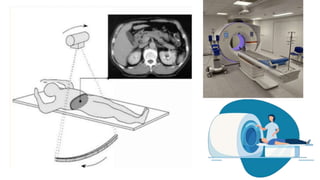
• The basics of CT is to take a series of conventional cross-
sectional x-rays while the patient "is rotated" slightly around
an axis between each exposure
• A series of projection data is obtained, these data are used
to reconstruct cross-sectional images
COMPUTED TOMOGRAPHY
• 1917: The austrian mathematician Radon develop a way to
reconstruct the density distribution of an object if the line
integrals (for every direction)are available
• 1957-63:The physician Cormack develops a lot of theoretical
work on x-rays creating the basis of CT scanning (without
knowing Radon work)
• 1971: The first CT system has been created by Godfrey N.
Hounsfield, he received the Nobel prize in 1979 (together
with Cromack)
• 1972: The first clinical use of a CT system in London
COMPUTED TOMOGRAPHY
• 1973-74: The first II Generation CT system total-body
scanner has been realized in the U.S., the acquisition time for
1 tomogram was 18 sec
• 1976-77: III and IV Generations CT with acquisition time for 1
tomogram lower than 5 sec
• 1983: First electron beam CT, very expensive
• 1989: First helical CT, very low acquisition time (less than 1
sec) and able to explore a large body volume
• 2000: Multislice CT scanner, multiple arrays of detectors;
continuous development
INTRODUCTION
• Generation is the order in which CT scanner design has been
introduced,and each has a number associated with it
• Classification based on arrangement of components and
mechanical motion required to collect data
• Higher generation number doesn’t necessarily indicate
higher performance system
FIRST GENERATION CT
• It is functional marriage of diverse technology including
computer hardware,control systems,x-ray
detectors,sophisticated reconstruction algorithms,x-ray
tube,generator systems
• 1ST generation of CT scanners employed a rotate-translate,
pencil beam system
• Two x-ray detectors were used, and they measured the
transmission of x-rays through the patient for two different slices
• X-ray tube and detectors are rigidly linked and scan across
subject sweeping a narrow x-ray beam through the slice
FIRST GENERATION
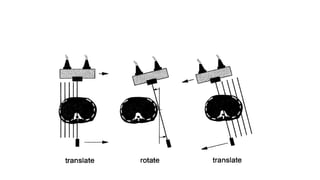
• Starting at a particular angle, the x-ray tube and detector
system translated linearly across the FOV acquiring 160
parallel rays per view
• After end of translation,tube and detector assembly rotated
around the subject by 1 degree
• This procedure was repeated until 180 projection
• A total of 180x160=28,800 rays were measured
• This combination of linear translation followed by
incremental rotation is called translate-rotate motion
• As the system translated and measured rays from the thickest part
of the head to the area adjacent to the head, a huge change in x-
ray flux occurred
• Early detector system couldn’t accommodate large change in signal
so patient head was recessed via a rubber membrane into a water
filled box/water bath
• Acted to bolus the x-rays so that the intensity outside the head is
similar to the intensity inside head
• ADVANTAGE
• With regard to scatter rejection,pencil beam geometry used in 1st
generation scanners were best
• DISADVANTAGE
• 5minute was required to complete a single image
• Contrast resolution of internal structures was
unprecedented, images had poor spatial resolution
• NAI detectors was used which are hygroscopic in nature
SECOND GENERATION CT
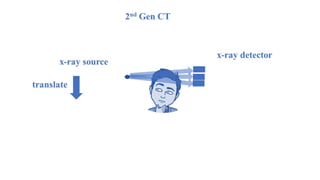
• 1st waterless full body CT scanner was developed and
installed by Ledley Gorgetown University in February 1974
• It consist of narrow fan beam (3-10) degree and multiple
detectors (linear array of 30 detectors)
• With 10 degree rotation increment,only 18 translation would
be required for 180 degree image acquisition
• Shortest scan time with 2nd generation CT was 18 s per slice,
15 times faster than with 1st generation CT
Disadvantage
• Further speed improvements were limited by mechanical
complexity of translate – rotate geometry
• Low efficiency
• Scatter radiation increased due to narrow fan beam
• One disadvantage of fan beam is the increased radiation
intensity towards the edge. But it is compensated with the
use of bow-tie filter (limits the range of intensity reaching
detector and hardens beam)
Third generation
• The translation motion of 1st and 2nd generation CT scanner
was fundamental impediment to fast scanning
• 1st and 2nd generation had to be dynamically recalibrated at
the end of each translation
• Faster scans required the elimination of translational motion
and the use of simple and pure rotational motion
• This is accomplished by widening the x-ray beam
encompassing the entire patient width and using and array
of detectors to intercept the beam
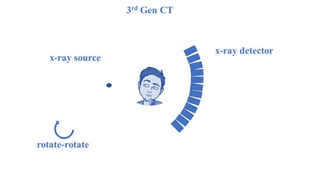
• The design, characterized by linked tube - detector system
undergoing only rotational motion is called third generation of
CT
• Wide angle fan beam of 50-55° was used and no. of detectors
was increased to more than 800 detectors - limits spatial
resolution - 5 to 10 lp/cm.
• The early third generation CT scanners installed on late 1975
could scan less than 5 sec, current designs can scan as quickly
as one third of a sec for cardiac application
DISADVANTAGE
• It requires extremely high detector stability and matching of
the detector response
• Any error or drift in the calibration of detectors relative to
other detectors is back projected along these ray path and
reinforced along a ring where they cross-the result is the ring
artifact
• Another disadvantage is sampling - sample size and spacing
are fixed by detector design. Samples cannot be closure
together than distance between rays associated with
detector at the level of center of rotation
Contd…
• A solution was provided by Xenon detector arrange
• Xenon arrays were inherently stable and well matched
because factor affecting detector response were either
uniform for the entire array or constant over chamber
• Xenon were eventually replaced by solid state detectors
Contd..
• Ring artifacts are never completely eliminated, rather they
are minimized by high quality detectors design and frequent
calibration
• Residual ring artifacts are then removed by image processing
algorithms
• Despite these limitations, 3rd generation CT was highly
successful and remains the basic geometry of must CT
scanners manufactured today
FOURTH GENERATION CT
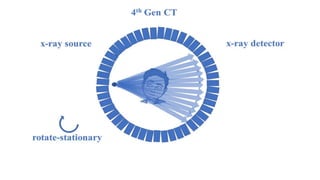
• By 1976, a design was incorporated with a large stationary
360 degrees ring of detectors with the x-ray tube alone
rotating round the patient
• This approach of wide angle fan beam and rotate/stationary
motion with sub second imaging time is referred to as fourth
generation of CT
• It uses about 4800 individual detectors and spatial resolution
of more than 20 lp/cm
• Xray beam angle = 50-55°
• Rotate(tube)-Fixed(detectors)
• Xray tube rotates in a circle inside the detector ring
• Was designed to overcome ring artifact
DRAWBACKS
• Size and geometric dose inefficiency
• Because tube rotated inside the detector ring large ring
diameter was needed. On the other hand acceptable spatial
resolution limited detector aperture to approx. 4mm.
• Scatter-The scatter absorbing septa used in 3rd generation
could not be used in 4th generation because septa could
necessarily be aimed at center of the ring which was the
source of scatter.
Fifth generation
• Cardiac imaging required ultra fast scan times(<50ms) which
was a hurdle with previous existed generation
• A novel CT scanner was developed specifically for cardiac
imaging which was capable of performing complete scans in
a little as 10-20ms
• The idea behind the ultrafast scanner is a large bell
shaped x- ray tube
Contd…
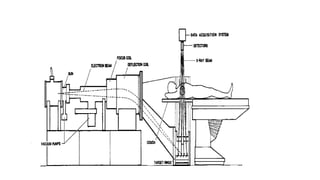
• It doesn't use conventional x-ray tube, instead a large arc of
tungsten encircles the patient and lies directly opposite to the
detector ring
• X-rays are produced from a focal track as a high energy
electron beam strikes the tungsten
• Electron beam is produced in cone like structures behind the
gantry and is electronically steered around the patient so that
it strikes the annular target
• Wherever it strikes - produces x-rays.The concept is known as
EBCT(Electron Beam CT)
• EBCT is also restricted to single slice acquisition for ECG-
triggered scan examination times may be still beyond a single
breathe hold
• Typical scan times are 30-40s for a 12 cm volume
• Although still available, EBCT was limited to cardiac screening
mostly because of image quality for general screening was lower
than that of conventional CT (because of low mAs values) and
higher equipment costs
• With progress being made cardiac scanning by multi slice CT, the
future of EBCT is uncertain
Advantages
• Produce high resolution image
• Faster than conventional CT scanners
• Uses electron beam instead of x-ray tube
Disadvantages
• Costly equipment
• Cmplicated electronics
Sixth generation CT
• Though 3rd and 4th generation CT scanners elimated the
transitional motion,the gantry had to be stopped after each
slice was acquired
• Cables are spooled onto a drum, released during rotation
and respooled during reversal
• Scanning,braking and reversal required at least 8-10 sec of
which only 1-2 sec were spent for data acquisition
• The result was poor temporal resolution and long procedure
time
• The development of helical or spiral CT was truly revoluntary
advancement in CT scanning that finally allowed true 3D image
acuistion within a single breath hold technique
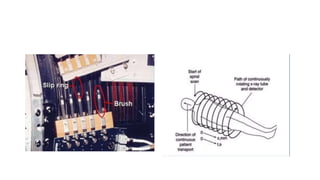
• As the table is smoothly moved through the rotating gantry,
the resulting trajectory of the tube and detector relative to
patient traces out a helical or spiral path
• Three technological developments were required;
Slip ring technology
High power x-ray tubes
Interpolation algorithms
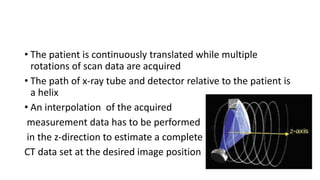
• The patient is continuously translated while multiple
rotations of scan data are acquired
• The path of x-ray tube and detector relative to the patient is
a helix
• An interpolation of the acquired
measurement data has to be performed
in the z-direction to estimate a complete
CT data set at the desired image position
Slip ring
• Electromechanical devices consisting of circular electrical
conductive rings and brushes that transmit electrical energy
across a rotating intereference
• Elimating interscan delays required continuous rotation,a
capability made possible by low voltage slip ring
• A slip ring passes electrical power to the rotating components
without fixed connections
• It allows the complete elimination of the interscan delays
expcept for the time required to move the table to next slice
position
• For example : if scanning and moving the table each take 1s
only 50% of time is spent acquiring the data
• Furthermore rapid table movement may introduce tissue
jiggle artifact
DESIGN
Disk design-corporates concentric conducting ring lying
parallel to plane of rotation
Cylindrical design-has conducting ring lying parallel to axis of
rotation forming a cylinder
The common brush designs are wire and composite brush
ADVANTAGES
• Less potential possible
• Less potential for motion
• Improves contrast protocals possible
• Greater accuracy for multiplanar and 3D images
HIGH POWER X-RAY TUBE
• Stationary tubes were used in 1st and 2nd generation CT
scanner - long scan time - allowed heat dissipation
• Shorter scan time required high power of x-ray tubes and use
of oil cooled rotating anodes for efficient thermal dissipation
• Largest heat capacities are achieved with thick graphite
backing of target disks, anode diameters of 200mm or more,
metal housing with ceramic insulator
• The working life of tubes ranges from 10,000-40,000 hours
Pitch
• It is defined as the table movement per rotation divided by beam
width
• If the beam widith is 10mm, table moves 10mm during one tube
rotation then pitch is 1 xray beam associated with consecutive
helical loops are contigious
• If beam width is 10mm and table moves 15mm per tube rotation
the pitch is 1.5-gap exits between x-ray beam edge of
consecutive loop
• If beam width is 10mm and table moves 7.5mm then pitch is
0.75-beams and consecutive loops overlap by 2.5mm (doubly
irradiating the underlying tissues)
Interpolation
• Helical CT scanning produces a data set in which the x-ray
source has travelled in helical trajectory around the patient
• Present day CT reconstruction algorithms assume that x-ray
source as negotiated a circular not a helical path around the
patient
• With helical scanning, CT images can be reconstructed at any
position along the length of scan
• It allows the production of additional overlapping images
with no additional dose to the patient
Adavantages
• Fast scan time and large volume of data collected
• Minimized motion artifacts
• Less mis-registration between consecutive slices
• Reduced patient dose
• Improved spatial resolution
• Enhaanced multiplaner of 3D renderings
• Improved temporal resolution
Seventh generation ct
MS/MD CT
• It is introduced in 1998
• Allows acquisition of multiple slice in single row
• A body section can be scanned faster with a multiple row of
detectors system with multiple fan beams scanning
simultaneously
• Crucial for covering a large body section with thin beams for
producing thin, high-detail slice images or 3-D images
• An approach to overcoming x-ray tube output limitation is it
make better use of x-rays that are produced by x-ray tube
• When multiple detector is used, the collimation spacing is wider
therefore more of x-rays that are produced by x-ray tubes are
used in producing image data.
• With conventional single detector array scanners, opening upthe
collimator increases slice thickness which is good for utilization
of x-ray but reduces spatial resolution in the slicethickness
dimension
• With introduction of multiple detector arrays, the slice thickness
is determined by the detector size and not by the collimator
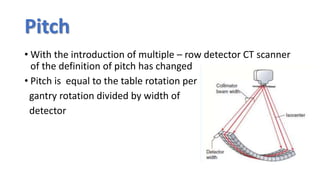
Pitch
• With the introduction of multiple – row detector CT scanner
of the definition of pitch has changed
• Pitch is equal to the table rotation per
gantry rotation divided by width of
detector
•ADVANTAGES
•It is based on 3rd generation geometry
•Has better Z-axis resolution
•Provides larger coverage
•Faster scan times.Less motion artifacts
•8,16, 64, 256 slice CT machine are available
ADVANCEMENT
• Dual energy ct
• Flat panel detector CT
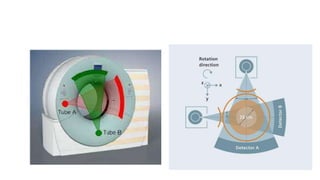
DUAL SOURCE CT
• Dual source increase the temporal resolution by reducing the
rotation angle required to acquire a complete image
• It permits cardiac imaging without the use of heart rate
lowering medication and imaging heart in systole
• The use of dual x-ray source makes possible the use of dual
energy imaging which allows an estimate of the average
atomic number in a voxel, as well as the total attenuation.
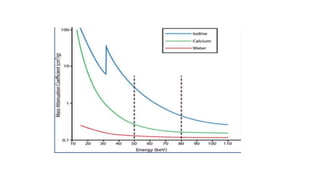
• Principle - materials show different attenuation at
different mean energies
TYPES OF DUAL ENERGY CT
SCANNER
• Three types of dual-energy CT scanners are available that
differ in the technique used to acquire high- and low-energy
CT datasets:
a dual-source dual-energy scanner
a single-source dual-energy scanner with fast kilovoltage
switching (ie, rapid alternation between high and low
kilovoltage settings)
a single-source dual-energy scanner with dual
detector layers
NEW GENERATION CARDIAC CT
• New generation CT scanners are recommended as the first line
imaging of coronary artery diseases in whom imaging is difficult
with earlier generation CT scanners
• These enhancement include better temporal resolution, better
spatial resolution and shorter acquisition times
These are;
• Acquilion One (Toshiba)
• Brilliance ICT (Philips)
• Discovery CT750 (GE Health Care)
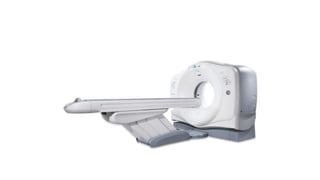
• Samatom Defination Flash (Siemens)
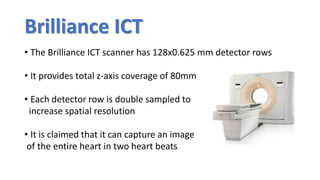
Brilliance ICT
• The Brilliance ICT scanner has 128x0.625 mm detector rows
• It provides total z-axis coverage of 80mm
• Each detector row is double sampled to
increase spatial resolution
• It is claimed that it can capture an image
of the entire heart in two heart beats
Discovery CT750 HD
• 64x0.625 mm detector dual - energy CT scanner
• Contains single x-ray source that switches between two
energy levels allowing two data sets - high and low energy
• It uses Gemstone detector that contributes to high image
quality and "snap shot" pulse - allows a complete picture of
the heart to be captured in 3-4 sec
• Snapshots are taken at precise table position and timed to
correspond to a specific phase of cardiac cycle
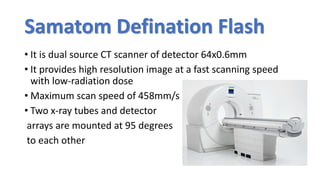
Samatom Defination Flash
• It is dual source CT scanner of detector 64x0.6mm
• It provides high resolution image at a fast scanning speed
with low-radiation dose
• Maximum scan speed of 458mm/s
• Two x-ray tubes and detector
arrays are mounted at 95 degrees
to each other
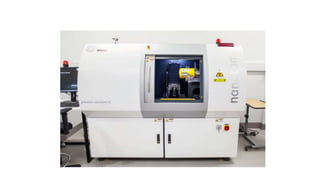
MICRO-CT
• commonly known as Industrial CT Scanner
• The term micro is used to indicate that the pixel sizes of the
cross-sections are in the micrometer range.
• The machine is much smaller in design compared to the human
version and is used to model smaller objects
There are two types of scanner
• one setup, the X-ray source and detector are typically stationary
during the scan while the sample/animal rotates
• second setup, much more like a clinical CT scanner, is gantry
based where the animal/specimen is stationary in space while
the X-ray tube and detector rotate around.
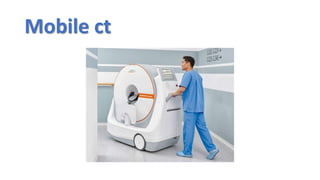
Mobile ct
REFERENCES
• The essential physics of medical imaging-Jerrold T.Bushberg
• Radiologic sciences for technologists-Stewart Caryle Bushong
• Various websites
• Thank you

Generation of CT.pptx...................

  • 1.
    GENERATIONS OF CT Presentedby :Prativa Khanal BSc.MIT 2nd year NMCTH
  • 2.
    CONVENTIONAL RADIOGRAPHY Limitation ofconventional radiography • Inefficient xray absorption • High scatter to primary x-ray ratios • superimposition • Inconspicuity
  • 3.
    CONVENTIONAL TOMOGRAPHY • Theseissues were recognized and led investigators to consider improvements • One such innovation was conventional tomography
  • 4.
    COMPUTED TOMOGRAPHY • Inthe last 30 years of X-ray Computed Tomography development produced a great change in the role of diagnostic imaging in medicine • The basics of CT is to take a series of conventional cross- sectional x-rays while the patient "is rotated" slightly around an axis between each exposure • A series of projection data is obtained, these data are used to reconstruct cross-sectional images
  • 5.
    COMPUTED TOMOGRAPHY • 1917:The austrian mathematician Radon develop a way to reconstruct the density distribution of an object if the line integrals (for every direction)are available • 1957-63:The physician Cormack develops a lot of theoretical work on x-rays creating the basis of CT scanning (without knowing Radon work) • 1971: The first CT system has been created by Godfrey N. Hounsfield, he received the Nobel prize in 1979 (together with Cromack) • 1972: The first clinical use of a CT system in London
  • 6.
    COMPUTED TOMOGRAPHY • 1973-74:The first II Generation CT system total-body scanner has been realized in the U.S., the acquisition time for 1 tomogram was 18 sec • 1976-77: III and IV Generations CT with acquisition time for 1 tomogram lower than 5 sec • 1983: First electron beam CT, very expensive • 1989: First helical CT, very low acquisition time (less than 1 sec) and able to explore a large body volume • 2000: Multislice CT scanner, multiple arrays of detectors; continuous development
  • 8.
    INTRODUCTION • Generation isthe order in which CT scanner design has been introduced,and each has a number associated with it • Classification based on arrangement of components and mechanical motion required to collect data • Higher generation number doesn’t necessarily indicate higher performance system
  • 9.
    FIRST GENERATION CT •It is functional marriage of diverse technology including computer hardware,control systems,x-ray detectors,sophisticated reconstruction algorithms,x-ray tube,generator systems • 1ST generation of CT scanners employed a rotate-translate, pencil beam system • Two x-ray detectors were used, and they measured the transmission of x-rays through the patient for two different slices • X-ray tube and detectors are rigidly linked and scan across subject sweeping a narrow x-ray beam through the slice
  • 10.
    FIRST GENERATION • Startingat a particular angle, the x-ray tube and detector system translated linearly across the FOV acquiring 160 parallel rays per view • After end of translation,tube and detector assembly rotated around the subject by 1 degree • This procedure was repeated until 180 projection • A total of 180x160=28,800 rays were measured • This combination of linear translation followed by incremental rotation is called translate-rotate motion
  • 12.
    • As thesystem translated and measured rays from the thickest part of the head to the area adjacent to the head, a huge change in x- ray flux occurred • Early detector system couldn’t accommodate large change in signal so patient head was recessed via a rubber membrane into a water filled box/water bath • Acted to bolus the x-rays so that the intensity outside the head is similar to the intensity inside head
  • 13.
    • ADVANTAGE • Withregard to scatter rejection,pencil beam geometry used in 1st generation scanners were best • DISADVANTAGE • 5minute was required to complete a single image • Contrast resolution of internal structures was unprecedented, images had poor spatial resolution • NAI detectors was used which are hygroscopic in nature
  • 14.
    SECOND GENERATION CT •1st waterless full body CT scanner was developed and installed by Ledley Gorgetown University in February 1974 • It consist of narrow fan beam (3-10) degree and multiple detectors (linear array of 30 detectors) • With 10 degree rotation increment,only 18 translation would be required for 180 degree image acquisition • Shortest scan time with 2nd generation CT was 18 s per slice, 15 times faster than with 1st generation CT
  • 16.
    Disadvantage • Further speedimprovements were limited by mechanical complexity of translate – rotate geometry • Low efficiency • Scatter radiation increased due to narrow fan beam • One disadvantage of fan beam is the increased radiation intensity towards the edge. But it is compensated with the use of bow-tie filter (limits the range of intensity reaching detector and hardens beam)
  • 17.
    Third generation • Thetranslation motion of 1st and 2nd generation CT scanner was fundamental impediment to fast scanning • 1st and 2nd generation had to be dynamically recalibrated at the end of each translation • Faster scans required the elimination of translational motion and the use of simple and pure rotational motion • This is accomplished by widening the x-ray beam encompassing the entire patient width and using and array of detectors to intercept the beam
  • 18.
    • The design,characterized by linked tube - detector system undergoing only rotational motion is called third generation of CT • Wide angle fan beam of 50-55° was used and no. of detectors was increased to more than 800 detectors - limits spatial resolution - 5 to 10 lp/cm. • The early third generation CT scanners installed on late 1975 could scan less than 5 sec, current designs can scan as quickly as one third of a sec for cardiac application
  • 20.
    DISADVANTAGE • It requiresextremely high detector stability and matching of the detector response • Any error or drift in the calibration of detectors relative to other detectors is back projected along these ray path and reinforced along a ring where they cross-the result is the ring artifact • Another disadvantage is sampling - sample size and spacing are fixed by detector design. Samples cannot be closure together than distance between rays associated with detector at the level of center of rotation
  • 21.
    Contd… • A solutionwas provided by Xenon detector arrange • Xenon arrays were inherently stable and well matched because factor affecting detector response were either uniform for the entire array or constant over chamber • Xenon were eventually replaced by solid state detectors
  • 22.
    Contd.. • Ring artifactsare never completely eliminated, rather they are minimized by high quality detectors design and frequent calibration • Residual ring artifacts are then removed by image processing algorithms • Despite these limitations, 3rd generation CT was highly successful and remains the basic geometry of must CT scanners manufactured today
  • 23.
    FOURTH GENERATION CT •By 1976, a design was incorporated with a large stationary 360 degrees ring of detectors with the x-ray tube alone rotating round the patient • This approach of wide angle fan beam and rotate/stationary motion with sub second imaging time is referred to as fourth generation of CT • It uses about 4800 individual detectors and spatial resolution of more than 20 lp/cm
  • 24.
    • Xray beamangle = 50-55° • Rotate(tube)-Fixed(detectors) • Xray tube rotates in a circle inside the detector ring • Was designed to overcome ring artifact
  • 26.
    DRAWBACKS • Size andgeometric dose inefficiency • Because tube rotated inside the detector ring large ring diameter was needed. On the other hand acceptable spatial resolution limited detector aperture to approx. 4mm. • Scatter-The scatter absorbing septa used in 3rd generation could not be used in 4th generation because septa could necessarily be aimed at center of the ring which was the source of scatter.
  • 27.
    Fifth generation • Cardiacimaging required ultra fast scan times(<50ms) which was a hurdle with previous existed generation • A novel CT scanner was developed specifically for cardiac imaging which was capable of performing complete scans in a little as 10-20ms • The idea behind the ultrafast scanner is a large bell shaped x- ray tube
  • 28.
    Contd… • It doesn'tuse conventional x-ray tube, instead a large arc of tungsten encircles the patient and lies directly opposite to the detector ring • X-rays are produced from a focal track as a high energy electron beam strikes the tungsten • Electron beam is produced in cone like structures behind the gantry and is electronically steered around the patient so that it strikes the annular target • Wherever it strikes - produces x-rays.The concept is known as EBCT(Electron Beam CT)
  • 30.
    • EBCT isalso restricted to single slice acquisition for ECG- triggered scan examination times may be still beyond a single breathe hold • Typical scan times are 30-40s for a 12 cm volume • Although still available, EBCT was limited to cardiac screening mostly because of image quality for general screening was lower than that of conventional CT (because of low mAs values) and higher equipment costs • With progress being made cardiac scanning by multi slice CT, the future of EBCT is uncertain
  • 31.
    Advantages • Produce highresolution image • Faster than conventional CT scanners • Uses electron beam instead of x-ray tube Disadvantages • Costly equipment • Cmplicated electronics
  • 32.
    Sixth generation CT •Though 3rd and 4th generation CT scanners elimated the transitional motion,the gantry had to be stopped after each slice was acquired • Cables are spooled onto a drum, released during rotation and respooled during reversal • Scanning,braking and reversal required at least 8-10 sec of which only 1-2 sec were spent for data acquisition • The result was poor temporal resolution and long procedure time
  • 33.
    • The developmentof helical or spiral CT was truly revoluntary advancement in CT scanning that finally allowed true 3D image acuistion within a single breath hold technique • As the table is smoothly moved through the rotating gantry, the resulting trajectory of the tube and detector relative to patient traces out a helical or spiral path • Three technological developments were required; Slip ring technology High power x-ray tubes Interpolation algorithms
  • 34.
    • The patientis continuously translated while multiple rotations of scan data are acquired • The path of x-ray tube and detector relative to the patient is a helix • An interpolation of the acquired measurement data has to be performed in the z-direction to estimate a complete CT data set at the desired image position
  • 35.
    Slip ring • Electromechanicaldevices consisting of circular electrical conductive rings and brushes that transmit electrical energy across a rotating intereference • Elimating interscan delays required continuous rotation,a capability made possible by low voltage slip ring • A slip ring passes electrical power to the rotating components without fixed connections • It allows the complete elimination of the interscan delays expcept for the time required to move the table to next slice position
  • 36.
    • For example: if scanning and moving the table each take 1s only 50% of time is spent acquiring the data • Furthermore rapid table movement may introduce tissue jiggle artifact DESIGN Disk design-corporates concentric conducting ring lying parallel to plane of rotation Cylindrical design-has conducting ring lying parallel to axis of rotation forming a cylinder The common brush designs are wire and composite brush
  • 38.
    ADVANTAGES • Less potentialpossible • Less potential for motion • Improves contrast protocals possible • Greater accuracy for multiplanar and 3D images
  • 39.
    HIGH POWER X-RAYTUBE • Stationary tubes were used in 1st and 2nd generation CT scanner - long scan time - allowed heat dissipation • Shorter scan time required high power of x-ray tubes and use of oil cooled rotating anodes for efficient thermal dissipation • Largest heat capacities are achieved with thick graphite backing of target disks, anode diameters of 200mm or more, metal housing with ceramic insulator • The working life of tubes ranges from 10,000-40,000 hours
  • 40.
    Pitch • It isdefined as the table movement per rotation divided by beam width • If the beam widith is 10mm, table moves 10mm during one tube rotation then pitch is 1 xray beam associated with consecutive helical loops are contigious • If beam width is 10mm and table moves 15mm per tube rotation the pitch is 1.5-gap exits between x-ray beam edge of consecutive loop • If beam width is 10mm and table moves 7.5mm then pitch is 0.75-beams and consecutive loops overlap by 2.5mm (doubly irradiating the underlying tissues)
  • 41.
    Interpolation • Helical CTscanning produces a data set in which the x-ray source has travelled in helical trajectory around the patient • Present day CT reconstruction algorithms assume that x-ray source as negotiated a circular not a helical path around the patient • With helical scanning, CT images can be reconstructed at any position along the length of scan • It allows the production of additional overlapping images with no additional dose to the patient
  • 42.
    Adavantages • Fast scantime and large volume of data collected • Minimized motion artifacts • Less mis-registration between consecutive slices • Reduced patient dose • Improved spatial resolution • Enhaanced multiplaner of 3D renderings • Improved temporal resolution
  • 43.
    Seventh generation ct MS/MDCT • It is introduced in 1998 • Allows acquisition of multiple slice in single row • A body section can be scanned faster with a multiple row of detectors system with multiple fan beams scanning simultaneously • Crucial for covering a large body section with thin beams for producing thin, high-detail slice images or 3-D images
  • 44.
    • An approachto overcoming x-ray tube output limitation is it make better use of x-rays that are produced by x-ray tube • When multiple detector is used, the collimation spacing is wider therefore more of x-rays that are produced by x-ray tubes are used in producing image data. • With conventional single detector array scanners, opening upthe collimator increases slice thickness which is good for utilization of x-ray but reduces spatial resolution in the slicethickness dimension • With introduction of multiple detector arrays, the slice thickness is determined by the detector size and not by the collimator
  • 45.
    Pitch • With theintroduction of multiple – row detector CT scanner of the definition of pitch has changed • Pitch is equal to the table rotation per gantry rotation divided by width of detector
  • 46.
    •ADVANTAGES •It is basedon 3rd generation geometry •Has better Z-axis resolution •Provides larger coverage •Faster scan times.Less motion artifacts •8,16, 64, 256 slice CT machine are available
  • 47.
    ADVANCEMENT • Dual energyct • Flat panel detector CT
  • 48.
    DUAL SOURCE CT •Dual source increase the temporal resolution by reducing the rotation angle required to acquire a complete image • It permits cardiac imaging without the use of heart rate lowering medication and imaging heart in systole • The use of dual x-ray source makes possible the use of dual energy imaging which allows an estimate of the average atomic number in a voxel, as well as the total attenuation. • Principle - materials show different attenuation at different mean energies
  • 50.
    TYPES OF DUALENERGY CT SCANNER • Three types of dual-energy CT scanners are available that differ in the technique used to acquire high- and low-energy CT datasets: a dual-source dual-energy scanner a single-source dual-energy scanner with fast kilovoltage switching (ie, rapid alternation between high and low kilovoltage settings) a single-source dual-energy scanner with dual detector layers
  • 52.
    NEW GENERATION CARDIACCT • New generation CT scanners are recommended as the first line imaging of coronary artery diseases in whom imaging is difficult with earlier generation CT scanners • These enhancement include better temporal resolution, better spatial resolution and shorter acquisition times These are; • Acquilion One (Toshiba) • Brilliance ICT (Philips) • Discovery CT750 (GE Health Care) • Samatom Defination Flash (Siemens)
  • 53.
    Brilliance ICT • TheBrilliance ICT scanner has 128x0.625 mm detector rows • It provides total z-axis coverage of 80mm • Each detector row is double sampled to increase spatial resolution • It is claimed that it can capture an image of the entire heart in two heart beats
  • 54.
    Discovery CT750 HD •64x0.625 mm detector dual - energy CT scanner • Contains single x-ray source that switches between two energy levels allowing two data sets - high and low energy • It uses Gemstone detector that contributes to high image quality and "snap shot" pulse - allows a complete picture of the heart to be captured in 3-4 sec • Snapshots are taken at precise table position and timed to correspond to a specific phase of cardiac cycle
  • 56.
    Samatom Defination Flash •It is dual source CT scanner of detector 64x0.6mm • It provides high resolution image at a fast scanning speed with low-radiation dose • Maximum scan speed of 458mm/s • Two x-ray tubes and detector arrays are mounted at 95 degrees to each other
  • 57.
    MICRO-CT • commonly knownas Industrial CT Scanner • The term micro is used to indicate that the pixel sizes of the cross-sections are in the micrometer range. • The machine is much smaller in design compared to the human version and is used to model smaller objects There are two types of scanner • one setup, the X-ray source and detector are typically stationary during the scan while the sample/animal rotates • second setup, much more like a clinical CT scanner, is gantry based where the animal/specimen is stationary in space while the X-ray tube and detector rotate around.
  • 59.
  • 60.
    REFERENCES • The essentialphysics of medical imaging-Jerrold T.Bushberg • Radiologic sciences for technologists-Stewart Caryle Bushong • Various websites
  • 61.

Editor's Notes

  • #3 Not easily seen Conventional radiography, also known as plain radiography or X-ray imaging, is a widely used medical imaging technique….. the patient is positioned between an X-ray machine and a special film or detector to acquire the image
  • #10 1.CT SCANNERS REPRESENT THE 4.AS X-ray beam was collimated down to a narrow beam
  • #12  The x-ray tube and a single detector (per (T slice) translate across the field of view, producing a series of parallel rays. The system then rotates slightly and translates back across the field of view, producing ray measurements at a different angle. This process is repeated at 1-degree intervals over 180 degrees, resulting in the complete CT data set.
  • #13 the number of X-ray photons emitted per unit time Though water bath cannot be used forbody scanning ,it was used because it allowed hounsefield to maximize accuracy of attenuation coefficient measurement (limitation if dynamic range,beam hardening correction)
  • #14 Sodium iodide
  • #16 Second generation CT is still a translate rotate acquisition but was significantly faster than 1st generation CT
  • #17 reduces unnecessary radiation dose to the peripheries of a patient and equalizes radiation signal to the detector
  • #19 Line pair per cm
  • #20 In this geometry, the x-ray tube and detector array are mechanically attached and rotate together inside the gantry. The detector array is long enough so that the fan angle encompasses the entire width of the patient.
  • #21 Reducing a continuous time (Ct) signal to a discrete-time (Dt) signal…
  • #24 Line pair / cm
  • #26 x-ray tuberotates within a complete circulararray of detectors, which are sta-tionary. This design requiresabout six times more individualdetectors than a third-generationCT scanner does. At any pointduring the scan, a divergent fanof x-rays is detected by a group ofx-ray detectors.
  • #29 3.. There are no moving parts in the gantry
  • #30 A schematic diagram of the fifth-generation, Imatron (South San Fran-cisco, CA) cine-CT scanner  ….electron gun..which produces x-ray which are focused on target… THE scanner contains an electron gun,focusing coils, tungsten target and luminescent crystal detectors ring..
  • #33 Temporal resolution is defined as the amount of time needed to revisit and acquire data for the exact same location
  • #50 Graph of mass-attenuation coefficients for iodine (blue), calcium (green), and water (red) on CT images obtained at two different energies (vertical dashed lines) shows that these materials can be characterized by comparing their attenuation at the lower energy with that at the higher energy. When dual-energy images reconstructed for 50 and 80 keV are compared, iodine demonstrates a greater decrease in attenuation than calcium does at the higher energy, whereas the attenuation of water remains more or less constant
  • #56 Discovery CT750 HD
  • #59 Image of micro
  • #60 allows the unit to be wheeled right into the patient rooms for bedside procedures, rather than transporting the patient to radiology