‫تعلم‬ ‫تكن‬ ‫مالم‬ ‫وعلمك‬
‫هللا‬ ‫فضل‬ ‫وكان‬
‫عظيما‬ ‫عليك‬
Basics Of Computed
Tomography (CT)
Lecture Three
Gamal Fathalla M.
Mahdaly
gamal_mahdaly@hotmail.com
Computed Tomography
 1- A highly collimated X-Ray beam is transmitted through a specific
cross-section of the patient.
(No superimposition- Minimal scattered radiation resulting in better
Contrast Resolution).
 2- This beam is variably attenuated in the body of the patient by
different anatomies with different densities
 3- The attenuated beam strikes special detectors , these detectors
are quantitative and measure subtle attenuation differences
resulting in high Spatial Resolution.
 4- The data from the detectors are processed by digital computer
(ADC) that uses special algorithms to reconstruct an image of cross-
section in different ways & different filters.
 5- The computed motion of the cradle together with the collimation
helps determine the slice thickness.
c.f. www.sprawls.org, computed tomography lecture
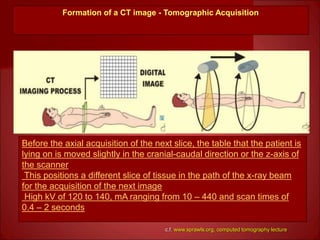
Formation of a CT image - Tomographic Acquisition
Before the axial acquisition of the next slice, the table that the patient is
lying on is moved slightly in the cranial-caudal direction or the z-axis of
the scanner
This positions a different slice of tissue in the path of the x-ray beam
for the acquisition of the next image
High kV of 120 to 140, mA ranging from 10 – 440 and scan times of
0.4 – 2 seconds
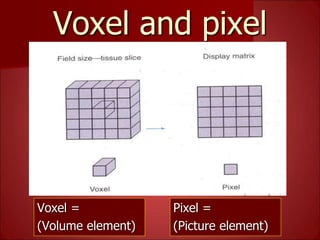
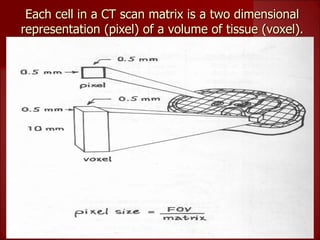
Voxel and pixel
Voxel =
(Volume element)
Pixel =
(Picture element)
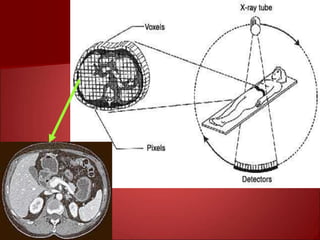
Each cell in a CT scan matrix is a two dimensional
representation (pixel) of a volume of tissue (voxel).
Field of view (FOV):
The diameter of reconstructed image
Matrix :
 Orderly array of cells fashioned in rows
and columns.
 Current CT Scanners produce 512x512
images and 1024x1024 is available on
many.
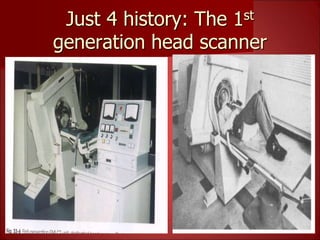
Just 4 history: The 1st
generation head scanner
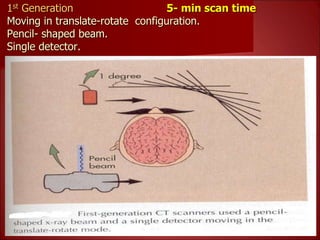
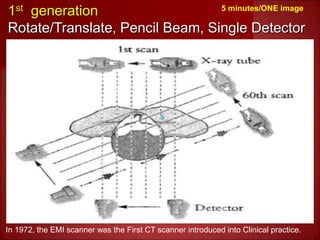
1st Generation 5- min scan time
Moving in translate-rotate configuration.
Pencil- shaped beam.
Single detector.
In 1972, the EMI scanner was the First CT scanner introduced into Clinical practice.
5 minutes/ONE image
1st generation
Rotate/Translate, Pencil Beam, Single Detector
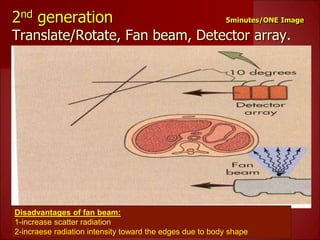
2nd generation 5minutes/ONE Image
Translate/Rotate, Fan beam, Detector array.
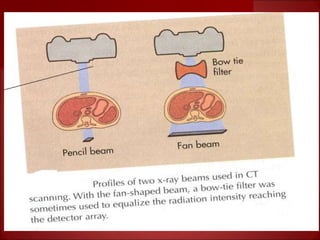
Disadvantages of fan beam:
1-increase scatter radiation
2-incraese radiation intensity toward the edges due to body shape
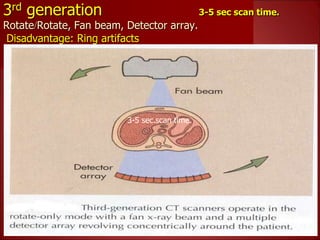
3rd generation 3-5 sec scan time.
Rotate/Rotate, Fan beam, Detector array.
Disadvantage: Ring artifacts
3-5 sec.scan time.
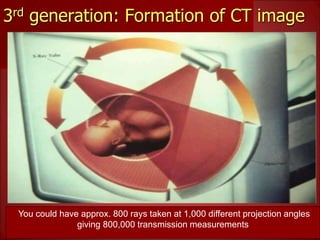
3rd generation: Formation of CT image
You could have approx. 800 rays taken at 1,000 different projection angles
giving 800,000 transmission measurements
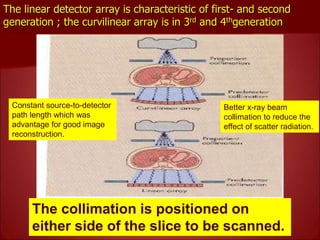
The linear detector array is characteristic of first- and second
generation ; the curvilinear array is in 3rd and 4thgeneration
The collimation is positioned on
either side of the slice to be scanned.
Constant source-to-detector
path length which was
advantage for good image
reconstruction.
Better x-ray beam
collimation to reduce the
effect of scatter radiation.
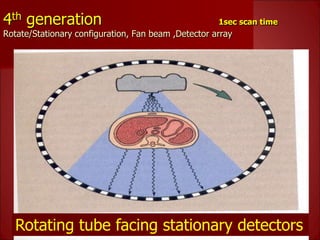
4th generation 1sec scan time
Rotate/Stationary configuration, Fan beam ,Detector array
Rotating tube facing stationary detectors
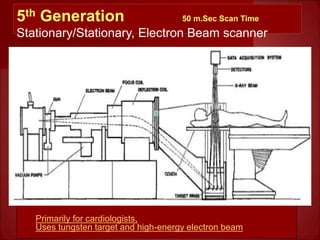
5th Generation 50 m.Sec Scan Time
Stationary/Stationary, Electron Beam scanner
Primarily for cardiologists,
Uses tungsten target and high-energy electron beam
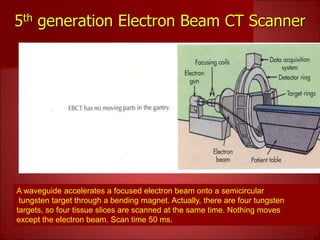
5th generation Electron Beam CT Scanner
A waveguide accelerates a focused electron beam onto a semicircular
tungsten target through a bending magnet. Actually, there are four tungsten
targets, so four tissue slices are scanned at the same time. Nothing moves
except the electron beam. Scan time 50 ms.
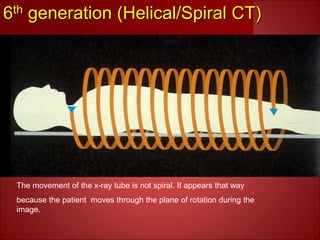
Patient is transported continuously through
gantry while data are acquired continuously
during several 360-deg rotations
6th generation (Helical/Spiral CT)
The movement of the x-ray tube is not spiral. It appears that way
because the patient moves through the plane of rotation during the
image.
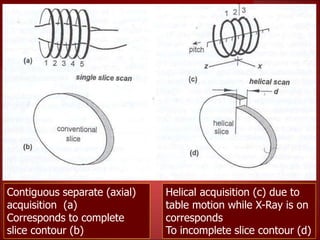
Contiguous separate (axial)
acquisition (a)
Corresponds to complete
slice contour (b)
Helical acquisition (c) due to
table motion while X-Ray is on
corresponds
To incomplete slice contour (d)
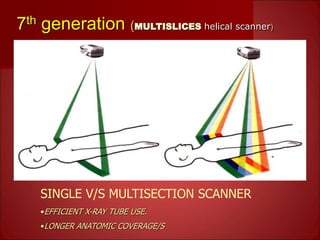
7th generation (MULTISLICES helical scanner)
SINGLE V/S MULTISECTION SCANNER
•EFFICIENT X-RAY TUBE USE.
•LONGER ANATOMIC COVERAGE/S
Advantages Spiral CT vs
Conventional CT
 Faster image acquisition.
 Quicker contrast follow up.
 Reduced patient dose at Pitch>1.
 Physiologic monitoring.
 Improved 3D imaging.
 Angiographic imaging.
 Fewer partial volume artifacts
 Fewer motion artifacts
 Freeze breathing.
 No Mis-registration.
 Increased output.
 Improved patient comfort
 Real time CT guided biopsy.
Any Question???.
Take your Tiiime!!! .
Again Any Question???.
Otherwise, I’m going to ask!!!.
Should I Ask???.
Have a nice day

Basics of CT- Lecture 3.ppt

  • 1.
    ‫تعلم‬ ‫تكن‬ ‫مالم‬‫وعلمك‬ ‫هللا‬ ‫فضل‬ ‫وكان‬ ‫عظيما‬ ‫عليك‬
  • 2.
    Basics Of Computed Tomography(CT) Lecture Three Gamal Fathalla M. Mahdaly gamal_mahdaly@hotmail.com
  • 3.
    Computed Tomography  1-A highly collimated X-Ray beam is transmitted through a specific cross-section of the patient. (No superimposition- Minimal scattered radiation resulting in better Contrast Resolution).  2- This beam is variably attenuated in the body of the patient by different anatomies with different densities  3- The attenuated beam strikes special detectors , these detectors are quantitative and measure subtle attenuation differences resulting in high Spatial Resolution.  4- The data from the detectors are processed by digital computer (ADC) that uses special algorithms to reconstruct an image of cross- section in different ways & different filters.  5- The computed motion of the cradle together with the collimation helps determine the slice thickness.
  • 4.
    c.f. www.sprawls.org, computedtomography lecture Formation of a CT image - Tomographic Acquisition Before the axial acquisition of the next slice, the table that the patient is lying on is moved slightly in the cranial-caudal direction or the z-axis of the scanner This positions a different slice of tissue in the path of the x-ray beam for the acquisition of the next image High kV of 120 to 140, mA ranging from 10 – 440 and scan times of 0.4 – 2 seconds
  • 5.
    Voxel and pixel Voxel= (Volume element) Pixel = (Picture element)
  • 7.
    Each cell ina CT scan matrix is a two dimensional representation (pixel) of a volume of tissue (voxel).
  • 8.
    Field of view(FOV): The diameter of reconstructed image Matrix :  Orderly array of cells fashioned in rows and columns.  Current CT Scanners produce 512x512 images and 1024x1024 is available on many.
  • 9.
    Just 4 history:The 1st generation head scanner
  • 10.
    1st Generation 5-min scan time Moving in translate-rotate configuration. Pencil- shaped beam. Single detector.
  • 11.
    In 1972, theEMI scanner was the First CT scanner introduced into Clinical practice. 5 minutes/ONE image 1st generation Rotate/Translate, Pencil Beam, Single Detector
  • 12.
    2nd generation 5minutes/ONEImage Translate/Rotate, Fan beam, Detector array. Disadvantages of fan beam: 1-increase scatter radiation 2-incraese radiation intensity toward the edges due to body shape
  • 14.
    3rd generation 3-5sec scan time. Rotate/Rotate, Fan beam, Detector array. Disadvantage: Ring artifacts 3-5 sec.scan time.
  • 15.
    3rd generation: Formationof CT image You could have approx. 800 rays taken at 1,000 different projection angles giving 800,000 transmission measurements
  • 16.
    The linear detectorarray is characteristic of first- and second generation ; the curvilinear array is in 3rd and 4thgeneration The collimation is positioned on either side of the slice to be scanned. Constant source-to-detector path length which was advantage for good image reconstruction. Better x-ray beam collimation to reduce the effect of scatter radiation.
  • 17.
    4th generation 1secscan time Rotate/Stationary configuration, Fan beam ,Detector array Rotating tube facing stationary detectors
  • 18.
    5th Generation 50m.Sec Scan Time Stationary/Stationary, Electron Beam scanner Primarily for cardiologists, Uses tungsten target and high-energy electron beam
  • 19.
    5th generation ElectronBeam CT Scanner A waveguide accelerates a focused electron beam onto a semicircular tungsten target through a bending magnet. Actually, there are four tungsten targets, so four tissue slices are scanned at the same time. Nothing moves except the electron beam. Scan time 50 ms.
  • 20.
    Patient is transportedcontinuously through gantry while data are acquired continuously during several 360-deg rotations 6th generation (Helical/Spiral CT)
  • 21.
    6th generation (Helical/SpiralCT) The movement of the x-ray tube is not spiral. It appears that way because the patient moves through the plane of rotation during the image.
  • 22.
    Contiguous separate (axial) acquisition(a) Corresponds to complete slice contour (b) Helical acquisition (c) due to table motion while X-Ray is on corresponds To incomplete slice contour (d)
  • 23.
    7th generation (MULTISLICEShelical scanner) SINGLE V/S MULTISECTION SCANNER •EFFICIENT X-RAY TUBE USE. •LONGER ANATOMIC COVERAGE/S
  • 24.
    Advantages Spiral CTvs Conventional CT  Faster image acquisition.  Quicker contrast follow up.  Reduced patient dose at Pitch>1.  Physiologic monitoring.  Improved 3D imaging.  Angiographic imaging.  Fewer partial volume artifacts  Fewer motion artifacts  Freeze breathing.  No Mis-registration.  Increased output.  Improved patient comfort  Real time CT guided biopsy.
  • 25.
    Any Question???. Take yourTiiime!!! . Again Any Question???. Otherwise, I’m going to ask!!!. Should I Ask???.
  • 26.

Editor's Notes