


Theory of
Knowledge
CHAPTER 1
Aims of this chapter
This chapter is aimed to help the students to know:
1. what “knowledge” is defined
2. Know what sources of knowledge comes from
3. Understand how knowledge is justified
4. Realize what criticism has been made to the theory of Knowledge
Definition of Knowledge
Knowledge
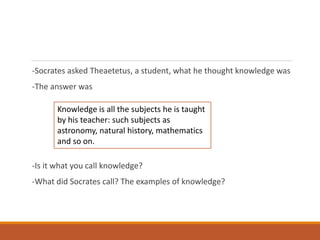
-Socrates asked Theaetetus, a student, what he thought knowledge was
-The answer was
-Is it what you call knowledge?
-What did Socrates call? The examples of knowledge?
Knowledge is all the subjects he is taught
by his teacher: such subjects as
astronomy, natural history, mathematics
and so on.
-Some people define knowledge as a means/tool that can help people
to know what the truth or falsehood, right or wrong, bad or good is.
Some people define it as the truth, the rights, or goodness itself.
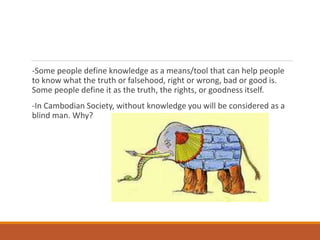
-In Cambodian Society, without knowledge you will be considered as a
blind man. Why?
Sources of Knowledge
1
2
3
Rationalism (Reasoning)
-Attaining knowledge of the existence of things through the exercise of
reason alone
◦ Do you realize that you exist? How? BY REASON OR REASONS
-Some knowledge is innate
◦ If you do not have innate knowledge of the general grammatical principles, how you can learn
more language?
◦ Like a computer, just imagine if you do not have some PC systems, how will you install any
programs in it?
◦ Does God exist? Do you have a soul before you incarnate into what you are now?
◦ Look at human biology, is it a work of design or just the accident?
◦ Whatever, you still need to argue or reason to make sure that you have enough evidence to
support it.
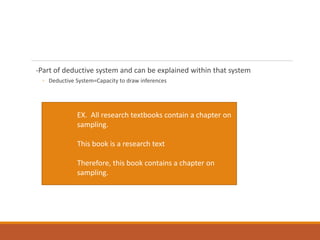
-Part of deductive system and can be explained within that system
◦ Deductive System=Capacity to draw inferences
EX. All research textbooks contain a chapter on
sampling.
This book is a research text
Therefore, this book contains a chapter on
sampling.
◦ A priori Knowledge is to know something without doing any research, without doing a field
study or going into the lab, without doing any experiments.
◦ If A taller than B and B is taller than C, A can not fail to be taller than C.
◦ 2+2=4, do you need to do experiment?
◦ What else you can think of?
Empiricism
-You can get knowledge based on the experience you have.
Any Examples?
-No innate Ideas or Knowledge: Mind is a blank tablet (a tabula rasa) at
birth.
◦ Knowledge comes to us via senses.
◦ Seeing is believing
◦ Nothing in the mind that has not first been in the senses
-The rejection of reason
◦ No a priori, everything is the result of a posteriori (thing can not be known to
be true without some help or support from experience)
-Reason cannot prove the existence of anything
◦ Can anyone prove:
◦ the existence of the external world?
◦ The necessary causal connection in nature
◦ Existence of the self
◦ Existence of either material or immaterial substance
Are there other sources of
Knowledge?
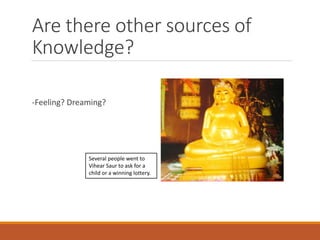
-Feeling? Dreaming?
Several people went to
Vihear Saur to ask for a
child or a winning lottery.
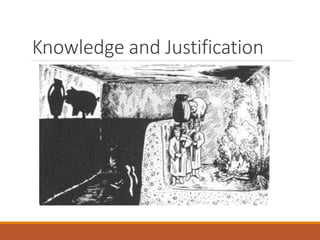
Knowledge and Justification
-Quantity and quality of evidence
◦ Witnessing the events or receiving information from a reliable witness
◦ Photographs, sound recordings, documents, DNA samples, fingerprints,
other physical evidence that attests to what happened
◦ A competent authority: one with training, experience and expertise to make
judgment in such as matter.
◦ The use of appropriately sophisticated or refined equipment for making any
relevant observations or test.
◦ Sufficient numbers of tests or observations.
-Predictive and explanatory power
-Reasonableness and probability
◦ Sex work should be legalized because sex workers will be protected by law;
less violence to the sex workers in the country that has law to protect them;
less HIV/AIDs;….
-Reliable Methods of belief acquisition
◦ You can cheat 100 time when you write a cheating note on your palm.
-Foundational piece of knowledge
◦ If something you said have the relationship to other beliefs known as being
true then you do not need to prove it.
◦ All people die is true, then why I need to prove that Mr. A, as a person, also
dies?
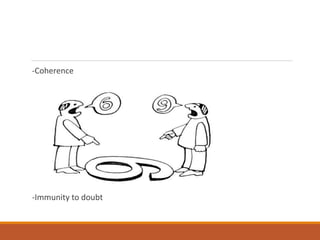
-Coherence
-Immunity to doubt
-The tripartite definition of knowledge
◦ It can be a knowledge only if it meets three conditions: justification, truth
and belief.
Knowledge and Scepticism
If everything is in doubt, then there is no what you can call knowledge.
-Philosophical doubt or metaphysical doubt
◦ It goes beyond the ordinary feeling of uncertainty or psychological doubts
◦ It is said that knowledge not only involved with experience alone but the
concept + background information + experience. However, concept can be
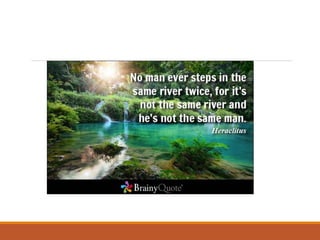
revised. So if it is revised then it is not true all the time.
-Global Doubt
◦ Nothing is considered as knowledge.
◦ Easy to be defeated but if we are not sure that everything we know is true
then this doubt can be applied.
◦ If you are not sure you are dreaming or not
◦ If you do not know if you know your lesson
◦ If you are not sure if you are full
◦ If you are not sure if you love someone
-Externalism and internalism about knowledge
◦ Externalist believes that someone might meet all the conditions necessary
for possession of knowledge without knowing that he knows.
◦ You said you do not know the lesson but whenever you do the exam you get high score
◦ Or your boss asks you to do something you can do.
• Internalist believes that true knower knows that all the conditions for
knowledge have been met. No accidence.
•Ex.1: You want to be a successful businessman/woman, you
have to know ….leadership, management, finance, accounting….
•Ex.2: S knows P only if
•P is true
•S believes that P
•S is justified in believing P, and
•There is no element of luck or accident in S’s believing p on
the basis of the justification he knows himself to have.
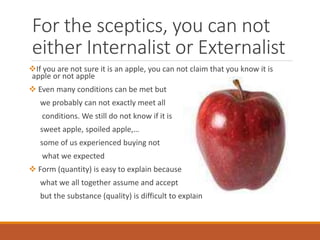
For the sceptics, you can not
either Internalist or Externalist
If you are not sure it is an apple, you can not claim that you know it is
apple or not apple
 Even many conditions can be met but
we probably can not exactly meet all
conditions. We still do not know if it is
sweet apple, spoiled apple,…
some of us experienced buying not
what we expected
 Form (quantity) is easy to explain because it is
what we all together assume and accept
but the substance (quality) is difficult to explain
-illusion
◦ A large jumbo jet in the distance looks small
◦ If my hand is cold then water that is only lukewarm may feel hot to me
◦ If the conditions, for example the lighting, were non-standard I might see,
say purple object as black
◦ If I am in an unusual condition- dehydrate, drugged, ill- everything may seem
blurry to me
◦ If I experience a mirage or other hallucination or an after-image I may have a
rich array of sense data that have no external cause at all.
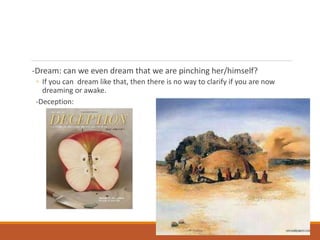
-Dream: can we even dream that we are pinching her/himself?
◦ If you can dream like that, then there is no way to clarify if you are now
dreaming or awake.
-Deception:
Assignment
-Realism
-Idealism
-Phenomenalism

2 chapter 1 theories of knowledge

  • 1.
  • 2.
    Aims of thischapter This chapter is aimed to help the students to know: 1. what “knowledge” is defined 2. Know what sources of knowledge comes from 3. Understand how knowledge is justified 4. Realize what criticism has been made to the theory of Knowledge
  • 3.
  • 4.
    -Socrates asked Theaetetus,a student, what he thought knowledge was -The answer was -Is it what you call knowledge? -What did Socrates call? The examples of knowledge? Knowledge is all the subjects he is taught by his teacher: such subjects as astronomy, natural history, mathematics and so on.
  • 5.
    -Some people defineknowledge as a means/tool that can help people to know what the truth or falsehood, right or wrong, bad or good is. Some people define it as the truth, the rights, or goodness itself. -In Cambodian Society, without knowledge you will be considered as a blind man. Why?
  • 6.
  • 7.
    Rationalism (Reasoning) -Attaining knowledgeof the existence of things through the exercise of reason alone ◦ Do you realize that you exist? How? BY REASON OR REASONS
  • 8.
    -Some knowledge isinnate ◦ If you do not have innate knowledge of the general grammatical principles, how you can learn more language? ◦ Like a computer, just imagine if you do not have some PC systems, how will you install any programs in it? ◦ Does God exist? Do you have a soul before you incarnate into what you are now? ◦ Look at human biology, is it a work of design or just the accident? ◦ Whatever, you still need to argue or reason to make sure that you have enough evidence to support it.
  • 9.
    -Part of deductivesystem and can be explained within that system ◦ Deductive System=Capacity to draw inferences EX. All research textbooks contain a chapter on sampling. This book is a research text Therefore, this book contains a chapter on sampling.
  • 10.
    ◦ A prioriKnowledge is to know something without doing any research, without doing a field study or going into the lab, without doing any experiments. ◦ If A taller than B and B is taller than C, A can not fail to be taller than C. ◦ 2+2=4, do you need to do experiment? ◦ What else you can think of?
  • 11.
    Empiricism -You can getknowledge based on the experience you have. Any Examples?
  • 12.
    -No innate Ideasor Knowledge: Mind is a blank tablet (a tabula rasa) at birth. ◦ Knowledge comes to us via senses. ◦ Seeing is believing ◦ Nothing in the mind that has not first been in the senses -The rejection of reason ◦ No a priori, everything is the result of a posteriori (thing can not be known to be true without some help or support from experience) -Reason cannot prove the existence of anything ◦ Can anyone prove: ◦ the existence of the external world? ◦ The necessary causal connection in nature ◦ Existence of the self ◦ Existence of either material or immaterial substance
  • 13.
    Are there othersources of Knowledge? -Feeling? Dreaming? Several people went to Vihear Saur to ask for a child or a winning lottery.
  • 14.
  • 16.
    -Quantity and qualityof evidence ◦ Witnessing the events or receiving information from a reliable witness ◦ Photographs, sound recordings, documents, DNA samples, fingerprints, other physical evidence that attests to what happened ◦ A competent authority: one with training, experience and expertise to make judgment in such as matter. ◦ The use of appropriately sophisticated or refined equipment for making any relevant observations or test. ◦ Sufficient numbers of tests or observations.
  • 17.
  • 18.
    -Reasonableness and probability ◦Sex work should be legalized because sex workers will be protected by law; less violence to the sex workers in the country that has law to protect them; less HIV/AIDs;…. -Reliable Methods of belief acquisition ◦ You can cheat 100 time when you write a cheating note on your palm. -Foundational piece of knowledge ◦ If something you said have the relationship to other beliefs known as being true then you do not need to prove it. ◦ All people die is true, then why I need to prove that Mr. A, as a person, also dies?
  • 19.
  • 20.
    -The tripartite definitionof knowledge ◦ It can be a knowledge only if it meets three conditions: justification, truth and belief.
  • 21.
    Knowledge and Scepticism Ifeverything is in doubt, then there is no what you can call knowledge. -Philosophical doubt or metaphysical doubt ◦ It goes beyond the ordinary feeling of uncertainty or psychological doubts ◦ It is said that knowledge not only involved with experience alone but the concept + background information + experience. However, concept can be revised. So if it is revised then it is not true all the time.
  • 24.
    -Global Doubt ◦ Nothingis considered as knowledge. ◦ Easy to be defeated but if we are not sure that everything we know is true then this doubt can be applied. ◦ If you are not sure you are dreaming or not ◦ If you do not know if you know your lesson ◦ If you are not sure if you are full ◦ If you are not sure if you love someone
  • 25.
    -Externalism and internalismabout knowledge ◦ Externalist believes that someone might meet all the conditions necessary for possession of knowledge without knowing that he knows. ◦ You said you do not know the lesson but whenever you do the exam you get high score ◦ Or your boss asks you to do something you can do. • Internalist believes that true knower knows that all the conditions for knowledge have been met. No accidence. •Ex.1: You want to be a successful businessman/woman, you have to know ….leadership, management, finance, accounting…. •Ex.2: S knows P only if •P is true •S believes that P •S is justified in believing P, and •There is no element of luck or accident in S’s believing p on the basis of the justification he knows himself to have.
  • 26.
    For the sceptics,you can not either Internalist or Externalist If you are not sure it is an apple, you can not claim that you know it is apple or not apple  Even many conditions can be met but we probably can not exactly meet all conditions. We still do not know if it is sweet apple, spoiled apple,… some of us experienced buying not what we expected  Form (quantity) is easy to explain because it is what we all together assume and accept but the substance (quality) is difficult to explain
  • 27.
    -illusion ◦ A largejumbo jet in the distance looks small ◦ If my hand is cold then water that is only lukewarm may feel hot to me ◦ If the conditions, for example the lighting, were non-standard I might see, say purple object as black ◦ If I am in an unusual condition- dehydrate, drugged, ill- everything may seem blurry to me ◦ If I experience a mirage or other hallucination or an after-image I may have a rich array of sense data that have no external cause at all.
  • 28.
    -Dream: can weeven dream that we are pinching her/himself? ◦ If you can dream like that, then there is no way to clarify if you are now dreaming or awake. -Deception:
  • 30.