ARBA MINCH UNIVERSITY
COLLEGE OF NATURAL SCIENCES
DEPARTMENT: CHEMISTRY
COURSE: RESEARCH METHOD AND SCIENTIFIC
COMMUNICATIONS
PHILOSOPHY:
MEANING OF PHILIOSOPHY:
The word philosophy is derived from
the Greek words philia (love) and
sophia (wisdom) and means the love
of wisdom.
PHILOSOPH
Y
PHILIOSOPHY:
is The study of general and fundamental
problems, such as those connected with
existence, knowledge, values, reason,
mind and language.
Pythagoras was the first man to
call himself a philosopher.(one who
attempting to find out). Before that time the
wise men had called themselves a
Sage,(those who know)
PHILOSOPH
Y
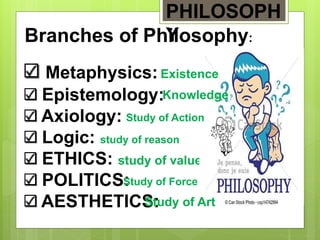
Branches of Philosophy:
Metaphysics:
Epistemology:
Axiology:
Logic: study of reason
ETHICS: study of value
POLITICS:
AESTHETICS:
Existence
Knowledge
Study of Action
Study of Force
Study of Art
PHILOSOPH
Y
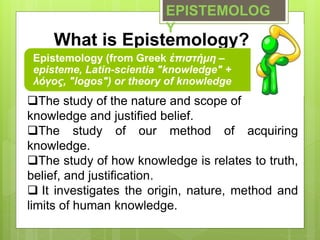
What is Epistemology?
EPISTEMOLOG
Y
The study of the nature and scope of
knowledge and justified belief.
The study of our method of acquiring
knowledge.
The study of how knowledge is relates to truth,
belief, and justification.
 It investigates the origin, nature, method and
limits of human knowledge.
Epistemology (from Greek ἐπιστήμη –
episteme, Latin-scientia "knowledge" +
λόγος, "logos") or theory of knowledge
EPISTEMOLOG
Y
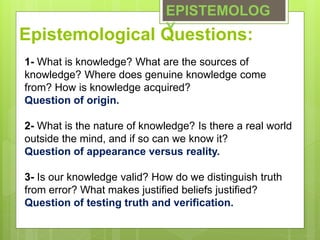
Epistemological Questions:
1- What is knowledge? What are the sources of
knowledge? Where does genuine knowledge come
from? How is knowledge acquired?
Question of origin.
2- What is the nature of knowledge? Is there a real world
outside the mind, and if so can we know it?
Question of appearance versus reality.
3- Is our knowledge valid? How do we distinguish truth
from error? What makes justified beliefs justified?
Question of testing truth and verification.
What you didn’t know
You didn’t know that you didn’t
know
Since you didn’t know you didn’t
miss what you didn’t know
EPISTEMOLOG
Y
Why is Epistemology important?
Epistemology is the explanation of how
we think.
Without epistemology, we could not think.
distinguish truth from error.
consequences are obvious.
flaws in epistemology will make it harder
to accomplish anything.
EPISTEMOLOG
Y
What are the key elements of a proper Epistemology?
 Valid- Our senses are valid, and the only
way to gain information about the world.
 Reason- is our method of gaining
knowledge, and acquiring understanding.
 Logic- is our method of maintaining
consistency within our set of knowledge.
 Objectivity- is our means of associating
knowledge with reality to determine its
validity.
 Concepts- are abstracts of specific details
of reality, or of other abstractions.
EPISTEMOLOG
Y
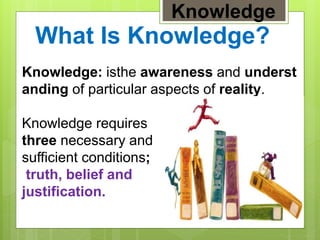
What Is Knowledge?
Knowledge: isthe awareness and underst
anding of particular aspects of reality.
Knowledge requires
three necessary and
sufficient conditions;
truth, belief and
justification.
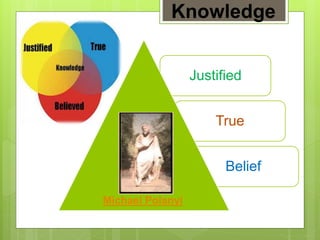
Knowledge
Justified
True
Belief
Michael Polanyi
Knowledge
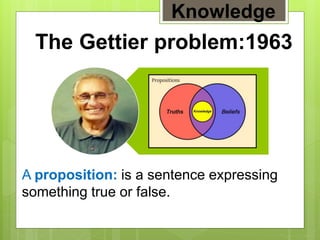
The Gettier problem:1963
A proposition: is a sentence expressing
something true or false.
Knowledge
In Response to
justification;there are several schools of thought on
the definition of justification:
Evidentialism: what makes a belief justified in this sense
is the possession of evidence.
Reliabilism: suggest that justification is not necessary
for knowledge provided it is a reliably-produced true
belief.
Infallibilism: holds that a belief must not only be true and
justified, but the belief must necessitate its truth, so that
the justification for the belief must be infallible.
Knowledge
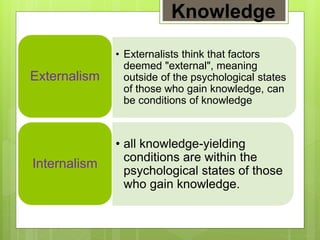
Externalism
Internalism
• Externalists think that factors
deemed "external", meaning
outside of the psychological states
of those who gain knowledge, can
be conditions of knowledge
• all knowledge-yielding
conditions are within the
psychological states of those
who gain knowledge.
Knowledge
Knowledge
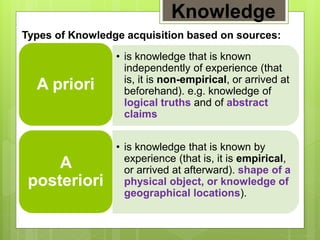
Types of Knowledge acquisition based on sources:
• is knowledge that is known
independently of experience (that
is, it is non-empirical, or arrived at
beforehand). e.g. knowledge of
logical truths and of abstract
claims
A priori
• is knowledge that is known by
experience (that is, it is empirical,
or arrived at afterward). shape of a
physical object, or knowledge of
geographical locations).
A
posteriori
Knowledge
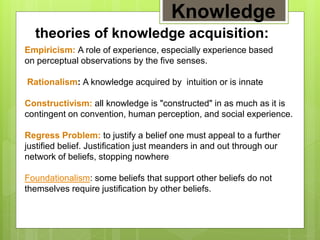
theories of knowledge acquisition:
Empiricism: A role of experience, especially experience based
on perceptual observations by the five senses.
Rationalism: A knowledge acquired by intuition or is innate
Constructivism: all knowledge is "constructed" in as much as it is
contingent on convention, human perception, and social experience.
Regress Problem: to justify a belief one must appeal to a further
justified belief. Justification just meanders in and out through our
network of beliefs, stopping nowhere
Foundationalism: some beliefs that support other beliefs do not
themselves require justification by other beliefs.
Knowledge
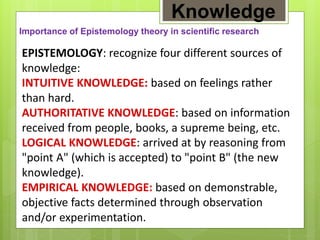
Importance of Epistemology theory in scientific research
EPISTEMOLOGY: recognize four different sources of
knowledge:
INTUITIVE KNOWLEDGE: based on feelings rather
than hard.
AUTHORITATIVE KNOWLEDGE: based on information
received from people, books, a supreme being, etc.
LOGICAL KNOWLEDGE: arrived at by reasoning from
"point A" (which is accepted) to "point B" (the new
knowledge).
EMPIRICAL KNOWLEDGE: based on demonstrable,
objective facts determined through observation
and/or experimentation.
Scientific Research often makes use of all
these four ways of knowing:
 INTUITIVE: when coming up with an initial
idea for research.
 AUTHORITATIVE: when reviewing the
professional literature.
 LOGICAL: when reasoning from findings to
conclusions.
 EMPIRICAL: when engaging in
procedures that lead to these findings.
Knowledge
EPISTEMOLOG
Y
CONCLUSION:
The study of knowledge is one of the most
fundamental aspects of philosophical inquiry. Any
claim to knowledge must be evaluated to determine
whether or not it indeed constitutes knowledge. Such
an evaluation essentially requires an understanding of
what knowledge is and how much knowledge is
possible. While this entry provides on overview of the
important issues, it of course leaves the most basic
questions unanswered; epistemology will continue to
be an area of philosophical discussion as long as
these questions remain.
EPISTEMOLOG
Y
[1] Epistemology Page, maintained by Keith De Rose (Yale University).
[2] Alston, William. 1989. Epistemic Justification. Essays in the Theory
of Knowledge. Ithaca: Cornell University Press.
[3] SLIDE SHARE prepared by: APRIL L. CENTES M.A.T.-P.E
[4] 1998. Epistemology: A Contemporary Introduction to the Theory of
Knowledge. Cambridge: Cambridge University Press.
[5] 1999. Moral Knowledge and Ethical Pluralism. In: Greco and Sosa
1999, pp. 271–302.
[6] Some web slide shares
REFERENCE
SE:
EPISTEMOLOG
Y

Epistemology

  • 1.
    ARBA MINCH UNIVERSITY COLLEGEOF NATURAL SCIENCES DEPARTMENT: CHEMISTRY COURSE: RESEARCH METHOD AND SCIENTIFIC COMMUNICATIONS
  • 2.
    PHILOSOPHY: MEANING OF PHILIOSOPHY: Theword philosophy is derived from the Greek words philia (love) and sophia (wisdom) and means the love of wisdom. PHILOSOPH Y
  • 3.
    PHILIOSOPHY: is The studyof general and fundamental problems, such as those connected with existence, knowledge, values, reason, mind and language. Pythagoras was the first man to call himself a philosopher.(one who attempting to find out). Before that time the wise men had called themselves a Sage,(those who know) PHILOSOPH Y
  • 4.
    Branches of Philosophy: Metaphysics: Epistemology: Axiology: Logic:study of reason ETHICS: study of value POLITICS: AESTHETICS: Existence Knowledge Study of Action Study of Force Study of Art PHILOSOPH Y
  • 5.
    What is Epistemology? EPISTEMOLOG Y Thestudy of the nature and scope of knowledge and justified belief. The study of our method of acquiring knowledge. The study of how knowledge is relates to truth, belief, and justification.  It investigates the origin, nature, method and limits of human knowledge. Epistemology (from Greek ἐπιστήμη – episteme, Latin-scientia "knowledge" + λόγος, "logos") or theory of knowledge
  • 6.
    EPISTEMOLOG Y Epistemological Questions: 1- Whatis knowledge? What are the sources of knowledge? Where does genuine knowledge come from? How is knowledge acquired? Question of origin. 2- What is the nature of knowledge? Is there a real world outside the mind, and if so can we know it? Question of appearance versus reality. 3- Is our knowledge valid? How do we distinguish truth from error? What makes justified beliefs justified? Question of testing truth and verification.
  • 7.
    What you didn’tknow You didn’t know that you didn’t know Since you didn’t know you didn’t miss what you didn’t know EPISTEMOLOG Y
  • 8.
    Why is Epistemologyimportant? Epistemology is the explanation of how we think. Without epistemology, we could not think. distinguish truth from error. consequences are obvious. flaws in epistemology will make it harder to accomplish anything. EPISTEMOLOG Y
  • 9.
    What are thekey elements of a proper Epistemology?  Valid- Our senses are valid, and the only way to gain information about the world.  Reason- is our method of gaining knowledge, and acquiring understanding.  Logic- is our method of maintaining consistency within our set of knowledge.  Objectivity- is our means of associating knowledge with reality to determine its validity.  Concepts- are abstracts of specific details of reality, or of other abstractions. EPISTEMOLOG Y
  • 10.
    What Is Knowledge? Knowledge:isthe awareness and underst anding of particular aspects of reality. Knowledge requires three necessary and sufficient conditions; truth, belief and justification. Knowledge
  • 11.
  • 12.
    The Gettier problem:1963 Aproposition: is a sentence expressing something true or false. Knowledge
  • 13.
    In Response to justification;thereare several schools of thought on the definition of justification: Evidentialism: what makes a belief justified in this sense is the possession of evidence. Reliabilism: suggest that justification is not necessary for knowledge provided it is a reliably-produced true belief. Infallibilism: holds that a belief must not only be true and justified, but the belief must necessitate its truth, so that the justification for the belief must be infallible. Knowledge
  • 14.
    Externalism Internalism • Externalists thinkthat factors deemed "external", meaning outside of the psychological states of those who gain knowledge, can be conditions of knowledge • all knowledge-yielding conditions are within the psychological states of those who gain knowledge. Knowledge
  • 15.
    Knowledge Types of Knowledgeacquisition based on sources: • is knowledge that is known independently of experience (that is, it is non-empirical, or arrived at beforehand). e.g. knowledge of logical truths and of abstract claims A priori • is knowledge that is known by experience (that is, it is empirical, or arrived at afterward). shape of a physical object, or knowledge of geographical locations). A posteriori
  • 16.
    Knowledge theories of knowledgeacquisition: Empiricism: A role of experience, especially experience based on perceptual observations by the five senses. Rationalism: A knowledge acquired by intuition or is innate Constructivism: all knowledge is "constructed" in as much as it is contingent on convention, human perception, and social experience. Regress Problem: to justify a belief one must appeal to a further justified belief. Justification just meanders in and out through our network of beliefs, stopping nowhere Foundationalism: some beliefs that support other beliefs do not themselves require justification by other beliefs.
  • 17.
    Knowledge Importance of Epistemologytheory in scientific research EPISTEMOLOGY: recognize four different sources of knowledge: INTUITIVE KNOWLEDGE: based on feelings rather than hard. AUTHORITATIVE KNOWLEDGE: based on information received from people, books, a supreme being, etc. LOGICAL KNOWLEDGE: arrived at by reasoning from "point A" (which is accepted) to "point B" (the new knowledge). EMPIRICAL KNOWLEDGE: based on demonstrable, objective facts determined through observation and/or experimentation.
  • 18.
    Scientific Research oftenmakes use of all these four ways of knowing:  INTUITIVE: when coming up with an initial idea for research.  AUTHORITATIVE: when reviewing the professional literature.  LOGICAL: when reasoning from findings to conclusions.  EMPIRICAL: when engaging in procedures that lead to these findings. Knowledge
  • 19.
    EPISTEMOLOG Y CONCLUSION: The study ofknowledge is one of the most fundamental aspects of philosophical inquiry. Any claim to knowledge must be evaluated to determine whether or not it indeed constitutes knowledge. Such an evaluation essentially requires an understanding of what knowledge is and how much knowledge is possible. While this entry provides on overview of the important issues, it of course leaves the most basic questions unanswered; epistemology will continue to be an area of philosophical discussion as long as these questions remain.
  • 20.
    EPISTEMOLOG Y [1] Epistemology Page,maintained by Keith De Rose (Yale University). [2] Alston, William. 1989. Epistemic Justification. Essays in the Theory of Knowledge. Ithaca: Cornell University Press. [3] SLIDE SHARE prepared by: APRIL L. CENTES M.A.T.-P.E [4] 1998. Epistemology: A Contemporary Introduction to the Theory of Knowledge. Cambridge: Cambridge University Press. [5] 1999. Moral Knowledge and Ethical Pluralism. In: Greco and Sosa 1999, pp. 271–302. [6] Some web slide shares REFERENCE SE:
  • 21.