Fisheries Resources
 Professor: Chea Leng, M.Sc.
 Presentation By: Keo Song(Leader and Combination)
 Kim Hyun Ji
 Ouch Raksmeysosoeng
 Kang Mouyhong

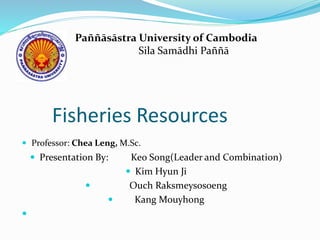
Paññāsāstra University of Cambodia
Sila Samādhi Paññā
OUTLINE
 1. Inland Fisheries
 2. Fisheries Export
 3.Community Fisheries
 4.Marine Fisheries
Intoduction
 Fisheries provides food security to the
majority of the countries population in
terms of protein and essential minerals and
Vitamins as rice and fish constitute the
stable diet of most Cambodians.
I. Inland Fisheries
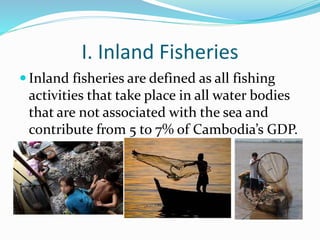
 Inland fisheries are defined as all fishing
activities that take place in all water bodies
that are not associated with the sea and
contribute from 5 to 7% of Cambodia’s GDP.
I. Inland Fisheries
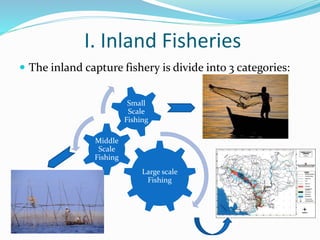
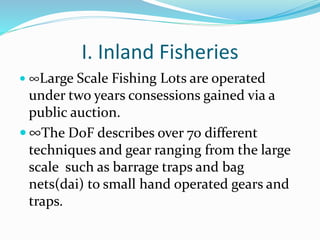
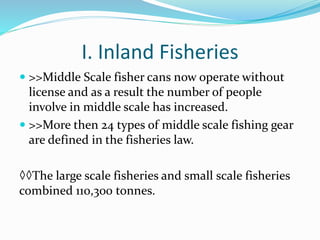
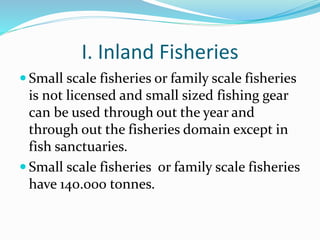
 The inland capture fishery is divide into 3 categories:
Large scale
Fishing
Middle
Scale
Fishing
Small
Scale
Fishing
I. Inland Fisheries
 ∞Large Scale Fishing Lots are operated
under two years consessions gained via a
public auction.
 ∞The DoF describes over 70 different
techniques and gear ranging from the large
scale such as barrage traps and bag
nets(dai) to small hand operated gears and
traps.
I. Inland Fisheries
 >>Middle Scale fisher cans now operate without
license and as a result the number of people
involve in middle scale has increased.
 >>More then 24 types of middle scale fishing gear
are defined in the fisheries law.
◊◊The large scale fisheries and small scale fisheries
combined 110,300 tonnes.
I. Inland Fisheries
 Small scale fisheries or family scale fisheries
is not licensed and small sized fishing gear
can be used through out the year and
through out the fisheries domain except in
fish sanctuaries.
 Small scale fisheries or family scale fisheries
have 140.000 tonnes.
II. Fisheries on Export
 Cambodian livelihoods affected by fish trade
and export.
 Fresh fish products in Cambodia exported
widely to neighboring countries such as
Vietnam and Thailand, as well as Singapore,
China's Hong Kong, Japan and South Korea.
II. Fisheries on Export
 There are three things on export from
Cambodia, such as having licenses, imposing
taxes, and problems on exports.
II. Fisheries on Export
 The first thing is having licenses.
 Any person or company must obtain an export
license. Because all fish product exports are
controlled by KAMFIMEX (Cambodia
Kampuchea Fishery Import and Export). All of
export traders or companies must have an
export license from MAFF.
II. Fisheries on Export
All of distributors also must have an
export license. Each province has
distributors, but any person or company
cannot distribute on export. All of
distributors must obtain licenses from the
provincial authorities through an auction
system.
II. Fisheries on Export
 The second thing is imposing taxes.
 Fish and fish products impose taxes by
transportation. If all fish products are
transported over long distances to reach export
gates, its taxes and expenses will impose high
prices on export.
II. Fisheries on Export
 On the contrary, if it is transported nearby
export gates, its taxes and expenses will
impose cheap prices on export. However, fish
products to transport nearby export gates are
rarely happened. Therefore, it causes some
problems on export.
II. Fisheries on Export
 The last thing is problems such as smuggling
and underreporting of catches.
 High export expenses motivate smuggling. All
of fishermen, export traders or companies want
to make a lot of money on fish export, but
sometimes their fish products impose high
expenses. Therefore, they sell their fish
products illegally.
II. Fisheries on Export
 Other one of big problem is underreporting of
catches. I mentioned in the front, they want to
earn money a lot on fish export. For that reason,
they report their fish products less than they
catch or have.
II. Fisheries on Export
 To sum up, fish export affects fisheries, and
fisheries affects livelihoods. This means fish
export is the most important in Cambodia.
 In order to export well, it is good information
to know having licenses, imposing taxes, some
problems on fish export.
III. Community Fisheries
 Commnunity fisheries established is a
mechanism that
Can improve management of local fisheries
and ensure local food security
 Tonle Sap is one of the most biggest
community fisheries in Cambodia.
III. Community Fisheries
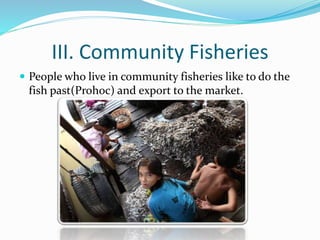
 People who live in community fisheries like to do the
fish past(Prohoc) and export to the market.
III. Community Fisheries
 Stung Treng is the other community
fisheries in Cambodia too.
 People in that province depend on fisheries
resources as main source of protein.
III. Community Fisheries
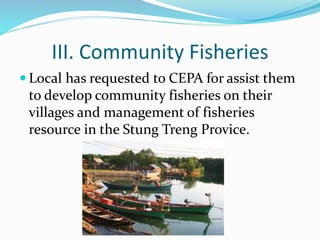
 Local has requested to CEPA for assist them
to develop community fisheries on their
villages and management of fisheries
resource in the Stung Treng Provice.
III. Community Fisheries
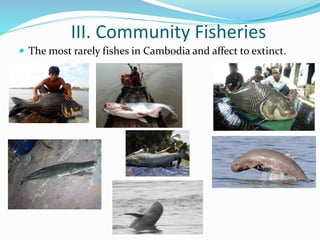
 The most rarely fishes in Cambodia and affect to extinct.
IV Marine Fisheries
Marine fisheries in Cambodia have
been slow to develop relative to inland
fisheries.
Fishing activities can be classified into :
 coastal fisheries
 and commercial fisheries.
IV Marine Fisheries
Fishing production mean :
 Largest scale use Dia system
 Middle-scale use generally methods
 and Smallest-scale use gill nets... Etc
Demend
 The Cambodian people have a strong
preference for freshwater fish and the
domestic demand for fish is expected to
increase with population growth
IV Marine Fisheries
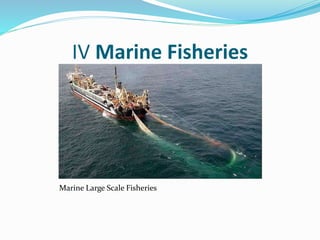
Marine Large Scale Fisheries
IV Marine Fisheries
Management
The Cambodia fishery law identifies a range of input controls
to be used as main management tools:
 Fishing permits for commercial fishing,
 Licences for offshore boats,
 Licences for foreign vessels fishing in Cambodian waters,
 Prohibition of illegal fishing gears,
 Restrictions on some gear types and sizes,
 Prohibition to trawling in waters less than 20 m deep,
 Protection of mangrove areas and designated fish
sanctuaries,
 Closed spawning season for mackerel from 15 January to
31st March,
Group 3 fisheries resources

Group 3 fisheries resources

  • 1.
    Fisheries Resources  Professor:Chea Leng, M.Sc.  Presentation By: Keo Song(Leader and Combination)  Kim Hyun Ji  Ouch Raksmeysosoeng  Kang Mouyhong  Paññāsāstra University of Cambodia Sila Samādhi Paññā
  • 2.
    OUTLINE  1. InlandFisheries  2. Fisheries Export  3.Community Fisheries  4.Marine Fisheries
  • 3.
    Intoduction  Fisheries providesfood security to the majority of the countries population in terms of protein and essential minerals and Vitamins as rice and fish constitute the stable diet of most Cambodians.
  • 4.
    I. Inland Fisheries Inland fisheries are defined as all fishing activities that take place in all water bodies that are not associated with the sea and contribute from 5 to 7% of Cambodia’s GDP.
  • 5.
    I. Inland Fisheries The inland capture fishery is divide into 3 categories: Large scale Fishing Middle Scale Fishing Small Scale Fishing
  • 6.
    I. Inland Fisheries ∞Large Scale Fishing Lots are operated under two years consessions gained via a public auction.  ∞The DoF describes over 70 different techniques and gear ranging from the large scale such as barrage traps and bag nets(dai) to small hand operated gears and traps.
  • 7.
    I. Inland Fisheries >>Middle Scale fisher cans now operate without license and as a result the number of people involve in middle scale has increased.  >>More then 24 types of middle scale fishing gear are defined in the fisheries law. ◊◊The large scale fisheries and small scale fisheries combined 110,300 tonnes.
  • 8.
    I. Inland Fisheries Small scale fisheries or family scale fisheries is not licensed and small sized fishing gear can be used through out the year and through out the fisheries domain except in fish sanctuaries.  Small scale fisheries or family scale fisheries have 140.000 tonnes.
  • 9.
    II. Fisheries onExport  Cambodian livelihoods affected by fish trade and export.  Fresh fish products in Cambodia exported widely to neighboring countries such as Vietnam and Thailand, as well as Singapore, China's Hong Kong, Japan and South Korea.
  • 10.
    II. Fisheries onExport  There are three things on export from Cambodia, such as having licenses, imposing taxes, and problems on exports.
  • 11.
    II. Fisheries onExport  The first thing is having licenses.  Any person or company must obtain an export license. Because all fish product exports are controlled by KAMFIMEX (Cambodia Kampuchea Fishery Import and Export). All of export traders or companies must have an export license from MAFF.
  • 12.
    II. Fisheries onExport All of distributors also must have an export license. Each province has distributors, but any person or company cannot distribute on export. All of distributors must obtain licenses from the provincial authorities through an auction system.
  • 13.
    II. Fisheries onExport  The second thing is imposing taxes.  Fish and fish products impose taxes by transportation. If all fish products are transported over long distances to reach export gates, its taxes and expenses will impose high prices on export.
  • 14.
    II. Fisheries onExport  On the contrary, if it is transported nearby export gates, its taxes and expenses will impose cheap prices on export. However, fish products to transport nearby export gates are rarely happened. Therefore, it causes some problems on export.
  • 15.
    II. Fisheries onExport  The last thing is problems such as smuggling and underreporting of catches.  High export expenses motivate smuggling. All of fishermen, export traders or companies want to make a lot of money on fish export, but sometimes their fish products impose high expenses. Therefore, they sell their fish products illegally.
  • 16.
    II. Fisheries onExport  Other one of big problem is underreporting of catches. I mentioned in the front, they want to earn money a lot on fish export. For that reason, they report their fish products less than they catch or have.
  • 17.
    II. Fisheries onExport  To sum up, fish export affects fisheries, and fisheries affects livelihoods. This means fish export is the most important in Cambodia.  In order to export well, it is good information to know having licenses, imposing taxes, some problems on fish export.
  • 18.
    III. Community Fisheries Commnunity fisheries established is a mechanism that Can improve management of local fisheries and ensure local food security  Tonle Sap is one of the most biggest community fisheries in Cambodia.
  • 19.
    III. Community Fisheries People who live in community fisheries like to do the fish past(Prohoc) and export to the market.
  • 20.
    III. Community Fisheries Stung Treng is the other community fisheries in Cambodia too.  People in that province depend on fisheries resources as main source of protein.
  • 21.
    III. Community Fisheries Local has requested to CEPA for assist them to develop community fisheries on their villages and management of fisheries resource in the Stung Treng Provice.
  • 22.
    III. Community Fisheries The most rarely fishes in Cambodia and affect to extinct.
  • 23.
    IV Marine Fisheries Marinefisheries in Cambodia have been slow to develop relative to inland fisheries. Fishing activities can be classified into :  coastal fisheries  and commercial fisheries.
  • 24.
    IV Marine Fisheries Fishingproduction mean :  Largest scale use Dia system  Middle-scale use generally methods  and Smallest-scale use gill nets... Etc Demend  The Cambodian people have a strong preference for freshwater fish and the domestic demand for fish is expected to increase with population growth
  • 25.
    IV Marine Fisheries MarineLarge Scale Fisheries
  • 26.
    IV Marine Fisheries Management TheCambodia fishery law identifies a range of input controls to be used as main management tools:  Fishing permits for commercial fishing,  Licences for offshore boats,  Licences for foreign vessels fishing in Cambodian waters,  Prohibition of illegal fishing gears,  Restrictions on some gear types and sizes,  Prohibition to trawling in waters less than 20 m deep,  Protection of mangrove areas and designated fish sanctuaries,  Closed spawning season for mackerel from 15 January to 31st March,