Concept Maps &
Knowledge Encoding
Putcha V. Narasimham
Knowledge Enabler Systems
Concept Maps & Knowledge Encoding

06 JAN 14

1
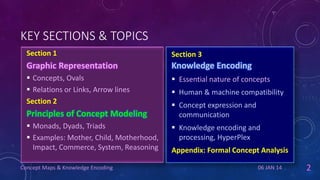
KEY SECTIONS & TOPICS
Section 1

Section 3

Graphic Representation

Knowledge Encoding

 Concepts, Ovals
 Relations or Links, Arrow lines
Section 2

 Essential nature of concepts

Principles of Concept Modeling
 Monads, Dyads, Triads
 Examples: Mother, Child, Motherhood,
Impact, Commerce, System, Reasoning
Concept Maps & Knowledge Encoding

 Human & machine compatibility
 Concept expression and
communication
 Knowledge encoding and
processing, HyperPlex
Appendix: Formal Concept Analysis
06 JAN 14

2
GRAPHIC REPRESENTATION OF CONCEPTS
SECTION 1
Concept Maps & Knowledge Encoding

06 JAN 14

3
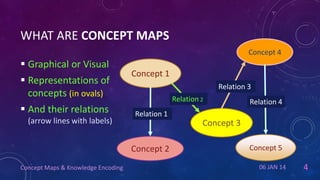
WHAT ARE CONCEPT MAPS
Concept 4

 Graphical or Visual
 Representations of
concepts (in ovals)
 And their relations
(arrow lines with labels)

Concept 1
Relation 3
Relation 2
Relation 1

Concept 3
Concept 2

Concept Maps & Knowledge Encoding

Relation 4

Concept 5
06 JAN 14

4
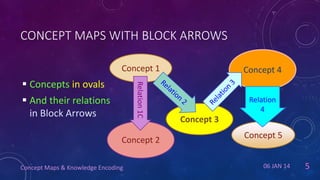
CONCEPT MAPS WITH BLOCK ARROWS
Concept 1
Relation 1C

 Concepts in ovals
 And their relations
in Block Arrows

Concept 2
Concept Maps & Knowledge Encoding

Concept 4
Relation
4

Concept 3
Concept 5
06 JAN 14

5
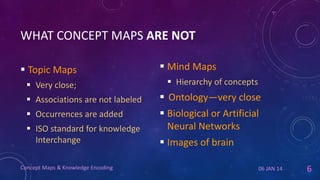
WHAT CONCEPT MAPS ARE NOT
 Topic Maps
 Very close;

 Mind Maps
 Hierarchy of concepts

 Associations are not labeled

 Ontology—very close

 Occurrences are added

 Biological or Artificial
Neural Networks

 ISO standard for knowledge
Interchange
Concept Maps & Knowledge Encoding

 Images of brain
06 JAN 14

6
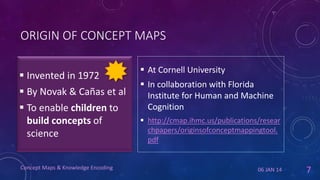
ORIGIN OF CONCEPT MAPS
 Invented in 1972
 By Novak & Cañas et al
 To enable children to
build concepts of
science
Concept Maps & Knowledge Encoding

 At Cornell University
 In collaboration with Florida
Institute for Human and Machine
Cognition
 http://cmap.ihmc.us/publications/resear
chpapers/originsofconceptmappingtool.
pdf

06 JAN 14

7
ELEGANT FOR HUMANS & MACHINES
 Graphic Concept Maps

 Help clear
 Visualizing, expression
and communication
 By humans
Concept Maps & Knowledge Encoding

 More importantly
 The principles of Concept
Maps also help
 Precise representation of
knowledge
 For Machine Processing
06 JAN 14

8
PRINCIPLES OF CONCEPT MODELING
SECTION 2
Concept Maps & Knowledge Encoding

06 JAN 14

9
WHAT IS CONCEPT?
 An idea or a thought
 A set of related thoughts
 A concept is an idea,
something that is conceived in
the human mind--Wikipedia
Concept Maps & Knowledge Encoding

 These are colloquial
definitions or meanings
 See separate PPT for
Fundamentals of Thinking,
Brain, Mind &
Consciousness for details

06 JAN 14

10
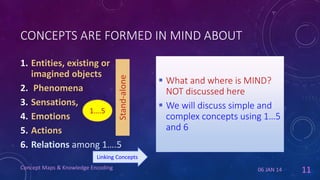
CONCEPTS ARE FORMED IN MIND ABOUT
Stand-alone

1. Entities, existing or
imagined objects
2. Phenomena
3. Sensations,
1….5
4. Emotions
5. Actions
6. Relations among 1….5

 What and where is MIND?
NOT discussed here
 We will discuss simple and
complex concepts using 1…5
and 6

Linking Concepts
Concept Maps & Knowledge Encoding

06 JAN 14

11
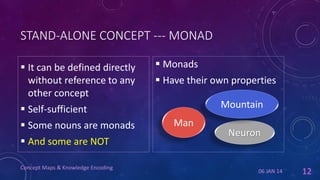
STAND-ALONE CONCEPT --- MONAD
 It can be defined directly
without reference to any
other concept

 Monads

 Have their own properties
Mountain

 Self-sufficient

 Some nouns are monads
 And some are NOT
Concept Maps & Knowledge Encoding

Man

Neuron

06 JAN 14

12
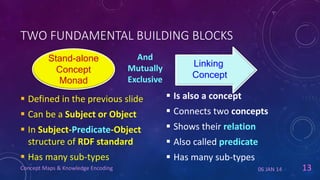
TWO FUNDAMENTAL BUILDING BLOCKS
Stand-alone
Concept
Monad

And
Mutually
Exclusive

Linking
Concept

 Defined in the previous slide

 Is also a concept

 Can be a Subject or Object

 Connects two concepts

 In Subject-Predicate-Object
structure of RDF standard

 Shows their relation

 Has many sub-types

 Has many sub-types

Concept Maps & Knowledge Encoding

 Also called predicate
06 JAN 14

13
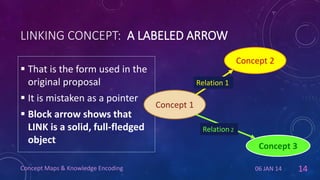
LINKING CONCEPT: A LABELED ARROW
Concept 2

 That is the form used in the
original proposal
 It is mistaken as a pointer

 Block arrow shows that
LINK is a solid, full-fledged
object
Concept Maps & Knowledge Encoding

Relation 1

Concept 1
Relation 2

Concept 3
06 JAN 14

14
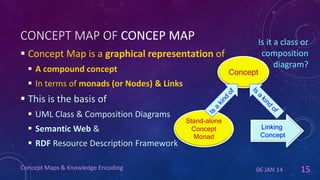
CONCEPT MAP OF CONCEP MAP
 Concept Map is a graphical representation of
 A compound concept

Is it a class or
composition
diagram?

Concept

 In terms of monads (or Nodes) & Links

 This is the basis of
 UML Class & Composition Diagrams
 Semantic Web &
 RDF Resource Description Framework
Concept Maps & Knowledge Encoding

Stand-alone
Concept
Monad

Linking
Concept

06 JAN 14

15
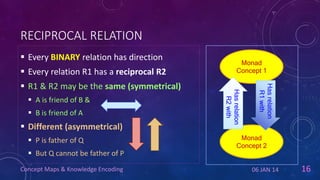
RECIPROCAL RELATION
 Every BINARY relation has direction
 Every relation R1 has a reciprocal R2

 B is friend of A

 Different (asymmetrical)
 P is father of Q
 But Q cannot be father of P
Concept Maps & Knowledge Encoding

Has relation
R1 with

 A is friend of B &

Has relation
R2 with

 R1 & R2 may be the same (symmetrical)

Monad
Concept 1

Monad
Concept 2

06 JAN 14

16
Mutually
dependent

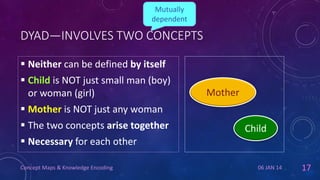
DYAD—INVOLVES TWO CONCEPTS
 Neither can be defined by itself
 Child is NOT just small man (boy)
or woman (girl)

Mother

 Mother is NOT just any woman
 The two concepts arise together

Child

 Necessary for each other
Concept Maps & Knowledge Encoding

06 JAN 14

17
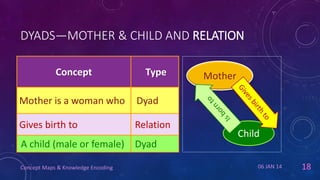
DYADS—MOTHER & CHILD AND RELATION
Concept

Type

Mother is a woman who

Dyad

Gives birth to

Relation

Mother

A child (male or female) Dyad
Concept Maps & Knowledge Encoding

Child
06 JAN 14

18
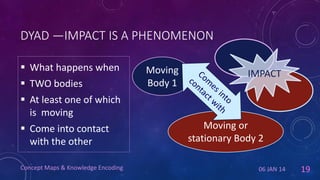
DYAD —IMPACT IS A PHENOMENON
 What happens when
 TWO bodies

Moving
Body 1

IMPACT

 At least one of which
is moving

 Come into contact
with the other
Concept Maps & Knowledge Encoding

Moving or
stationary Body 2
06 JAN 14

19
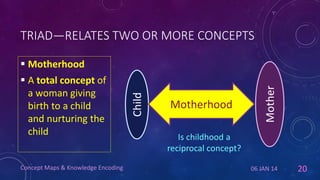
TRIAD—RELATES TWO OR MORE CONCEPTS

Concept Maps & Knowledge Encoding

Motherhood

Mother

 A total concept of
a woman giving
birth to a child
and nurturing the
child

Child

 Motherhood

Is childhood a
reciprocal concept?
06 JAN 14

20
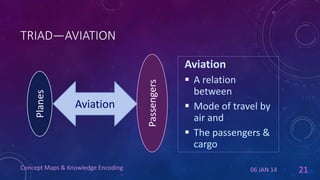
TRIAD—AVIATION

Aviation

Concept Maps & Knowledge Encoding

Passengers

Planes

Aviation
 A relation
between
 Mode of travel by
air and
 The passengers &
cargo
06 JAN 14

21
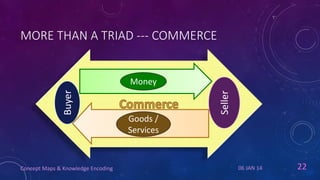
MORE THAN A TRIAD --- COMMERCE

Concept Maps & Knowledge Encoding

Goods /
Services

Seller

Buyer

Money

06 JAN 14

22
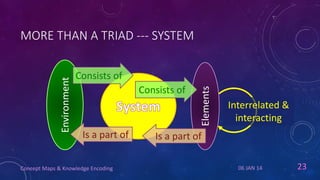
Consists of
Consists of

Is a part of

Concept Maps & Knowledge Encoding

Elements

Environment

MORE THAN A TRIAD --- SYSTEM

Interrelated &
interacting

Is a part of
06 JAN 14

23
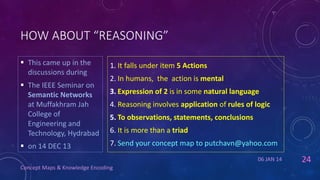
HOW ABOUT “REASONING”
 This came up in the
discussions during
 The IEEE Seminar on
Semantic Networks
at Muffakhram Jah
College of
Engineering and
Technology, Hydrabad
 on 14 DEC 13

1. It falls under item 5 Actions
2. In humans, the action is mental

3. Expression of 2 is in some natural language
4. Reasoning involves application of rules of logic
5. To observations, statements, conclusions

6. It is more than a triad
7. Send your concept map to putchavn@yahoo.com
06 JAN 14

Concept Maps & Knowledge Encoding

24
KNOWLEDGE ENCODING
USING CONCEPT MAPS
SECTION 3
Concept Maps & Knowledge Encoding

06 JAN 14

25
THE ESSENTIAL NATURE OF CONCEPTS
 Essentially the Concept
Maps seem to exist in
 Human minds or
 Text & speech or
 Computers

 To represent & process
knowledge
Concept Maps & Knowledge Encoding

 The exact form

 Of concept maps in
 Humans & Machines varies

 But recognition of the
essential nature of
knowledge is profound
06 JAN 14

26
HUMAN EXPRESSION & COMMUNICATION
 Expression is explicit statement
for communication
 Can be observed & interpreted

 If standard conventions,
grammar, lexicon are
followed

 Expressions can be physiological  The expressions clearly
communicate the concepts
changes, gestures, utterances,
speech, linguistic, mathematical,  Some negotiation may be
graphic..
necessary to disambiguate
Concept Maps & Knowledge Encoding

06 JAN 14

27
HUMAN & MACHINE COMPATIBILITY
See

Data & Information:
Knuth’s Definitions

 Concept Maps
graphically represent
knowledge

 The explicit

 Using Nodes & Links

 Is also well-suited for
machine processing

 For use by humans
Concept Maps & Knowledge Encoding

 Information & data
 Relating to Nodes & Links

06 JAN 14

28
CONCEPT MAPS FOR MACHINE PROCESSING
 The explicit Nodes
& Links of Concept
Maps
 Help knowledge
representation for
 Humans &
Machines
Concept Maps & Knowledge Encoding

 Information is in the microstructures of templates of
See
Nodes & Links
HyperPlex
 Data are in
 The populated Nodes & Links +
 The specific configurations of
populated Nodes and Links
06 JAN 14

29
HIGH PRECISION QUERY-RESPONSE
 By defining
microstructures of
Nodes and Links

 All those details can be precisely
EVALUATED to generate specific
responses for action

 We can encode
 Not like thousands of hits of search
many more details
engines
of concepts
See
 See HyperPlex
HyperPlex
precisely
Concept Maps & Knowledge Encoding

06 JAN 14

30
FORMAL CONCEPT ANALYSIS
 So far we have used  Rudolf Wille’s proposal of
linguistic description
Concept Lattices & Formal
of concepts
Concept Analysis in 1982 is
generally accepted as very
 Traditional Logic is
significant
applied to concept

analysis

 See the Appendix on this
06 JAN 14

Concept Maps & Knowledge Encoding

31
LINKS TO REFERENCES CITED

 http://www.slideshare.net
/putchavn/knuthsdefinitions-of-data-andinformation-04-mar13

 http://www.slideshare.net
/putchavn/hyper-plexhigh-precisionqueryresponse-knowledgerepository-pdf
06 JAN 14

Concept Maps & Knowledge Encoding

32
SUMMARY & CONCLUSION
 Concept Maps are simple
and profound for
 Knowledge representation,
communication and
processing

 KIF, RDF & UNL are some
standards for encoding
knowledge in machines

 HyperPlex is our proposal
for high precision queryresponse
 Both in humans & machines
Concept Maps & Knowledge Encoding

06 JAN 14

33
FORMAL CONCEPT ANALYSIS & CONCEPT LATTICES
APPENDIX
Concept Maps & Knowledge Encoding

06 JAN 14

34
PRECISION OF CONCEPT (MATH)
 http://en.wikipedia.org/wiki/A
ccuracy_and_precision
 This is informative but applies
to quantitative measurement
 See the notes below
 This does not apply to concept

 Formal Concept Analysis is a
branch of mathematics
 Deals with concepts and
context in terms of Objects,
their attributes and
interrelations between them
06 JAN 14

Concept Maps & Knowledge Encoding

35
FORMAL CONCEPT ANALYSIS (INFORMATION SCIENCE)
a principled way of
deriving a concept
hierarchy or
formal ontology from
a collection
of objects and
their properties.

 Each concept in the hierarchy represents
the set of objects sharing the same values
for a certain set of properties; and
 each sub-concept in the hierarchy
contains a subset of the objects in the
concepts above it
 Fits with INTRA Class Diagram of OOAD
06 JAN 14

Concept Maps & Knowledge Encoding

36
TENTATIVE VIEW OF PRECISION OF CONCEPT
 It is best to apply Formal Concept
Analysis and Concept Lattices
 The class-subclass hierarchy of
OOAD is sound and applicable
 PRECISION of CONCEPT may be
taken as 1/n TENTATIVELY, where n
is the number of all sub-classes of
the concept class

Precision of a
concept is NOT
fineness of
concept but its
distinction from
similar concepts
of the class
06 JAN 14

Concept Maps & Knowledge Encoding

37
A COMPREHENSIVE AND EXCELLENT SOURCE

 INTRODUCTION TO FORMAL CONCEPT
ANALYSIS (2008)
 RADIM BˇELOHL´AVEK

 Department of Computer Science Palacky
University, Olomouc

 It is highly
mathematical

 Needs to be studied
for modeling and
software
development
06 JAN 14

Concept Maps & Knowledge Encoding

38
ORDERED SETS
 http://logcom.oxfor
djournals.org/conte
nt/12/1/137.short
 http://golem.ph.ute
xas.edu/category/2
013/09/formal_con
cept_analysis.html
Concept Maps & Knowledge Encoding

schroeder, ordered sets, first
chapter.pdf - Louisiana Tech
University
Schröder, Bernd S. W. 1966Ordered sets : an introduction

06 JAN 14

39

Concept Maps & Knowledge Encoding

  • 1.
    Concept Maps & KnowledgeEncoding Putcha V. Narasimham Knowledge Enabler Systems Concept Maps & Knowledge Encoding 06 JAN 14 1
  • 2.
    KEY SECTIONS &TOPICS Section 1 Section 3 Graphic Representation Knowledge Encoding  Concepts, Ovals  Relations or Links, Arrow lines Section 2  Essential nature of concepts Principles of Concept Modeling  Monads, Dyads, Triads  Examples: Mother, Child, Motherhood, Impact, Commerce, System, Reasoning Concept Maps & Knowledge Encoding  Human & machine compatibility  Concept expression and communication  Knowledge encoding and processing, HyperPlex Appendix: Formal Concept Analysis 06 JAN 14 2
  • 3.
    GRAPHIC REPRESENTATION OFCONCEPTS SECTION 1 Concept Maps & Knowledge Encoding 06 JAN 14 3
  • 4.
    WHAT ARE CONCEPTMAPS Concept 4  Graphical or Visual  Representations of concepts (in ovals)  And their relations (arrow lines with labels) Concept 1 Relation 3 Relation 2 Relation 1 Concept 3 Concept 2 Concept Maps & Knowledge Encoding Relation 4 Concept 5 06 JAN 14 4
  • 5.
    CONCEPT MAPS WITHBLOCK ARROWS Concept 1 Relation 1C  Concepts in ovals  And their relations in Block Arrows Concept 2 Concept Maps & Knowledge Encoding Concept 4 Relation 4 Concept 3 Concept 5 06 JAN 14 5
  • 6.
    WHAT CONCEPT MAPSARE NOT  Topic Maps  Very close;  Mind Maps  Hierarchy of concepts  Associations are not labeled  Ontology—very close  Occurrences are added  Biological or Artificial Neural Networks  ISO standard for knowledge Interchange Concept Maps & Knowledge Encoding  Images of brain 06 JAN 14 6
  • 7.
    ORIGIN OF CONCEPTMAPS  Invented in 1972  By Novak & Cañas et al  To enable children to build concepts of science Concept Maps & Knowledge Encoding  At Cornell University  In collaboration with Florida Institute for Human and Machine Cognition  http://cmap.ihmc.us/publications/resear chpapers/originsofconceptmappingtool. pdf 06 JAN 14 7
  • 8.
    ELEGANT FOR HUMANS& MACHINES  Graphic Concept Maps  Help clear  Visualizing, expression and communication  By humans Concept Maps & Knowledge Encoding  More importantly  The principles of Concept Maps also help  Precise representation of knowledge  For Machine Processing 06 JAN 14 8
  • 9.
    PRINCIPLES OF CONCEPTMODELING SECTION 2 Concept Maps & Knowledge Encoding 06 JAN 14 9
  • 10.
    WHAT IS CONCEPT? An idea or a thought  A set of related thoughts  A concept is an idea, something that is conceived in the human mind--Wikipedia Concept Maps & Knowledge Encoding  These are colloquial definitions or meanings  See separate PPT for Fundamentals of Thinking, Brain, Mind & Consciousness for details 06 JAN 14 10
  • 11.
    CONCEPTS ARE FORMEDIN MIND ABOUT Stand-alone 1. Entities, existing or imagined objects 2. Phenomena 3. Sensations, 1….5 4. Emotions 5. Actions 6. Relations among 1….5  What and where is MIND? NOT discussed here  We will discuss simple and complex concepts using 1…5 and 6 Linking Concepts Concept Maps & Knowledge Encoding 06 JAN 14 11
  • 12.
    STAND-ALONE CONCEPT ---MONAD  It can be defined directly without reference to any other concept  Monads  Have their own properties Mountain  Self-sufficient  Some nouns are monads  And some are NOT Concept Maps & Knowledge Encoding Man Neuron 06 JAN 14 12
  • 13.
    TWO FUNDAMENTAL BUILDINGBLOCKS Stand-alone Concept Monad And Mutually Exclusive Linking Concept  Defined in the previous slide  Is also a concept  Can be a Subject or Object  Connects two concepts  In Subject-Predicate-Object structure of RDF standard  Shows their relation  Has many sub-types  Has many sub-types Concept Maps & Knowledge Encoding  Also called predicate 06 JAN 14 13
  • 14.
    LINKING CONCEPT: ALABELED ARROW Concept 2  That is the form used in the original proposal  It is mistaken as a pointer  Block arrow shows that LINK is a solid, full-fledged object Concept Maps & Knowledge Encoding Relation 1 Concept 1 Relation 2 Concept 3 06 JAN 14 14
  • 15.
    CONCEPT MAP OFCONCEP MAP  Concept Map is a graphical representation of  A compound concept Is it a class or composition diagram? Concept  In terms of monads (or Nodes) & Links  This is the basis of  UML Class & Composition Diagrams  Semantic Web &  RDF Resource Description Framework Concept Maps & Knowledge Encoding Stand-alone Concept Monad Linking Concept 06 JAN 14 15
  • 16.
    RECIPROCAL RELATION  EveryBINARY relation has direction  Every relation R1 has a reciprocal R2  B is friend of A  Different (asymmetrical)  P is father of Q  But Q cannot be father of P Concept Maps & Knowledge Encoding Has relation R1 with  A is friend of B & Has relation R2 with  R1 & R2 may be the same (symmetrical) Monad Concept 1 Monad Concept 2 06 JAN 14 16
  • 17.
    Mutually dependent DYAD—INVOLVES TWO CONCEPTS Neither can be defined by itself  Child is NOT just small man (boy) or woman (girl) Mother  Mother is NOT just any woman  The two concepts arise together Child  Necessary for each other Concept Maps & Knowledge Encoding 06 JAN 14 17
  • 18.
    DYADS—MOTHER & CHILDAND RELATION Concept Type Mother is a woman who Dyad Gives birth to Relation Mother A child (male or female) Dyad Concept Maps & Knowledge Encoding Child 06 JAN 14 18
  • 19.
    DYAD —IMPACT ISA PHENOMENON  What happens when  TWO bodies Moving Body 1 IMPACT  At least one of which is moving  Come into contact with the other Concept Maps & Knowledge Encoding Moving or stationary Body 2 06 JAN 14 19
  • 20.
    TRIAD—RELATES TWO ORMORE CONCEPTS Concept Maps & Knowledge Encoding Motherhood Mother  A total concept of a woman giving birth to a child and nurturing the child Child  Motherhood Is childhood a reciprocal concept? 06 JAN 14 20
  • 21.
    TRIAD—AVIATION Aviation Concept Maps &Knowledge Encoding Passengers Planes Aviation  A relation between  Mode of travel by air and  The passengers & cargo 06 JAN 14 21
  • 22.
    MORE THAN ATRIAD --- COMMERCE Concept Maps & Knowledge Encoding Goods / Services Seller Buyer Money 06 JAN 14 22
  • 23.
    Consists of Consists of Isa part of Concept Maps & Knowledge Encoding Elements Environment MORE THAN A TRIAD --- SYSTEM Interrelated & interacting Is a part of 06 JAN 14 23
  • 24.
    HOW ABOUT “REASONING” This came up in the discussions during  The IEEE Seminar on Semantic Networks at Muffakhram Jah College of Engineering and Technology, Hydrabad  on 14 DEC 13 1. It falls under item 5 Actions 2. In humans, the action is mental 3. Expression of 2 is in some natural language 4. Reasoning involves application of rules of logic 5. To observations, statements, conclusions 6. It is more than a triad 7. Send your concept map to putchavn@yahoo.com 06 JAN 14 Concept Maps & Knowledge Encoding 24
  • 25.
    KNOWLEDGE ENCODING USING CONCEPTMAPS SECTION 3 Concept Maps & Knowledge Encoding 06 JAN 14 25
  • 26.
    THE ESSENTIAL NATUREOF CONCEPTS  Essentially the Concept Maps seem to exist in  Human minds or  Text & speech or  Computers  To represent & process knowledge Concept Maps & Knowledge Encoding  The exact form  Of concept maps in  Humans & Machines varies  But recognition of the essential nature of knowledge is profound 06 JAN 14 26
  • 27.
    HUMAN EXPRESSION &COMMUNICATION  Expression is explicit statement for communication  Can be observed & interpreted  If standard conventions, grammar, lexicon are followed  Expressions can be physiological  The expressions clearly communicate the concepts changes, gestures, utterances, speech, linguistic, mathematical,  Some negotiation may be graphic.. necessary to disambiguate Concept Maps & Knowledge Encoding 06 JAN 14 27
  • 28.
    HUMAN & MACHINECOMPATIBILITY See Data & Information: Knuth’s Definitions  Concept Maps graphically represent knowledge  The explicit  Using Nodes & Links  Is also well-suited for machine processing  For use by humans Concept Maps & Knowledge Encoding  Information & data  Relating to Nodes & Links 06 JAN 14 28
  • 29.
    CONCEPT MAPS FORMACHINE PROCESSING  The explicit Nodes & Links of Concept Maps  Help knowledge representation for  Humans & Machines Concept Maps & Knowledge Encoding  Information is in the microstructures of templates of See Nodes & Links HyperPlex  Data are in  The populated Nodes & Links +  The specific configurations of populated Nodes and Links 06 JAN 14 29
  • 30.
    HIGH PRECISION QUERY-RESPONSE By defining microstructures of Nodes and Links  All those details can be precisely EVALUATED to generate specific responses for action  We can encode  Not like thousands of hits of search many more details engines of concepts See  See HyperPlex HyperPlex precisely Concept Maps & Knowledge Encoding 06 JAN 14 30
  • 31.
    FORMAL CONCEPT ANALYSIS So far we have used  Rudolf Wille’s proposal of linguistic description Concept Lattices & Formal of concepts Concept Analysis in 1982 is generally accepted as very  Traditional Logic is significant applied to concept analysis  See the Appendix on this 06 JAN 14 Concept Maps & Knowledge Encoding 31
  • 32.
    LINKS TO REFERENCESCITED  http://www.slideshare.net /putchavn/knuthsdefinitions-of-data-andinformation-04-mar13  http://www.slideshare.net /putchavn/hyper-plexhigh-precisionqueryresponse-knowledgerepository-pdf 06 JAN 14 Concept Maps & Knowledge Encoding 32
  • 33.
    SUMMARY & CONCLUSION Concept Maps are simple and profound for  Knowledge representation, communication and processing  KIF, RDF & UNL are some standards for encoding knowledge in machines  HyperPlex is our proposal for high precision queryresponse  Both in humans & machines Concept Maps & Knowledge Encoding 06 JAN 14 33
  • 34.
    FORMAL CONCEPT ANALYSIS& CONCEPT LATTICES APPENDIX Concept Maps & Knowledge Encoding 06 JAN 14 34
  • 35.
    PRECISION OF CONCEPT(MATH)  http://en.wikipedia.org/wiki/A ccuracy_and_precision  This is informative but applies to quantitative measurement  See the notes below  This does not apply to concept  Formal Concept Analysis is a branch of mathematics  Deals with concepts and context in terms of Objects, their attributes and interrelations between them 06 JAN 14 Concept Maps & Knowledge Encoding 35
  • 36.
    FORMAL CONCEPT ANALYSIS(INFORMATION SCIENCE) a principled way of deriving a concept hierarchy or formal ontology from a collection of objects and their properties.  Each concept in the hierarchy represents the set of objects sharing the same values for a certain set of properties; and  each sub-concept in the hierarchy contains a subset of the objects in the concepts above it  Fits with INTRA Class Diagram of OOAD 06 JAN 14 Concept Maps & Knowledge Encoding 36
  • 37.
    TENTATIVE VIEW OFPRECISION OF CONCEPT  It is best to apply Formal Concept Analysis and Concept Lattices  The class-subclass hierarchy of OOAD is sound and applicable  PRECISION of CONCEPT may be taken as 1/n TENTATIVELY, where n is the number of all sub-classes of the concept class Precision of a concept is NOT fineness of concept but its distinction from similar concepts of the class 06 JAN 14 Concept Maps & Knowledge Encoding 37
  • 38.
    A COMPREHENSIVE ANDEXCELLENT SOURCE  INTRODUCTION TO FORMAL CONCEPT ANALYSIS (2008)  RADIM BˇELOHL´AVEK  Department of Computer Science Palacky University, Olomouc  It is highly mathematical  Needs to be studied for modeling and software development 06 JAN 14 Concept Maps & Knowledge Encoding 38
  • 39.
    ORDERED SETS  http://logcom.oxfor djournals.org/conte nt/12/1/137.short http://golem.ph.ute xas.edu/category/2 013/09/formal_con cept_analysis.html Concept Maps & Knowledge Encoding schroeder, ordered sets, first chapter.pdf - Louisiana Tech University Schröder, Bernd S. W. 1966Ordered sets : an introduction 06 JAN 14 39