Shahid Mobeen Ali Anjum
Resource Person
AIOU Islamabad
Whatsapp:03024251700
What is Knowledge
Facts, information, and skills
acquired through experience or
education; the theoretical or
practical understanding of a
subject.
Introduction
 Knowledge seems to be something
we gain as we live.
 Knowledge is the awareness and understanding
of particular aspects of reality.
 It is the clear, logical information gained
through the process of reason applied to reality.
 In forming new knowledge, a human being is
assisted by previous knowledge.
 Studying knowledge is something
philosophers have been doing for as
long as philosophy has been around.
 It’s one of the constant topics.
 Philosophy also strives to find the answer of
question: what is the source that provides them
with this stream of thought and knowledge?'
 But how do we gain it?
This issue has an important history in the
various stages of Greek, Islamic and European
philosophy.
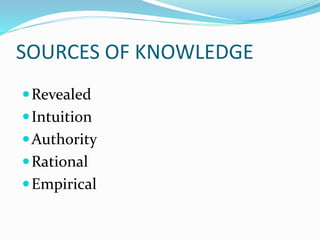
SOURCES OF KNOWLEDGE
Revealed
Intuition
Authority
Rational
Empirical
Revealed
 This sort of knowledge is based upon revelation from
some supernatural celestial beings.
 Revealed Knowledge described as a knowledge that
God has disclosed to man.
 In the Islamic tradition, the Quran is held to be an
authoritative and revealed source of knowledge.
 In the Christian fold, for instance, dreams, visions and
even the Bible have come to be accepted as forms of
revealed knowledge.
 Islam calls us to seek knowledge.
 Islam calls us to learn all kinds of beneficial
knowledge.
 Truth obtained through revelation is believed to be
absolute.
 It must be accepted by faith and cannot be disproved
or proved empirically.
Intuition
 Intuitive Knowledge is the ability to utilize and acquire
knowledge without the use of reason; that science is now
facilitating and helping explain.
 It is the most personal way of knowing.
 It is immediate cognition or sharp insight. It occurs
beneath the threshold of consciousness.
 Intuitive knowledge is based on intuition, faith, beliefs etc.
Intuition
 Human feelings plays greater role in intuitive
knowledge compared to reliance on facts.
 Intuitive knowledge involves direct and immediate
recognition of the agreement or disagreement of two
ideas.
 It yields perfect certainty, but is only rarely available to
us.
 Intuition as a mode of knowledge develops on the
basis of immediate apprehension.
Authority
 Authoritarian knowledge relies
on information that has been obtained from books,
research papers, experts, supreme powers etc.
 Authoritative knowledge comes from the experts.
 It is only as valid as the assumptions on which it
stands.
Rational
 Rationalists hold that at least some of
our knowledge is derived from reason
alone, and that reason plays an important role in the
acquisition of all of our knowledge.
 Rationalists believe that knowledge can be arrived at
through the use of reason or deductive reasoning.
 The view that reasoning or logic is the central factor in
knowledge is known as rationalism.
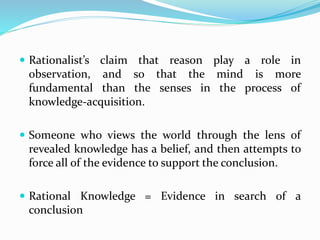
 Rationalist’s claim that reason play a role in
observation, and so that the mind is more
fundamental than the senses in the process of
knowledge-acquisition.
 Someone who views the world through the lens of
revealed knowledge has a belief, and then attempts to
force all of the evidence to support the conclusion.
 Rational Knowledge = Evidence in search of a
conclusion
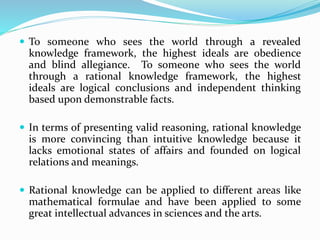
 To someone who sees the world through a revealed
knowledge framework, the highest ideals are obedience
and blind allegiance. To someone who sees the world
through a rational knowledge framework, the highest
ideals are logical conclusions and independent thinking
based upon demonstrable facts.
 In terms of presenting valid reasoning, rational knowledge
is more convincing than intuitive knowledge because it
lacks emotional states of affairs and founded on logical
relations and meanings.
 Rational knowledge can be applied to different areas like
mathematical formulae and have been applied to some
great intellectual advances in sciences and the arts.
Empirical
 Empirical ---- based on, concerned
with, or verifiable by observation or
experience rather than theory or pure logic.
 The empirical knowledge is an attempt to discover a basis
for our knowledge in sense experience.
 Empirical knowledge is knowledge of such facts as one may
meet in experience.
 Empirical knowledge relies on objective facts that have
been established and can be demonstrated.
 Empiricists hold that all of our
knowledge is ultimately derived from
our senses or our experiences. They
therefore deny the existence of innate knowledge, i.e.
knowledge that we possess from birth.
 Empiricism accepts personal experiences associated
with observation, feelings and senses as a valid source
of knowledge, whereas rationalism relies on empirical
findings gained through valid and reliable measures as
a source of knowledge.
 Empirical knowledge is knowledge of such facts as one
may meet in experience.
 These are always particular and may be of many kinds,
including such as need a lot of training or some
apparatus to experience them.
unit 4 8609.pptx

unit 4 8609.pptx

  • 1.
    Shahid Mobeen AliAnjum Resource Person AIOU Islamabad Whatsapp:03024251700
  • 2.
    What is Knowledge Facts,information, and skills acquired through experience or education; the theoretical or practical understanding of a subject.
  • 3.
    Introduction  Knowledge seemsto be something we gain as we live.  Knowledge is the awareness and understanding of particular aspects of reality.  It is the clear, logical information gained through the process of reason applied to reality.  In forming new knowledge, a human being is assisted by previous knowledge.
  • 4.
     Studying knowledgeis something philosophers have been doing for as long as philosophy has been around.  It’s one of the constant topics.  Philosophy also strives to find the answer of question: what is the source that provides them with this stream of thought and knowledge?'  But how do we gain it? This issue has an important history in the various stages of Greek, Islamic and European philosophy.
  • 5.
  • 6.
    Revealed  This sortof knowledge is based upon revelation from some supernatural celestial beings.  Revealed Knowledge described as a knowledge that God has disclosed to man.  In the Islamic tradition, the Quran is held to be an authoritative and revealed source of knowledge.  In the Christian fold, for instance, dreams, visions and even the Bible have come to be accepted as forms of revealed knowledge.
  • 7.
     Islam callsus to seek knowledge.  Islam calls us to learn all kinds of beneficial knowledge.  Truth obtained through revelation is believed to be absolute.  It must be accepted by faith and cannot be disproved or proved empirically.
  • 8.
    Intuition  Intuitive Knowledgeis the ability to utilize and acquire knowledge without the use of reason; that science is now facilitating and helping explain.  It is the most personal way of knowing.  It is immediate cognition or sharp insight. It occurs beneath the threshold of consciousness.  Intuitive knowledge is based on intuition, faith, beliefs etc.
  • 9.
    Intuition  Human feelingsplays greater role in intuitive knowledge compared to reliance on facts.  Intuitive knowledge involves direct and immediate recognition of the agreement or disagreement of two ideas.  It yields perfect certainty, but is only rarely available to us.  Intuition as a mode of knowledge develops on the basis of immediate apprehension.
  • 10.
    Authority  Authoritarian knowledgerelies on information that has been obtained from books, research papers, experts, supreme powers etc.  Authoritative knowledge comes from the experts.  It is only as valid as the assumptions on which it stands.
  • 11.
    Rational  Rationalists holdthat at least some of our knowledge is derived from reason alone, and that reason plays an important role in the acquisition of all of our knowledge.  Rationalists believe that knowledge can be arrived at through the use of reason or deductive reasoning.  The view that reasoning or logic is the central factor in knowledge is known as rationalism.
  • 12.
     Rationalist’s claimthat reason play a role in observation, and so that the mind is more fundamental than the senses in the process of knowledge-acquisition.  Someone who views the world through the lens of revealed knowledge has a belief, and then attempts to force all of the evidence to support the conclusion.  Rational Knowledge = Evidence in search of a conclusion
  • 13.
     To someonewho sees the world through a revealed knowledge framework, the highest ideals are obedience and blind allegiance. To someone who sees the world through a rational knowledge framework, the highest ideals are logical conclusions and independent thinking based upon demonstrable facts.  In terms of presenting valid reasoning, rational knowledge is more convincing than intuitive knowledge because it lacks emotional states of affairs and founded on logical relations and meanings.  Rational knowledge can be applied to different areas like mathematical formulae and have been applied to some great intellectual advances in sciences and the arts.
  • 14.
    Empirical  Empirical ----based on, concerned with, or verifiable by observation or experience rather than theory or pure logic.  The empirical knowledge is an attempt to discover a basis for our knowledge in sense experience.  Empirical knowledge is knowledge of such facts as one may meet in experience.  Empirical knowledge relies on objective facts that have been established and can be demonstrated.
  • 15.
     Empiricists holdthat all of our knowledge is ultimately derived from our senses or our experiences. They therefore deny the existence of innate knowledge, i.e. knowledge that we possess from birth.  Empiricism accepts personal experiences associated with observation, feelings and senses as a valid source of knowledge, whereas rationalism relies on empirical findings gained through valid and reliable measures as a source of knowledge.
  • 16.
     Empirical knowledgeis knowledge of such facts as one may meet in experience.  These are always particular and may be of many kinds, including such as need a lot of training or some apparatus to experience them.