Different ways of knowing


             Dr Valerie Mannix
                                 1
Rationale

• Call by several academics in the field of
  education for an alternative view of
  learning i.e. Enabling learners to perceive
  themselves as creators of personal
  knowledge.

• Need to escape “a one size fits all approach
  to teaching and learning” (Gamache, 2002)
                                                 2
Discussion Outline
• Draw on key PhD research finding- motivational
  self systems in a SLA context (Mannix, 2008)

• Explore the reconstruction of learner identities
  (habitus) and learner perceptions of knowledge,
  skills, dispositions and qualities via motivational
  self systems and life wide learning.

• Implications for curriculum development and
  learning facilitation

                                                        3
PhD Research Project
• Involved 49 student participants at WIT

• Investigated the perceived sources of language
  learner motivation and demotivation.

• Students were pursuing language studies across a
  wide range of disciplines – engineering, science,
  business, humanities.

                                                      4
Kind finding of the research

       Academic Year Abroad/ Work Placement


• Students pursuing language studies were more
  motivated and self-determined in their learning
  and had developed a more defined sense of self
  or future self having spent an academic year
  abroad (alternative learning space).


                                                    5
Having spent time in a second
    language (L2 ) community:
• Students were more inclined to relate
  aspects of their previous learning
  experience to their current one.

• Use creative strategies in achieving their
  learning goals (e.g. Tandem learning)


                                               6
Having spent time in a second
  language (L2 ) community:

• Students reported being able to identify
  more with the second language and culture
  and their attitudes towards learning other
  languages and other cultures (alternative
  spaces) had changed in a positive way
  (actual and future selves).

                                               7
Learners who did not partake in
   the academic year abroad:

• Perceived the value of learning and indeed
  the value of language learning to be purely
  instrumental, for example, the completion
  of an academic degree course in order to
  enhance their employment prospects

• Reported feeling anxious before
  assessments.
                                                8
Learners who did not partake in
   the academic year abroad:

• Reported less confidence or a lack of
  confidence in their own ability to succeed
  or to improve on their existing grades.

• More reliance on lecture notes and support
  from Lecturer.

                                               9
Studies in Second Language
             Acquisition

• Strong evidence that learners who
  encounter and draw on different spaces of
  learning are more self-determined in their
  learning and are more willing to engage in
  new and multiple spaces (also
  collaborative spaces) of learning.

                                               10
Motivation – Possible and Ideal
  Selves- Learning Spaces


                                  11
The notion of ‘Self’
• Traditionally self-representations were
  static concepts

• Self-theorists have become increasingly
  interested in the active dynamic nature of
  the self system reflecting changing realities
  (Leahy, 2007).

                                              12
Changing reality
• Globalisation
• Widespread political and economic
  migration
• Increased mobility
• Ever-developing media technologies
• Electronic discourse communities.


                                       13
The Notion of Self-
          Key Researchers

• Markus and Nurius (1986) Multiple Self
  Systems

• Higgins et al (1985) and Higgins (1987
  &1996) – Self Discrepancy Theory
  ( One single ideal or ought self shaped by
  composite self guides)
                                               14
Markus and Nurius 1986
      Multiple Possible Selves

• Possible selves, “a future self state rather
  than a current one, represents the ideas
  which an individual has regarding what
  they could become, what they would like
  to become and what they are afraid of
  becoming”.
        (Markus and Nurius,1986, 954)
                                             15
Markus and Nurius 1986 –
      Multiple Possible Selves

• Information derived from past experiences
  also plays a significant role in this regard.
• Markus and Nurius provide a broad outline
  of the scope of possible selves, that is,
  multiple future orientated possible
  selves, but do not provide a finite
  taxonomy.
                                              16
Markus and Nurius 1986
     Multiple Possible Selves

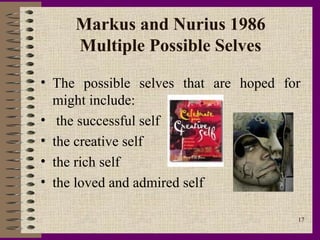
• The possible selves that are hoped for
  might include:
• the successful self
• the creative self
• the rich self
• the loved and admired self

                                       17
Markus and Nurius 1986

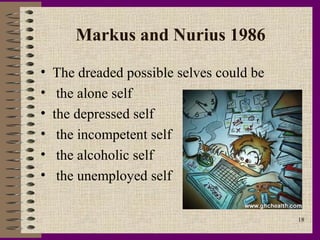
•   The dreaded possible selves could be
•    the alone self
•   the depressed self
•    the incompetent self
•    the alcoholic self
•    the unemployed self

                                           18
Higgins et al. (1985)
              Self- discrepancy theory
• A systematic framework of the interrelations
  among the different self states.

• 3 Self domains – Actual, Ideal and Ought Self
• 2 Standpoints- One’s one; significant other.

          6 Basic Self States


                                                  19
Domains of the Self
• Actual Self – representation of the
  attributes that someone (yourself or
  another) believes you actually possess.

• Ideal Self – representation of the attributes
  (hopes, aspirations or wishes for you) that
  someone (yourself or another) would like
  you ideally to possess.

                                                  20
Domains of the Self

• Ought Self – representation of the
  attributes that someone (yourself or
  another) believes you should or ought to
  possess (sense of duty, obligations or
  responsibilities).


                                             21
Implications of Self State
           representations
• Individuals differ as to which self guide they are
  motivated towards.

• Individuals are motivated to reach a condition
  which matches their personally relevant self
  guides.


                                                       22
Implications
• Applied to an educational context the motivation
  to learn involves the desire to reduce the
  discrepancy between one’s actual self and the
  projected behavioural standards of the
  ideal/ought selves

• This would imply that future self guides provide
  incentive, direction and impetus for action


                                                 23
Implications

• Discrepancy between actual and future
  selves initiates self-regulatory strategies to
  reduce the discrepancy.


                                               24
Imagination- envisioning futures

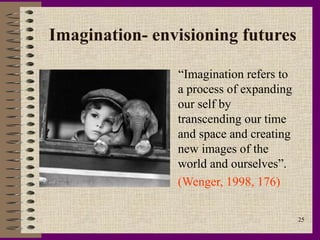
                “Imagination refers to
                a process of expanding
                our self by
                transcending our time
                and space and creating
                new images of the
                world and ourselves”.
                (Wenger, 1998, 176)

                                         25
Imagination- Wide Array of
   Contexts- Life wide learning

                  The wider the array of
                  contexts, (spaces for
                  learning –past, present
                  and future), the more
                  capable and willing,
                  people will be to
                  generate possible
                  selves.
                    Markus (2006, xii)
The Searcher
                                            26
Life wide Learning (Liquid
             Learning)
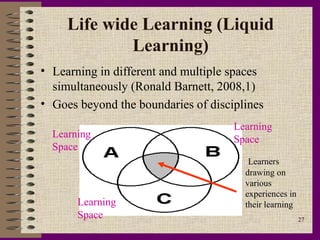
• Learning in different and multiple spaces
  simultaneously (Ronald Barnett, 2008,1)
• Goes beyond the boundaries of disciplines
                                     Learning
  Learning                           Space
  Space
                                        Learners
                                       drawing on
                                       various
                                       experiences in
       Learning                        their learning
       Space                                            27
Examples of Learning Spaces
         Barnett (2008)
Individuals inhibit created learning spaces
• Work, non work, occupational networks.

• Family, leisure, social networks and
  engagements,

• Manifold channels of news, information and
  communication

• Physical and global mobility (actual and virtual)
                                                      28
Examples of Learning Spaces
      Savin- Baden (2008,12)
Individuals inhibit created learning spaces

• Bounded learning spaces: days away in which to
  think and reflect as a group

• Formal learning spaces: Courses and
  Conferences

• Social learning spaces: dialogue and debate in
  informal settings

                                                   29
Examples of Learning Spaces
      Savin- Baden (2008,12)
Individuals inhibit created learning spaces


• Silent learning spaces: away from noise that
  erodes creativity, innovation and space to think
• Writing space: Places not only to write but to
  consider one’s stances and ideas
• Dialogic spaces: critical conversations where the
  relationship between the oral and the written can be
  explored.
                                                         30
Examples of Learning Spaces
   Savin- Baden (2008,12)
Individuals inhibit created learning spaces

• Reflective learning spaces: which reach
  beyond contemplation and reconsidering past thought,
  they are spaces of meaning-making and consciousness-
  raising.

• Digital learning spaces: where explorations
  occur about new types of visuality, literacy, pedagogy,
  representations of knowledge, communication and
  embodiment.
                                                            31
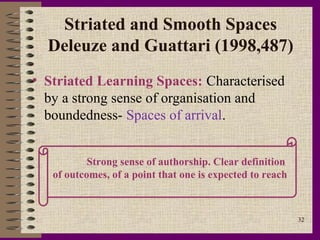
Striated and Smooth Spaces
  Deleuze and Guattari (1998,487)
• Striated Learning Spaces: Characterised
  by a strong sense of organisation and
  boundedness- Spaces of arrival.


           Strong sense of authorship. Clear definition
   of outcomes, of a point that one is expected to reach


                                                           32
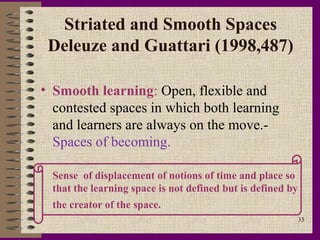
Striated and Smooth Spaces
 Deleuze and Guattari (1998,487)

• Smooth learning: Open, flexible and
  contested spaces in which both learning
  and learners are always on the move.-
  Spaces of becoming.

` Sense of displacement of notions of time and place so
  that the learning space is not defined but is defined by
  the creator of the space.
                                                             33
Categorisation of forms of
        Lifewide Learning

• The language of knowledge and skills is
  insufficient to capture the complexity of the
  learning processes that many are undergoing.

• These domains need to be supplemented with a
  sense of a student’s being, and indeed , their
  continuing becoming- dispositions and qualities.
                            (Barnett, 2008)
                                                     34
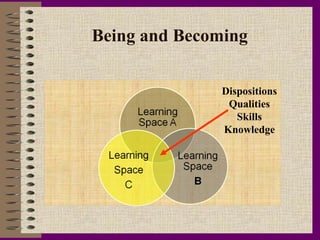
Being and Becoming

               Dispositions
                Qualities
                  Skills
               Knowledge
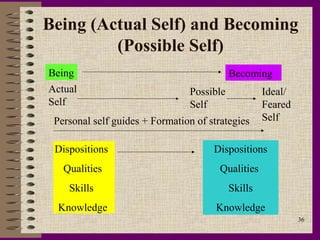
Being (Actual Self) and Becoming
         (Possible Self)
Being                                      Becoming
Actual                          Possible            Ideal/
Self                            Self                Feared
 Personal self guides + Formation of strategies     Self

 Dispositions                         Dispositions
   Qualities                            Qualities
    Skills                                 Skills
  Knowledge                            Knowledge
                                                             36
Implication

Investment in learning
through different spaces and
in various forms is also an
investment in the learner’s
complex identity (habitus)


                               37
Implication

Further exploration of the
possibilities for the creation
of smooth spaces in straited
environments is required for
higher education.


                                 38
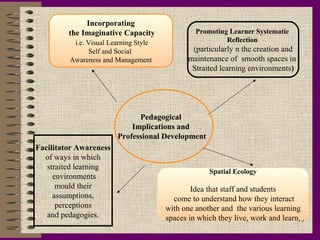
Incorporating
         the Imaginative Capacity               Promoting Learner Systematic
          i.e. Visual Learning Style                     Reflection
               Self and Social                 (particularly n the creation and
         Awareness and Management             maintenance of smooth spaces in
                                               Straited learning environments)


                              Pedagogical
                            Implications and
                        Professional Development
Facilitator Awareness
  of ways in which
   straited learning
                                                    Spatial Ecology
     environments
      mould their                              Idea that staff and students
     assumptions,                        come to understand how they interact
      perceptions                      with one another and the various learning
   and pedagogies.                     spaces in which they live, work and learn.
                                                                                39
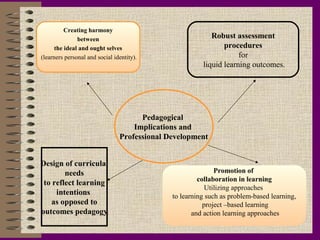
Creating harmony
               between                                     Robust assessment
      the ideal and ought selves                               procedures
(learners personal and social identity).                            for
                                                        liquid learning outcomes.


                                      Pedagogical
                                    Implications and
                                Professional Development


Design of curricula
        needs                                                Promotion of
                                                       collaboration in learning
 to reflect learning
                                                          Utilizing approaches
     intentions                               to learning such as problem-based learning,
   as opposed to                                         project –based learning
outcomes pedagogy.                                   and action learning approaches
                                                                                            40
Thank You


            41

Different ways of knowing

  • 1.
    Different ways ofknowing Dr Valerie Mannix 1
  • 2.
    Rationale • Call byseveral academics in the field of education for an alternative view of learning i.e. Enabling learners to perceive themselves as creators of personal knowledge. • Need to escape “a one size fits all approach to teaching and learning” (Gamache, 2002) 2
  • 3.
    Discussion Outline • Drawon key PhD research finding- motivational self systems in a SLA context (Mannix, 2008) • Explore the reconstruction of learner identities (habitus) and learner perceptions of knowledge, skills, dispositions and qualities via motivational self systems and life wide learning. • Implications for curriculum development and learning facilitation 3
  • 4.
    PhD Research Project •Involved 49 student participants at WIT • Investigated the perceived sources of language learner motivation and demotivation. • Students were pursuing language studies across a wide range of disciplines – engineering, science, business, humanities. 4
  • 5.
    Kind finding ofthe research Academic Year Abroad/ Work Placement • Students pursuing language studies were more motivated and self-determined in their learning and had developed a more defined sense of self or future self having spent an academic year abroad (alternative learning space). 5
  • 6.
    Having spent timein a second language (L2 ) community: • Students were more inclined to relate aspects of their previous learning experience to their current one. • Use creative strategies in achieving their learning goals (e.g. Tandem learning) 6
  • 7.
    Having spent timein a second language (L2 ) community: • Students reported being able to identify more with the second language and culture and their attitudes towards learning other languages and other cultures (alternative spaces) had changed in a positive way (actual and future selves). 7
  • 8.
    Learners who didnot partake in the academic year abroad: • Perceived the value of learning and indeed the value of language learning to be purely instrumental, for example, the completion of an academic degree course in order to enhance their employment prospects • Reported feeling anxious before assessments. 8
  • 9.
    Learners who didnot partake in the academic year abroad: • Reported less confidence or a lack of confidence in their own ability to succeed or to improve on their existing grades. • More reliance on lecture notes and support from Lecturer. 9
  • 10.
    Studies in SecondLanguage Acquisition • Strong evidence that learners who encounter and draw on different spaces of learning are more self-determined in their learning and are more willing to engage in new and multiple spaces (also collaborative spaces) of learning. 10
  • 11.
    Motivation – Possibleand Ideal Selves- Learning Spaces 11
  • 12.
    The notion of‘Self’ • Traditionally self-representations were static concepts • Self-theorists have become increasingly interested in the active dynamic nature of the self system reflecting changing realities (Leahy, 2007). 12
  • 13.
    Changing reality • Globalisation •Widespread political and economic migration • Increased mobility • Ever-developing media technologies • Electronic discourse communities. 13
  • 14.
    The Notion ofSelf- Key Researchers • Markus and Nurius (1986) Multiple Self Systems • Higgins et al (1985) and Higgins (1987 &1996) – Self Discrepancy Theory ( One single ideal or ought self shaped by composite self guides) 14
  • 15.
    Markus and Nurius1986 Multiple Possible Selves • Possible selves, “a future self state rather than a current one, represents the ideas which an individual has regarding what they could become, what they would like to become and what they are afraid of becoming”. (Markus and Nurius,1986, 954) 15
  • 16.
    Markus and Nurius1986 – Multiple Possible Selves • Information derived from past experiences also plays a significant role in this regard. • Markus and Nurius provide a broad outline of the scope of possible selves, that is, multiple future orientated possible selves, but do not provide a finite taxonomy. 16
  • 17.
    Markus and Nurius1986 Multiple Possible Selves • The possible selves that are hoped for might include: • the successful self • the creative self • the rich self • the loved and admired self 17
  • 18.
    Markus and Nurius1986 • The dreaded possible selves could be • the alone self • the depressed self • the incompetent self • the alcoholic self • the unemployed self 18
  • 19.
    Higgins et al.(1985) Self- discrepancy theory • A systematic framework of the interrelations among the different self states. • 3 Self domains – Actual, Ideal and Ought Self • 2 Standpoints- One’s one; significant other. 6 Basic Self States 19
  • 20.
    Domains of theSelf • Actual Self – representation of the attributes that someone (yourself or another) believes you actually possess. • Ideal Self – representation of the attributes (hopes, aspirations or wishes for you) that someone (yourself or another) would like you ideally to possess. 20
  • 21.
    Domains of theSelf • Ought Self – representation of the attributes that someone (yourself or another) believes you should or ought to possess (sense of duty, obligations or responsibilities). 21
  • 22.
    Implications of SelfState representations • Individuals differ as to which self guide they are motivated towards. • Individuals are motivated to reach a condition which matches their personally relevant self guides. 22
  • 23.
    Implications • Applied toan educational context the motivation to learn involves the desire to reduce the discrepancy between one’s actual self and the projected behavioural standards of the ideal/ought selves • This would imply that future self guides provide incentive, direction and impetus for action 23
  • 24.
    Implications • Discrepancy betweenactual and future selves initiates self-regulatory strategies to reduce the discrepancy. 24
  • 25.
    Imagination- envisioning futures “Imagination refers to a process of expanding our self by transcending our time and space and creating new images of the world and ourselves”. (Wenger, 1998, 176) 25
  • 26.
    Imagination- Wide Arrayof Contexts- Life wide learning The wider the array of contexts, (spaces for learning –past, present and future), the more capable and willing, people will be to generate possible selves. Markus (2006, xii) The Searcher 26
  • 27.
    Life wide Learning(Liquid Learning) • Learning in different and multiple spaces simultaneously (Ronald Barnett, 2008,1) • Goes beyond the boundaries of disciplines Learning Learning Space Space Learners drawing on various experiences in Learning their learning Space 27
  • 28.
    Examples of LearningSpaces Barnett (2008) Individuals inhibit created learning spaces • Work, non work, occupational networks. • Family, leisure, social networks and engagements, • Manifold channels of news, information and communication • Physical and global mobility (actual and virtual) 28
  • 29.
    Examples of LearningSpaces Savin- Baden (2008,12) Individuals inhibit created learning spaces • Bounded learning spaces: days away in which to think and reflect as a group • Formal learning spaces: Courses and Conferences • Social learning spaces: dialogue and debate in informal settings 29
  • 30.
    Examples of LearningSpaces Savin- Baden (2008,12) Individuals inhibit created learning spaces • Silent learning spaces: away from noise that erodes creativity, innovation and space to think • Writing space: Places not only to write but to consider one’s stances and ideas • Dialogic spaces: critical conversations where the relationship between the oral and the written can be explored. 30
  • 31.
    Examples of LearningSpaces Savin- Baden (2008,12) Individuals inhibit created learning spaces • Reflective learning spaces: which reach beyond contemplation and reconsidering past thought, they are spaces of meaning-making and consciousness- raising. • Digital learning spaces: where explorations occur about new types of visuality, literacy, pedagogy, representations of knowledge, communication and embodiment. 31
  • 32.
    Striated and SmoothSpaces Deleuze and Guattari (1998,487) • Striated Learning Spaces: Characterised by a strong sense of organisation and boundedness- Spaces of arrival. Strong sense of authorship. Clear definition of outcomes, of a point that one is expected to reach 32
  • 33.
    Striated and SmoothSpaces Deleuze and Guattari (1998,487) • Smooth learning: Open, flexible and contested spaces in which both learning and learners are always on the move.- Spaces of becoming. ` Sense of displacement of notions of time and place so that the learning space is not defined but is defined by the creator of the space. 33
  • 34.
    Categorisation of formsof Lifewide Learning • The language of knowledge and skills is insufficient to capture the complexity of the learning processes that many are undergoing. • These domains need to be supplemented with a sense of a student’s being, and indeed , their continuing becoming- dispositions and qualities. (Barnett, 2008) 34
  • 35.
    Being and Becoming Dispositions Qualities Skills Knowledge
  • 36.
    Being (Actual Self)and Becoming (Possible Self) Being Becoming Actual Possible Ideal/ Self Self Feared Personal self guides + Formation of strategies Self Dispositions Dispositions Qualities Qualities Skills Skills Knowledge Knowledge 36
  • 37.
    Implication Investment in learning throughdifferent spaces and in various forms is also an investment in the learner’s complex identity (habitus) 37
  • 38.
    Implication Further exploration ofthe possibilities for the creation of smooth spaces in straited environments is required for higher education. 38
  • 39.
    Incorporating the Imaginative Capacity Promoting Learner Systematic i.e. Visual Learning Style Reflection Self and Social (particularly n the creation and Awareness and Management maintenance of smooth spaces in Straited learning environments) Pedagogical Implications and Professional Development Facilitator Awareness of ways in which straited learning Spatial Ecology environments mould their Idea that staff and students assumptions, come to understand how they interact perceptions with one another and the various learning and pedagogies. spaces in which they live, work and learn. 39
  • 40.
    Creating harmony between Robust assessment the ideal and ought selves procedures (learners personal and social identity). for liquid learning outcomes. Pedagogical Implications and Professional Development Design of curricula needs Promotion of collaboration in learning to reflect learning Utilizing approaches intentions to learning such as problem-based learning, as opposed to project –based learning outcomes pedagogy. and action learning approaches 40
  • 41.