WE ARE…WE ARE…
BA (Hons) in English
UNIVERSITY OF ASIA PACIFIC
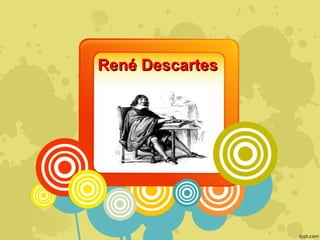
René DescartesRené Descartes
IntroductionIntroduction
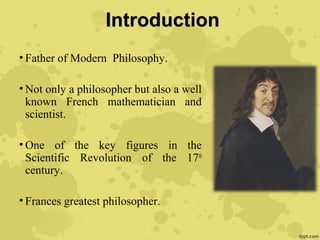
• Father of Modern Philosophy.
• Not only a philosopher but also a well
known French mathematician and
scientist.
• One of the key figures in the
Scientific Revolution of the 17th
century.
• Frances greatest philosopher.
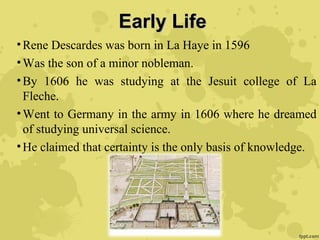
•Rene Descardes was born in La Haye in 1596
•Was the son of a minor nobleman.
•By 1606 he was studying at the Jesuit college of La
Fleche.
•Went to Germany in the army in 1606 where he dreamed
of studying universal science.
•He claimed that certainty is the only basis of knowledge.
Early LifeEarly Life
The Search for IntellectualThe Search for Intellectual
FaithFaith
•Descartes confronted many scientists and
mathematicians that everything is not based on
probability.
•He claimed that education except for mathematic gave
him’ little of substance.
• Only Mathematics had given him certain knowledge.
Mathematical
Accomplishments
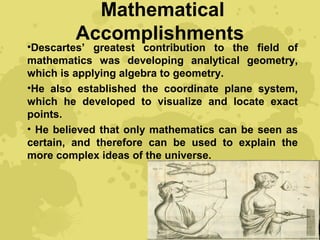
•Descartes’ greatest contribution to the field of
mathematics was developing analytical geometry,
which is applying algebra to geometry.
•He also established the coordinate plane system,
which he developed to visualize and locate exact
points.
• He believed that only mathematics can be seen as
certain, and therefore can be used to explain the
more complex ideas of the universe.
Descartes’ Epistemology
Epistemology- The philosophical
examination of knowledge – its nature and
its origin.
Rationalism
• Epistemological school that maintains that the most
important truths about reality are obtained by means of
the intellect (the mind) alone, without relying at all
upon the senses.
• Descartes gave his theory of knowledge, which is
rational. Descartes' arguments in support of
rationalism are given below.
• Two objects are different if experience can show that
the qualities of objects are different empirical view.
• Experience shows that liquid wax and solid wax have
different qualities.
– Liquid wax and solid wax are different objects
Notion of innate ideas
• Rationalism can be acquiredRationalism can be acquired
by a priori means.by a priori means.
• Descartes emphasized theDescartes emphasized the
important of a priori ideasimportant of a priori ideas
and argument inand argument in
establishing genuineestablishing genuine
knowledge on a firmknowledge on a firm
foundation.foundation.
Notion of innate ideas
• In accordance with the rationalist view,
there are representations or ideas in the
mind that do not have empirical origins (a
priori representations).
• Rationalists consider the possibility that
humans are born with these types of
ideas.
Problem of Skepticism in epistemology
• Knowledge is not possible due to the fact
that all knowledge remains uncertain.
• No knowledge is definite
• No knowledge can be justified
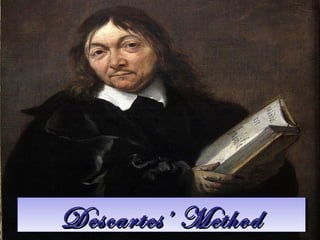
Descartes’ MethodDescartes’ MethodDescartes’ MethodDescartes’ Method
Descartes’ Method:Descartes’ Method:
BackgroundBackground
•The real turning point came on
November 10, 1619.
•He found he can doubt pretty
much everything.
•Descartes claim he has also
developed a set of scientific
principles that had allowed him to
make many discoveries.
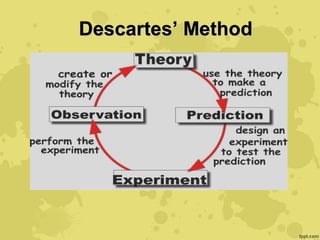
Descartes’ MethodDescartes’ Method
Descartes’Descartes’ four rulesfour rules
•Rule one is to never believe anything unless
you know it to be true.
•Rules two to analyze every problem into as many
parts as are necessary to resolve the problem.
•Rule three is to find the easiest solution and
work up to the most difficult.
•Rule four is to list every possible detail of a
problem.
Descartes’Descartes’ Four RulesFour Rules
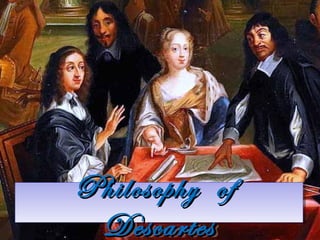
Philosophy ofPhilosophy of
DescartesDescartes
Philosophy ofPhilosophy of
DescartesDescartes
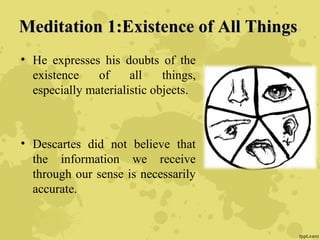
• He expresses his doubts of the
existence of all things,
especially materialistic objects.
• Descartes did not believe that
the information we receive
through our sense is necessarily
accurate.
Meditation 1:Existence of All ThingsMeditation 1:Existence of All Things
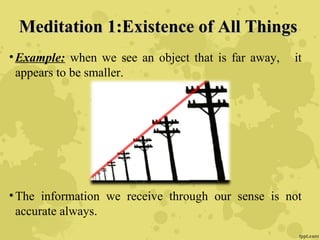
•Example: when we see an object that is far away, it
appears to be smaller.
•The information we receive through our sense is not
accurate always.
Meditation 2 :Absolute CertaintyMeditation 2 :Absolute Certainty
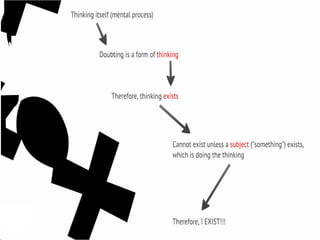
• He Tried to express absolute certainty, through his
phrase, "I think, therefore I am”.
• Mediation 1- He expressed The information we receive
through our sense is not accurate always.
• This includes the belief that I have a body with sensory
organs. “No”, because he had convinced himself that his
beliefs are false, and then there must be an “I” convince.
Meditation 3 The Existence of GodMeditation 3 The Existence of God
• Casual Principle:Casual Principle: That something cannot come from
nothing.
•P1: I have the clear idea of God (a most perfect being:
infinite, eternal, omnipotent, benevolent).
•P2: A cause must be at least as real as its effect.
•C: This idea of God (P1) can’t be imperfect to me (P2).
Its cause must be God greater. So God exists.
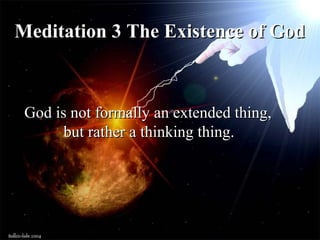
God is not formally an extended thing,God is not formally an extended thing,
but rather a thinking thing.but rather a thinking thing.
Meditation 3 The Existence of GodMeditation 3 The Existence of God
Meditation 4: Possibility of ErrorMeditation 4: Possibility of Error
Judgement is a faculty of the mind, resulting
from the interaction of will and intellect.
When our will to make decisions, exceeds
the ability to understand, error arises.
Meditation 5: The Ontological
Argument
Descartes believed that since the idea of God is
perfect, God has to exist, because without existence
he would lack a quality of perfection.
If God lacked existence, then God would no longer
be perfect.
Therefore, if God had imperfections such as not
being existent, it would no longer be the idea of God.
God without existence is unintelligible, meaning that
existence is contained in the essence of an infinite
substance.
Because of this, God must exist in his very own
nature. God without existence can be compared to a
mountain without a valley. It is unintelligible.
Meditation 6: The Distinction
between Mind and Body
Descartes defined substance as
“an existent thing which requires
nothing but itself to exist.”
The operation of the mind and
the body are completely distinct.
The body is governed by physical
forces.
Human consist of a mind and a
body. Some activities of the body
are purely mechanical.
However, the mind has some
control over the body.
Cartesianism
Cartesianism emphasizes on –
Dualistic distinction between mind and body.
Mechanistic interpretation
Logical analysis
Cartesianism
Cartesianism is a species of rationalism, because
Cartesians hold certain knowledge.
It is opposed to the tradition of empiricism.
According to empiricism, “all knowledge is based on
sense experience and is therefore only probable”.
Cartesians believed that God is omnipotent and his
will is entirely free.
The human intellect, by contrast, is finite; thus,
humans can be certain only of what God reveals and
of the fact that they and God exist.
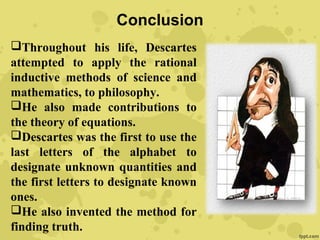
Conclusion
Throughout his life, Descartes
attempted to apply the rational
inductive methods of science and
mathematics, to philosophy.
He also made contributions to
the theory of equations.
Descartes was the first to use the
last letters of the alphabet to
designate unknown quantities and
the first letters to designate known
ones.
He also invented the method for
finding truth.
René descartes

René descartes

  • 2.
    WE ARE…WE ARE… BA(Hons) in English UNIVERSITY OF ASIA PACIFIC
  • 3.
  • 4.
    IntroductionIntroduction • Father ofModern Philosophy. • Not only a philosopher but also a well known French mathematician and scientist. • One of the key figures in the Scientific Revolution of the 17th century. • Frances greatest philosopher.
  • 5.
    •Rene Descardes wasborn in La Haye in 1596 •Was the son of a minor nobleman. •By 1606 he was studying at the Jesuit college of La Fleche. •Went to Germany in the army in 1606 where he dreamed of studying universal science. •He claimed that certainty is the only basis of knowledge. Early LifeEarly Life
  • 6.
    The Search forIntellectualThe Search for Intellectual FaithFaith •Descartes confronted many scientists and mathematicians that everything is not based on probability. •He claimed that education except for mathematic gave him’ little of substance. • Only Mathematics had given him certain knowledge.
  • 7.
    Mathematical Accomplishments •Descartes’ greatest contributionto the field of mathematics was developing analytical geometry, which is applying algebra to geometry. •He also established the coordinate plane system, which he developed to visualize and locate exact points. • He believed that only mathematics can be seen as certain, and therefore can be used to explain the more complex ideas of the universe.
  • 8.
    Descartes’ Epistemology Epistemology- Thephilosophical examination of knowledge – its nature and its origin.
  • 9.
    Rationalism • Epistemological schoolthat maintains that the most important truths about reality are obtained by means of the intellect (the mind) alone, without relying at all upon the senses. • Descartes gave his theory of knowledge, which is rational. Descartes' arguments in support of rationalism are given below. • Two objects are different if experience can show that the qualities of objects are different empirical view. • Experience shows that liquid wax and solid wax have different qualities. – Liquid wax and solid wax are different objects
  • 10.
    Notion of innateideas • Rationalism can be acquiredRationalism can be acquired by a priori means.by a priori means. • Descartes emphasized theDescartes emphasized the important of a priori ideasimportant of a priori ideas and argument inand argument in establishing genuineestablishing genuine knowledge on a firmknowledge on a firm foundation.foundation.
  • 11.
    Notion of innateideas • In accordance with the rationalist view, there are representations or ideas in the mind that do not have empirical origins (a priori representations). • Rationalists consider the possibility that humans are born with these types of ideas.
  • 12.
    Problem of Skepticismin epistemology • Knowledge is not possible due to the fact that all knowledge remains uncertain. • No knowledge is definite • No knowledge can be justified
  • 13.
  • 14.
    Descartes’ Method:Descartes’ Method: BackgroundBackground •Thereal turning point came on November 10, 1619. •He found he can doubt pretty much everything. •Descartes claim he has also developed a set of scientific principles that had allowed him to make many discoveries.
  • 15.
  • 16.
    Descartes’Descartes’ four rulesfourrules •Rule one is to never believe anything unless you know it to be true. •Rules two to analyze every problem into as many parts as are necessary to resolve the problem. •Rule three is to find the easiest solution and work up to the most difficult. •Rule four is to list every possible detail of a problem.
  • 17.
  • 18.
  • 19.
    • He expresseshis doubts of the existence of all things, especially materialistic objects. • Descartes did not believe that the information we receive through our sense is necessarily accurate. Meditation 1:Existence of All ThingsMeditation 1:Existence of All Things
  • 20.
    Meditation 1:Existence ofAll ThingsMeditation 1:Existence of All Things •Example: when we see an object that is far away, it appears to be smaller. •The information we receive through our sense is not accurate always.
  • 21.
    Meditation 2 :AbsoluteCertaintyMeditation 2 :Absolute Certainty • He Tried to express absolute certainty, through his phrase, "I think, therefore I am”. • Mediation 1- He expressed The information we receive through our sense is not accurate always. • This includes the belief that I have a body with sensory organs. “No”, because he had convinced himself that his beliefs are false, and then there must be an “I” convince.
  • 23.
    Meditation 3 TheExistence of GodMeditation 3 The Existence of God • Casual Principle:Casual Principle: That something cannot come from nothing. •P1: I have the clear idea of God (a most perfect being: infinite, eternal, omnipotent, benevolent). •P2: A cause must be at least as real as its effect. •C: This idea of God (P1) can’t be imperfect to me (P2). Its cause must be God greater. So God exists.
  • 24.
    God is notformally an extended thing,God is not formally an extended thing, but rather a thinking thing.but rather a thinking thing. Meditation 3 The Existence of GodMeditation 3 The Existence of God
  • 25.
    Meditation 4: Possibilityof ErrorMeditation 4: Possibility of Error Judgement is a faculty of the mind, resulting from the interaction of will and intellect. When our will to make decisions, exceeds the ability to understand, error arises.
  • 26.
    Meditation 5: TheOntological Argument Descartes believed that since the idea of God is perfect, God has to exist, because without existence he would lack a quality of perfection. If God lacked existence, then God would no longer be perfect. Therefore, if God had imperfections such as not being existent, it would no longer be the idea of God. God without existence is unintelligible, meaning that existence is contained in the essence of an infinite substance. Because of this, God must exist in his very own nature. God without existence can be compared to a mountain without a valley. It is unintelligible.
  • 27.
    Meditation 6: TheDistinction between Mind and Body Descartes defined substance as “an existent thing which requires nothing but itself to exist.” The operation of the mind and the body are completely distinct. The body is governed by physical forces. Human consist of a mind and a body. Some activities of the body are purely mechanical. However, the mind has some control over the body.
  • 28.
    Cartesianism Cartesianism emphasizes on– Dualistic distinction between mind and body. Mechanistic interpretation Logical analysis
  • 29.
    Cartesianism Cartesianism is aspecies of rationalism, because Cartesians hold certain knowledge. It is opposed to the tradition of empiricism. According to empiricism, “all knowledge is based on sense experience and is therefore only probable”. Cartesians believed that God is omnipotent and his will is entirely free. The human intellect, by contrast, is finite; thus, humans can be certain only of what God reveals and of the fact that they and God exist.
  • 30.
    Conclusion Throughout his life,Descartes attempted to apply the rational inductive methods of science and mathematics, to philosophy. He also made contributions to the theory of equations. Descartes was the first to use the last letters of the alphabet to designate unknown quantities and the first letters to designate known ones. He also invented the method for finding truth.